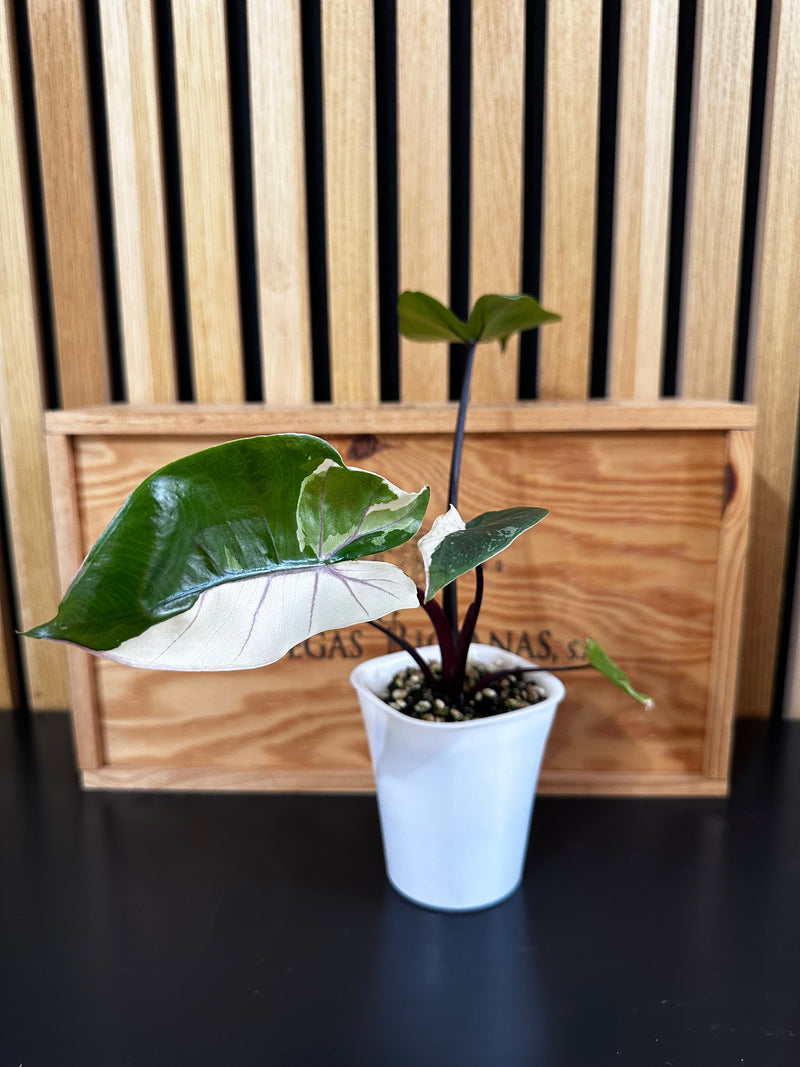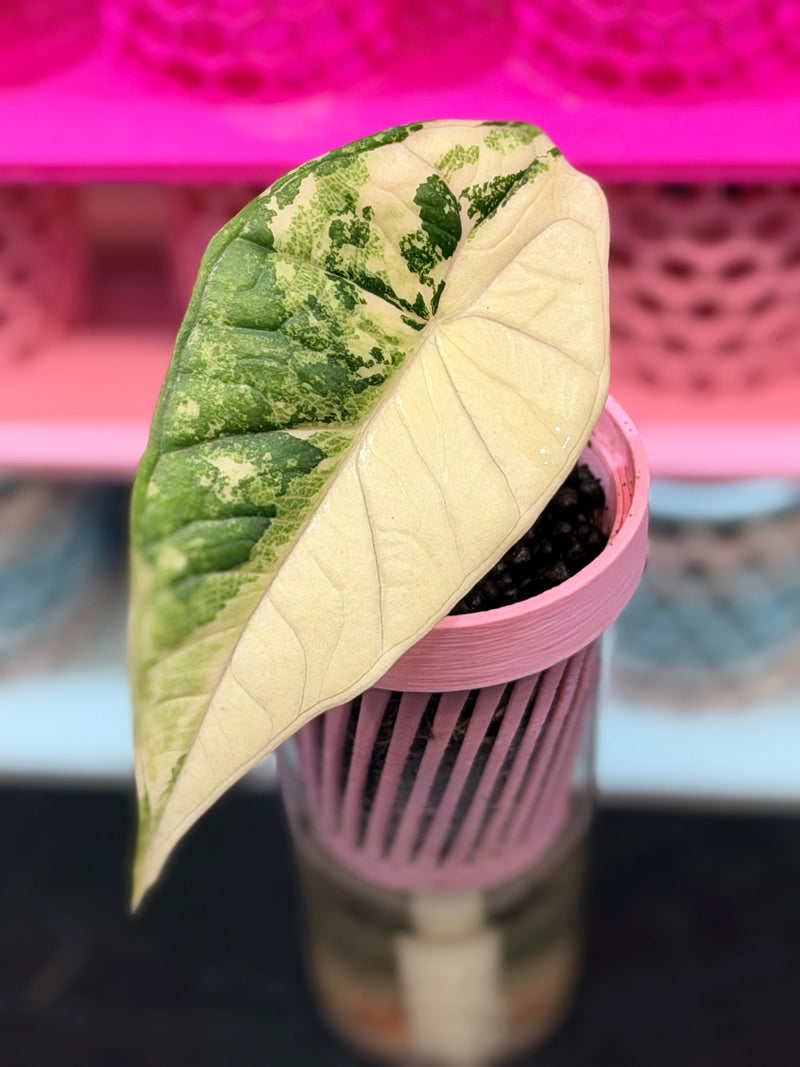

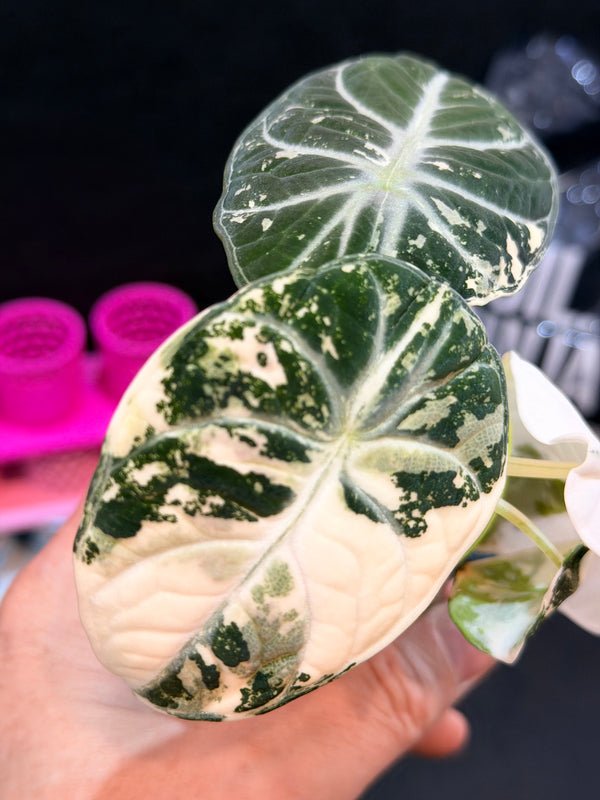
Alocasia Ninja Albo is a white-variegated form of Alocasia reginula 'Ninja', sold elsewhere as 'Black Ninja' or 'Black Velvet Ninja'. It pairs a near-black, velvety jewel leaf with chimeric albo sectors that contain no chlorophyll, and it is one of the most visually dramatic expressions of chimeric albo variegation in the jewel Alocasia world. This guide sets out what is documented about the plant underneath, how to recognise it, what albo variegation means for its care, and how it compares with related plants. Aroidpedia, our primary reference, has entries for the species and for the 'Black Ninja' cultivar but no entry for an albo form, so we say plainly where the detail stops.
What is Alocasia reginula 'Ninja'?
Aroidpedia lists the plant as a cultivar of Alocasia reginula introduced to the market around 2020, under the names Alocasia reginula 'Black Ninja', Alocasia 'Black Ninja' and Alocasia 'Black Velvet Ninja'. It is described as almost identical to 'Black Velvet', distinguished by characteristic double marginal veins and by leaves that are thicker, darker and more embossed. Its dark, velvety foliage has made it one of the most collected Alocasia in recent years.
Aroidpedia is open about the uncertainty. There is no consensus on whether it deserves cultivar status or is simply a minor mutation of 'Black Velvet', and some reports say mature plants become indistinguishable from 'Black Velvet'. Its 'Black Velvet' entry calls it a possible mutant that has appeared recently. That unresolved question does not diminish the plant's collector value. We treat the double marginal vein as the feature to look for, and as most legible on younger leaves.
Origin and naming of the species
Aroidpedia records Alocasia reginula A. Hay as published in Gardens' Bulletin Singapore in 1998. The description was based on cultivated material and dried leaves sent to Alistair Hay by Dewey Fisk in Florida, and the plant was described as a new species because it was clearly distinct from any known one. The epithet comes from the Latin for 'little queen', a fitting name for a plant with this much presence at a compact size.
The wild origin is unclear. The plant is known only in cultivation and is believed to come from Borneo, where it appears to belong to the group around Alocasia scabriuscula. Aroidpedia's 'Black Velvet' entry traces that cultivar to Scott Hyndman, who introduced it to the market in the early 1990s with material from the Lyon Arboretum in Hawaii, which reportedly received it from a collector in Japan. A single plant was put into tissue culture, and that stock is the cultivar grown today. Aroidpedia lists white, yellow and green variegated forms of the species.
How to identify Alocasia Ninja Albo
- A compact plant: Aroidpedia gives the species a height of up to about 25cm, with blades of roughly 15cm by 8-11cm.
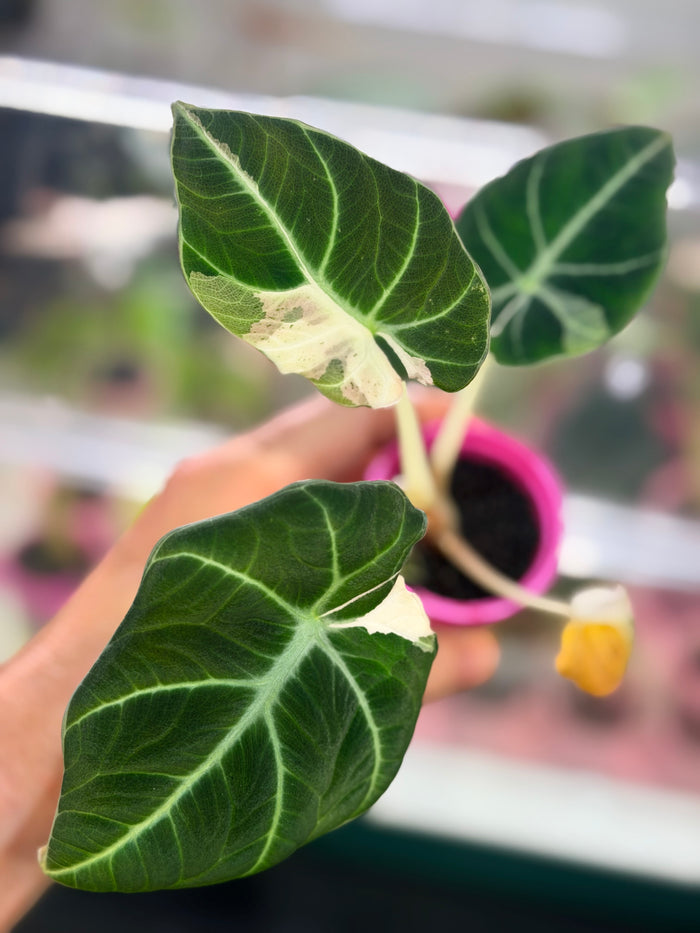
- Thick, nearly peltate leaves with a very dark, matt green upper surface and a paler, purple-flushed underside.
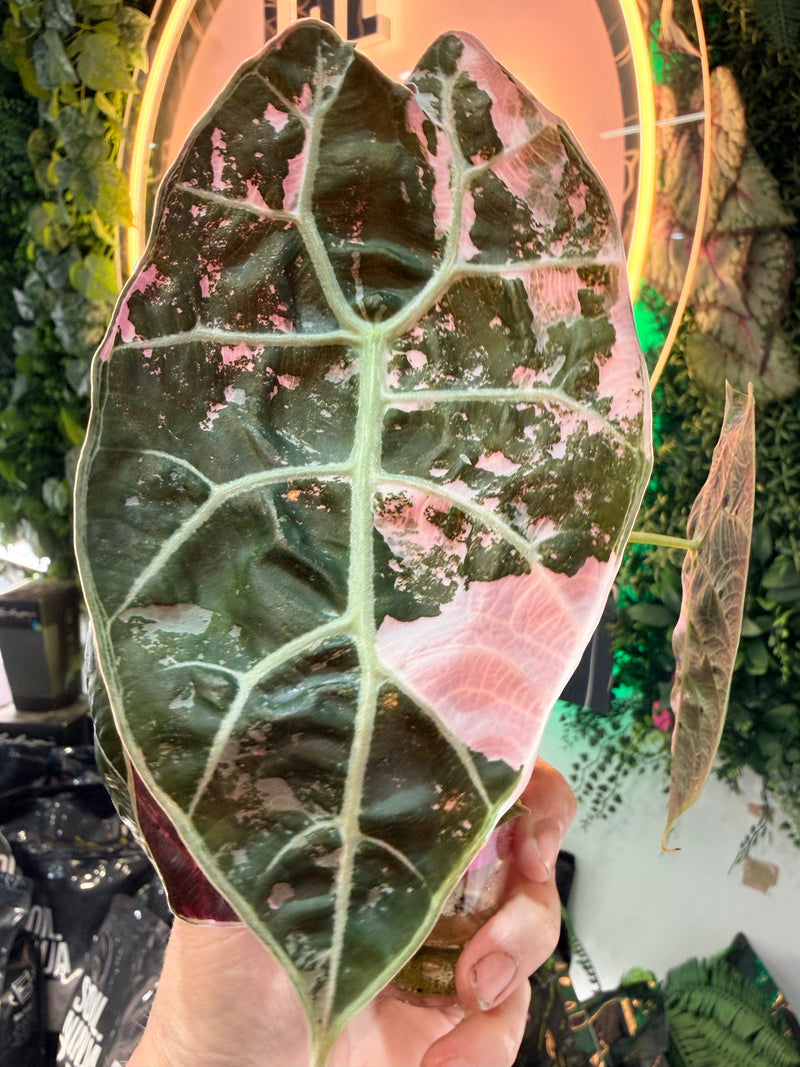
- Whitish impressed veins against the dark blade, with the double marginal vein as the Ninja marker.
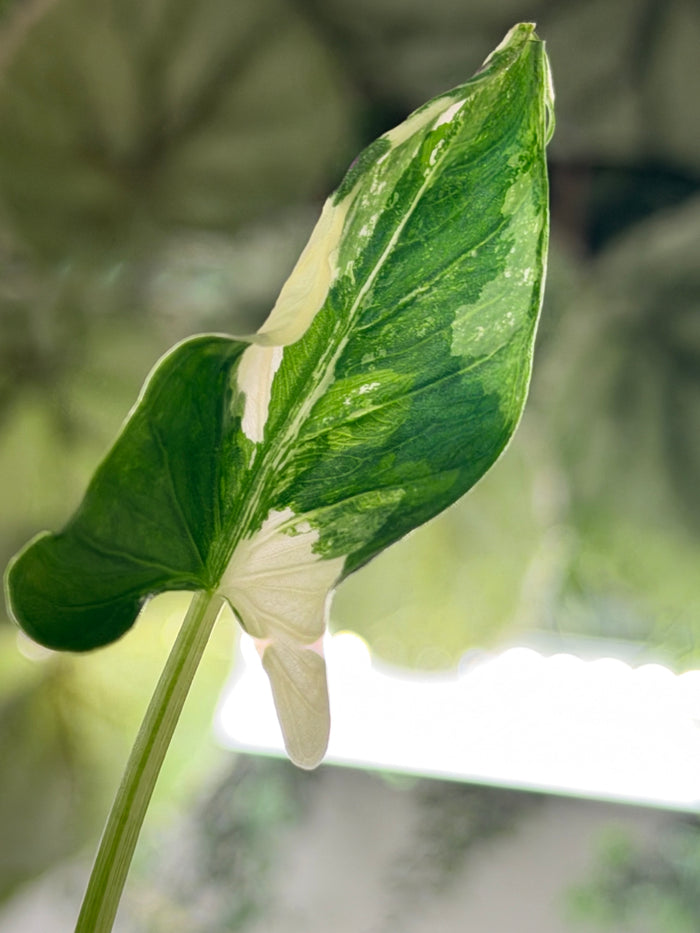
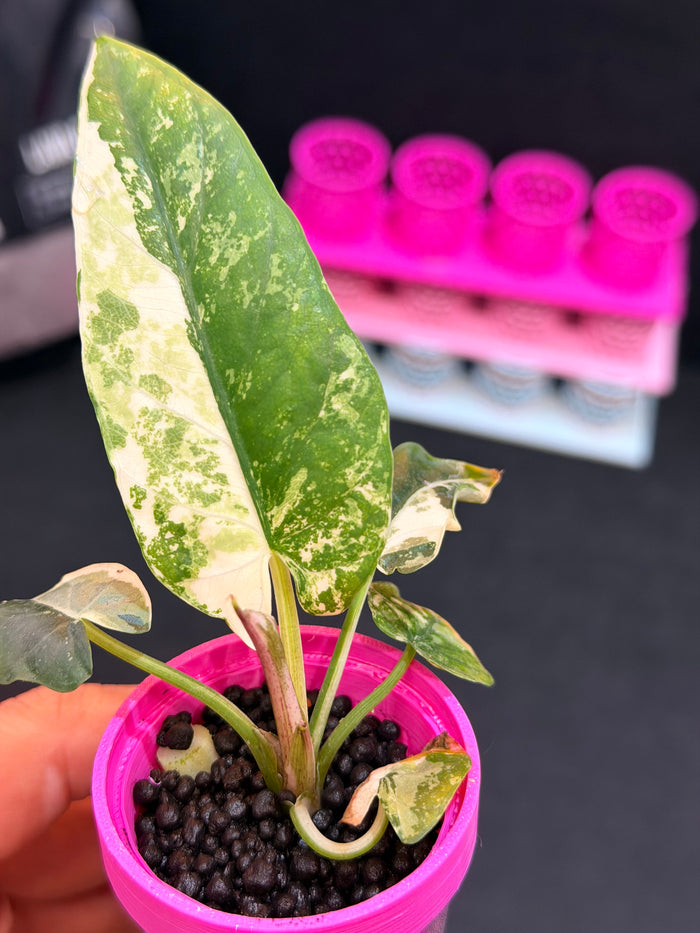
- Irregular white or cream sectors, which differ from leaf to leaf.
Albo variegation on a dark leaf
Albo variegation is the absence of chlorophyll in a sector of tissue, which makes it white. It is chimeric: the pattern comes from the arrangement of cell layers, so each leaf differs and the pattern can shift, fade or revert to plain dark green. Chimeric variegation can fail to carry over to a plant grown from a corm. Our guide to albo variegation and the complete variegation guide explain the mechanism.
On a near-black base the white sectors stand out sharply. The result is a composition that is extreme in its tonal range: white sectors against near-black foliage, with silver-white primary venation and double marginal veins providing additional structural elements within that contrast. The white tissue creates a contrast that is unmatched in the reginula family, reading almost luminous against the dark background, particularly under good light. The velvety matte texture of the blade means that white sectors absorb light in the same way as the surrounding dark tissue, giving both a similar surface quality rather than the reflective contrast that would occur on glossier foliage. The distinctive double marginal veins, one of the key differences from standard 'Black Velvet', continue to be expressed through both variegated and non-variegated tissue, adding a further structural element to the high-contrast composition. On a leaf with extensive albo sectors, the double marginal vein running along the white margin area is one of the most compelling visual details in the plant: a feature that would be barely visible on standard Black Velvet becomes a prominent design element in the high-contrast white context. White tissue cannot photosynthesise, so a leaf with extensive albo has less working surface than a plain green one, and good, consistent light matters more than usual. On a compact species like 'Ninja' the non-photosynthetic albo sectors represent a significant proportion of the leaf's potential photosynthetic area. Aroidpedia has no specific size or growth data for the albo form, so we do not make any claims about it.
Care for Alocasia Ninja Albo
This is general Alocasia care that applies to this plant. Provide bright indirect light, with LED grow lights to supplement room light, aiming for 10,000 to 15,000 lux for 12 to 14 hours per day. Aim for 20-27°C and humidity of 60-80%. Water thoroughly when the top 2-3cm of the substrate has dried. We prefer Fluval Stratum as a substrate, and a heat mat under the pot supports the roots if the room runs cool.
Feed with our Alocasia feed from the plant feed range at half strength, or down to quarter strength for a conservative approach, every 2 to 3 weeks. A compact plant suits a self-watering pot if you like a steady moisture level. Our ultimate Alocasia care guide goes deeper, and the root rot guide helps if growth stalls.
Propagation from corms
Many collectors build their collection from corms, and propagating them successfully is simpler than it looks. Our Alocasia corm propagation guide describes the self-wicking method we use: a firm corm sits in Fluval Stratum inside our Corm Keeper, which wicks moisture to the corm without waterlogging it. Also see growing Alocasia corms in Fluval Stratum and how long a corm takes to sprout.
How Ninja Albo compares with similar plants
Against standard 'Black Velvet', Ninja is the thicker, more embossed form with paired marginal veins. Within the Ninja family we have guides to Ninja Pink, Ninja Aurea Splash and Ninja Tri-colour. The Reginula species guide covers the base plant, and Black Velvet Pink and Black Velvet Gold Aurea show other variegation on the same dark foliage. For albo on another dark jewel plant, see our Dragon Scale Albo guide. Aroidpedia also lists 'Maharani' and 'Regal Shields' among hybrids of the species, covered in our Maharani Albo and Regal Shields guides.
Frequently asked questions
Is Ninja a separate cultivar from Black Velvet?
Unresolved. Aroidpedia notes there is no consensus, and reports say mature plants can look the same as 'Black Velvet'.
How do I tell Ninja from Black Velvet?
Look for the double marginal veins, plus thicker, darker, more embossed leaves.
How large does it grow?
Aroidpedia gives up to about 25cm for the species. No size is documented for the albo form specifically.
Where is it from?
The species is known only in cultivation and is believed to be Bornean. The exact wild origin is unclear.
Will the white variegation stay on a corm-grown plant?
Not reliably, because chimeric variegation depends on the cell layers of the parent plant.
We release Ninja Albo through our drop model. Join the collector list for access and view our Alocasia Ninja Albo listing.
Questions about Alocasia Ninja Albo or the reginula jewel family? Contact our team for guidance from specialists who grow rare Alocasia in our UK-based private nursery. We are glad to help with light and care for dark, compact foliage.