ALOCASIA DRAGON SCALE ALBO VARIEGATED: THE COMPLETE COLLECTOR'S GUIDE

There are very few plants in the jewel Alocasia world that combine botanical rarity, sculptural presence, and visual impact in the way that Alocasia baginda 'Dragon Scale' Albo Variegated does. The standard Dragon Scale is already one of the most distinctive jewel Alocasia in cultivation, its heavily bullate, dark matte-green foliage with contrasting pale grey sections creates a surface texture that genuinely resembles armoured dragon scales in a way that few plant names actually live up to. The Albo form adds a layer of extraordinary complexity: chimeric white and cream sectors across those same deeply textured leaves, creating a visual contrast that is unlike anything else available in the collector Alocasia market.
This is a plant that rewards serious attention. The Albo variegation is chimeric in nature, arising from a cellular mutation affecting the meristematic tissue, which means it cannot be reliably replicated through tissue culture and every leaf expresses a unique, unrepeatable pattern. Combined with the slow, deliberate growth habit of Alocasia baginda and the exacting care requirements that come with any chimeric variegated jewel Alocasia, the Dragon Scale Albo is emphatically not a plant for passive collectors. It rewards those who understand what they are working with and are prepared to provide the conditions it needs.
At The Alocasia Company, we grow our Alocasia Dragon Scale Albo Variegated from corm at our private UK nursery, from verified albo mother plant stock. Every plant is assessed before listing with variegation confirmed and present. This guide covers the species' origins, the botanical context of the Dragon Scale cultivar, the nature of the albo variegation, and everything you need to know to grow one successfully in UK conditions.
Alocasia baginda: The Royal Species from Eastern Borneo
Alocasia baginda is a relatively recently described species, formally named in 2011 by Kurniawan and P.C. Boyce in the journal Acta Phytotax. Geobot., based on a specimen collected from Eastern Kalimantan, Indonesian Borneo, and cultivated at the Bali Botanic Garden. The species name itself is revealing: baginda is a Bahasa Indonesia honorific title denoting 'King' or 'Majesty', chosen as a continuation of the regal naming tradition applied to botanically and horticulturally significant Alocasia, a tradition that includes reginula (little queen), reginae (queen), and maharani (the Hindi word for queen), among others.
The species is native to Eastern Kalimantan, the Indonesian portion of Borneo, where it grows in equatorial lowland humid forest, an environment characterised by consistently high humidity of 80–90%, year-round temperatures ranging from 23°C in the early morning to 32°C during the day, with minimum lowland temperatures rarely dropping below 20°C, and annual rainfall between 3,300 and 4,600 millimetres depending on locality. These are extreme growing conditions by any measure, and understanding them provides the framework for the care requirements that make Alocasia baginda demanding in cultivation.
The formal species description notes that Alocasia baginda most closely resembles Alocasia melo, another Eastern Borneo jewel Alocasia with notably thick, coriaceous leaves, but is readily distinguished by its adaxially smooth leaf surface (rather than melo's finely rugose texture), dark matte green colouration, and contrasting pale grey bullate portions of the blade. The closest morphological relatives, Alocasia reginae from northeastern Sarawak and Alocasia reginula from eastern Sabah, are both associated with specific substrate types (limestone and ultramafic soils respectively), and it is expected that Alocasia baginda will prove to have a similar geological substrate preference once additional wild populations are located.
The Dragon Scale Cultivar: What Distinguishes It from the Type Species
Alocasia baginda 'Dragon Scale' is a cultivar selection from the broader, variable Alocasia baginda type species. According to Aroidpedia, the key distinguishing characteristic is the adaxial surface, Dragon Scale exhibits darker, fully green leaf surfaces compared to the more muted, mixed colouration of the type species. This deeper, richer green ground colour, combined with the characteristic pale grey bullate sections defined by the primary and marginal venation, produces the dramatic dark-and-light contrast that gives the cultivar its name.
The bullate surface, the raised, patterned sections of the leaf surface that sit between the impressed venation, creates the visual texture that makes Dragon Scale so immediately distinctive. Each leaf is stiffly and thickly coriaceous, almost rigid in larger specimens, with the deep red abaxial venation becoming more pronounced as the plant matures. The posterior lobes of the leaf are united for 75–90% of their length, significantly more than most Alocasia, giving Dragon Scale its characteristic almost circular leaf outline that differs from the more elongated sagittate form of many collector Alocasia.
The cultivar has also given rise to a notable hybrid lineage. Alocasia 'Andromeda' and Alocasia 'Green Dragon' were both created using Dragon Scale as a parent, crossed with Alocasia azlanii. Our Alocasia Green Unicorn, an Alocasia azlanii × Alocasia baginda 'Dragon Scale' cross, is from this same breeding line, demonstrating the cultivar's value as a parent species in producing extraordinary hybrid offspring.
Understanding the Albo Variegation
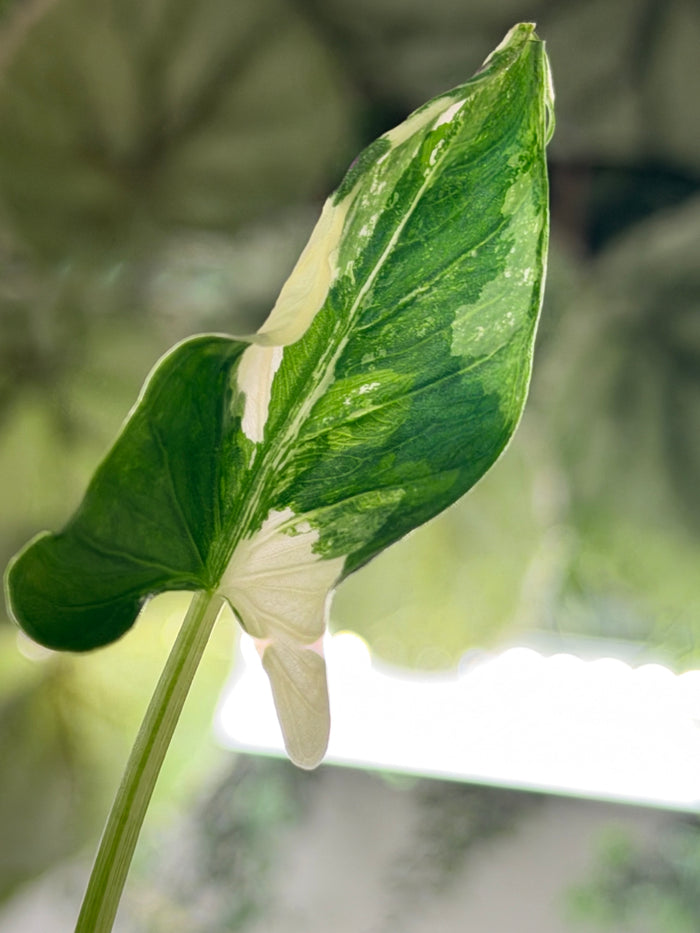
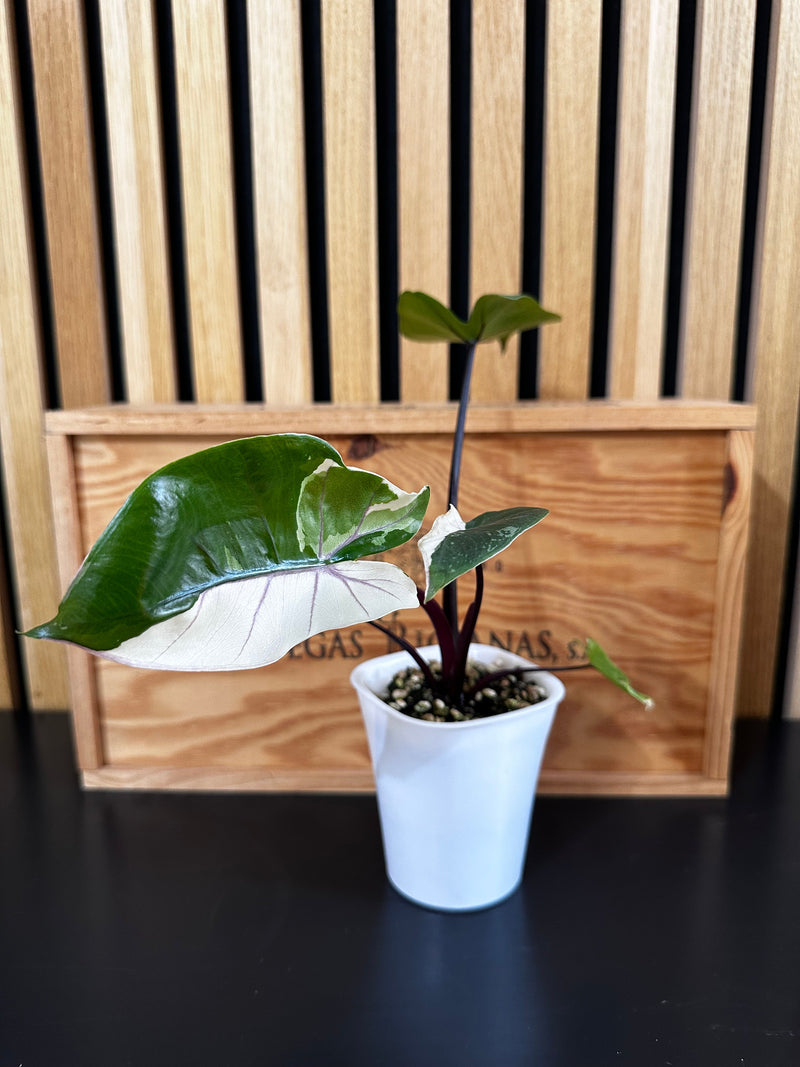
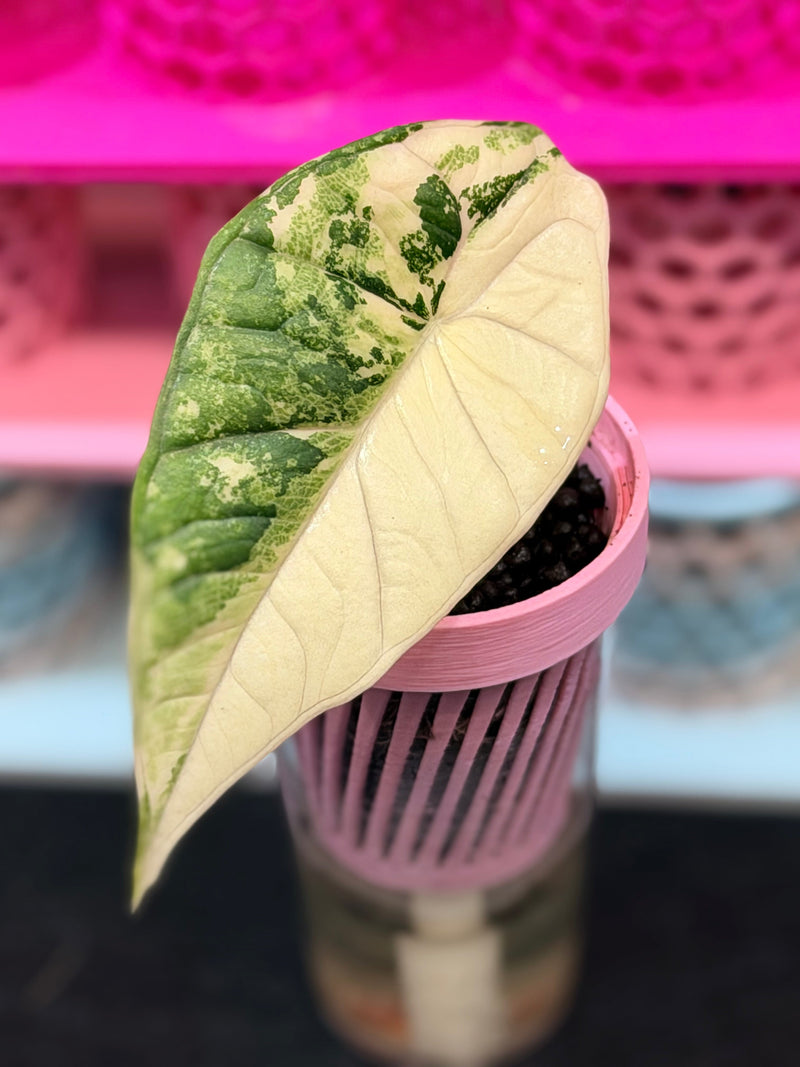
The Albo form of Dragon Scale adds an entirely separate dimension to an already exceptional plant. Albo variegation, the white and cream sectoral patterning that appears across the leaves, arises from a chimeric mutation affecting the meristematic tissue of the plant. In chimeric albo variegation, some cells lack the genetic instruction to produce chlorophyll, resulting in white or cream tissue alongside fully green tissue. Because the mutation is present at the cellular level and distributed unpredictably through the meristem, no two leaves ever express the same pattern, and the variegation cannot be reliably reproduced through tissue culture. Every Albo Dragon Scale is, in the truest sense, unique.
For a detailed exploration of the science behind albo variegation in Alocasia, including why it cannot be tissue cultured true-to-type, how chimeric mutations arise, and what they mean for the collector, our guide to albo variegation in Alocasia covers the subject in full. Our complete guide to Alocasia variegation types places albo variegation in the broader context of aurea, pink, and green-on-green expressions.
In the specific context of Dragon Scale Albo, the visual effect of the variegation is particularly striking because of the interaction between the white sectors and the heavily textured, bullate leaf surface. The three-dimensional quality of the leaf means that the albo sectors catch light differently from the green areas, the texture creates shadow and depth across what would otherwise be flat colour, making the variegation appear almost sculptural rather than simply graphic. This is a quality that photographs rarely do justice to and that only becomes fully apparent when you are in front of the plant.
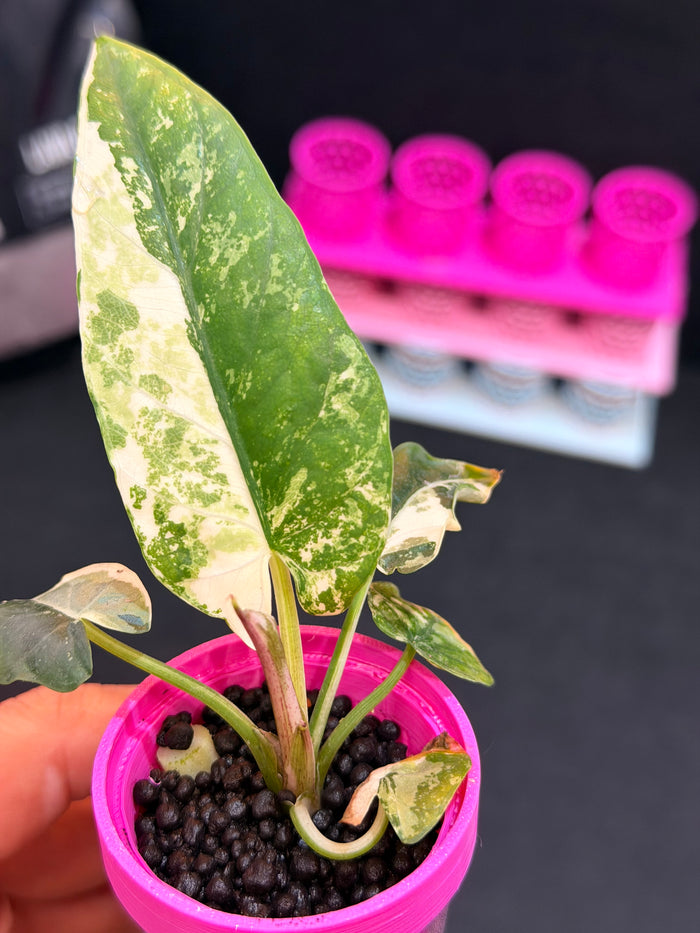
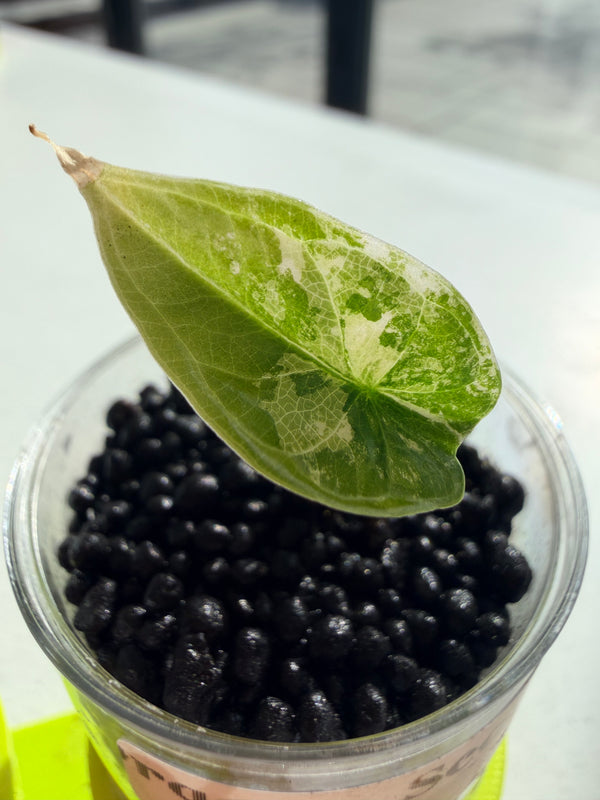
The variegation pattern in Dragon Scale Albo tends toward sectoral expression, larger areas of white or cream rather than fine speckling, though this varies considerably between individual plants. Some specimens express heavy variegation with large white sectors dominating leaf areas; others show more subtle marbling or smaller cream patches against the dark green-grey ground. All expressions are genuine and desirable, heavily variegated leaves are visually dramatic but contain less chlorophyll and require more careful light management; more modestly variegated leaves tend to be more vigorous and easier to sustain long-term.
Identifying Dragon Scale Albo: Distinguishing Features
Within the Alocasia baginda family, Dragon Scale Albo is unmistakeable once you know what you are looking at. The white or cream sectors against the heavily bullate dark green surface create a contrast that does not exist in any other cultivar. However, newer collectors sometimes confuse Dragon Scale with other related jewel Alocasia, so understanding the distinguishing features is worthwhile.
Versus Alocasia baginda 'Silver Dragon'
'Silver Dragon' is the most commonly confused relative. Both are Alocasia baginda cultivars, but Silver Dragon shows a notably lighter, more silvery overall leaf colouration, the pale grey bullate sections are larger and more dominant relative to the green venation framework, creating an overall silver impression rather than the darker contrast of Dragon Scale. Silver Dragon also lacks the albo variegation of the Albo form, its silvery appearance is a characteristic of the cultivar itself rather than a variegation mutation. The abaxial venation in Silver Dragon is also less intensely red than in Dragon Scale in comparable growth stages.
Versus Alocasia melo
The resemblance to Alocasia melo is strongest in young plants where the characteristic features are less developed. The key distinguishing features are the adaxial leaf surface, melo has a much more deeply rugose, almost geological texture compared to Dragon Scale's smoother (though still bullate) surface, and the abaxial colouration. Alocasia melo has light green abaxials, while Alocasia baginda including Dragon Scale has the deep red abaxial venation that becomes more pronounced with maturity.
Versus Alocasia Maharani
Both plants are compact, thick-leaved, grey-green jewel Alocasia and are sometimes compared by newer collectors. The leaf shape is the primary distinguishing feature: Maharani has a more ovate, rounded leaf with lighter veining inherited from reginula, while Dragon Scale has the strongly bullate surface texture and the very distinctive pale grey sections between the impressed venation that give it its characteristic appearance. The albo variegation in Dragon Scale Albo is entirely absent in standard Maharani, though the Maharani Aurea from our aurea variegated collection offers a comparable jewel Alocasia with a different variegation expression.
Growing Alocasia Dragon Scale Albo in the UK: Complete Care Guide
Substrate and Potting
The substrate requirements for Dragon Scale Albo follow the standard jewel Alocasia approach, with an additional note of caution around the chimeric variegation: any significant root stress can affect the quality and expression of new leaves during development, making substrate choice and pot sizing even more consequential than for fully green cultivars.
A well-draining aroid mix with generous perlite content, 30% or more, provides the drainage and aeration that Alocasia baginda requires. Fluval Stratum is our preferred substrate for Dragon Scale at the nursery, offering excellent drainage, appropriate pH, and the microbial support that benefits root development in sensitive jewel Alocasia. Avoid any substrate that compacts over time or retains moisture for extended periods after watering.
Pot sizing is critical. Dragon Scale, like all Alocasia baginda cultivars, is particularly sensitive to the anaerobic root conditions that develop in oversized pots with excess wet substrate. Use the smallest pot that comfortably accommodates the current root system, with no more than 20–30% additional substrate space. The root growth pattern, horizontal first before extending downward, means a slightly deeper, narrower pot is preferable to a wide, shallow one. Our self watering corm pots with humidity dome provide an ideal controlled environment for Dragon Scale corms during propagation.
Light
Dragon Scale Albo has a more specific light requirement than the fully green Dragon Scale, because the white sectors of albo variegation contain no chlorophyll, the plant is photosynthesising from a reduced proportion of its leaf surface. Adequate light is therefore more important here than for green cultivars, not to intensify the variegation (albo variegation is chimeric and is not influenced by light intensity in the way aurea variegation is), but to support healthy growth from the reduced photosynthetically active tissue.
Bright, indirect light, 10,000–15,000 lux, is the appropriate target. Direct sunlight should be avoided as it will scorch the white sectors, which lack the chlorophyll that provides some degree of UV protection in green tissue. For UK collectors, supplemental LED grow lighting through autumn and winter is not optional for Dragon Scale Albo, insufficient light during the darker months will produce smaller, less well-formed new leaves, and in severe cases the plant may cease producing new growth entirely until conditions improve.
East or west-facing positions work well through the growing season. South-facing positions require some diffusion during peak summer light intensity, particularly given the sensitivity of the albo sectors to direct sun.
Temperature and Humidity
The native climate data for Alocasia baginda, never below 20°C in the lowlands, 23–32°C year-round, 80–90% humidity, makes clear that this is among the more demanding jewel Alocasia in terms of environmental requirements. UK homes can achieve appropriate temperatures year-round in most circumstances, but humidity management requires deliberate effort.
A target of 70–80% relative humidity will support strong, healthy growth and is particularly important for Dragon Scale Albo, where new leaves are forming the chimeric tissue that determines variegation expression. Stress during leaf development, including humidity fluctuation, temperature drops, or root disturbance, can result in poorly formed leaves, reduced variegation, or leaves that emerge crinkled or distorted.
A dedicated ultrasonic humidifier placed near your Dragon Scale is the most reliable approach. Group growing alongside other humidity-tolerant Alocasia will provide a degree of ambient humidity improvement, but is unlikely to achieve the 70%+ consistently that this plant benefits from without additional humidification.
Temperature stability through autumn and winter is important, avoid positions near cold windows or external walls, and keep the plant away from draughts. The substrate temperature is as significant as air temperature: cold floors can chill root zones even when air temperature seems adequate, making a shelf or elevated position preferable to a floor placement during the colder months.
Watering
Water Dragon Scale Albo when the top 2–3cm of substrate is dry to the touch, allow excess to drain fully, and never allow standing water in the saucer. The thick, coriaceous leaves tolerate slightly longer intervals between waterings than thinner-leaved Alocasia, but the substrate should never fully dry out, complete desiccation stresses the root system in a way that can affect new leaf formation.
Room temperature water is important to avoid cold-shock root stress. In hard water areas, filtered or collected rainwater is beneficial over time, as calcium carbonate accumulation gradually affects substrate pH and drainage capacity.
Dragon Scale Albo is notably slow-growing compared to many Alocasia, a new leaf every few weeks under good conditions rather than the rapid pace of faster-growing cultivars. This slow growth is not a sign of poor health; it is characteristic of the species and the cultivar, and the quality of each individual leaf that emerges makes the wait worthwhile.
Feeding
A dilute, consistent feed programme applied with every watering through the active growing season, spring through early autumn, provides the steady nutrition that Dragon Scale Albo needs without the stress of concentrated feeds applied infrequently. Use a balanced liquid fertiliser at approximately half the recommended strength. Magnesium supplementation is particularly relevant given the reduced photosynthetic capacity of the albo sectors, the fully green portions of the leaf need to work harder, and ensuring they have the nutrients required for chlorophyll function and cell integrity matters more here than with fully green plants.
Our plant feed collection and targeted nutrients support both the base feeding programme and the targeted supplementation that benefits chimeric variegated jewel Alocasia. Reduce feed frequency and strength significantly during winter, and wait until new growth is actively visible before resuming the full growing season programme in spring. Superthrive is part of every feed we mix at the nursery, a vitamin B1 and kelp supplement that supports root development and helps plants settle after repotting or a change of conditions.
Growing Dragon Scale Albo from Corm
Growing Dragon Scale Albo from corm is the most common route for UK collectors accessing this cultivar, and it comes with important honest caveats that deserve setting out clearly.
Corms from albo mother plants carry the genetic potential for chimeric albo variegation, but variegation expression in the resulting plant cannot be guaranteed. Chimeric mutations are distributed unpredictably through the meristematic tissue, some cells carry the mutation, others do not, and the proportion and distribution varies in ways that cannot be determined at the corm stage. Plants grown from albo corms may express heavy variegation, subtle variegation, or in some cases revert entirely to green as the variegated meristematic sectors are outcompeted by fully green tissue.
This is the honest reality of chimeric variegated Alocasia propagation, and it is why reputable sources are transparent about it rather than guaranteeing what each corm will produce. Our Dragon Scale Albo corms are harvested from verified albo mother plants, the parentage is confirmed, but the expression in each individual plant will become clear as leaves develop.
For propagation, Dragon Scale corms require the same warm, humid conditions as other jewel Alocasia: substrate temperature of 25–30°C, ambient humidity above 70%, and a well-aerated substrate that prevents waterlogging. Our Corm Keeper and Corm Crown propagation system maintains these conditions effectively, and Fluval Stratum is our preferred propagation substrate. Our complete corm propagation guide covers the process from dormancy through to established plant in full detail.
Dragon Scale is notably slow from corm to first leaf compared to faster-growing Alocasia species, patience is required, and maintaining consistent warmth and humidity throughout the dormancy period is essential to successful germination.
Dragon Scale Albo in a Collection Context
Alocasia baginda 'Dragon Scale' Albo Variegated occupies a position at the higher end of the jewel Alocasia collector spectrum, above the standard Dragon Scale in desirability, rarity, and the care investment it requires, and comparable in collector status to other chimeric albo jewel forms such as Alocasia Scalprum Albo Variegated and Alocasia Sinuata Albo Variegated.
The plant's slow growth habit means it is not a rapid collection builder, it will not fill a shelf in a growing season the way faster Alocasia do. What it provides instead is depth of character in a compact form: a plant that reveals more the longer you spend with it, that produces leaves of extraordinary individuality, and that represents a genuine botanical rarity in UK collections. For collectors who value quality over quantity in their jewel Alocasia section, Dragon Scale Albo is among the most important acquisitions available.
It pairs naturally with other Alocasia baginda cultivars, the standard Dragon Scale provides a green reference point that makes the albo variegation of the Albo form more visually striking by comparison, as well as with other chimeric albo jewel forms from our albo variegated collection.
Pest and Disease Management
Dragon Scale Albo faces the same pest pressures as other jewel Alocasia, with the additional consideration that the albo sectors are more vulnerable to damage than fully green tissue, white leaf areas have reduced structural integrity and are more susceptible to both physical damage and the cellular damage caused by sap-sucking insects.
Spider mites are the primary threat, particularly during the low-humidity winter months in UK homes. The bullate leaf surface provides some natural protection, the textured surface makes it harder for mites to establish than on flat-leaved Alocasia, but regular inspection of leaf undersides during watering remains essential. Our pest control range covers the treatments we use at the nursery for active infestations.
Thrips present a particular risk to Dragon Scale Albo because of the damage they cause to developing leaves. Track marks on leaves in formation, the characteristic silver streaking caused by thrips feeding, are more visually prominent on the textured Dragon Scale surface and on the white albo sectors, making early detection easier but making the impact of any infestation more immediately obvious. Inspect new growth carefully as it emerges.
Root rot, as with all Alocasia baginda cultivars, remains the primary disease risk. The combination of appropriate substrate, correctly sized pots, and careful watering eliminates almost all root rot risk. If decline is observed, unpot and inspect immediately, early intervention dramatically improves recovery outcomes. Our root rot guide covers identification and recovery in full.
Dragon Scale Albo at The Alocasia Company
Every Dragon Scale Albo Variegated in our collection has been grown from corm at our private UK nursery, from verified albo mother plant stock. We grow, assess, and list these plants ourselves, there are no externally sourced specimens, no wholesale restocks, and no plants listed without variegation confirmed at the time of listing.
Given the slow growth habit of Alocasia baginda and the limited quantity that can be produced from verified albo mother plants at any one time, availability of Dragon Scale Albo is genuinely limited. Our rare plant drop system ensures our subscriber list receives first notification when specimens become available. If Dragon Scale Albo is a priority acquisition for your collection, joining the list is the most reliable path to securing one.
Browse our full albo variegated Alocasia collection for related chimeric albo cultivars, and our complete Alocasia collection for the full range of what we currently have in stock across corms, juveniles, and mature plants.
Questions about Alocasia Dragon Scale Albo Variegated, its care requirements, or the Alocasia baginda cultivar family? Contact our team for guidance from specialists who grow jewel Alocasia professionally at our UK nursery. We are happy to advise on whether Dragon Scale Albo is the right next acquisition for your collection and your growing setup.