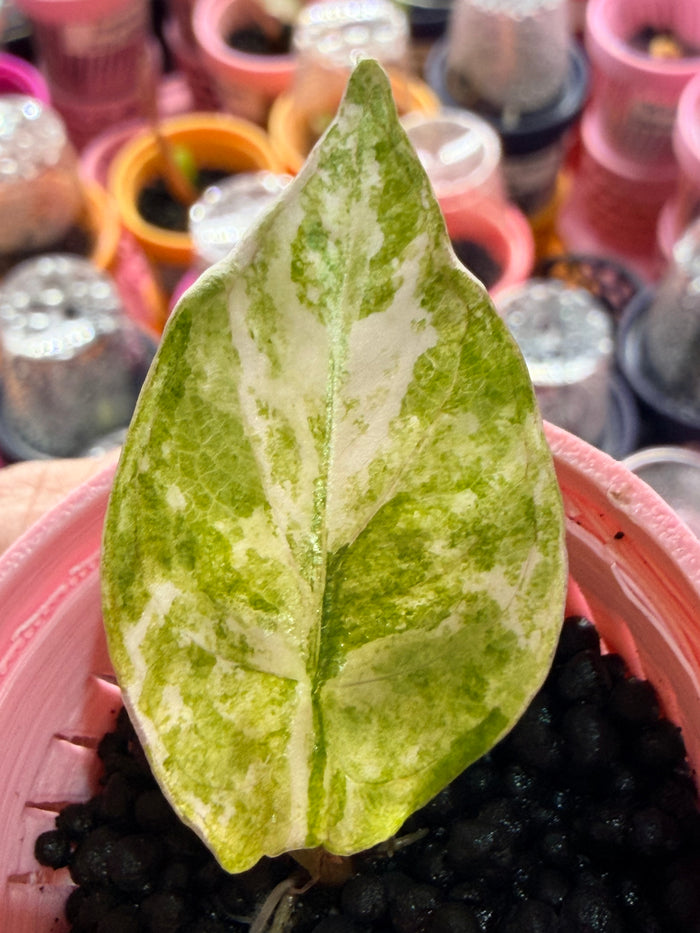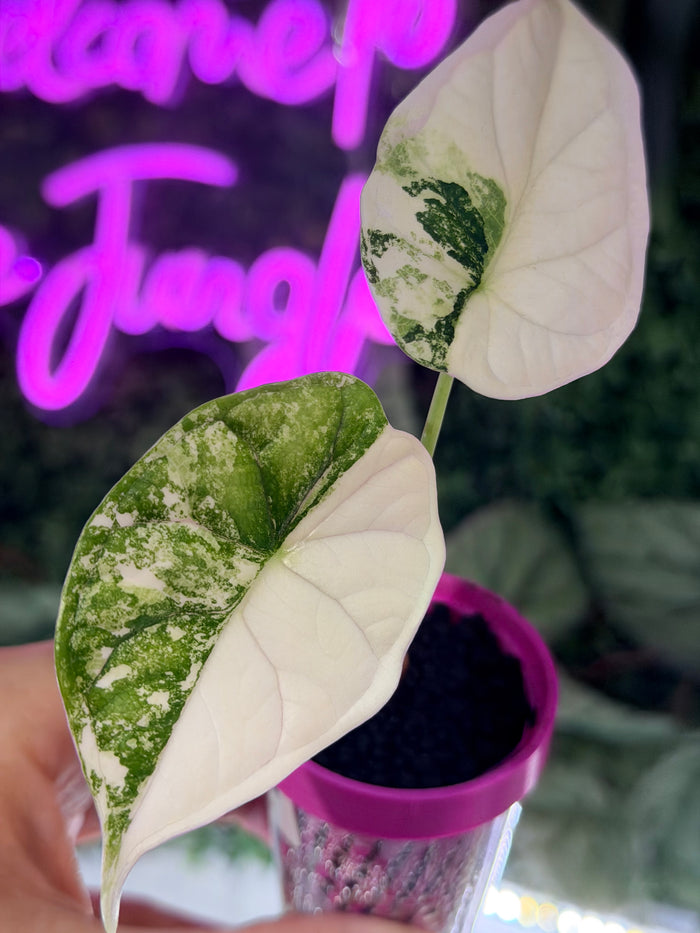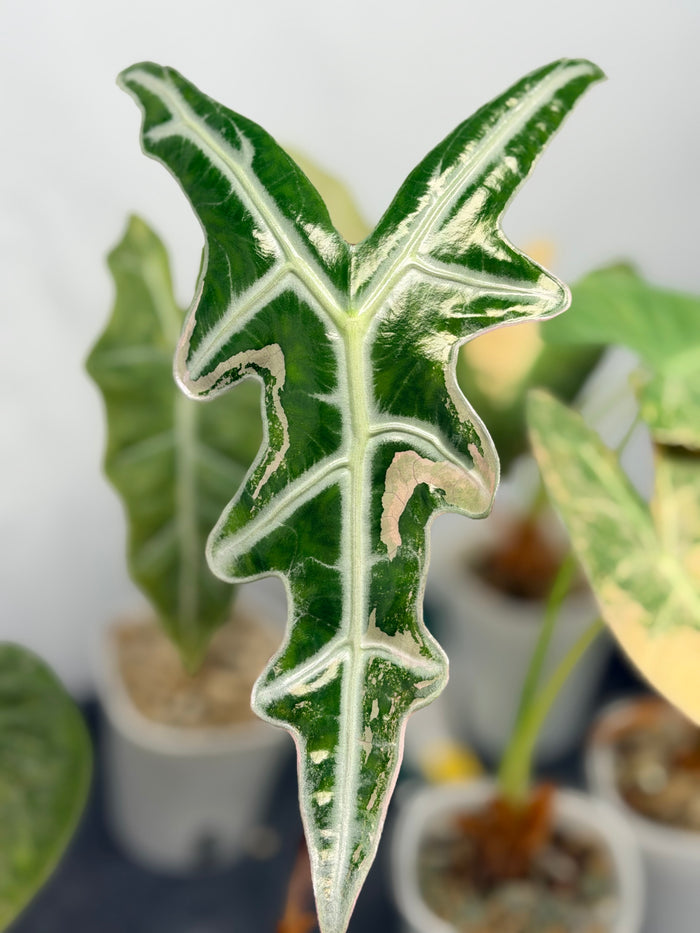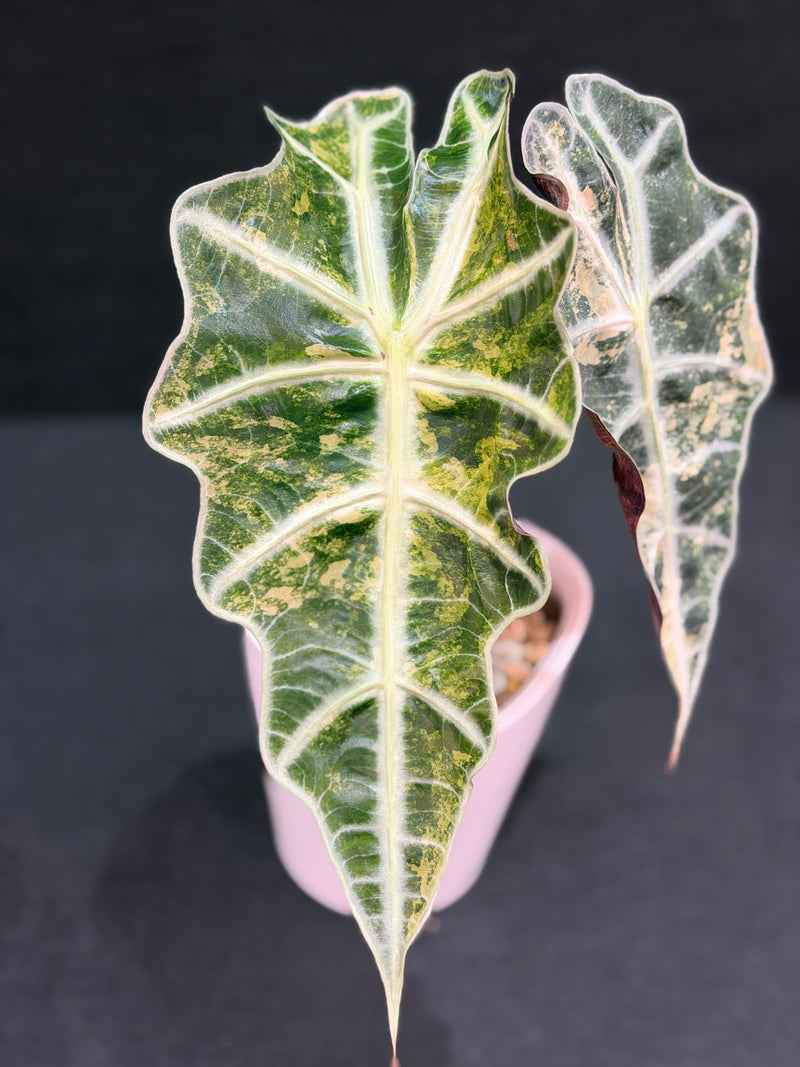

Looking for Alocasia Ninja Pink Variegated? You have found it, along with everything you need to understand what this plant actually is, where it comes from botanically, what the pink variegation means in practice, and how to give it the conditions it needs to thrive in a UK collection.
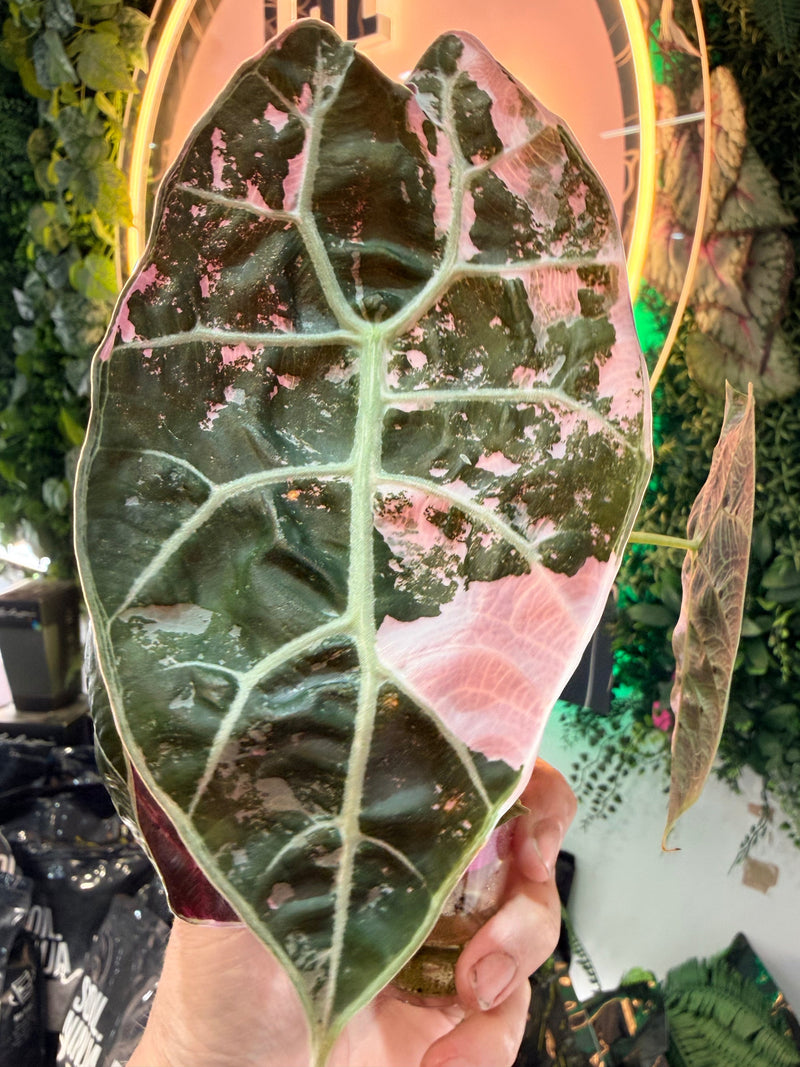
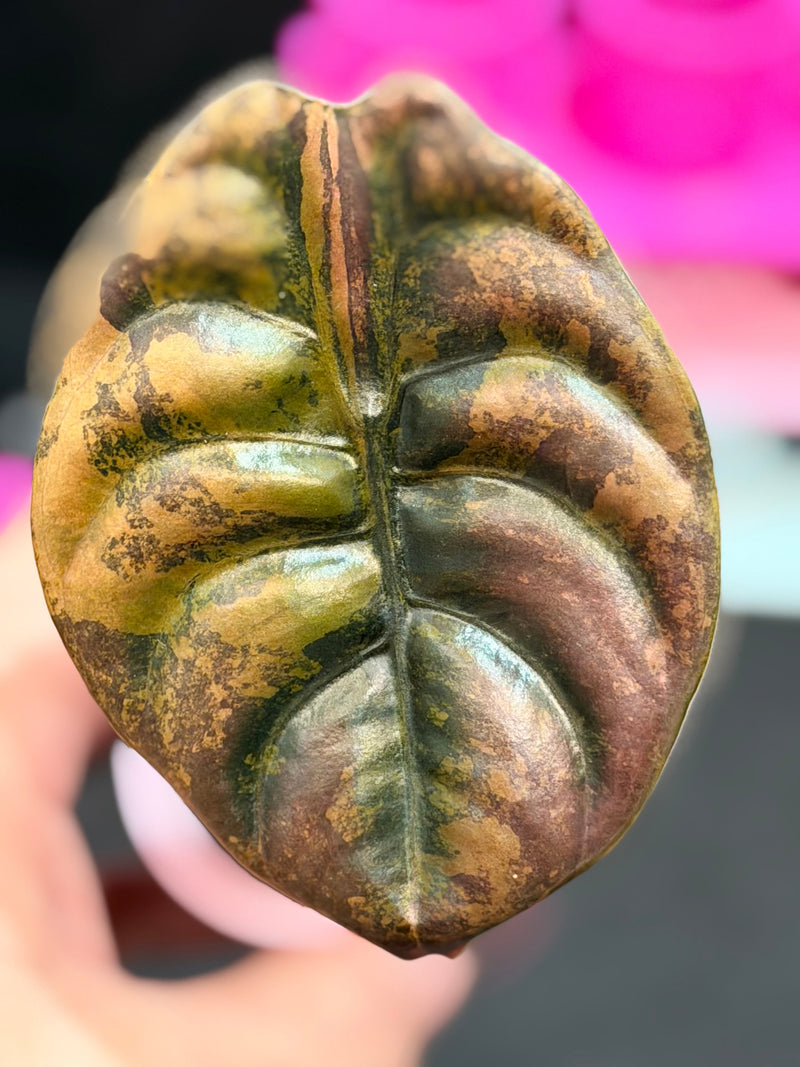
The Ninja Pink Variegated is one of the most visually striking jewel Alocasia available to UK collectors. The combination of factors that creates it, the very dark matte green, velvety, deeply textured foliage of Alocasia reginula 'Black Ninja', overlaid with chimeric pink variegation that produces bold splashes and sectors of blush-to-deep-rose against that dark ground, results in a contrast that is genuinely unlike anything else in the Alocasia world. Dark and light, velvety and vivid, architecturally compact and visually arresting: this is a plant that earns its collector status.
Understanding what creates that combination, the species history, the cultivar distinctions, the nature of the pink variegation, and the specific care requirements that flow from both, is the foundation for growing it well. This guide covers all of that in full.
Alocasia reginula: The Little Queen from Borneo
Alocasia reginula is the parent species behind the entire Black Velvet, Black Ninja, and their variegated forms. The species history is somewhat unusual for a jewel Alocasia: it was formally described in 1998, in the Gardens' Bulletin Singapore, from cultivation, specifically from dried leaf specimens sent to taxonomist A. Hay by Dewey Fisk in Florida. The type specimen came not from a wild collection but from plants already established in horticulture, which had been obtained via Lyon Arboretum in Hawaii from a Japanese collector who sourced material from Borneo.
The species name reginula is Latin for 'little queen', a choice that continues the regal naming tradition in Alocasia, running from reginae (queen) and baginda (majesty/king in Bahasa Indonesia) through to maharani (the Hindi word for queen). It was a fitting choice: in aspect and presence, Alocasia reginula is among the most regal of the compact jewel forms.
The formal taxonomic notes are candid about the plant's origins: it is known only in cultivation, and while it exhibits no characteristics suggesting hybrid origin, and is therefore treated as a true species, its precise wild provenance remains unconfirmed. It is believed to originate from Borneo, and in aspect belongs to the Bornean Alocasia scabriuscula group. The native climate is a tropical humid one, with humidity ranging from 60–70%, temperatures between 9°C and 31°C seasonally, a distinct rainy season from October to May and a dry season between June and October, and average annual rainfall of around 1,200mm. These are notably less extreme conditions than some jewel Alocasia, the temperature range in particular extends lower than species native to equatorial lowland Borneo, which is part of why Alocasia reginula and its cultivars tolerate UK home conditions reasonably well relative to some more demanding aroids.
The species is well established in cultivation under the trademark cultivar name 'Black Velvet', it has been successfully micropropagated and is now one of the most widely available jewel Alocasia in the UK hobby market. The broader reginula species has given rise to an impressive hybrid lineage: Alocasia 'Maharani' (reginula × melo), Alocasia 'Regal Shields' (reginula × odora), Alocasia 'Black Dragon' (baginda 'Silver Dragon' × reginula 'Black Velvet'), and others, several of which are available in our main Alocasia collection.
The Black Ninja Cultivar: Where Ninja Pink Begins
Alocasia reginula 'Black Ninja', the base cultivar behind the Pink Variegated, was introduced to the market around 2020. It is also sold under the names Alocasia 'Black Ninja' and Alocasia 'Black Velvet Ninja', and the naming ambiguity reflects a genuine taxonomic debate that has not been fully resolved.
According to Aroidpedia, Black Ninja is almost identical to Alocasia reginula 'Black Velvet', but differentiated by characteristic double marginal veins, and thicker, darker, and more embossed leaves. Those double marginal veins, a doubled white vein line tracing the leaf edge, are the most immediately visible distinguishing feature when comparing Black Ninja and Black Velvet side by side. The more deeply embossed leaf surface and richer, darker adaxial colouration, a deeper, more saturated dark green than Black Velvet, are the secondary distinguishing traits.
There is ongoing discussion in the collector community about whether Black Ninja constitutes a genuinely distinct cultivar or simply a minor developmental mutation that becomes indistinguishable from Black Velvet at maturity, Aroidpedia notes this explicitly, with reports that once matured, the two can become effectively identical. This uncertainty is worth acknowledging honestly. What matters practically for collectors is that juvenile and mid-growth Black Ninja specimens do show the distinctive double veining and embossed texture, and the Pink Variegated forms based on Black Ninja present those traits on every variegated specimen regardless of the broader nomenclature debate.
The cultivar name, and the broader Ninja framing, refers to the dark foliage and the bold, stealthy visual impact of the plant. A fully grown Black Ninja specimen, with its very dark matte green velvety leaves, pronounced white veining, and compact, low-growing clump form, lives up to the name. Add pink chimeric sectors to that already dramatic leaf surface, and the visual impact compounds considerably.
Understanding the Pink Variegation
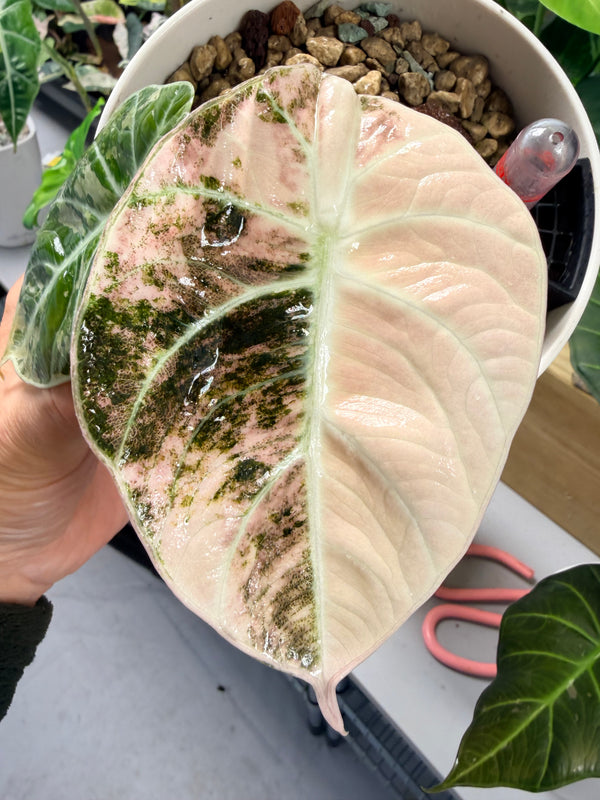
The pink variegation in Ninja Pink Variegated is chimeric in nature, the same fundamental mechanism that produces albo variegation in other Alocasia cultivars, but expressing as pink and blush tones rather than white or cream.
In chimeric variegation, a mutation affects the meristematic tissue, the actively dividing cells that generate new growth, so that some cellular lineages lack the ability to produce normal chlorophyll. In standard albo variegation, the affected cells produce no pigment at all, creating white or cream tissue. In pink variegation, the mutation produces cells that express anthocyanin pigments, the same class of pigments responsible for red, pink, and purple colouration in many plants, instead of, or alongside the absence of, normal chlorophyll. The result is pink and blush tissue where a fully green plant would show solid dark green, and where an albo form would show white.
Because the mutation is distributed unpredictably through the meristem, no two leaves ever express the same pattern. Every Ninja Pink specimen is genuinely individual, some leaves will show large bold sectors of deep rose, others will show diffuse blush marbling, others may show minimal variegation. The unpredictability is not a defect; it is inherent to chimeric variegation and is part of what makes each plant a one-off specimen.
For a deeper exploration of how pink variegation arises in Alocasia, including the anthocyanin pathway, how it differs from albo and aurea, and what it means for propagation, our complete guide to Alocasia variegation types covers the subject in full. Our pink variegated collection showcases the range of pink expressions we grow across multiple cultivars, and the Alocasia Bambino Pink Variegated and Alocasia Amazonica Pink Variegated offer instructive comparisons, different base species and foliage character, but the same chimeric pink expression.
The Visual Effect on Black Ninja Foliage
The particular impact of pink variegation on Black Ninja's dark, velvety, very dark green leaf surface deserves specific attention, because the contrast is different in kind from pink variegation on other Alocasia.
On a mid-green or bright green Alocasia base, pink variegation creates a pastel contrast, vivid but relatively harmonious in tone. On the very dark matte green velvet of Black Ninja, the same pink sectors create a far more dramatic opposition, the depth of the ground colour intensifies the apparent brightness and saturation of the pink tissue. The white marginal vein lines characteristic of Black Ninja further delineate the variegation sectors, framing the pink areas within the velvety dark ground in a way that reads as structured and considered rather than random. The result is a leaf that looks almost designed, a quality that photographs well but that is even more apparent when you see the plant in person.
The velvety texture of the leaf surface, the dense, fine trichomes (leaf hairs) that give Alocasia reginula cultivars their characteristic suede-like feel, adds another dimension to the variegation presentation. The textured surface catches and diffuses light differently across the green and pink sectors, creating a subtle shift in surface quality between the two tissue types that enhances the contrast further.
Ninja Pink Variegated Versus Other Pink Variegated Alocasia
Placing Ninja Pink in the context of other pink variegated Alocasia in your collection or under consideration is useful for collectors assessing whether this is the right addition and how it sits alongside existing plants.
Versus Alocasia Bambino Pink Variegated
Alocasia Bambino Pink Variegated, a compact pink chimeric form with a lighter, bright-green base, is the most commonly compared alternative. Bambino Pink shows pink and cream sectors against vivid mid-green foliage, producing a lighter, fresher visual effect. Ninja Pink, by contrast, presents the same pink chimeric sectors against very dark matte green velvet, a dramatically darker, richer combination. The two plants are complementary rather than redundant in a collection that includes both: Bambino Pink provides bright contrast, Ninja Pink provides dark drama.
Versus Alocasia Black Velvet Pink Variegated
The Black Velvet Pink Variegated, available in our pink variegated collection, is the closest direct comparison to Ninja Pink, given the shared reginula base. The primary distinction between the two is the double marginal veining characteristic of Black Ninja versus the single marginal veining of Black Velvet, and the more deeply embossed leaf surface of Ninja. In fully expressed specimens with strong pink variegation, these distinctions may be less immediately apparent than the shared dark-ground-with-pink-sectors character, but for collectors who want the deepest, most embossed leaf surface with the characteristic double vein detail, Ninja Pink is the specific form to acquire.
Versus Alocasia Chantrieri Pink Variegated
Alocasia Chantrieri Pink Variegated offers a very different visual character, the elongated, arrow-shaped Chantrieri leaf form with pink sectors is a more upright, larger-leaved plant than the compact clump of Ninja Pink. The two are stylistically distinct rather than competing: Chantrieri Pink provides height and sculptural presence, Ninja Pink provides compact jewel-scale intensity.
Growing Alocasia Ninja Pink Variegated in the UK: Complete Care Guide
Substrate and Potting
Alocasia reginula and its cultivars are notably sensitive to overwatering and poor drainage, the species is known only from deeply shaded limestone cliff environments in the wild, and its care requirements reflect that habitat. The most significant practical implication for UK growers is the critical importance of a genuinely fast-draining substrate and appropriately sized pots.
Use a well-structured aroid mix with a high proportion of chunky, inorganic material, perlite at 30–40% minimum, with orchid bark or similar coarse organic content providing structure. Fluval Stratum is our preferred substrate at the nursery: it drains freely, maintains an appropriate pH for jewel Alocasia, and provides the microbial environment that supports healthy root development in sensitive cultivars. Avoid any mix that compacts, retains moisture for extended periods, or becomes anaerobic at the root zone.
Pot sizing is, if anything, more critical for Ninja Pink than for many other Alocasia. The compact growth habit and sensitivity of reginula cultivars to root rot means that even a modest excess of substrate around the root ball creates conditions where moisture lingers in anaerobic zones, creating the conditions for rapid decline. Use the smallest pot that comfortably accommodates the current root system. Our self watering corm pots with humidity dome provide an excellent controlled-environment option for corm and early-growth propagation.
Light
Ninja Pink Variegated has a light requirement shaped by two factors: the inherent preference of Alocasia reginula for shaded conditions (reflecting its limestone cliff habitat), and the photosynthetic limitation created by the chimeric pink sectors, which contain reduced or no functional chlorophyll.
Bright, indirect light, filtered and consistent rather than intense or direct, is the correct approach. Direct sunlight will scorch the velvety leaf surface, and the pink sectors are particularly vulnerable: the lack of chlorophyll also means reduced UV protection in those tissues. However, insufficient light will limit the plant's ability to grow and maintain health from its reduced photosynthetically active tissue.
For UK conditions, an east or west-facing position works well. Supplemental LED grow lighting will meaningfully improve outcomes for Ninja Pink. A minimum of 10–12 hours of light daily supports continued, if slow, growth.
Temperature and Humidity
The native climate data for Alocasia reginula is more forgiving than many jewel Alocasia: temperatures as low as 9°C occur in its native range, and the seasonal variation in humidity (60–70%) is less extreme than the equatorial humidity of Alocasia baginda or Alocasia melo. In practice this means Ninja Pink tolerates typical UK home humidity better than some competing jewel forms.
That said, 60–70% relative humidity is still significantly above average UK home conditions (typically 40–50%), and providing supplemental humidity will support better leaf development, reduced likelihood of brown leaf edges, and more vigorous growth. A dedicated ultrasonic humidifier near the plant is the most reliable approach. A target of 60–70% represents a realistic and manageable goal for UK collectors that aligns with the plant's native conditions.
Temperature stability is more important than achieving a specific maximum: Ninja Pink does not appreciate cold draughts, temperature fluctuations, or positions near cold windows or external walls. A minimum consistent temperature of 15°C will maintain the plant in healthy growth; below 13°C, growth will slow significantly.
Watering
Water when the top 2–3cm of substrate has dried, allow to drain fully, and never allow water to sit in the saucer. The thick, coriaceous leaves of reginula cultivars are more drought-tolerant than thinner-leaved Alocasia, but the root system is highly susceptible to anaerobic wet conditions, consistent slight moisture is the target, with full substrate drying avoided at both extremes.
Water with room-temperature water, cold water can shock the roots of a plant that originates in a warm limestone cliff environment. In hard water areas, the calcium carbonate accumulation that builds up over time in the substrate affects drainage and pH; periodic flushing with filtered or collected rainwater, or complete substrate refreshes annually, prevents this becoming a problem.
Reduce watering frequency significantly when the plant is growing more slowly or not at all. The key is matching watering frequency to actual plant activity and never watering a very slow-growing plant on a schedule designed for active growth.
Feeding
Feed at dilute concentration, approximately half the manufacturer's recommended rate, applied with every watering. A balanced liquid fertiliser provides the base nutrition; consider a supplemental boost of a magnesium-containing foliar feed monthly, given the reduced photosynthetic capacity of the pink variegated sectors. The fully green portions of each leaf carry the full photosynthetic workload, and ensuring they have the micronutrients required for optimal function matters more in a chimeric variegated plant than in a fully green one.
Our plant feed range and targeted boosters support both the base feed programme and targeted supplementation. Cease feeding when growth has stopped, and wait until active new growth is visible before resuming. Superthrive is part of every feed we mix at the nursery, a vitamin B1 and kelp supplement that supports root development and helps plants settle after repotting or a change of conditions.
Growing Ninja Pink Variegated from Corm
Growing Ninja Pink from corm is the primary route for UK collectors, and it requires the same honest caveats as any chimeric variegated Alocasia grown from propagation material.
Corms from Ninja Pink Variegated mother plants carry the genetic potential for the chimeric pink mutation, but expression in the resulting plant cannot be guaranteed. The chimeric distribution of affected cells through the meristem is unpredictable: a corm from a heavily variegated mother plant may produce a plant with bold pink sectors, subtle marbling, minimal expression, or in some cases green reversion. This is the honest reality of propagating chimeric variegated Alocasia, and it applies universally regardless of source.
Our Alocasia Ninja Pink Variegated corms are harvested from verified pink variegated mother plants, parentage confirmed, but individual expression will develop as the plant grows. This is not a limitation unique to our stock; it is a feature of chimeric variegation itself.
For propagation, Ninja Pink corms require consistent warmth (25–28°C substrate temperature), humidity above 60%, and a free-draining substrate that prevents waterlogging before sprouting. Our Corm Keeper system and Fluval Stratum combination provides an effective controlled environment for this purpose. Full details of the corm propagation process, from assessment of corm viability through to established juvenile plant, are covered in our corm propagation guide.
Alocasia reginula cultivars are notably slower from corm to first leaf than many faster-growing Alocasia. Patience is essential, consistent conditions rather than intervention will produce the best outcomes.
Pest and Disease Management
Ninja Pink Variegated faces the same pest pressures as all jewel Alocasia, with additional considerations specific to the velvety leaf surface and the chimeric variegation.
Spider mites are the primary threat, they thrive in low-humidity conditions, which makes the risk particularly relevant whenever home humidity drops. The velvety trichome surface of reginula cultivars is somewhat protective against mite establishment, but offers no immunity, and regular inspection of leaf undersides during every watering session is important. Early identification and treatment dramatically reduces the damage sustained before an infestation is controlled. Our pest control range covers both preventive and treatment options.
Thrips are particularly damaging to Ninja Pink because of the visible impact they have on the variegated tissue: the silver track marks and distortion caused by thrips feeding on developing leaves are especially noticeable on both the pink sectors and the dark velvety ground of the fully green portions. Any damage sustained during leaf development is permanent, the leaf unfurls with the damage incorporated, and there is no recovery for the individual leaf. Inspecting new growth carefully as it emerges is the most important preventive measure.
Root rot remains the most serious disease risk, and for Alocasia reginula cultivars specifically, the risk is higher than for many Alocasia because of the species' documented sensitivity to excess moisture. The combination of correctly sized pots, genuinely free-draining substrate, and careful watering eliminates the vast majority of root rot risk. If unexpected decline is observed, yellowing, wilting, loss of leaf turgidity that cannot be explained by underwatering, unpotting and inspecting the root system immediately is the correct response. Our root rot guide covers identification, assessment, and the recovery process in detail.
Ninja Pink in a Collection Context
Alocasia Ninja Pink Variegated occupies an interesting position in a collector's jewel Alocasia section. It is not the most difficult jewel Alocasia to grow, Alocasia reginula's more tolerant native climate relative to some other jewel species means the care requirements are achievable in a well-managed UK collection without specialist facilities. But the combination of the chimeric pink variegation and the distinctive Black Ninja leaf character places it firmly in the upper tier of jewel Alocasia desirability.
In collection terms, it pairs naturally with other reginula cultivars, particularly the standard Black Velvet and Ninja, where the green reference point makes the pink variegation of the Pink form more visually apparent by contrast. Within our pink variegated collection, it sits alongside forms that share the chimeric expression but differ entirely in base foliage character, offering the collector an opportunity to explore how the same variegation mechanism produces fundamentally different effects across different species and cultivar base plants.
For collectors who are newer to jewel Alocasia, Ninja Pink is a reasonable entry point to the more exacting end of the jewel category, more forgiving than Alocasia baginda forms in terms of humidity requirements, while providing the full experience of growing a chimeric variegated jewel form from corm to mature specimen. For experienced jewel Alocasia collectors, it is a cultivar that deserves space on the shelf on its own terms.
Ninja Pink Variegated at The Alocasia Company
Every Alocasia Ninja Pink Variegated in our collection has been grown from corm at our private UK nursery, from verified pink variegated mother plant stock. We grow and assess all plants ourselves, no externally sourced specimens, no wholesale, no plants listed without variegation confirmed at the time of listing.
Availability is limited by the slow growth rate of Alocasia reginula cultivars and the finite production possible from verified mother plants. Our rare plant drop system provides subscriber list first access when Ninja Pink stock becomes available. If this cultivar is a priority, joining the list is the most reliable way to secure one.
Browse our full pink variegated Alocasia collection for related chimeric pink cultivars, and our complete Alocasia collection across corms, juveniles, and mature plants for the full range currently in stock.
Questions about Alocasia Ninja Pink Variegated, the Alocasia reginula cultivar family, or jewel Alocasia care in UK conditions? Contact our team, we grow these plants professionally and are happy to advise on care requirements, collection planning, and whether Ninja Pink is the right fit for your growing setup.
From the nursery