Alocasia Black Velvet Pink Variegated: The Complete Collector's Guide

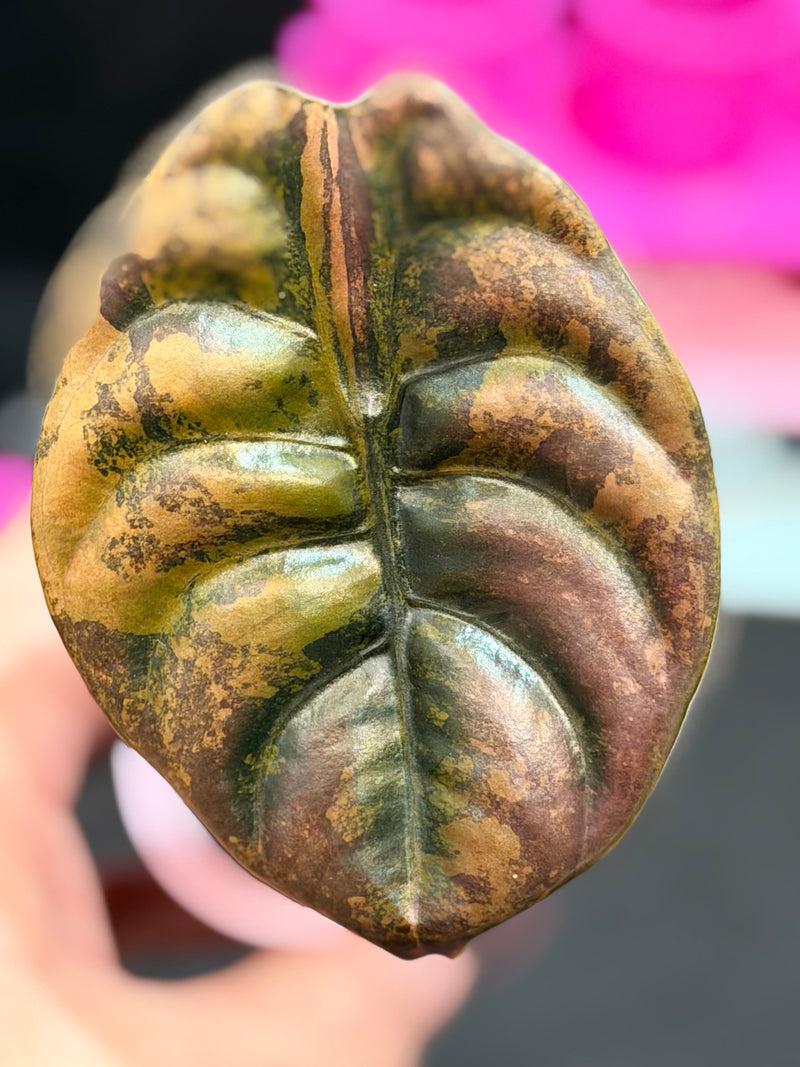
The Alocasia Black Velvet Pink Variegated is a pink-variegated form of Alocasia reginula 'Black Velvet', a compact jewel Alocasia with dark, velvety leaves. It is one of the most visually striking expressions of pink chimeric variegation in the jewel Alocasia world, with the near-black, velvety foliage serving as the backdrop for pink sectors that read as intensely warm and luminous against the dark, light-absorbing base. This guide covers the history of the Black Velvet cultivar, what pink variegation is, and how to care for the plant.
What is Alocasia Black Velvet Pink Variegated?
The base plant is 'Black Velvet', one of the best-known jewel Alocasia. Pink variegation adds sectors of warm pink on the dark leaf. Pink in Alocasia is anthocyanin-based and chimeric, which means it is unstable and can change from leaf to leaf. Our guide to pink variegation in Alocasia explains the mechanism, and the pink variegated Alocasia collection shows related plants.
Origin and naming of Black Velvet
Aroidpedia has an entry for Alocasia reginula 'Black Velvet' and describes the cultivar as having become synonymous with the species itself. It records that Scott Hyndman introduced the plant to the market in 1992, simply as Alocasia 'Black Velvet'. He reportedly obtained it from the Lyon Arboretum in Hawaii, which had apparently received it from a collector in Japan.
Aroidpedia notes Hyndman's theory that a Japanese orchid collector found the plant in Borneo, and that either one plant was collected or only one survived in cultivation. That single plant was put into tissue culture with Agristarts, and the line grown today comes from it. This is a theory rather than a documented fact, and we present it as such.
Aroidpedia has no entry for a pink-variegated Black Velvet, so the origin of the pink form is not documented there. We will not invent a history for it.
For the species, Wikipedia gives Alocasia reginula as native to Sabah in Malaysian Borneo, known from dry, deeply shaded limestone cliffs in Tabin Wildlife Reserve, with reddish leaf undersides. Our Alocasia reginula species guide covers the species in more depth.
How to identify it
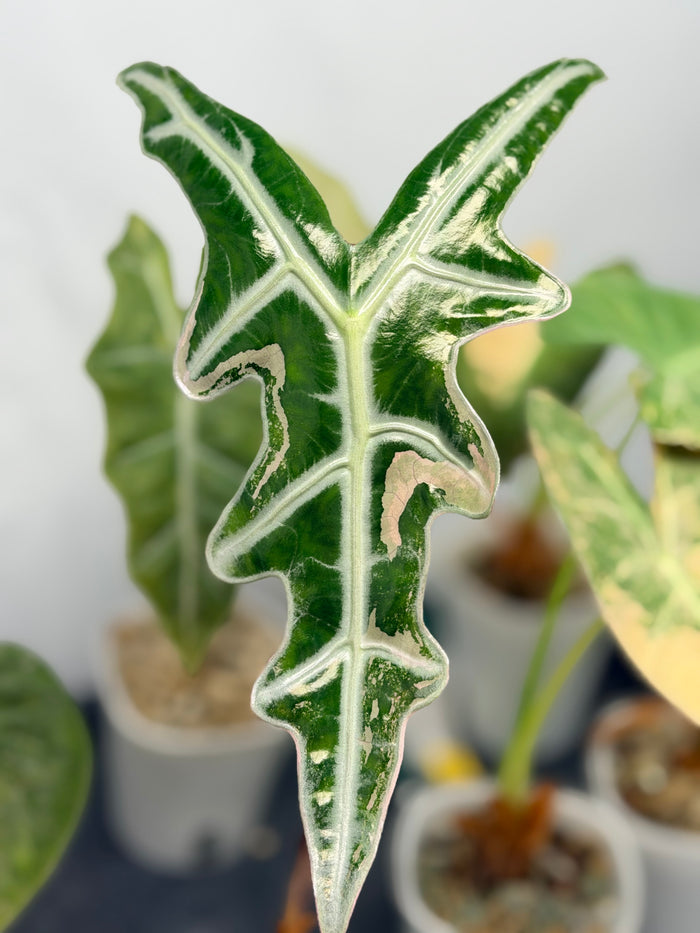
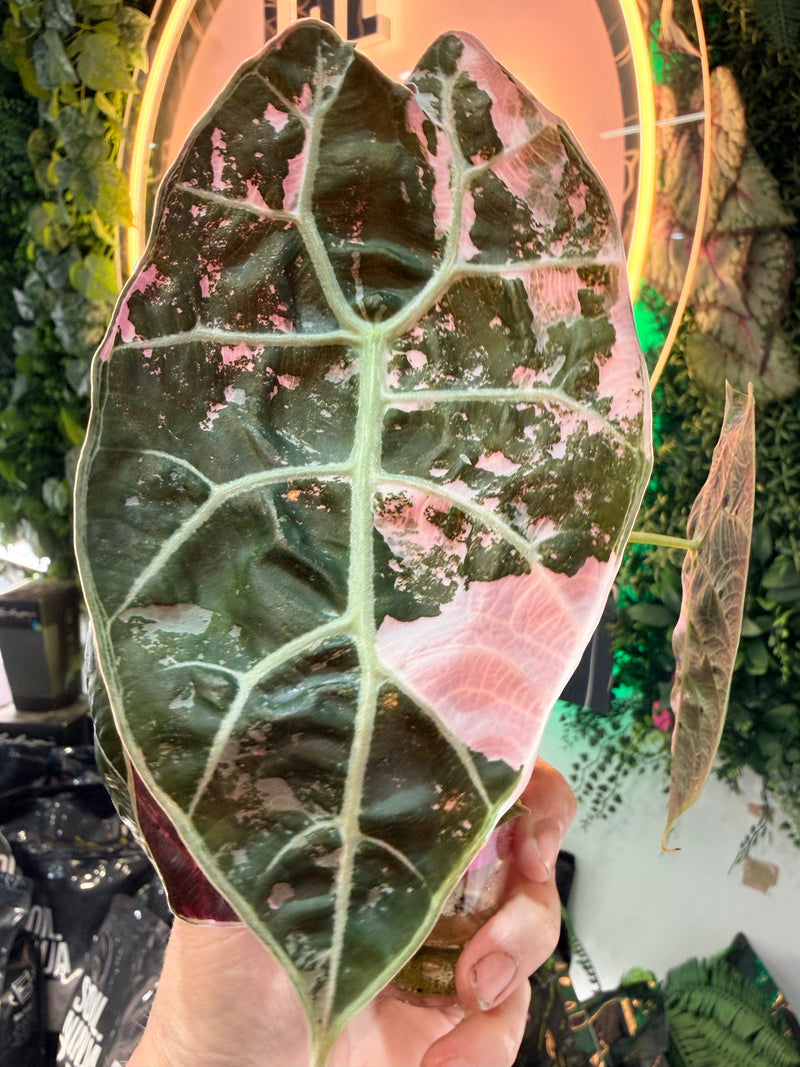
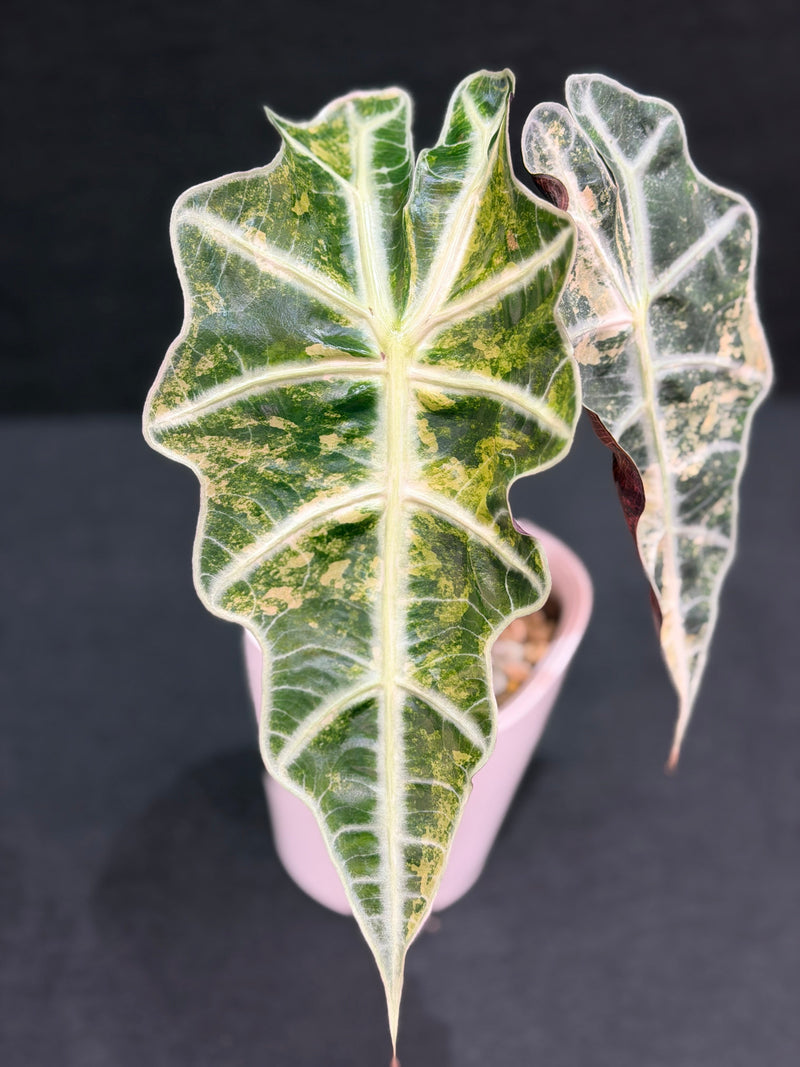
Black Velvet has dark, velvety leaves with pale venation, and it stays compact. Aroidpedia gives no measurements; in our growing it is a small jewel plant suited to a shelf or terrarium-style setting, reaching 20-40cm, with the characteristic dark near-black velvety leaves, silver-white primary venation and marginal vein that give it its exceptional visual character. The pink form shows irregular pink patches over the dark base; the pale veins continue through them.
The name reginula is Latin for 'little queen', an apt description of a small plant with such a formal appearance.
Understanding the pink variegation
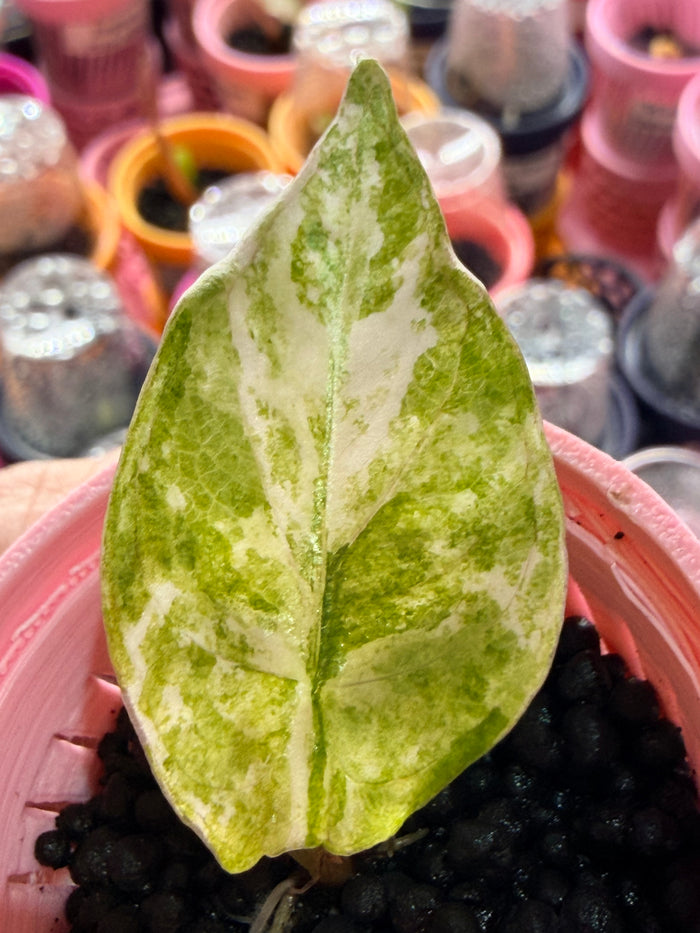
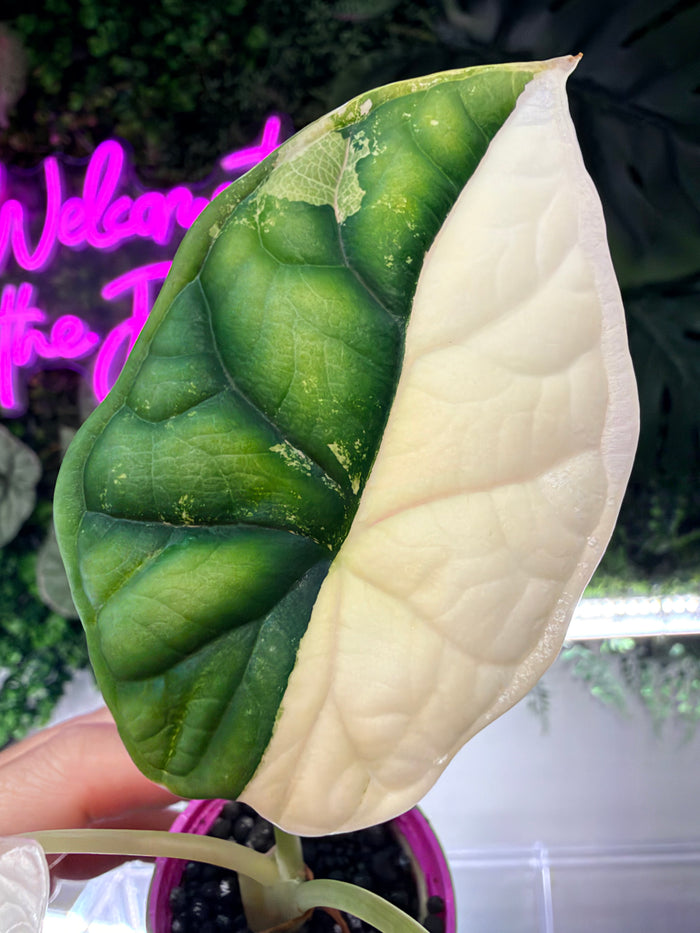
Pink sectors contain extra anthocyanin pigment laid over tissue that still has chlorophyll. That is different from albo, where sectors have no chlorophyll at all. Pink tissue therefore keeps some photosynthetic ability, and pink plants are generally less demanding than white ones. The pattern is still chimeric, so it can fade, revert or shift, and it may not carry over to plants grown from corms. For the other variegation types, see our complete guide to variegation types.
Pink variegation on dark foliage creates a fundamentally different visual experience from pink on green or medium-toned bases: the warmth of the pink sectors is amplified by the contrast with the dark surrounding tissue, and the matte, velvety texture of reginula's foliage ensures that the pink reads as a rich, saturated tone rather than the brighter, more reflective pink seen on glossier surfaces. The warm-dark contrast between pink and near-black is among the highest-contrast colour relationships in the variegated Alocasia world.
Black Velvet Pink care
This is general Alocasia care that applies to this plant. Give it bright indirect light, supplemented with LED grow lights. Keep temperatures between 20 and 27°C and humidity between 60 and 80%, maintained with a dedicated humidifier. Water when the top 2-3cm of substrate has dried, and avoid standing water.
Fluval Stratum is our preferred substrate. If the room runs cool, a heat mat under the pot supports the roots. Feed with our Alocasia feed from the plant feed range at half strength. Our Alocasia care guide and root rot guide give further detail. Plants that came from tissue culture can need gentle handling when moved to new conditions; see our tissue culture acclimation guide.
Propagating from corms
Our Alocasia corm propagation guide sets out the self-wicking method we use: the corm sits in Fluval Stratum inside the Corm Keeper, which wicks moisture up evenly. See also growing corms in Fluval Stratum.
How it compares to similar plants
Aroidpedia records 'Black Ninja' as a plant believed to be a mutation of Black Velvet, with no consensus on whether it deserves cultivar status, and some reports that mature plants look identical. See our guides to Ninja Albo and Ninja Pink Variegated for the related plants. Aroidpedia also lists Alocasia 'Dark Matter' as a cross of Black Velvet with Alocasia scalprum; our scalprum guide covers that parent. For more velvet-leaved plants, see the Black Velvet Gold Aurea guide.
We release Black Velvet Pink through our drop model. Join the collector list to hear about releases.
Frequently asked questions
Where does Black Velvet come from?
The species is native to Sabah in Malaysian Borneo. Aroidpedia records the cultivar entering the market in 1992 via Scott Hyndman, with its earlier history uncertain.
Is pink variegation stable?
No. It is chimeric and can shift, fade or revert, and may not carry over to corm-grown plants.
How big does it get?
Aroidpedia gives no measurements; in our growing it reaches 20-40cm, and it is known as a compact jewel plant.
Is Black Ninja the same plant?
Aroidpedia says Black Ninja is believed to be a mutation of Black Velvet, with no consensus on whether it is a separate cultivar.
Does pink variegation need more light?
Bright indirect light with LED supplementation suits it well, and pink tissue keeps some chlorophyll.
Questions about Alocasia Black Velvet Pink or reginula collecting? Contact our team for guidance from specialists who grow rare Alocasia in our UK-based private nursery. We are glad to help with light, substrate and variegation.
From the nursery