
Currently sold out
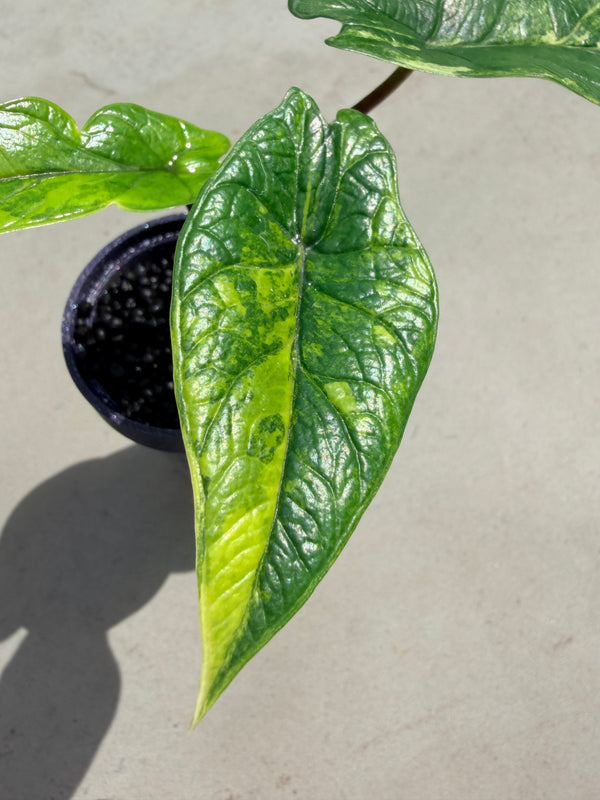
SCALPRUM AUREA VARIEGATED (BRIGHT FORM)
New plants go to the drop list first.
Join the drop listAlocasia scalprum is one of those species where the name does all the necessary work. Scalprum comes from the Latin for a tool used for scraping and cutting, very similar to a modern knife blade, and the leaf of this species is precisely that: narrowly lanceolate, slightly falcate (curved like a sickle), elongated and tapered in a way that makes it immediately recognisable and unmistakably distinct from the broader sagittate or orbicular forms that dominate the Alocasia genus.
Formally described in 1999 in The Gardens' Bulletin Singapore by A. Hay, based on a holotype cultivated at the Botanischer Garten München originating from Samar Island in the Philippines, Alocasia scalprum is a Philippine endemic. It is apparently well known in cultivation in the Philippines but poorly documented in wild-collected herbarium material, as Aroidpedia notes, the only flowered material seen by Hay matches the cultivar known as 'Samar Lance', one of four selected cultivars Burnett documented in his 1984 work The Cultivated Alocasia. The species is sympatric with Alocasia sinuata on Samar and Leyte, and the two species produce intermediate forms on the islands where their ranges overlap.
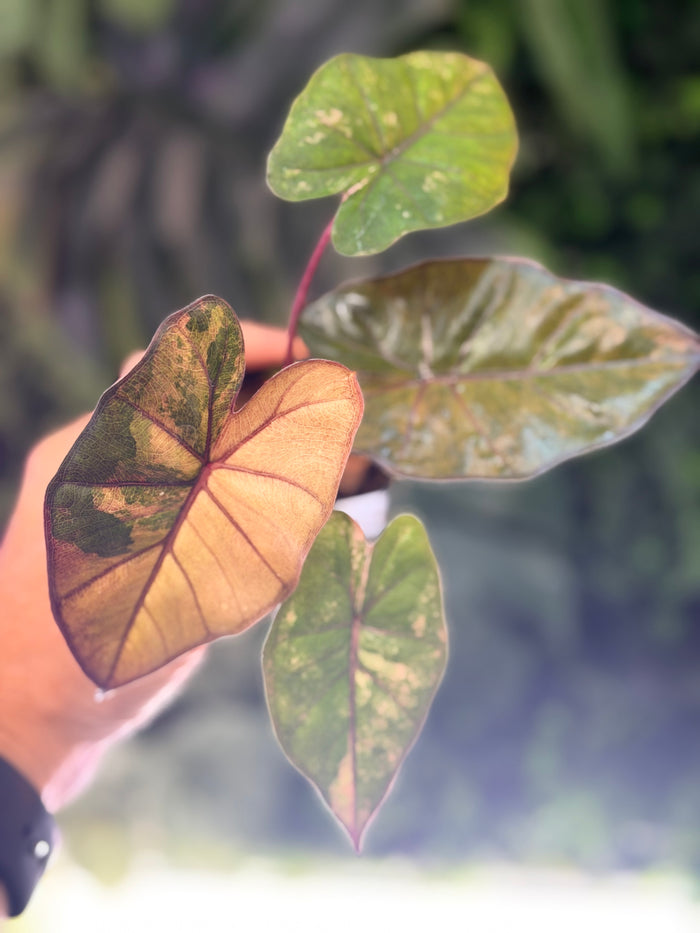
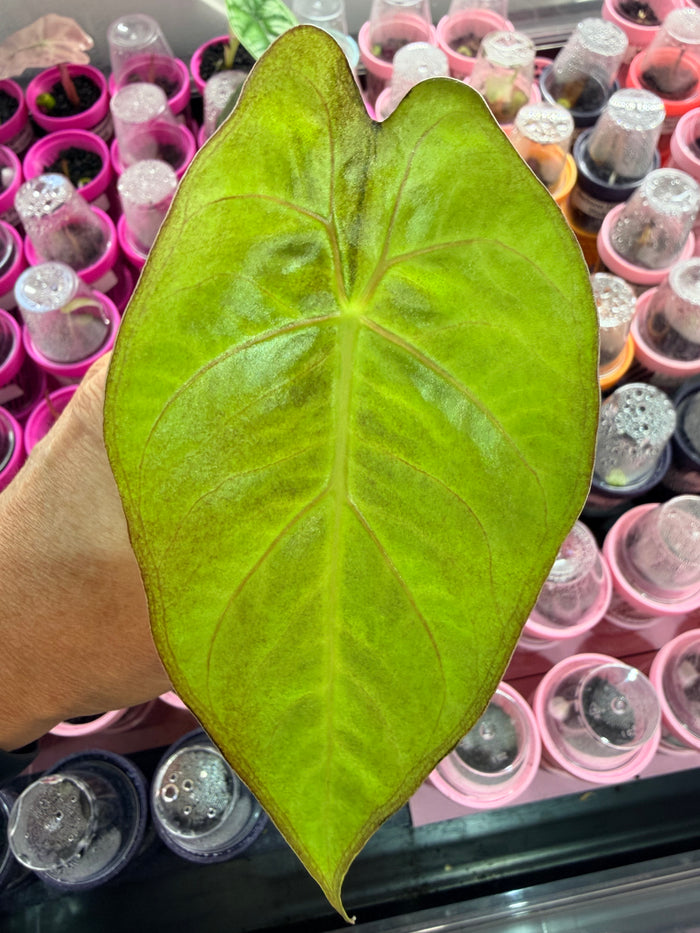
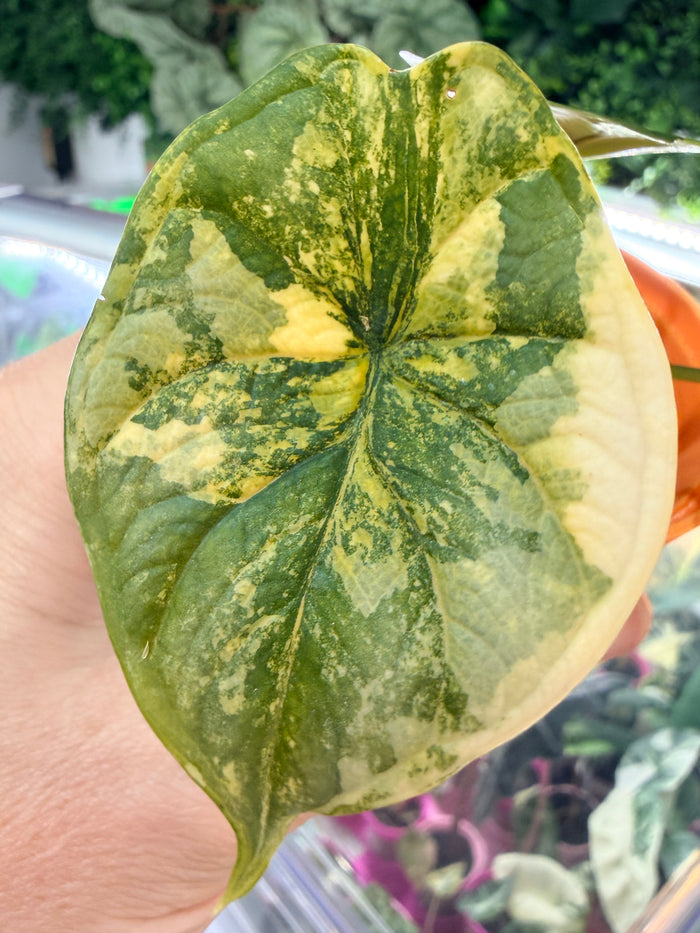
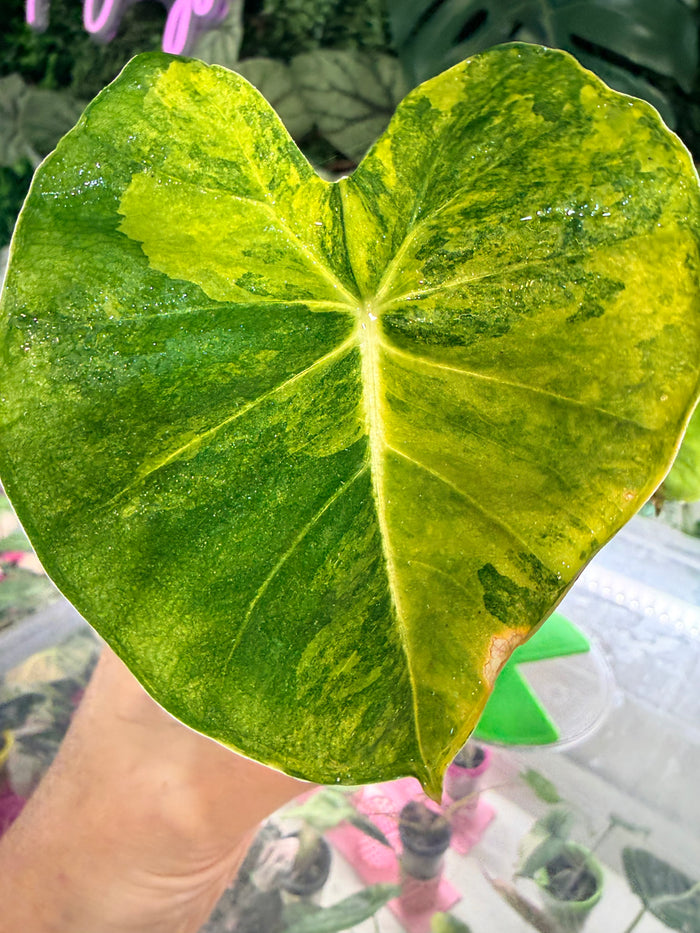
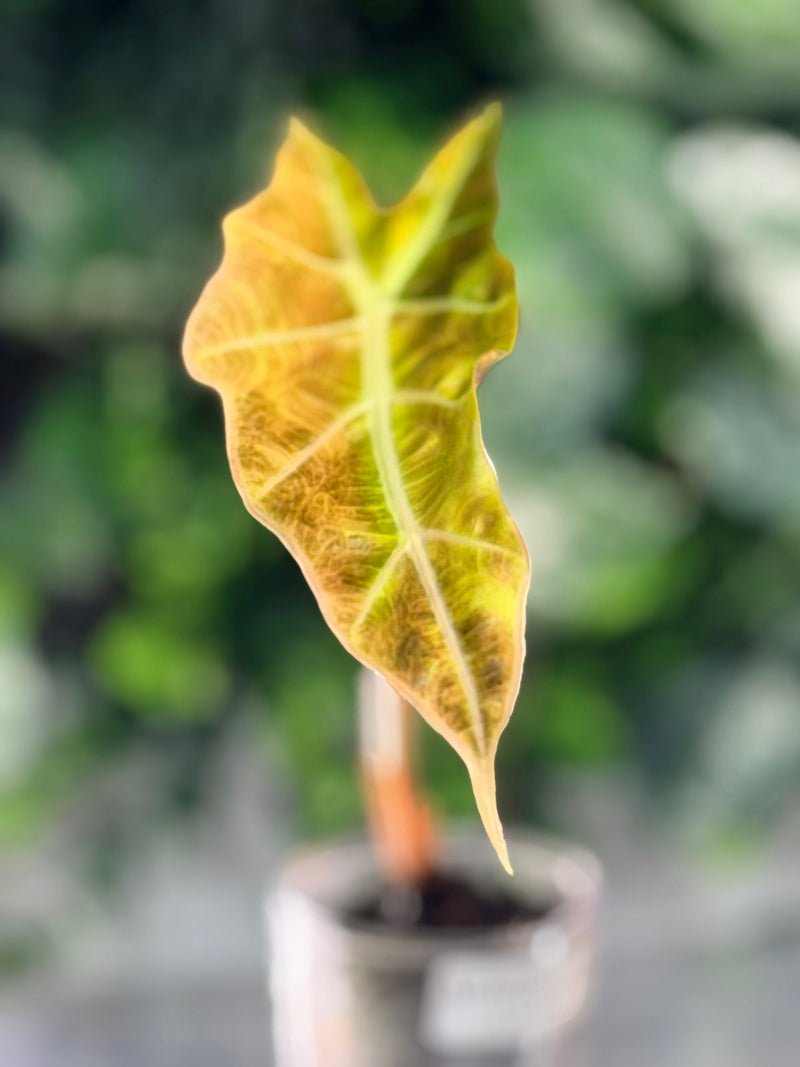
The aurea variegated form takes this already distinctive knife-blade leaf and adds golden-yellow chimeric sectors distributed across the narrow blade, creating a play of warm gold against the dark green veins that is particularly vivid precisely because the leaf form concentrates the colours in a long, tapered canvas rather than spreading them across a broad blade.
The Species: Alocasia scalprum
Formal Description
The formal description in Gardens' Bulletin Singapore (Volume 51, 1999) establishes Alocasia scalprum as a diminutive to small herb with leaves several together, petioles shorter than the blade (to approximately 10 cm long, sheathing in the lower third, green mottled darker green), and blades that are narrowly lanceolate, slightly falcate, 15 to 25 cm long by 2 to 5 cm wide. The anterior lobe is 14 to 22 cm long with 2 to 3 primary lateral veins on each side diverging at approximately 45°, all deeply impressed adaxially and prominent abaxially.
The posterior lobes are notably reduced, forming narrowly triangular auricles of only 1.5 to 3 cm long, with the posterior costae poorly developed and naked in the sinus. This near-absence of posterior lobe development is what produces the essentially linear leaf form; where most Alocasia have substantial basal lobes that create the sagittate silhouette, scalprum reduces these to minimal triangular projections, creating the knife-blade profile.
The Latin synonyms documented by Aroidpedia capture the naming history: Alocasia 'Samar', Alocasia 'Samar Lance', Alocasia 'Samar Prince'. Proven Winners have also marketed this species under the trade name Alocasia 'Mythic Pining for You', an incorrect renaming that Aroidpedia flags, as with several other Proven Winners renamings of documented Alocasia species.
Distribution and Climate
Alocasia scalprum is distributed across Samar Island and related Philippine islands, including Leyte, in a subtropical humid climate with humidity moderate year-round at 60 to 70 percent, temperatures from approximately 9°C to 31°C during the day with minimums above 7°C, and a rainy season from October through May. Annual rainfall averages 1,200 mm.
The variability documented by Aroidpedia across the scalprum complex is notable, specimens from different Philippine islands show considerable variation in leaf width, degree of falcation, and presence of the red colouration on the leaf underside. The overlap with Alocasia sinuata on Samar and Leyte produces intermediate forms where the somewhat bullate texture of sinuata merges with the slender form of scalprum. This natural variation in the wild is one reason careful sourcing of cultivated specimens matters for collectors who want a well-characterised form.
Hybrid Legacy
Despite its small stature, Alocasia scalprum has produced a notable hybrid lineage. Aroidpedia records: Alocasia 'Black Suhita' (scalprum × Alocasia 'Black Dragon'), Alocasia 'Dragon Wings' (Alocasia baginda 'Dragon Scale' × scalprum), Alocasia 'Overra' (scalprum × Alocasia baginda 'Silver Dragon'), Alocasia 'Suhita' (scalprum × Alocasia 'Black Dragon'), and an unnamed cross with Alocasia longiloba. The species' unusual leaf form makes it a distinctive contributor to hybrid development, offspring carrying the scalprum genetics often show the narrow, elongated leaf character moderated by the other parent's broader or more complex form.
Aurea Variegation on Scalprum
The aurea gold variegated form of Alocasia scalprum applies chimeric carotenoid-based variegation to the narrow blade, a combination that works particularly well given the concentrated visual effect of a long, lanceolate canvas. Aroidpedia confirms yellow as the documented variegated form for this species. The aurea mechanism is the same as across other variegated Alocasia: chimeric cell populations in the meristem unable to produce full chlorophyll content, allowing carotenoid pigments to become visible rather than being masked by green. The resulting golden sectors read particularly vividly against the dark green venation of the impressed primary veins.
For the detailed science of aurea variegation across the genus, our aurea variegation guide covers the carotenoid mechanism and care implications. Our complete variegation types overview provides the broader context across albo, aurea, and pink forms.
Growing Alocasia Scalprum Aurea in the UK
Light
The Philippine subtropical forest ecology indicates a plant adapted to filtered indirect light conditions. In UK cultivation, bright indirect light is the correct target, sufficient to maintain active growth and the full expression of aurea variegation, without direct sun exposure that the thin, narrow blade would not tolerate well. The lanceolate form means individual leaves offer limited structural resistance to strong light, and scorching develops quickly under prolonged direct exposure.
LED grow lights are useful for maintaining growth. The small, narrow leaf form means this is not a plant that dominates a growing space, and can be accommodated on a shelf or windowsill alongside LED supplementation without requiring the clearance space of larger-format cultivars.
Substrate and Watering
Fluval Stratum is the recommended substrate, providing the drainage and aeration that this compact Philippine species requires. The petioles are shorter than the blade, to approximately 10 cm, and the plant as a whole is smaller than most Alocasia in cultivation. Pot size should reflect this compact habit; an oversized pot with excess moisture-retaining substrate is a root rot risk for small plants. Allow the top 2 cm to dry between waterings. Because the leaf blade is narrow and the total leaf area is small, transpiration rate is lower than broader-leaved species, meaning the substrate stays moist for longer per watering.
Temperature and Humidity
The Philippine subtropical climate data is consistent with the standard jewel Alocasia care range, 16 to 27°C, 60 to 75 percent humidity. The subtropical classification (rather than equatorial tropical) suggests somewhat more tolerance of variation than strictly equatorial species, but this should not be tested by prolonged cold exposure. Cold draughts are the primary risk.
Pests and Propagation
Spider mites are the primary concern. The narrow blade means mite infestations are somewhat more immediately visible than on broader leaves, the stippling damage covers proportionally more of the total leaf area and becomes apparent sooner. Regular inspection remains good practice. The plant produces corms from the rhizome that carry the aurea genetics; corm-grown offspring may or may not express strong variegation, consistent with the chimeric mechanism.
Collector Context
Alocasia scalprum Aurea occupies a genuinely unique niche, the only lanceolate-bladed Alocasia with documented aurea variegation in our current collection, and one of the few compact Alocasia where the leaf form rather than the colour is the primary identifying characteristic. Alongside the standard Alocasia scalprum form and the Alocasia Scalprum Albo, the Aurea completes a trio of variegation expressions across the same knife-blade form, a coherent sub-collection within a collection that demonstrates how a single distinctive species can carry multiple colour expressions without repetition.
For the broader context of Philippine Alocasia and care fundamentals, our Alocasia care guide covers the cross-species principles.
Questions about Alocasia Scalprum Aurea, the Philippine scalprum complex, or building a variegated Alocasia collection? Contact our team for guidance from specialists at our UK-based private nursery.
If you are starting plants from corms, our Alocasia corm propagation guide walks through the self-wicking method we use in the nursery, from choosing a firm corm through to moving the sprouted plant on.