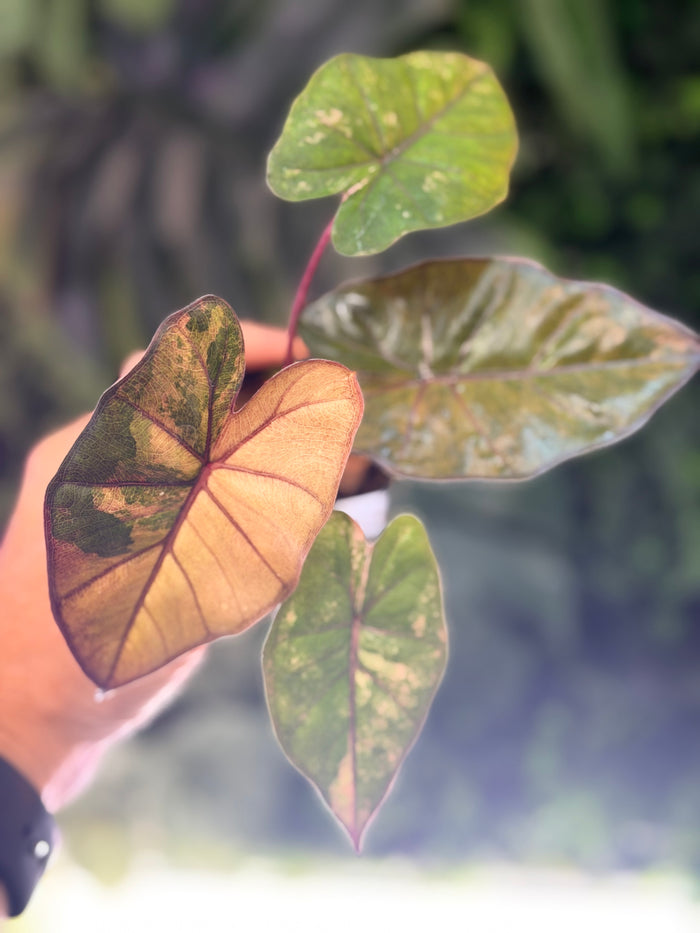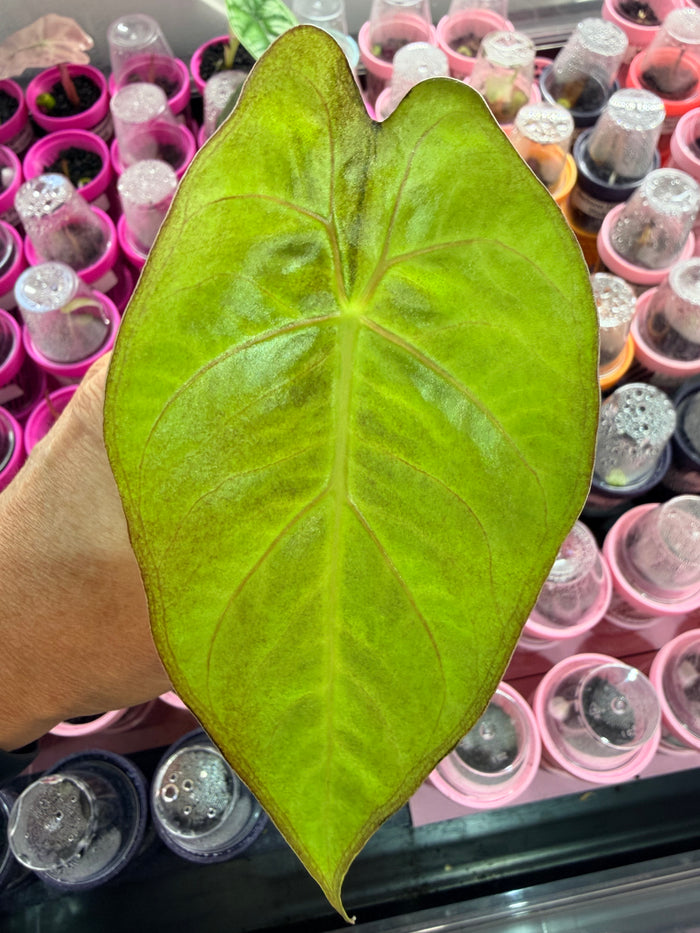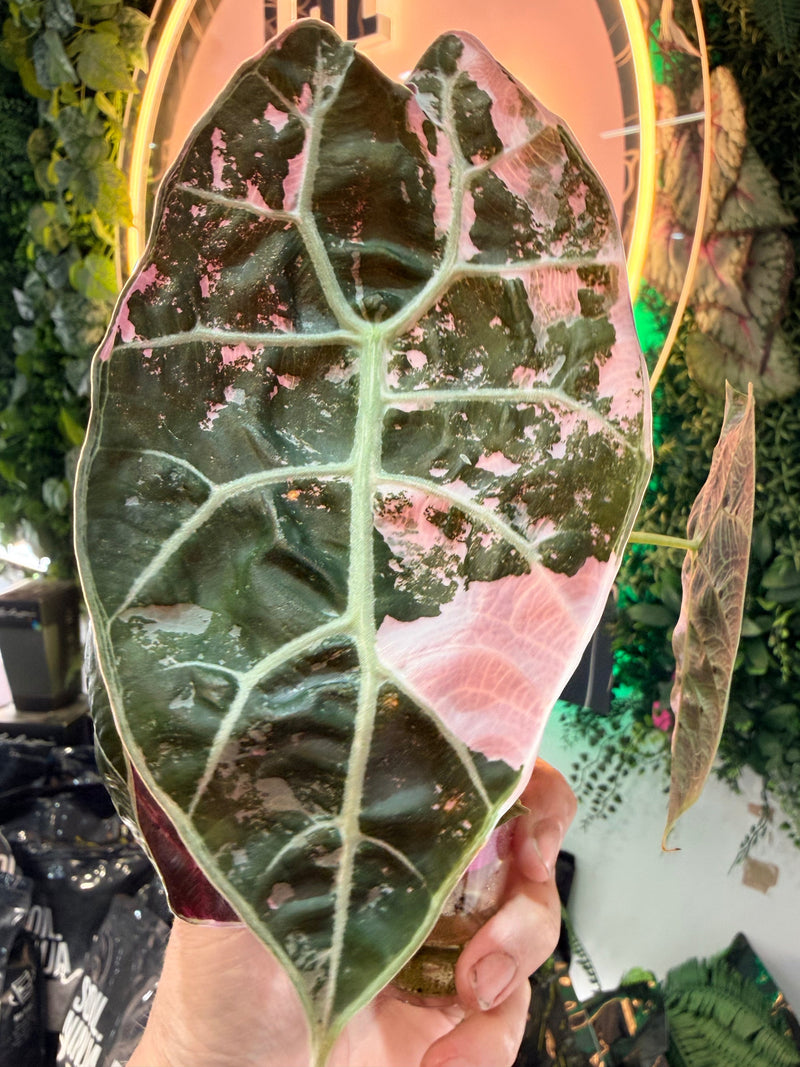

Alocasia reginula 'Black Velvet' is one of the most recognisable names in the jewel Alocasia world. The species, formally described in 1998, native to limestone cliffs in Sabah, Malaysian Borneo, and known only from cultivation before its natural population was confirmed, has earned its reputation through a leaf that is genuinely unlike almost anything else in the genus: small, thickly coriaceous, elliptic to ovate in form, with a surface texture that reads as matte and suede-like under direct observation and intensely dark in colour, with white to silvery primary veins impressed into the adaxial surface.
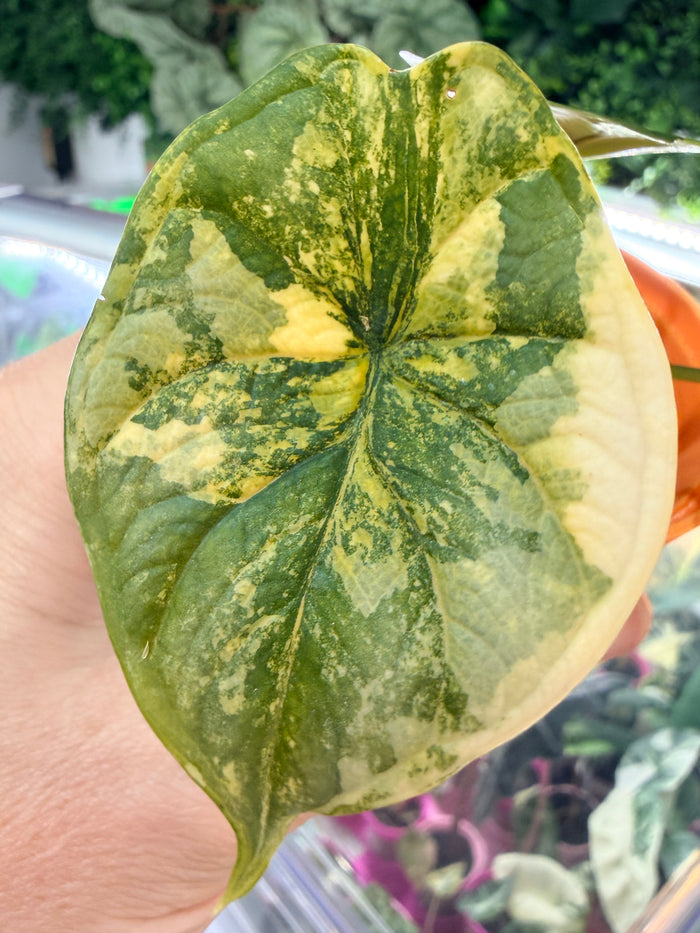
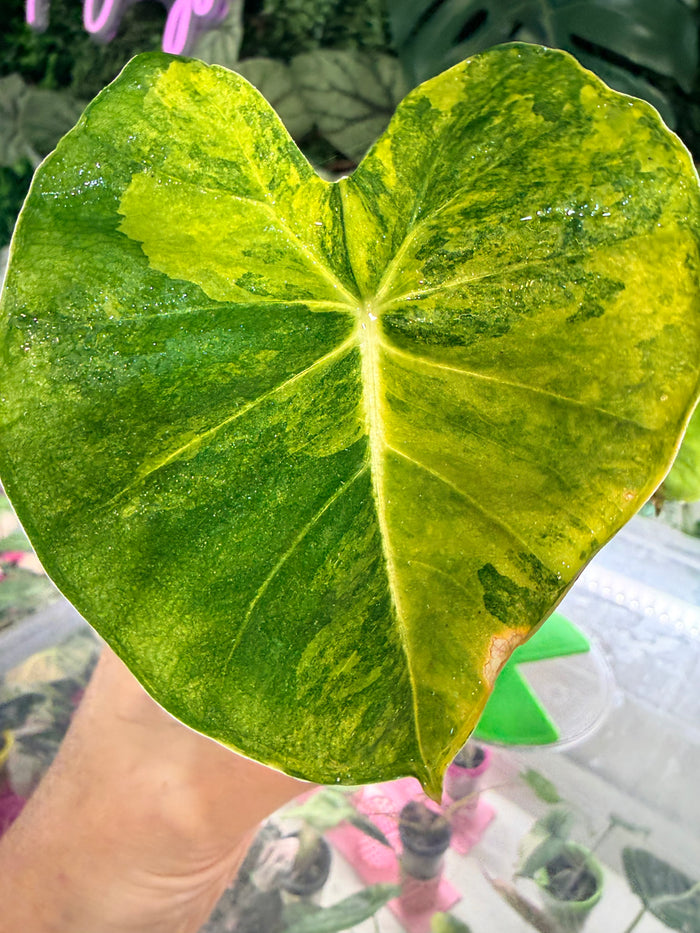
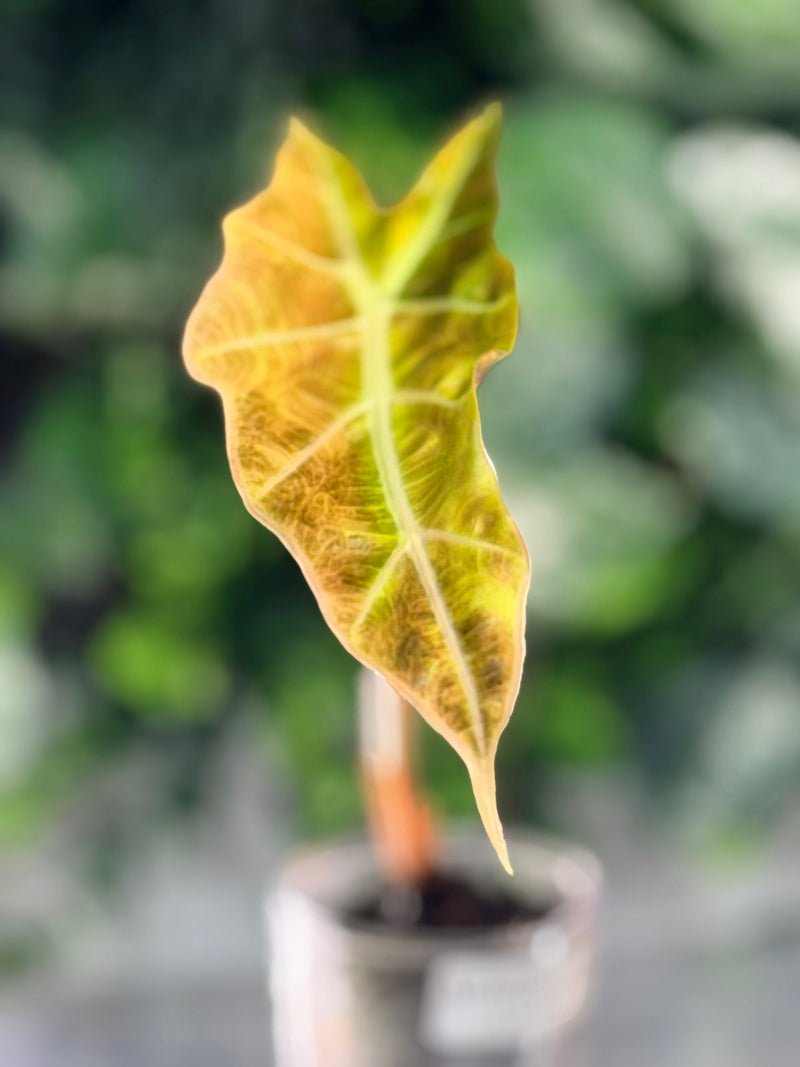
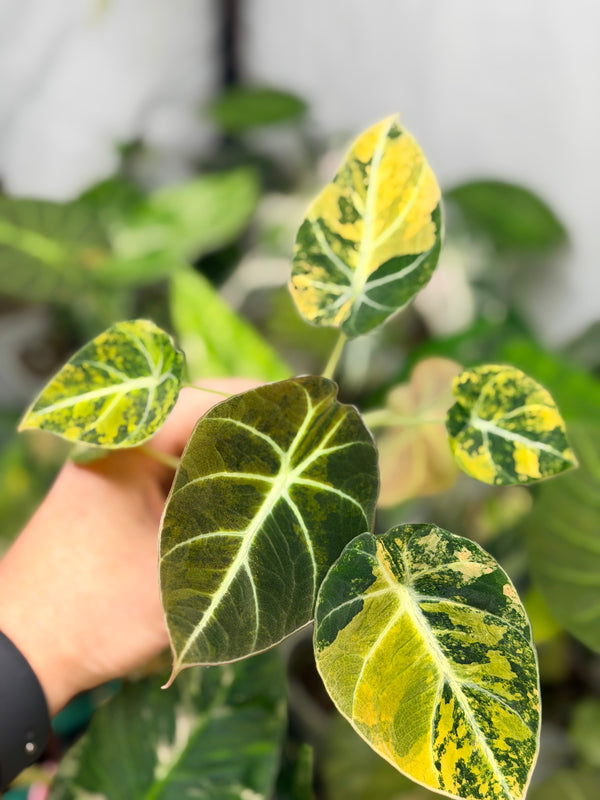
The aurea gold variegated form of 'Black Velvet' takes that extraordinary foundation and introduces what may be the most visually compelling colour contrast available in a compact jewel Alocasia. Golden yellow to deep amber sectors and splashes appear across the very dark base leaf, creating a tension between warmth and depth that no other combination replicates. The velvet texture, the silver veins, and the gold variegation create three simultaneous layers of visual interest on a leaf no larger than your hand.
This guide covers the full botanical background of Alocasia reginula, the nature of aurea variegation at a cellular level, and everything you need to successfully grow this exceptional cultivar in a UK collection. If you are building a jewel Alocasia collection and have not yet included this form, consider this guide your briefing.
The Species: Alocasia reginula
Formal Description and Type History
Alocasia reginula was formally described by A. Hay in 1998, based on dried leaf material sent from Florida by Dewey Fisk. The Latin type diagnosis was published in Gardens' Bulletin Singapore (Volume 50, 1998) and differentiates the species from the closely related Alocasia melo, the difference being that reginula has a leaf blade that is "atrovirida haud rugosa" (dark green, not rugose), with whitish impressed veins, and shorter spathe limb and appendix. This botanical differentiation from melo is precise and clinically stated, reflecting Hay's characteristic rigour in the Aroidpedia-documented original description.
The origin of the species in the wild is complex. Aroidpedia notes that Alocasia reginula is known only in cultivation, despite being clearly distinct from any known species and exhibiting few if any characteristics of hybrid origin. Scott Hyndman, who named the 'Black Velvet' cultivar, obtained material from Lyon Arboretum in Hawaii, which had reportedly been sourced from a Japanese collector in Borneo. Subsequent investigation confirmed the species in its natural state on dry, deeply shaded limestone cliffs in the Tabin Wildlife Reserve in Sabah, eastern Malaysian Borneo. This single known wild population is described by Wikipedia as growing on limestone cliffs, a habitat with exceptional drainage and moderate ambient humidity, directly informing the cultivation requirements.
Kew's Plants of the World Online confirms the species as Alocasia reginula A.Hay, with the cultivar 'Black Velvet' well established in cultivation through US trademark registration and successful micropropagation by Agristarts, one of the major tissue culture operations in the ornamental aroid trade.
Species Description
The formal species description documents a compact herb reaching approximately 25 cm tall, with petioles of around 18 cm that sheath in the lower third. The blade is elliptic to ovate, approximately 15 cm long by 8–11 cm wide, thickly coriaceous (leathery), and almost completely peltate save for a shallow notch between the posterior lobe tips. The adaxial surface is described as "very dark matt green", a precise botanical observation that establishes an important point: the 'black' in 'Black Velvet' is a cultivar marketing name, not a literal botanical colour description. The leaves are not black. They are exceptionally dark matte green, and this is documented in the original 1998 species description.
The abaxial (underside) surface is paler and flushed purple, the purple tone is another species characteristic that becomes visible in variegated forms where the contrast between adaxial and abaxial surfaces is part of the plant's visual composition. The primary lateral veins, 2–3 on each side of the anterior costa, diverge at angles ranging from approximately 45° to 90° depending on position, and appear whitish and somewhat impressed on the adaxial surface, creating the characteristic etched venation that distinguishes this species.
The inflorescence is paired, with a short peduncle hidden within the cataphylls, and a spathe of approximately 5 cm. The spathe is white with scattered purple flecks on the lower part.
Climate and Ecology
The Sabah habitat provides specific climatic data documented by Aroidpedia: daytime temperatures varying seasonally from approximately 9°C to 31°C, with minimum temperatures never dropping below around 7°C. There is a pronounced rainy and humid season from October through May and a drier period between June and October. Annual rainfall averages approximately 1,200 mm. Humidity is described as moderate throughout the year at around 60 to 70 percent.
The limestone cliff habitat is ecologically critical. Alocasia reginula grows anchored in rock crevices where drainage is immediate, substrate moisture does not persist, and the root system is accordingly adapted to short periods of moisture availability rather than consistent wetness. This explains the cultivar's well-documented sensitivity to overwatering in pot culture. The plant evolved in conditions where excess water drains instantly through rock fissures, not in a substrate that retains moisture for days.
Cultivars and Hybrids
Aroidpedia lists three recognised cultivars: 'Black Velvet', 'Black Ninja', and 'Silver Velvet'. The species has also contributed to a remarkable hybrid lineage: Alocasia 'Maharani' (reginula 'Black Velvet' × Alocasia melo), Alocasia 'Regal Shields' (reginula 'Black Velvet' × Alocasia odora), Alocasia 'Grim Reaper' (a mutant of 'Regal Shields'), Alocasia 'Black Dragon' (Alocasia baginda 'Silver Dragon' × reginula 'Black Velvet'), and several crosses within the 'Bisma' hybrid group. Each of these represents the contribution of reginula's compact dark foliage genetics to the broader ornamental hybrid world, a legacy second in jewel aroids only to Alocasia melo.
Aurea Variegation: The Science of Gold on Black
What Produces the Golden Colour
Aurea variegation in Alocasia reginula 'Black Velvet Gold' results from chimeric mutation in the apical meristem, the same fundamental mechanism that produces albo and pink variegation, but with a different pigment outcome in the de-greened areas. The distinction between aurea and albo variegation is one of degree rather than kind. In both, the chimeric cell population contains reduced or absent chlorophyll. The critical difference is that in aurea variegation, accessory pigments, specifically carotenoids, the yellow and orange pigment family, are retained in the de-greened areas and become visible once chlorophyll is no longer present to dominate the colour expression.
Carotenoids are present in all green leaf cells as part of the light-harvesting system. In normally functioning green tissue, their yellow and orange tones are completely masked by chlorophyll, which reflects in the green wavelengths. When chimeric mutation reduces or eliminates chlorophyll, the carotenoids that remain continue to absorb light in the blue-violet wavelengths and reflect in the yellow-orange range, producing the characteristic gold, amber, and warm yellow tones of aurea variegation. This is why aurea colouration, unlike albo white, has warmth and depth rather than appearing bleached.
The practical consequence of carotenoid retention is that aurea variegated sectors retain limited photosynthetic capacity through these accessory pigments, significantly less than fully green tissue, but more than the completely non-photosynthetic white sectors of albo variegation. Aurea variegated plants are, in general terms, slightly more robust than albo variegated plants of equivalent variegation percentage.
Against the very dark matte green of 'Black Velvet', this golden tone creates one of the highest-contrast colour combinations available in the compact Alocasia world. The warm gold reads against the cold, deep green with an intensity that photographs cannot fully capture, the depth of the suede-like matte surface amplifying the luminosity of the variegated sectors by contrast.
Maturity and Expression
An important characteristic of aurea variegation in 'Black Velvet Gold' specifically is documented across multiple specialist growers: the golden colour often becomes more apparent as leaves harden and mature. Newly unfurled leaves may show the variegation in a more muted, pale form, with the gold intensifying over the days and weeks following emergence as the leaf hardens off. This is normal and expected, patience during the initial unfurling period is rewarded by the full expression of the colour as the leaf reaches maturity.
Our aurea variegation in Alocasia guide covers this maturation behaviour in detail, alongside the broader science of carotenoid-based variegation across the genus.
Variegation Pattern and Stability
Aurea variegation in 'Black Velvet Gold' can express as splashes, irregular patches, streaks, or, in some specimens, larger sectoral panels. The patterning varies between individual plants and between successive leaves on the same plant. Because the chimeric cell population distribution in the meristem is stochastic rather than predetermined, no two leaves will be identical.
The species' compact growth habit and slow leaf production rate mean that each new leaf is a relatively significant event, but it also means that any shift in variegation expression (toward more green or toward more gold) becomes apparent over a longer timeframe than in faster-growing species. Stable conditions support stable variegation expression. Stress events, particularly root disturbance, significant temperature fluctuation, or prolonged water stress, can cause the plant to shift toward more heavily greened leaf production as it prioritises photosynthetic efficiency. Maintaining consistently good growing conditions is therefore the most effective way to maximise variegation quality.
For the broader context of how aurea expression compares with albo and pink forms across the genus, our complete variegation types guide covers all three mechanisms.
Growing Alocasia Black Velvet Gold in the UK
Light
The matte, dark leaf surface of 'Black Velvet' absorbs light rather than reflecting it, which has two practical implications. First, the plant is more efficient at capturing available light than gloss-leaved species of similar chlorophyll content. Second, the same dark surface is more susceptible to heat accumulation under direct sunlight, meaning the leaf can overheat and scorch under prolonged direct exposure that a lighter-coloured or glossier specimen would tolerate.
Target bright, consistent indirect light, from a south or east-facing window with diffused light, or supplemented with LED grow lights. The LED option is particularly valuable where natural light intensity and duration are insufficient to support active growth in jewel forms. A basic grow light running 12 to 14 hours daily prevents the potential reversion to greener leaf production that can occur in insufficient light.
Substrate and Watering
The limestone cliff origin of Alocasia reginula is non-negotiable context for substrate selection. This is a species that evolved anchored in rock crevices with instant drainage, it has no adaptation for water retention at root level and will rot in a dense, moisture-retaining substrate. Fluval Stratum is our primary recommendation: it provides an airy, well-draining matrix that releases excess water freely while retaining just enough moisture to sustain the root system between waterings.
Allow the top 2–3 cm of substrate to dry between waterings and resist the urge to compensate for perceived slow growth by increasing watering frequency. The root system of a healthy 'Black Velvet' is surprisingly fine relative to the plant's above-ground mass, and waterlogging causes rapid and often irreversible damage. When growth slows, reduce watering frequency significantly, the reduced transpiration rate means the substrate retains moisture much longer.
If root rot is suspected, remove the plant immediately, inspect the roots, cut away any black or mushy material with clean sterilised scissors, and repot into fresh, dry Fluval Stratum. Our root rot recovery guide covers the full process for jewel forms.
Temperature
The temperature range documented from the Sabah habitat, approximately 9°C to 31°C through the seasons, with minimums above 7°C, gives a useful reference. In UK home growing conditions, the practical target is maintaining the plant between 16°C and 27°C throughout the year. Cold draughts, cold windowsills, and placement near external doors present the main risks. Substrate temperature at root level is particularly important, cold glass or cold stone surfaces conduct heat away from the substrate and can drop root zone temperatures well below comfortable levels even when air temperature appears adequate.
Humidity
Moderate to high humidity, 60 to 75 percent, replicates the limestone forest environment of Sabah. UK homes with central heating frequently drop below 40 percent, which stresses jewel Alocasia and creates optimal conditions for spider mite establishment. A desktop humidifier in the growing area, placement in a naturally humid room with adequate light, or growing in a humidity-controlled cabinet are all effective solutions. Grouping the 'Black Velvet Gold' with other jewel Alocasia creates a modest micro-humidity benefit through combined transpiration.
Feeding
A balanced liquid feed at half-strength applied every two to three weeks supports healthy growth without overwhelming the fine root system with excess nutrients. This is not a fast-growing plant, and heavy feeding will not accelerate it meaningfully. Reduce feeding when growth slows. Our plant feed collection carries appropriate formulations for compact jewel forms.
Pests
Spider mites are the primary pest concern for 'Black Velvet Gold', as they are for all reginula cultivars. The matte dark surface makes early stippling damage visible relatively clearly once established, but by that point the infestation is often already significant. Regular inspection of leaf undersides, particularly where low humidity and heating create ideal mite conditions, is the most effective prevention strategy alongside consistent humidity management.
Propagation
Corm Propagation
Alocasia reginula produces offset corms from the central rhizome that can be harvested and propagated. In aurea variegated specimens, corms carry the chimeric genetics, though expression in offspring is variable, some corm-grown plants will express strong aurea variegation, others will be predominantly green. This is inherent to chimeric variegation biology and is not a propagation defect. Our Corm Keeper propagation system provides the optimal environment for corm germination, maintaining the warmth, humidity, and substrate conditions that jewel Alocasia corms require.
The slow growth rate of reginula forms means that corm-grown plants take longer to reach display size than faster-growing species. Patience is required, but the reward is a plant grown from scratch that carries its own history and potentially surprising variegation expression.
Collector Context: The Reginula Collection
Alocasia reginula 'Black Velvet Gold' sits at the centre of the species' collector appeal. With its compact form, dramatic foliage character, and the warmth that the aurea variegation adds, it is one of the more accessible jewel rarities while remaining genuinely difficult to source in well-variegated specimens.
Within the reginula group, it pairs naturally with the Alocasia Ninja Tri Colour Variegated and the Alocasia Ninja Pink Variegated, the same compact dark velvet base with different variegation expressions creating a coherent but visually diverse jewel collection. The Alocasia Maharani Aurea, the reginula × melo hybrid in its aurea form, is the natural hybrid companion, showing how the species' genetics translate across crossing while the aurea expression links the two plants visually.
For collectors interested in the full spectrum of aurea variegation across the genus, our aurea variegated Alocasia collection provides the wider context alongside the jewel-specific forms.
If you are starting plants from corms, our Alocasia corm propagation guide walks through the self-wicking method we use in the nursery, from choosing a firm corm through to moving the sprouted plant on.
Questions about Alocasia Black Velvet Gold, jewel Alocasia care in UK conditions, or building a reginula collection? Contact our team for expert guidance from specialists who grow and propagate Alocasia reginula cultivars at our UK-based private nursery. We're happy to advise on substrate, humidity, and light setups for your most sensitive jewel specimens.