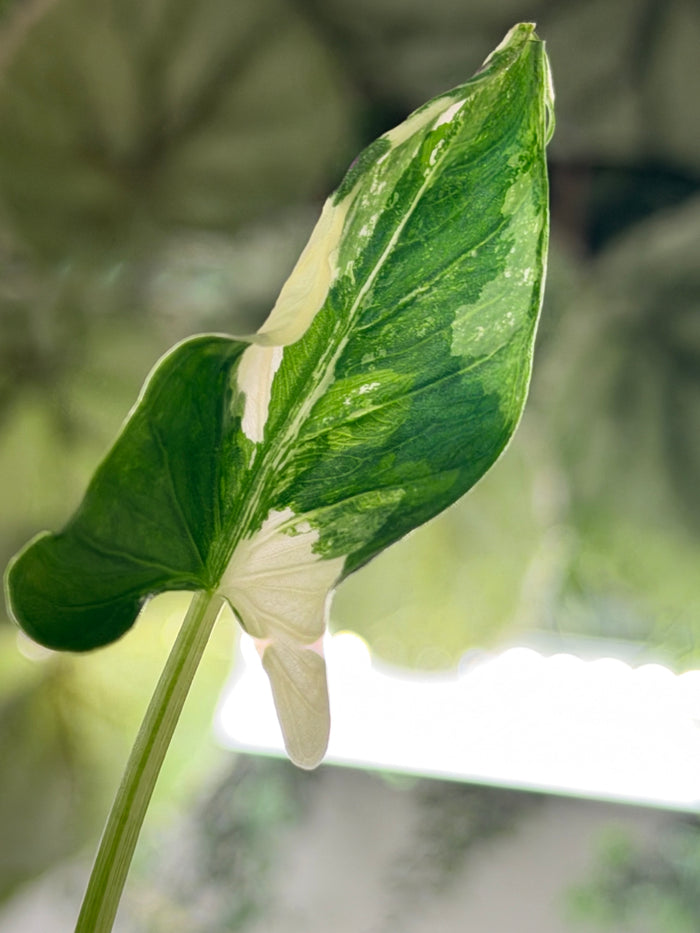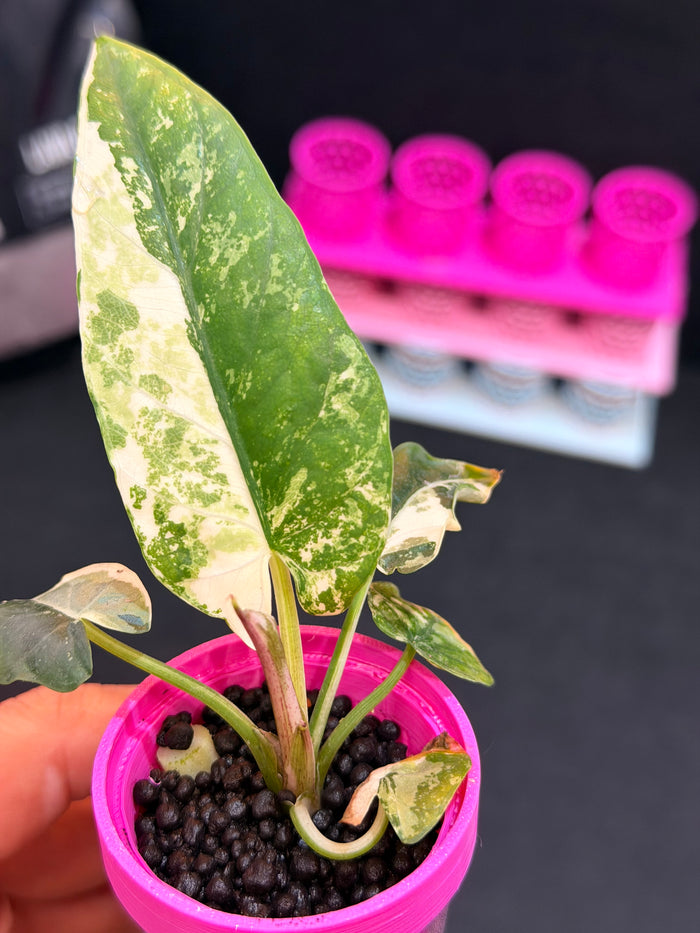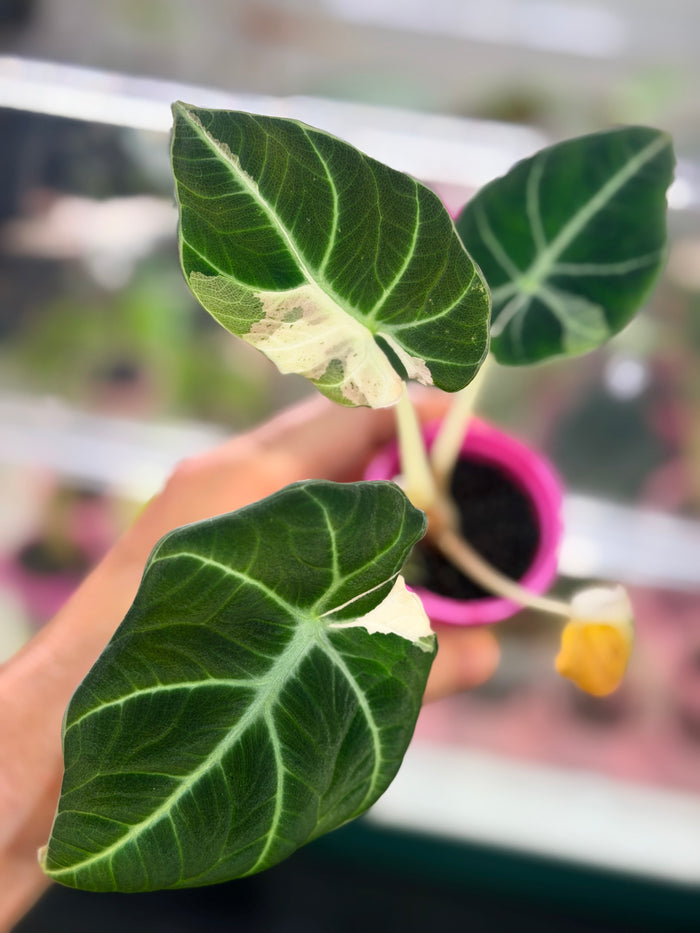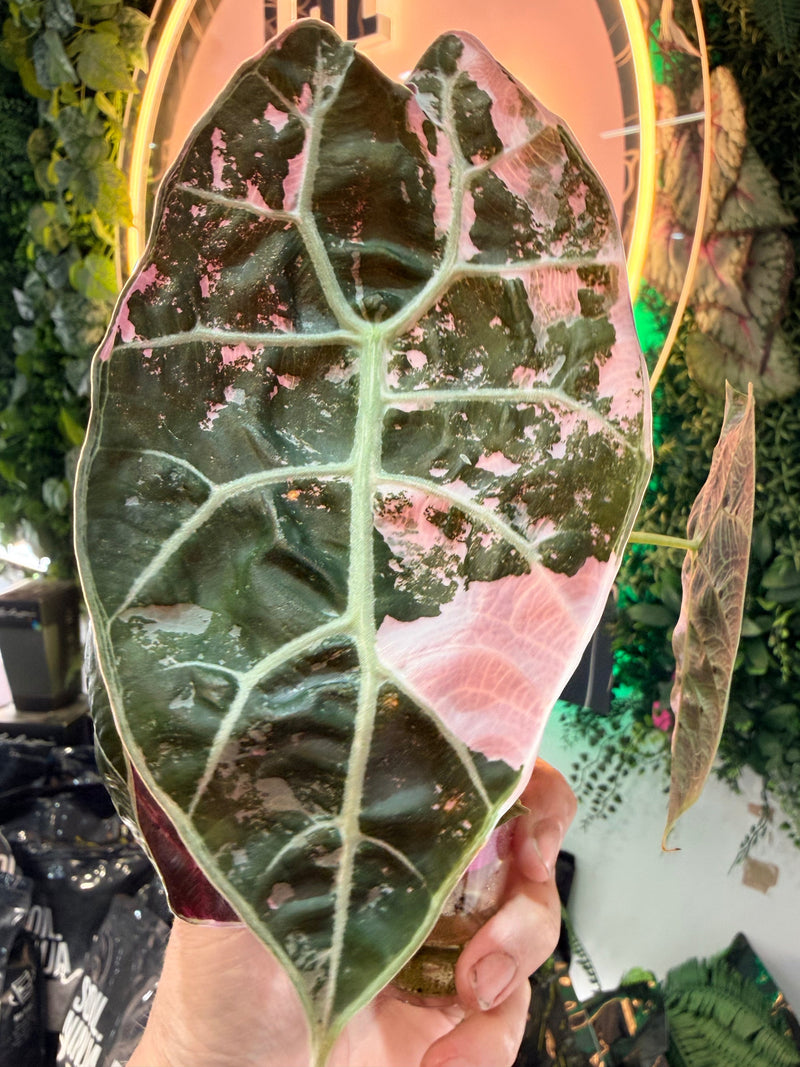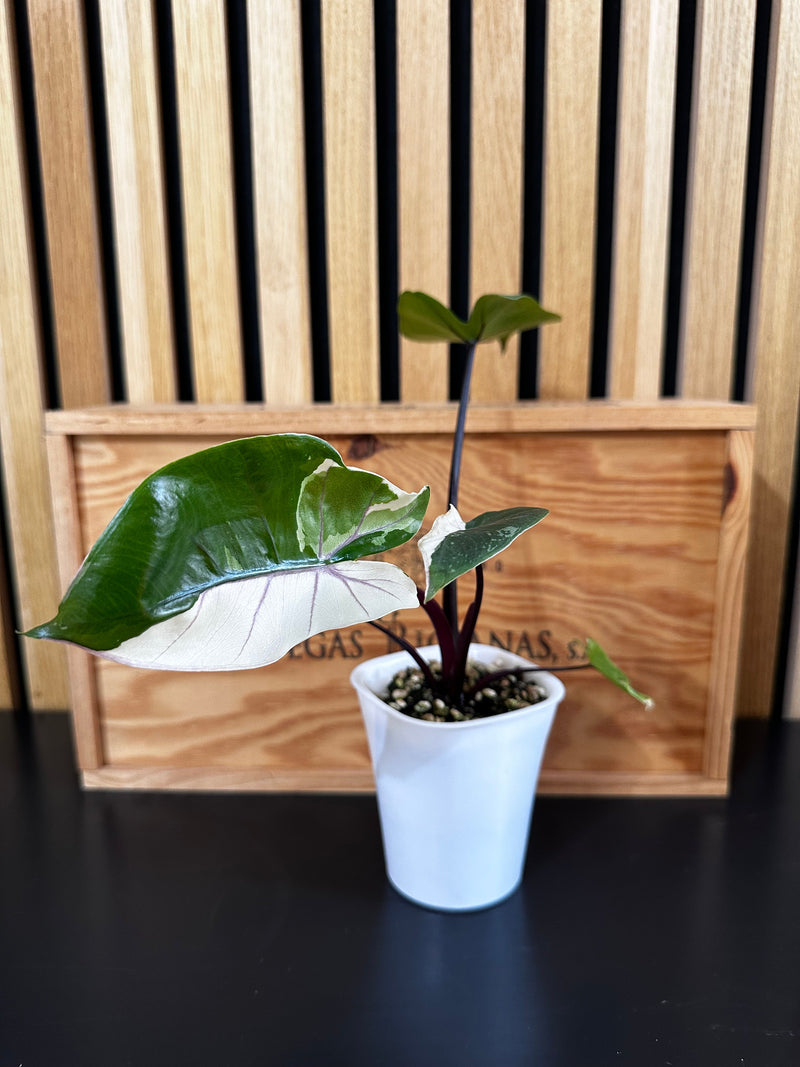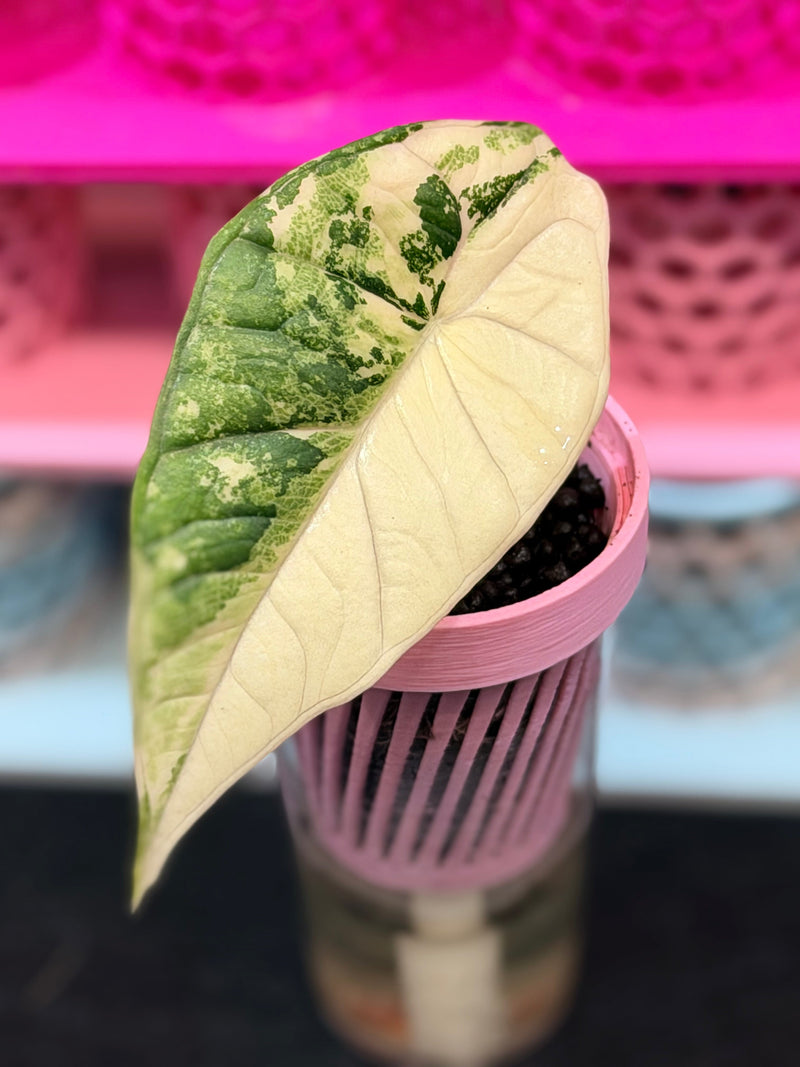

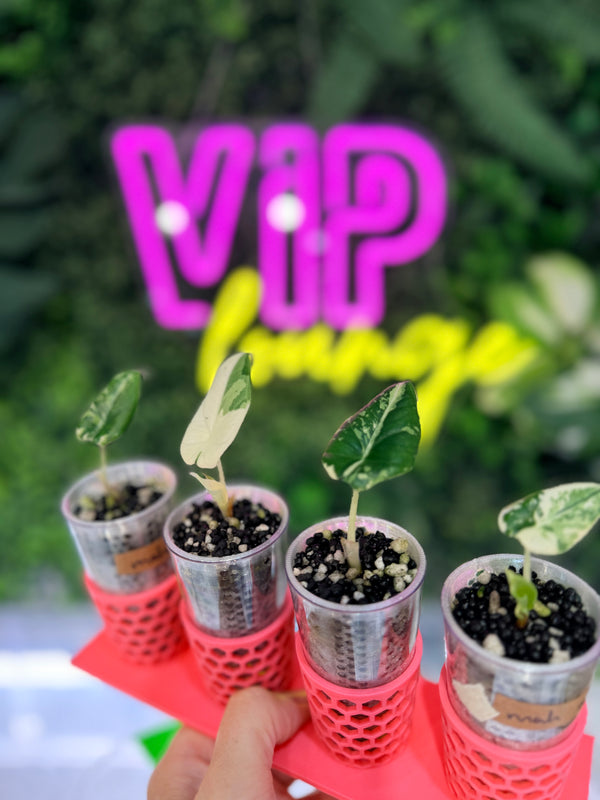
The Alocasia Maharani Albo applies chimeric white variegation to one of the most celebrated Alocasia hybrids in current collector cultivation, Alocasia 'Maharani', the compact jewel hybrid created by botanist Peter Boyce at Malesiana Tropicals in Malaysia around 2009 by crossing Alocasia reginula with Alocasia melo. The standard Maharani combines the velvety, near-dark-green compact character of the reginula parent with the structural rugosity and durability of the ultramafic-adapted melo parent, producing a deep grey-green, thick, somewhat corrugated jewel Alocasia of exceptional resilience and beauty. In the Albo form, white chimeric sectors appear on this already visually compelling base, white tissue emerging from the grey-green, corrugated surface in a combination that is uniquely textural and complex.
The Maharani Hybrid: Background
Alocasia 'Maharani' was deliberately created by Peter Boyce, one of the world's foremost Alocasia botanists and the co-describer of Alocasia azlanii and many other species, as a hybrid combining two Bornean jewel species with complementary characteristics. Alocasia reginula (the Black Velvet) contributes its compact jewel habit, velvety surface texture, dark deep-green colouration, and the characteristic silver-white venation of the Cuprea Group to which it belongs. Alocasia melo contributes its remarkable structural durability, the rugose-corrugated leaf surface characteristic of its ultramafic Sabah origin, and a robustness of growth that exceeds what the more delicate reginula alone would provide.
The resulting 'Maharani' hybrid inherits the best of both parents: compact jewel scale (typically 25-35cm in cultivation), thick, leathery, deeply rugose foliage in a deep grey-green with subtle reddish tones beneath on mature leaves, and a level of resilience significantly greater than Alocasia reginula alone. It is, relative to many jewel Alocasia, a forgiving and robust plant, a characteristic it inherits from the melo's adaptation to the challenging ultramafic substrate conditions of its Bornean origin.
Both parent species are covered in detail in our companion guides: Alocasia melo and the related Alocasia reginae guide provides context on the Cuprea Group lineage.
Albo Variegation on Maharani
Chimeric albo variegation on 'Maharani' produces white or cream sectors through the standard chlorophyll-absence mechanism. On the deep grey-green, rugose surface of Maharani's foliage, which already has a textured, three-dimensional quality, the white sectors interact with the corrugated surface in a visually interesting way. Ridge peaks and valley depths within the rugose blade catch and shadow the white sectors differently, giving the albo expression a topographic quality that flat-leaved albo forms cannot achieve. Even moderate white sector coverage on a Maharani Albo leaf creates a visually complex result, because every ridge and valley of the corrugated surface contributes shadow and highlight within the white areas.
The non-photosynthetic albo sectors create the standard metabolic demand, the green sectors carry all photosynthetic output. The Maharani's inherited vigour from the melo parent means it handles this demand somewhat more robustly than pure reginula, but consistent bright indirect light is still essential. LED supplementation from October to March is recommended for UK collectors.
Care Requirements
Temperature 20-27°C, humidity 60-80%, Fluval Stratum substrate with excellent drainage (the melo's ultramafic background makes good drainage especially important, never allow standing water). Water thoroughly when top 2-3cm is dry. Feed conservatively at quarter to half strength from our plant feed range every 2-3 weeks during the growing season. A heat mat supports root health through UK winters.
We release Maharani Albo through our drop model. Join the collector list for early access and view our Alocasia Maharani Albo listing. Our albo variegated collection includes related specimens.
Questions about Alocasia Maharani Albo or the Bornean jewel hybrid family? Contact our team for specialist guidance.