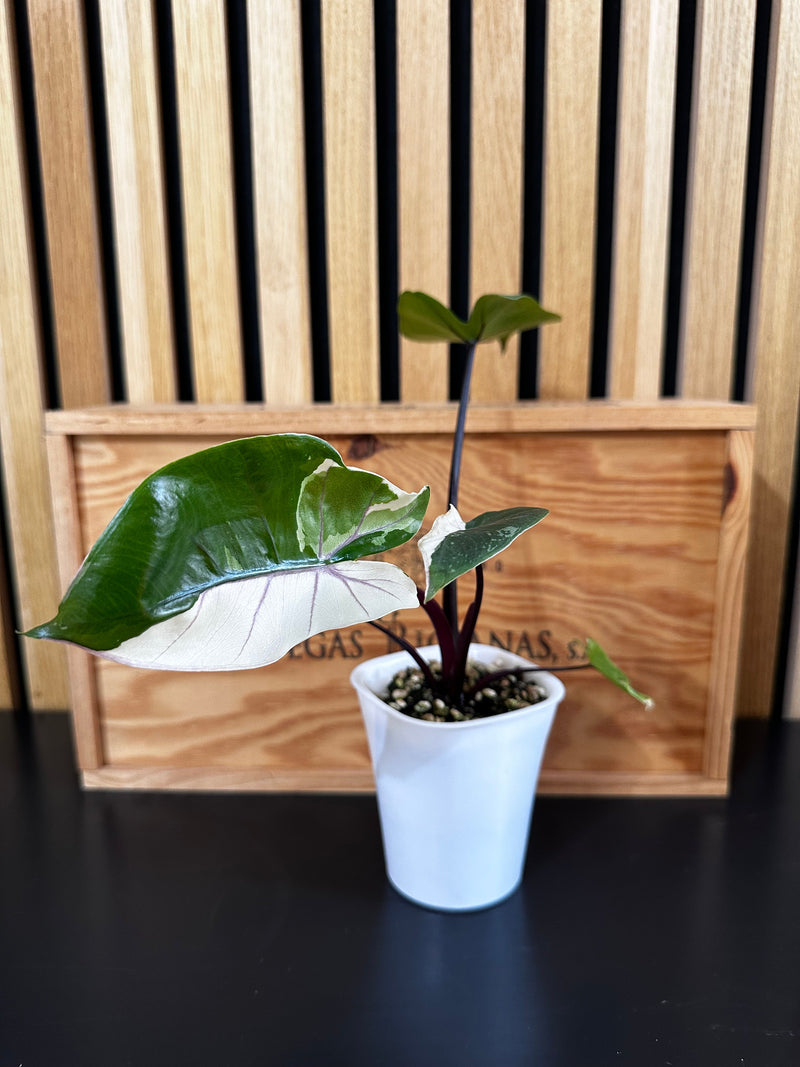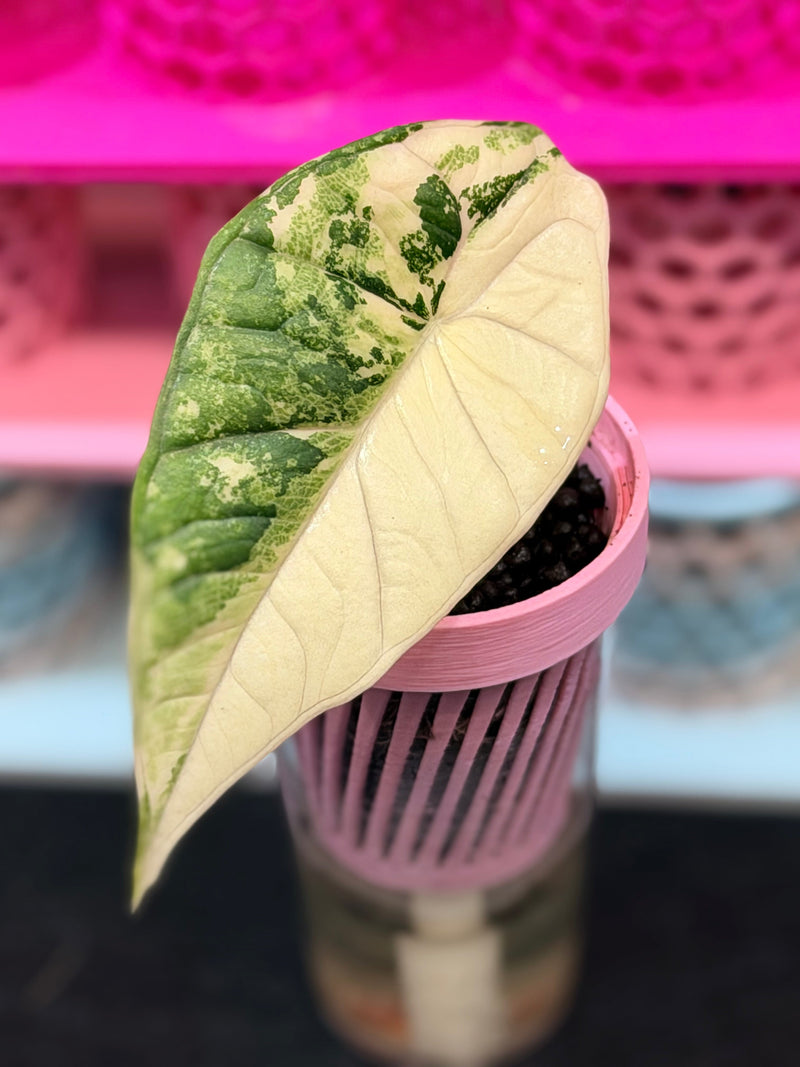

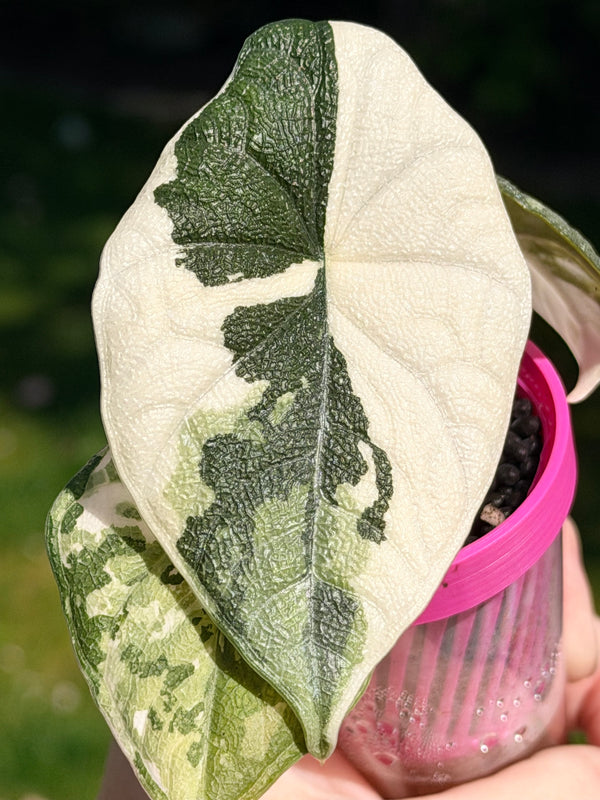
Alocasia melo is, in its standard form, one of the most visually distinctive species in the Alocasia genus. Its almost-circular, deeply bullate leaves, thick, leathery, and corrugated in a way that genuinely resembles the rind of a cantaloupe melon, represent a specific adaptation to its ultramafic substrate habitat in Sabah, Malaysian Borneo that has no real parallel elsewhere in the genus. When chimeric albo variegation appears on this already extraordinary species, the result is a collector specimen of rare complexity: the three-dimensional corrugated surface of the blade now carries sectors of white tissue that interact with every ridge and valley of that texture, creating an effect that shifts continuously with viewing angle and light.
The Alocasia Melo Albo Variegated is one of the most sought-after jewel Alocasia in current collector cultivation, and understanding why requires understanding the species itself before engaging with the variegation. This guide covers both in full: the botanical origins and ecological context of Alocasia melo, the nature of the albo variegation and how it manifests on this particular species, and the specific care requirements for maintaining a healthy, vigorously variegated specimen in a UK growing environment.
Alocasia melo: Origins and Botanical Background
Alocasia melo is endemic to Sabah, Malaysian Borneo, it does not naturally occur anywhere else in the world. This is not merely a geographic curiosity; it reflects a highly specific ecological niche to which the species has evolved over millennia. Alocasia melo grows on ultramafic substrate, rock formations rich in iron, magnesium, and heavy metals, but notably poor in the phosphorus, nitrogen, and calcium that support most plant growth. Ultramafic soils are challenging environments by any botanical standard, and the plants that have adapted to grow in them have typically developed specific morphological and physiological strategies for surviving in conditions that would be unsuitable for most species.
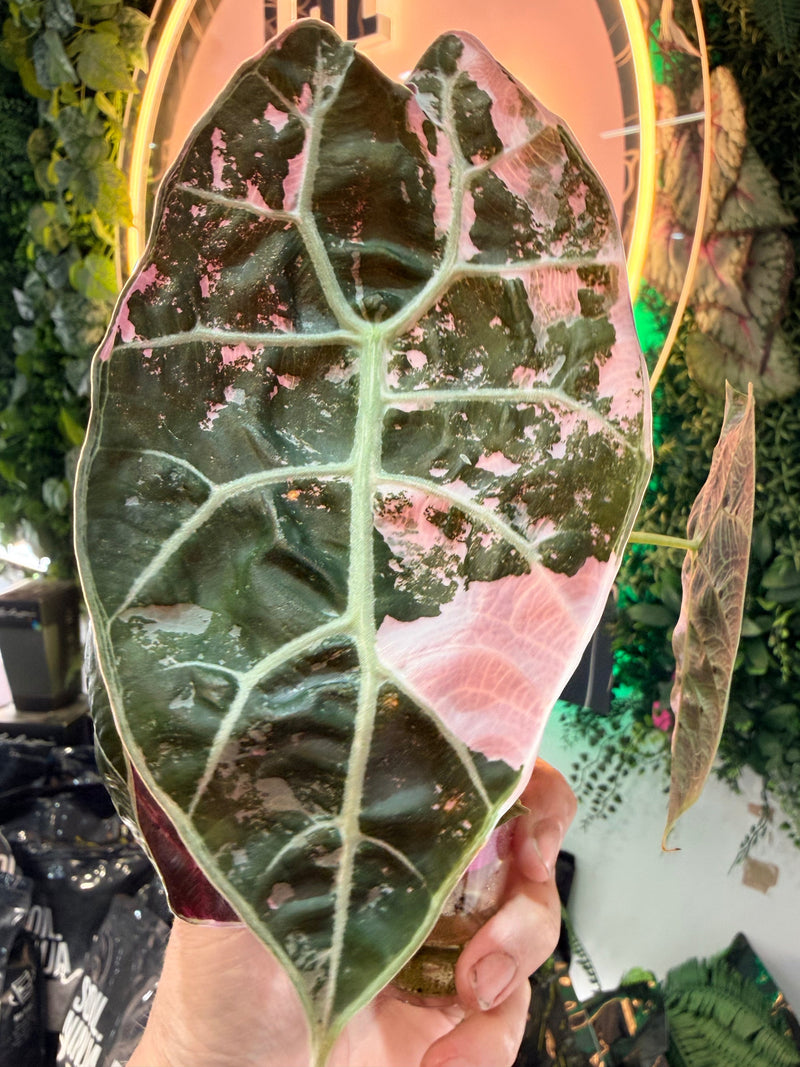
In Alocasia melo, those adaptations are visible in the plant's most distinctive feature: its leaves. The thick, deeply bullate, almost cartilaginous blade is not an aesthetic accident, it represents a structural investment in durable, long-lived photosynthetic tissue. In a nutrient-poor ultramafic environment, producing a leaf is metabolically costly, and producing one that can survive for an extended period in the conditions of its rocky, partly exposed Bornean habitat is a meaningful adaptive advantage. The result, from a collector's perspective, is a leaf of extraordinary resilience and visual interest: heavily corrugated, coriaceous to the point of feeling almost synthetic, and carrying a characteristic blue-grey to jade-green colouration that matures to a darker, more lustrous finish as each leaf ages.
The species was formally described by Alistair Hay, Peter Boyce, and K.M. Wong, and named in reference to the leaf's resemblance to cantaloupe melon rind, the Latin melo meaning melon. The etymology captures the leaf character precisely: deeply corrugated, nearly circular, and thick in a way that suggests solidity rather than softness. A specimen at the Royal Botanic Gardens, Kew, was painted by the botanical illustrator Mary Grierson from a plant in cultivation at Kew in the early 1960s, confirming the species' presence in cultivation for over six decades, well before its formal scientific description.
In the houseplant trade, Alocasia melo has also been sold under the names 'Rugosa' and 'Rhino Skin', trade names that reference the textured surface character, and was subject to an incorrect commercial renaming by Proven Winners as 'Mythic Dragonite', which has no botanical validity. The accepted name is Alocasia melo Hay, P.C. Boyce & K.M. Wong, and this is how it should be identified in any serious collector context.
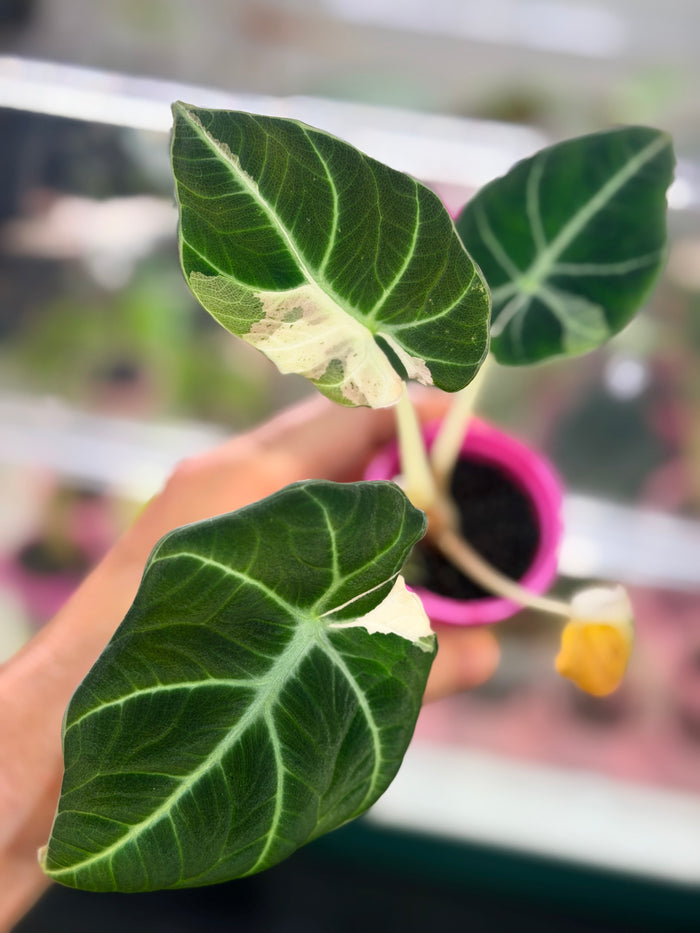
Alocasia melo is also a significant species in the genus because it is one of the parents of Alocasia 'Maharani', the celebrated hybrid created by botanist Peter Boyce at Malesiana Tropicals in Malaysia around 2009 by crossing Alocasia reginula with Alocasia melo. This hybrid combines the compact, velvety character of reginula with melo's structural durability, and it has become one of the most collected Alocasia hybrids globally. Understanding melo is therefore important context for collectors who grow Maharani and its variegated forms.
The Albo Variegation on Alocasia melo
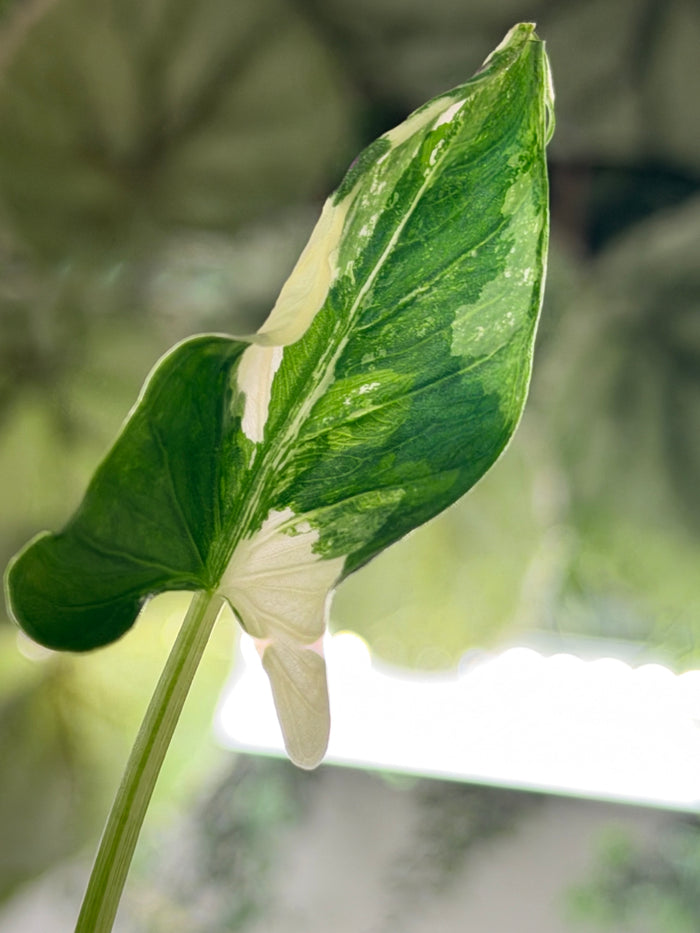
Chimeric albo variegation in Alocasia melo produces white or cream sectors on the blade through the same mechanism that drives albo variegation across the Alocasia genus: a somatic mutation in the plastid genome that causes certain cell lineages to lose chlorophyll synthesis capability. On Alocasia melo, this mutation creates something visually exceptional because of the leaf surface it appears on.
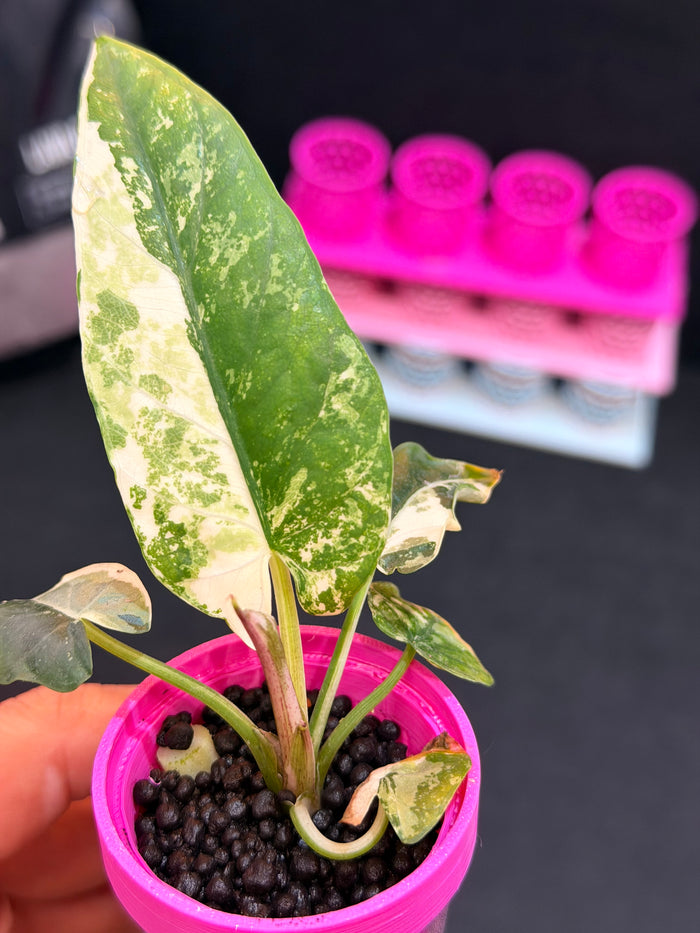
Most albo Alocasia display white sectors on relatively smooth or lightly textured leaf surfaces. Alocasia melo's deeply corrugated, three-dimensional surface means that the white sectors appear within a complex topographic landscape. The ridges and valleys of the bullate texture catch and shadow light differently in white sectors versus green sectors, and the blue-grey tone of the base foliage creates a more nuanced contrast with the white than the simple green-white contrast of most albo forms. The result is a blade that appears to have geological depth, where the white sectors seem to occupy a different plane from the green tissue, the corrugation creating a physical effect that reinforces the visual one.
As with all chimeric albo variegation, the distribution and extent of white sectors varies between leaves. Some leaves will carry broad, sweeping white sectors covering significant portions of the blade. Others will show smaller patches, streaks, or stippling. In Alocasia melo specifically, the slow growth rate of the species, a reflection of its ultramafic habitat adaptation, means that each new leaf emerges relatively infrequently, making the arrival of a new, well-variegated leaf a genuine event for the collector. The patience required to grow this species is fully rewarded when a new leaf unfurls and the extent of its variegation is revealed.
For a comprehensive explanation of how chimeric albo variegation works across the Alocasia genus, our complete variegation guide covers the mechanisms in detail.
Light: The Most Critical Variable
The albo form of Alocasia melo requires more attentive light management than the standard species because its white sectors cannot photosynthesise. Every unit of photosynthetic work falls to the green sectors of each leaf, and those green sectors must work efficiently to support the plant's growth and maintain the conditions that allow new leaves to develop. Insufficient light leads to stalled growth, particularly significant in a slow-growing species, and can encourage the plant to push less variegated, greener growth as a survival response.
Bright indirect light is the target. In practice for UK collectors, this means positioning within one to two metres of an east- or west-facing window, with the plant receiving consistent ambient light throughout the day without direct sun exposure. Alocasia melo's ultramafic habitat, on rocky slopes in Bornean forest, actually exposes it to somewhat more light than the forest-floor species, it grows in partly exposed positions where filtered but relatively strong light is available for extended periods. This means it tolerates, and benefits from, brighter light levels than many other jewel Alocasia, as long as direct sun exposure is avoided.
Supplementary LED grow lighting is strongly recommended for UK collectors from October through March. The slow growth rate of Alocasia melo can become effectively zero during UK winters without supplementary light, and maintaining 10,000-15,000 lux for 12-14 hours per day with a full-spectrum LED ensures that the plant continues developing even through the shortest days. For the albo form especially, consistent light throughout the year is important for variegation stability.
Never expose the albo form to direct sunlight. The white sectors have no chlorophyll to buffer incoming light energy and are substantially more vulnerable to photodamage than the green sectors, even the exceptionally thick cuticle of Alocasia melo does not protect the white tissue from scorching under direct sun. Position accordingly.
Temperature and Humidity
Alocasia melo's Bornean origins at 120-400m elevation in ultramafic forest establish its temperature preferences clearly: consistently warm, with minimal seasonal variation. Optimal temperatures in cultivation are 20-27°C, with a minimum of 15°C. The species is not frost-tolerant, and cold draughts from windows, doors, or air conditioning units represent a genuine risk, particularly because the plant's slow growth rate means that cold damage takes proportionally longer to recover from than in faster-growing Alocasia species.
Humidity in the natural Bornean habitat of Alocasia melo is consistently high, 60-70% or above throughout the year, with the wet season from October to May maintaining even higher ambient moisture. UK homes, particularly during the heating season, typically maintain 30-50% relative humidity, well below optimal. A dedicated ultrasonic humidifier maintaining 60-70% around your collection is the most effective solution, supplemented by plant grouping and a pebble tray beneath the pot. A heat mat beneath the pot during winter maintains root zone temperature and supports health through the UK cold season.
Substrate: Respecting the Ultramafic Origin
Alocasia melo's ultramafic substrate origin has practical implications for cultivation that are worth understanding. Ultramafic soils are characterised by extremely good drainage, water flows off the rocky, mineral substrate rapidly, combined with nutrient poverty. The species has evolved for a substrate that never waterloggs, never provides excess nutrients, but maintains some moisture through the humidity of the forest environment. In cultivation, this translates to a need for exceptionally well-draining substrate that does not compact or retain excess moisture.
Fluval Stratum provides the free-draining, mineral-based, well-aerated substrate that Alocasia melo requires. Its volcanic mineral composition and resistance to compaction over time closely approximates the drainage characteristics of the species' ultramafic native substrate. Never use dense, peat-heavy composts for this species, they retain moisture in ways that the ultramafic-adapted root system of Alocasia melo is not equipped to handle, and root rot is the predictable consequence.
For established specimens, our Lechuza self-watering planter system with Lechuza PON substrate provides excellent drainage and controlled moisture delivery well suited to Alocasia melo's preference for consistently moist but never waterlogged conditions.
Watering and Feeding the Melo Albo
Water thoroughly when the top 2-3cm of substrate has dried, ensuring complete drainage and never allowing standing water. Alocasia melo's ultramafic origins mean it is somewhat more tolerant of brief dry periods than many Alocasia species, but this should not be interpreted as a licence for irregular watering. The white sectors of the albo form are not photosynthetic: without chlorophyll they contribute nothing to the plant's energy budget, so it depends entirely on its green tissue and grows more slowly as a result. In summer, watering every 7-10 days is typically appropriate; in winter, 14-21 days or longer depending on environmental conditions.
The ultramafic nutrient-poor substrate context of Alocasia melo also suggests caution with feeding. This is a species that has evolved for low nutrient availability, and heavy feeding schedules can cause nutrient toxicity in a root system not adapted for processing high mineral concentrations. Feed at quarter to half strength balanced liquid fertiliser during the growing season, considerably less than you might apply to Alocasia from richer substrate environments. Our plant feed collection includes appropriate formulations, and a CalMag supplement at low dose supports healthy growth in soft water areas.
Melo Albo in a Collection Context
The Melo Albo occupies a unique position in an albo variegated Alocasia collection. Where other albo Alocasia express their white sectors on smooth or lightly textured surfaces, the Melo Albo presents its variegation within a three-dimensional corrugated landscape that has no equivalent in other cultivars. It is, for collectors who appreciate the intersection of botanical rarity with visual complexity, one of the most compelling specimens available.
It pairs naturally with the standard Alocasia melo and the Melo Aurea to demonstrate the full range of colour expression on this extraordinary species. Within the broader jewel Alocasia group, it complements the sinuata albo, Dragon Scale albo, and Maharani Albo, all species where an already remarkable base foliage character carries chimeric albo variegation to a different level of collector appeal.
We release Melo Albo specimens through our drop model when quality material is available. Join our collector list for early access, and view our current Alocasia Melo Albo Variegated listing for availability.
Questions about Alocasia melo Albo, ultramafic-adapted Alocasia care, or building a jewel Alocasia collection in the UK? Contact our team for expert guidance from specialists who work with rare Bornean endemics daily at our UK-based private nursery.