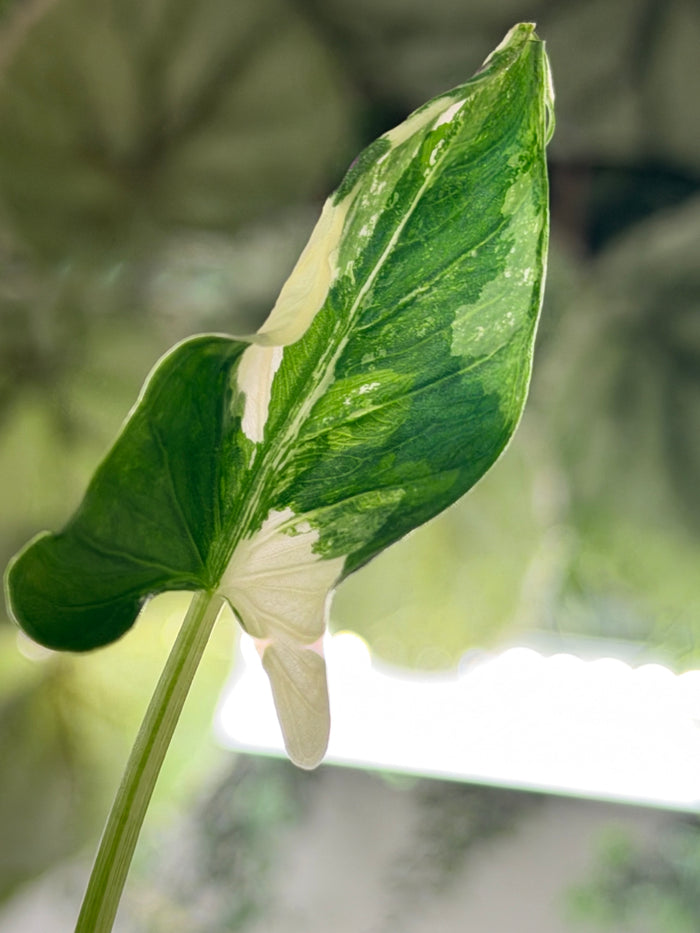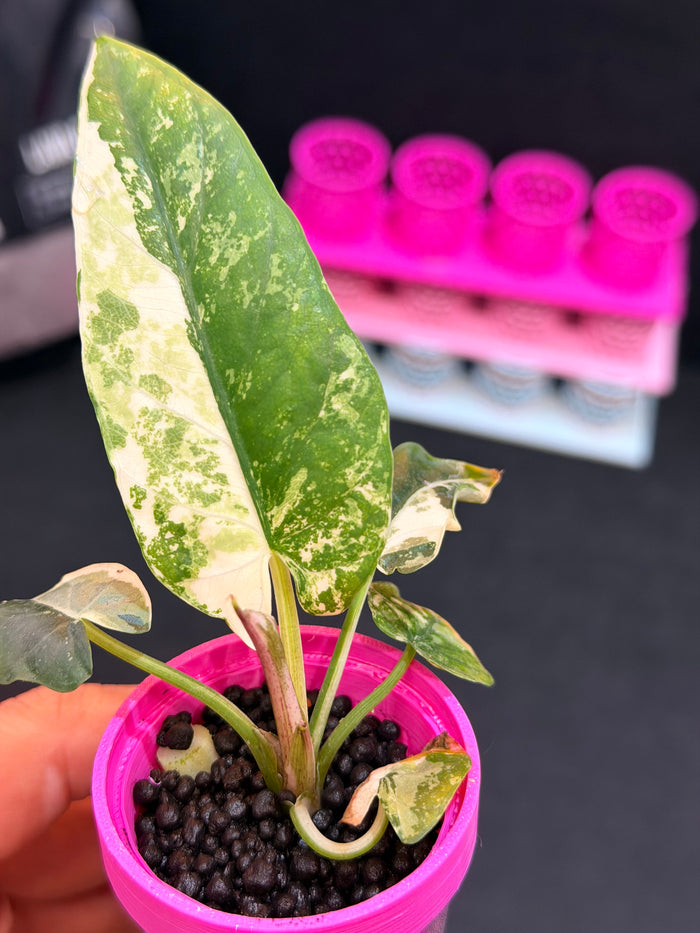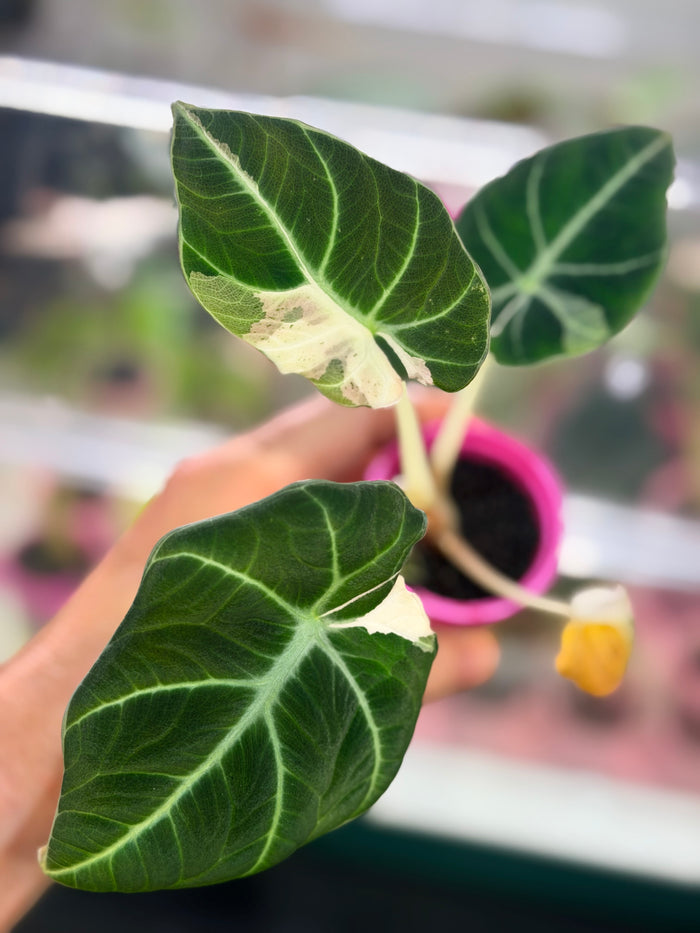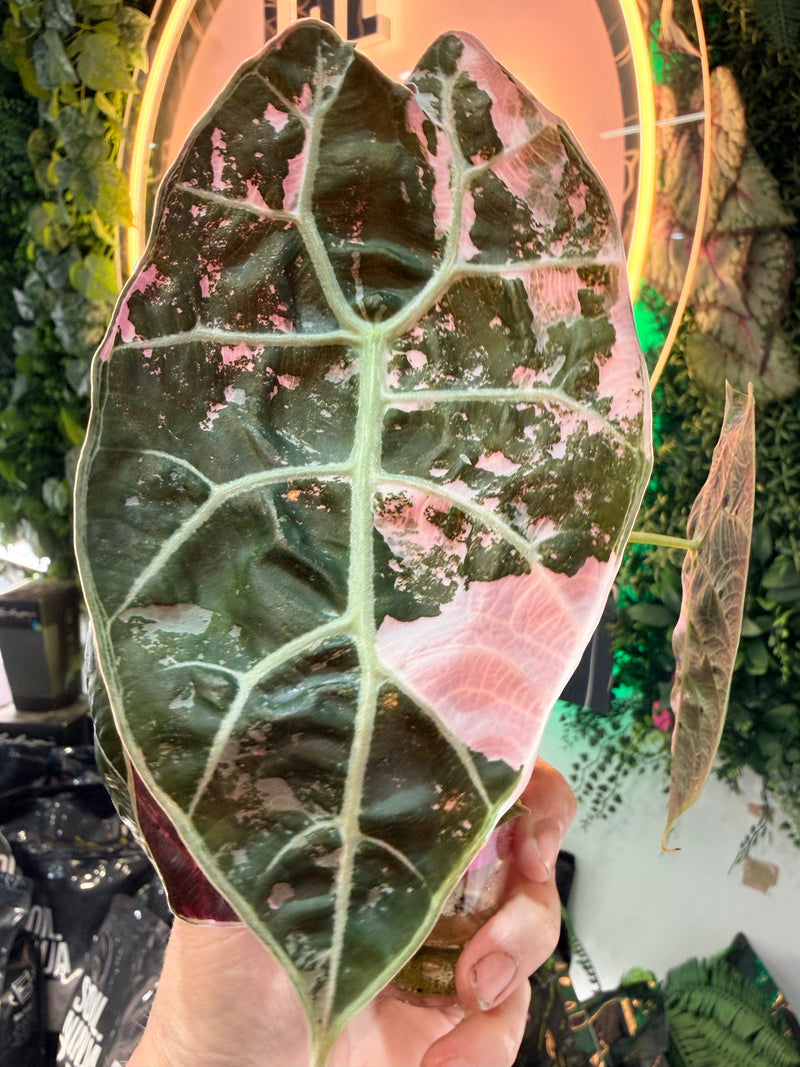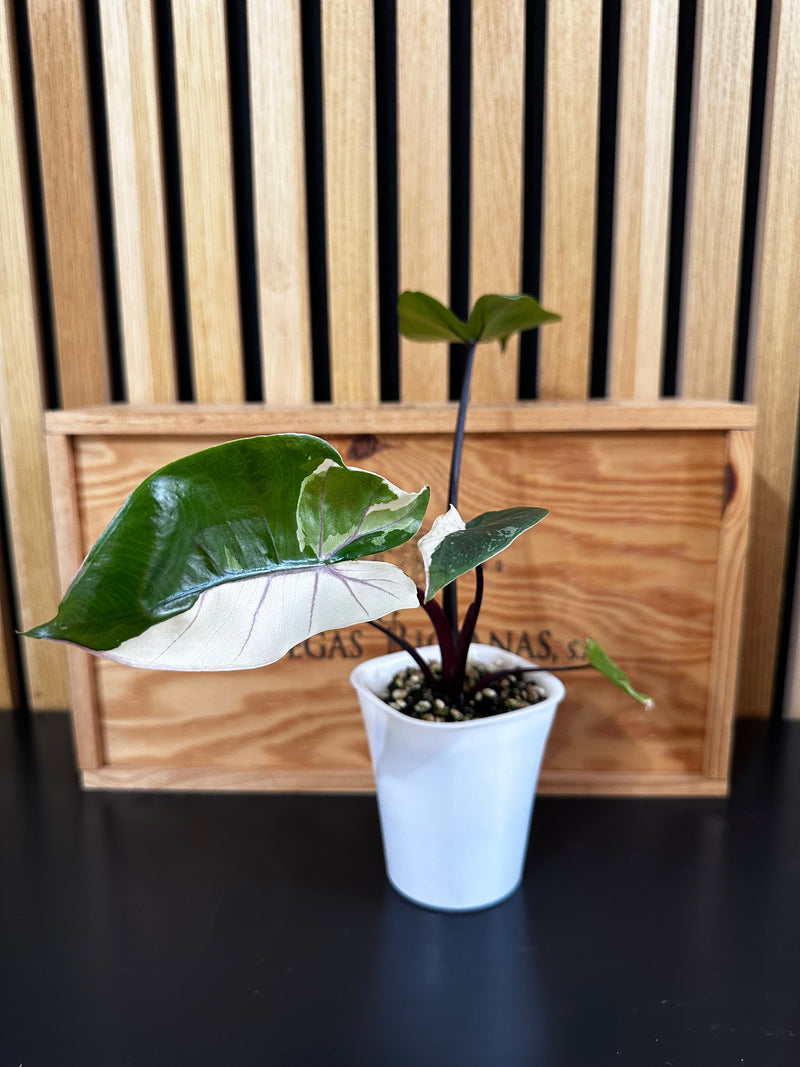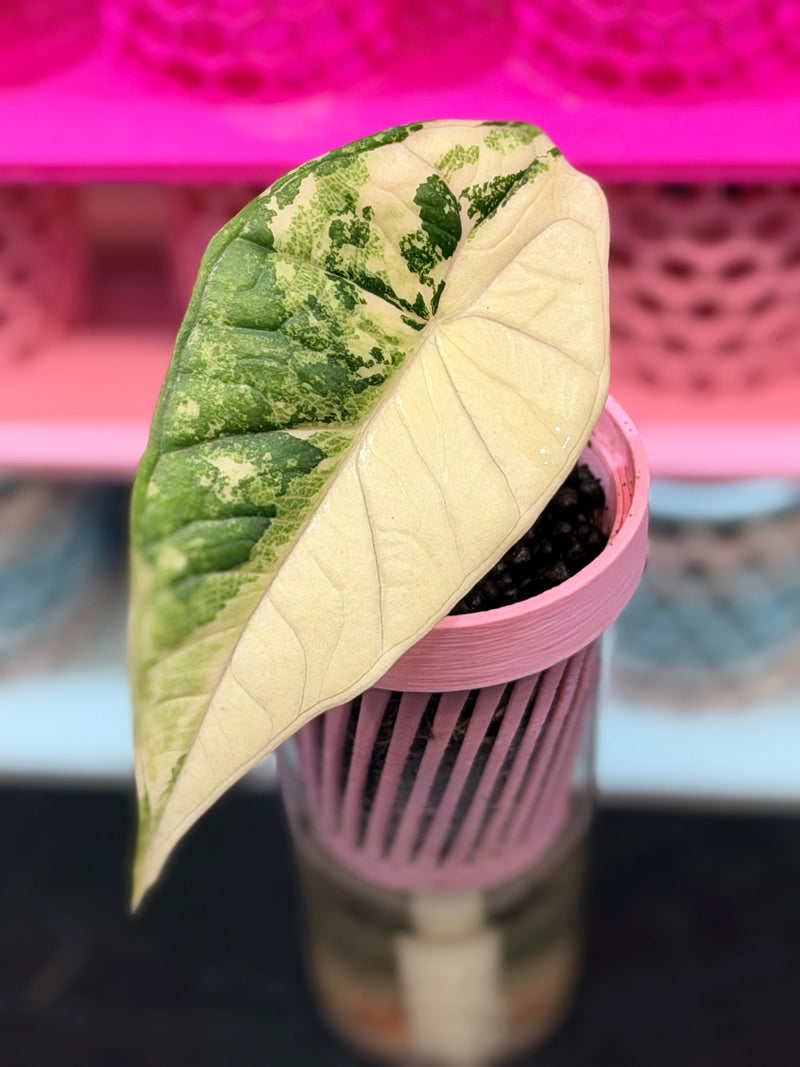

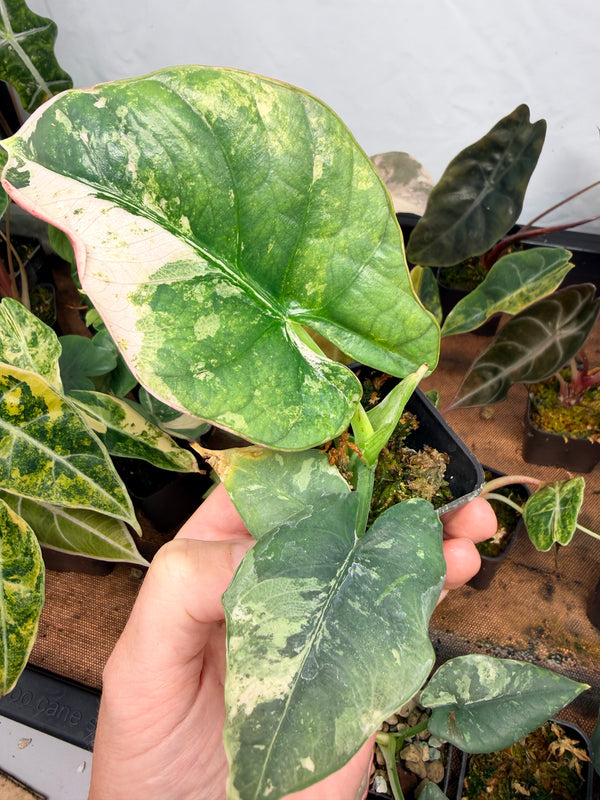
The Alocasia Reginae Silver Albo Variegated brings chimeric white sectors to Alocasia reginae, sold in the trade as Reginae Silver for the silvery cast of its velvety foliage, a Bornean jewel species with a provenance that stretches back to the International Exposition of St. Petersburg in 1884, where it was first presented to the Russian imperial court. On this species' characteristic thick, velvety leaves, where the silvery blue-green adaxial surface and reddish-purple underside already provide exceptional two-toned complexity, albo variegation introduces a third colour register: white sectors that read against the cool silver-blue base with a crisp, clear contrast that is visually quite different from albo on either dark-green or warm-toned base species.
Species Background: Alocasia reginae
A plant named for an empress sets a certain expectation, and the albo form does nothing to lower it. Alocasia reginae has one of the more remarkable introduction stories of any species in the genus: it was first presented to the Emperor and Empress of Russia at the International Exposition of St. Petersburg in 1884, by the 'Compagnie Continentale d'Horticulture'. The epithet reginae comes directly from that occasion, Latin for 'of the queen', in reference to the Empress. This is a plant whose botanical name commemorates a royal presentation over 140 years ago, and that connection to a specific historical moment of botanical spectacle gives it a provenance narrative unlike almost any other collector Alocasia.
In the wild the species is endemic to Borneo, known from Sarawak and Kalimantan, growing in the wet tropical biome of the Bornean lowland forests. It is closely allied to Alocasia scabriuscula but separated from it by its smaller overall size, its single-paired inflorescences and its longer peduncle. In cultivation our silver-toned form is sold as Reginae Silver. Aroidpedia describes the species leaf as thick and leathery, dark green, and paler or flushed with purple beneath, and records the cultivars 'Elaine' (a lighter, bluish upper surface) and 'Miri' (darker green with a dark red underside). It has no entry for 'Silver', so the silvery cast is a trade description of our plants and not a documented cultivar. Aroidpedia gives the plant at 20 to 30cm tall, with blades 13 to 25cm long, a compact jewel-like plant with a textured surface and precise venation.
One point of identification is worth settling. Alocasia reginae is not Alocasia reginula, the "Black Velvet" or "Ninja" species, which is a separate species from a different Bornean locality. The similar name roots lead collectors to conflate the two, but they are botanically distinct in foliage character, venation and ecological origin. Named cultivars of Alocasia reginae include 'Elaine' and 'Miri'.
Albo Variegation on Alocasia reginae
The silvery blue-green overlay of Alocasia reginae's adaxial surface creates an unusual context for chimeric albo sectors. Where most albo Alocasia display white against medium or deep green, the reginae Albo presents white sectors against a silvery, slightly blue-toned base, creating a cool, high-key colour composition where the white sectors blend into and emerge from the silver-grey-green base rather than contrasting sharply with a dark background. The effect is more luminous than stark, and the velvety, light-absorbing surface quality, which the albo sectors share with the surrounding non-variegated tissue, gives the entire blade a consistent, rich texture regardless of colour distribution.
The reddish-purple undersides of Alocasia reginae add a warm counterpoint when leaves are viewed at angle, maintaining warmth and depth in a specimen whose adaxial surface is entirely cool-toned. This combination, cool upper surface, warm undersides, white albo sectors, creates a collector specimen of unusual chromatic complexity for its compact jewel scale.
The compact size of Alocasia reginae, 20-30cm, means the albo sectors operate at the intimate scale of a desk or shelf specimen. Every leaf is an object of close observation, and the albo expression is best appreciated at the range where the velvety surface texture is also fully visible. The compact scale also makes terrarium cultivation an excellent option for maintaining optimal humidity and temperature.
What Chimeric Albo Means in Practice
The white sectors on Alocasia reginae Albo are chimeric: the plant carries both normal green cells and mutated cells that lack chlorophyll, and the two populations sit side by side in distinct sectors rather than blending. The mutation arises in the growing points, so the size and placement of each white sector is decided as the leaf forms, and no two leaves or plants are alike. Some leaves carry large white half-moons, others only fine flecks, and an occasional leaf will be almost entirely green or almost entirely white.
Because the white tissue cannot photosynthesise, the plant relies on its green tissue for energy, and heavily white leaves are more fragile and slower to grow. This is also why the variegation is maintained by vegetative propagation and not from seed. Our guides to albo variegation in Alocasia and the complete variegation guide cover the mechanism in full.
Reginae Albo Care Guide
Light and Temperature
Bright indirect light is the target. The white sectors have no chlorophyll to absorb excess energy and scorch easily in direct sun, so set the plant back from a south-facing window or behind a sheer curtain. In low light, growth slows and variegation can become less pronounced. LED grow lighting is strongly recommended. Keep temperatures between 20 and 27°C, and use a heat mat to support the roots.
Substrate and Watering
The roots are fine and sensitive, so the substrate needs to hold a little moisture between waterings while draining freely. We recommend Fluval Stratum, either on its own or blended with perlite or orchid bark for extra drainage. Water thoroughly when the top 2 to 3cm has dried, allow the excess to drain, and never leave the pot standing in water.
Humidity and Feeding
Aim for at least 60 per cent humidity, and 70 to 80 per cent for the most consistent growth. A humidifier in the room makes a real difference in a centrally heated UK home, and grouping plants creates a helpful microclimate. Avoid misting directly onto the foliage, particularly the velvety surface and the white sectors. Feed conservatively at quarter to half strength from our plant feed range every two to three weeks.
Propagating Reginae Albo from Corms
Corms form at the base of the plant and can be separated carefully when repotting. We start them in Fluval Stratum in the Corm Keeper, with a self-wicking reservoir and a dome, at 24 to 27°C. The method is set out step by step in our Alocasia corm propagation guide, and the Corm Keeper and Corm Crown Set is made for it. Corms can sprout in days, weeks or months.
Because albo is chimeric, a plant grown from a corm may not carry the same variegation as its parent. Some will show albo, others will come through green. That unpredictability is part of what makes these plants collectable.
Collecting Reginae Albo
We release Reginae Albo through our drop model. Join the collector list for early access and view our Alocasia Reginae Silver Albo Variegated listing. Our albo variegated collection includes related specimens, and collectors outside the UK can find details on our European exports page.
Questions about Alocasia Reginae Albo or Bornean jewel Alocasia? Contact our team for specialist guidance.