Alocasia Black Stem Albo (Macrorrhizos): The Complete Collector's Guide

Currently sold out
(MACRORRHIZOS) BLACK STEM ALBO VARIEGATED
New plants go to the drop list first.
Join the drop listThe Alocasia Black Stem Albo is a white-variegated form of Alocasia macrorrhizos 'Black Stem', a giant taro cultivar known for its dark petioles. This guide covers what the plant is, where the cultivar comes from, what the albo variegation means, and how to care for it.
What is Alocasia Black Stem Albo?
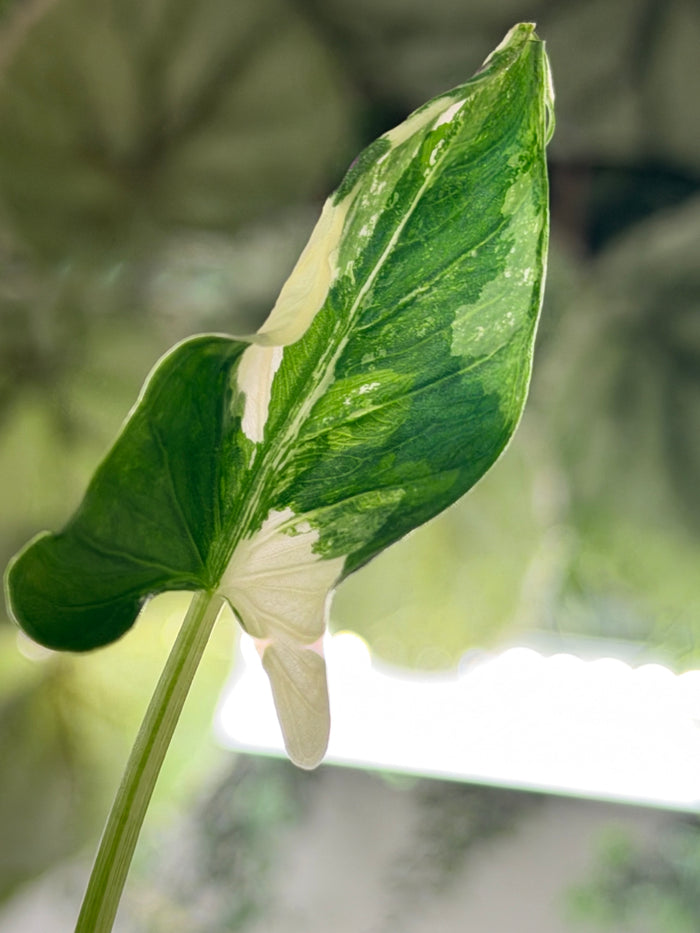
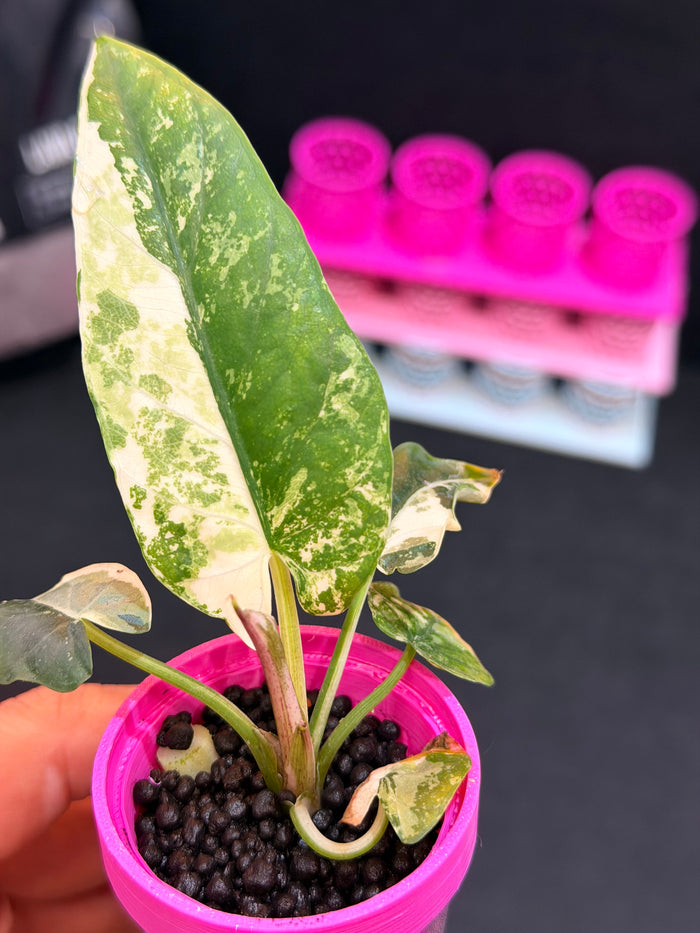
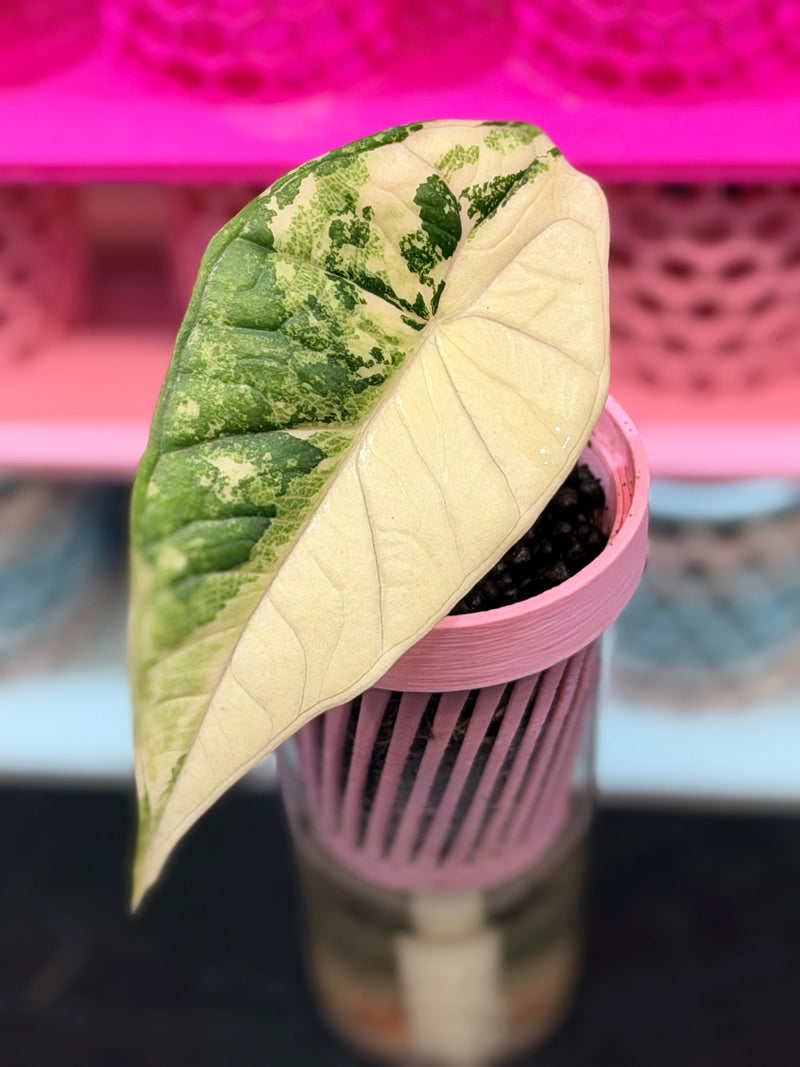
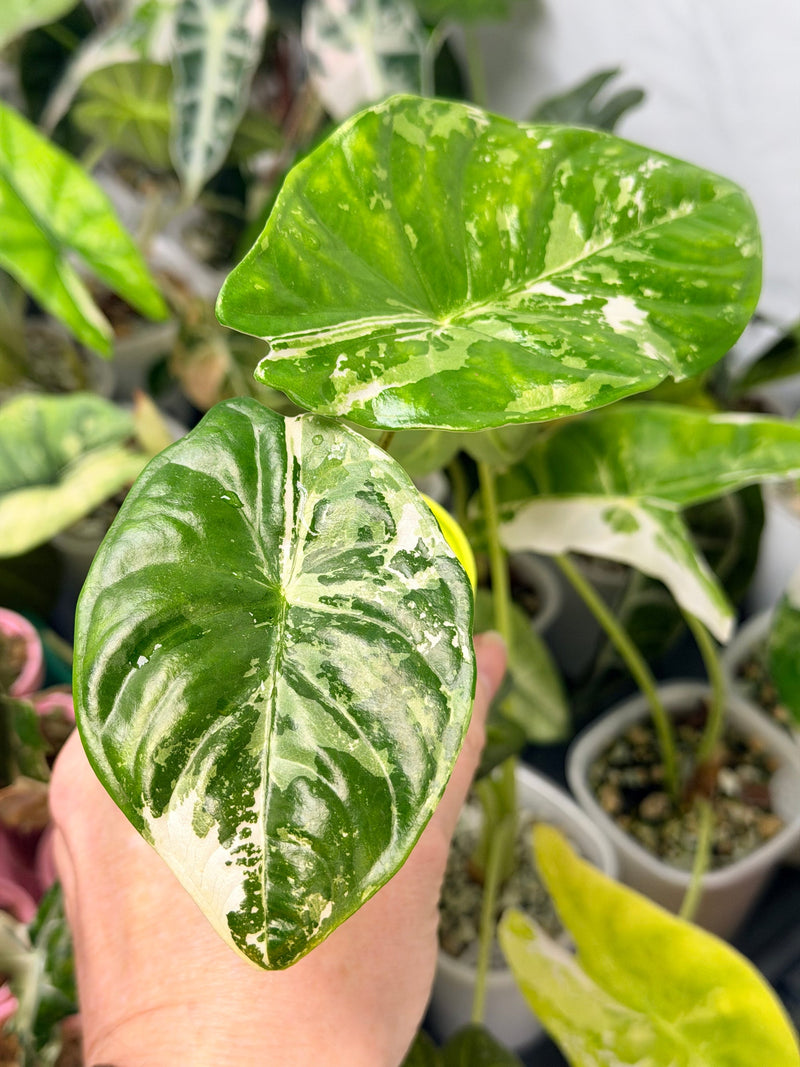
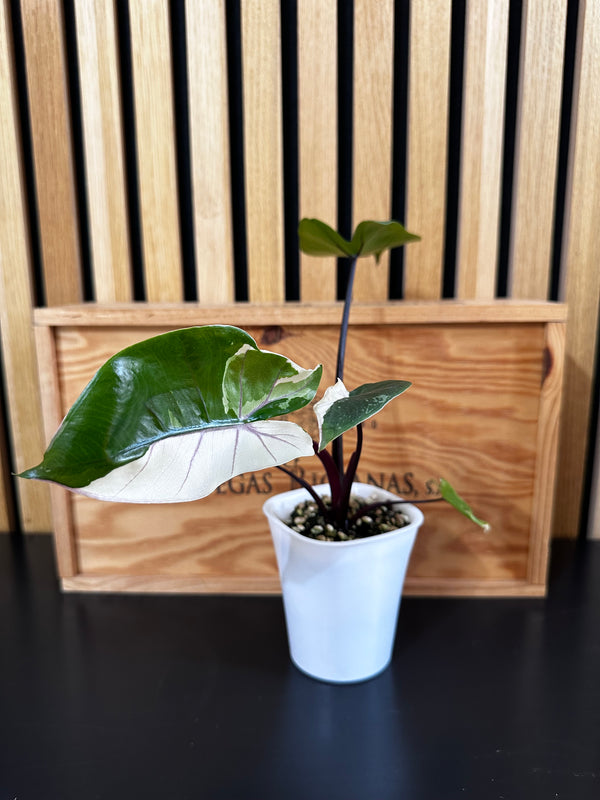
The base plant is Alocasia macrorrhizos 'Black Stem', a cultivar of the species commonly called giant taro. Its defining feature is the near-black colouring of the leaf stalks. The 'Black Stem' selection is made specifically for those darkened petioles, which are near-black rather than the standard green-grey of typical macrorrhizos, and they sit beneath the species' characteristic large, upward-pointing, broadly ovate leaves. The albo form adds chimeric white sectors on the leaf blades, which are pigment-free tissue with no chlorophyll. Together the dark architectural structure and the high-contrast white colour make a collector specimen that works at impressive scale. Our albo variegated Alocasia collection shows how this kind of variegation appears across different plants.
Origin and naming of the 'Black Stem' cultivar
Aroidpedia lists 'Black Stem' as a cultivar of Alocasia macrorrhizos and records that it was known on the market by 2007, when LariAnn Garner of Aroidia Research reported on her experience with it. Aroidpedia also points out that the name is botanically inaccurate: the black colouring is in the petioles rather than the stem. The name has simply stuck.
Aroidpedia does not give a breeder for the cultivar, and it does not describe a parentage beyond the species itself. It also has no separate entry for an albo-variegated Black Stem, so the history of the white-variegated form is not documented there and we will not guess at it.
The species behind it is far better known. Wikipedia describes Alocasia macrorrhizos as a rainforest plant ranging from Borneo east to the Solomon Islands, taking in Sulawesi, the Philippines, the Maluku Islands, New Guinea, the Bismarck Archipelago, the Torres Strait and Queensland. It was domesticated by Austronesian peoples in the Philippines thousands of years ago and became a staple starch crop across Oceania, a primary Pacific crop plant, which gives it one of the longest cultivation histories of any Alocasia. It is one of the most broadly distributed and historically significant Alocasia species in the world. Our Alocasia macrorrhizos species guide goes into the species in more depth.
How to identify Black Stem Albo
Aroidpedia describes the cultivar's inflorescence as having a mostly green spathe with a purplish swollen area around the female flowers, and a white spadix. The petioles are black, which is the feature that separates it from ordinary green-stalked giant taro. The leaves are the large, heart-shaped leaves typical of the species. Aroidpedia gives no measurements for the cultivar; the leaf size below comes from our own growing. Expect a large plant that needs real space. In our own experience, the albo variegation here is not jewel-scale expression on a 20cm leaf: bold white sectors can sit on leaves that reach 50-80cm in good conditions.
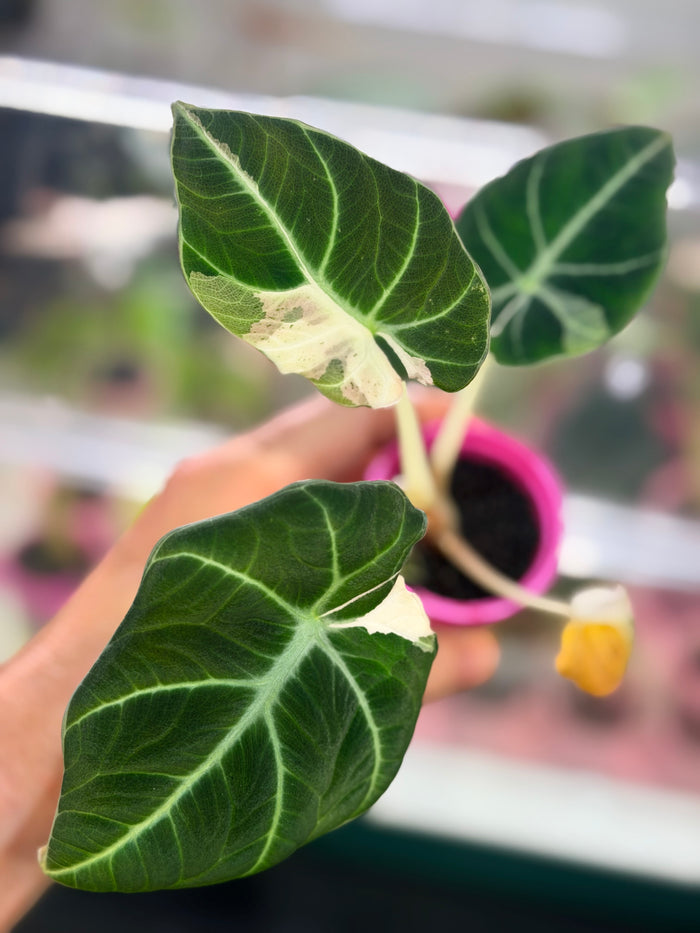
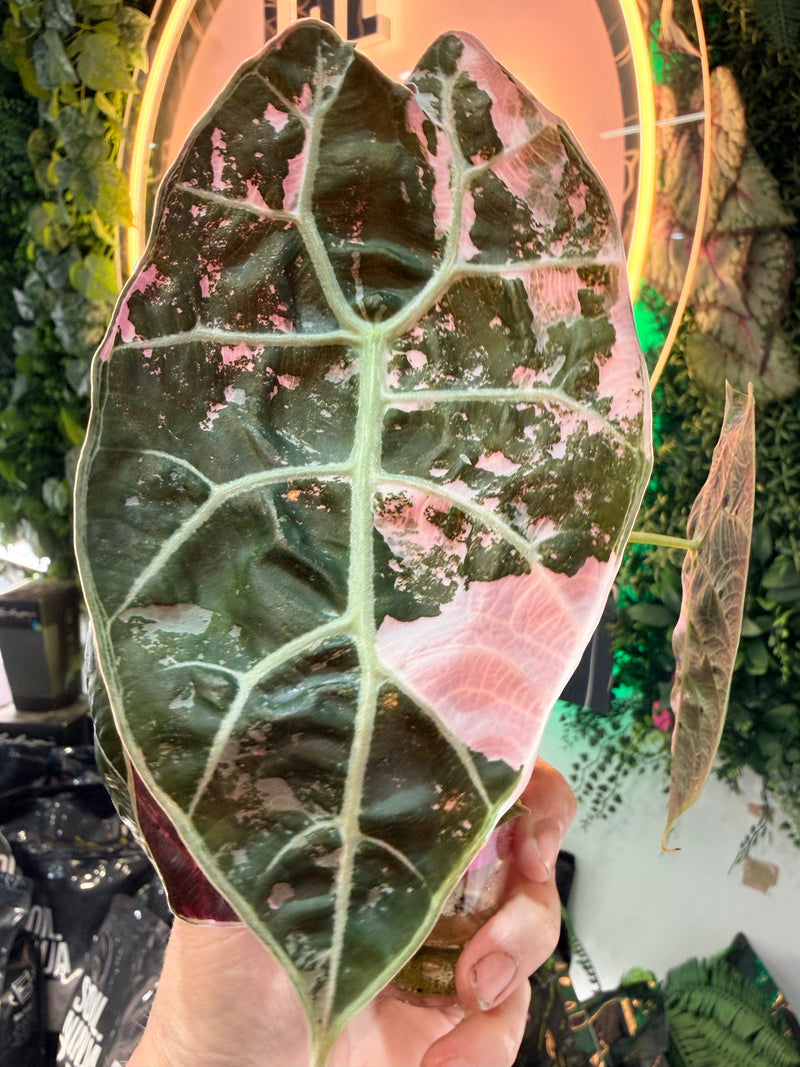
On the albo form, look for irregular white patches or sectors on the blade set against green, with the dark petioles remaining a constant feature. Because the variegation is chimeric, the amount of white varies from leaf to leaf and can change as the plant grows.
Understanding the albo variegation
Albo sectors contain no chlorophyll, so they cannot photosynthesise. The green parts of the leaf have to support the white parts, which is why heavily white leaves tend to be slower and more demanding than mostly green ones. Our guides to albo variegation and the full range of variegation types explain what to expect, including why chimeric patterns do not always carry over to plants grown from corms.
Black Stem Albo care
This is general Alocasia care that applies to this plant. Give it bright indirect light, and use LED grow lights to supplement daylight, since the white sectors make good light especially important; the non-photosynthetic albo tissue needs consistent bright indirect light, and the scale of the leaves makes that even more true here than for compact species. Keep temperatures between 20 and 27°C and humidity between 60 and 80%, maintained with a dedicated humidifier. Water when the top 2-3cm of substrate has dried, and never leave the pot standing in water.
Fluval Stratum is our preferred substrate, and our substrate guide explains the reasoning. If the room runs cool, a heat mat under the pot helps keep the roots warm. Feed with our Alocasia feed from the plant feed range at half strength; our plant feed guide has detail.
Large leaves give pests plenty of surface to settle on, so check them regularly for spider mites and keep the pest control range to hand. Our Alocasia care guide and root rot guide cover the wider picture. As with the species generally, the sap contains calcium oxalate and can irritate skin and mouth, so keep the plant away from children and pets.
Propagating from corms
Many collectors build their collection from corms. Our Alocasia corm propagation guide sets out the self-wicking method we use: the corm sits in Fluval Stratum inside the Corm Keeper, which draws moisture up evenly. See also growing corms in Fluval Stratum and how long a corm takes to sprout. Variegation seen on a mother plant is not guaranteed in corm-grown offspring.
How it compares to similar plants
The species guide covers the plain green plant, which is the natural comparison. For a different take on white variegation at a smaller scale, see our guides to Alocasia fornicata Albo and Alocasia lauterbachiana Albo.
We release Black Stem Albo through our drop model. Join the collector list and view our Alocasia Black Stem Albo listing.
Frequently asked questions
Is the Black Stem's stem actually black?
Not strictly. Aroidpedia notes that the dark colouring is in the petioles, so the name is a little inaccurate, though it is the name in common use.
How large does Black Stem Albo grow?
Aroidpedia gives no measurements for the cultivar; in our own experience, leaves reach 50-80cm in good conditions. The species is a large plant, so allow plenty of room.
Does the albo variegation stay stable?
Chimeric variegation can shift from leaf to leaf, and it may not carry over to plants grown from corms.
Does it need more light than a green plant?
Generally yes. White sectors cannot photosynthesise, so bright indirect light with LED supplementation matters.
Is it toxic?
Like the species, it contains calcium oxalate in the sap and tissues, which irritates skin and mouth. Keep it away from children and pets.
Questions about Alocasia Black Stem Albo or the macrorrhizos cultivar family? Contact our team for guidance from specialists who grow rare Alocasia in our UK-based private nursery. We are always happy to talk through light, substrate and variegation.