
Alocasia fornicata albo is a white-variegated form of Alocasia fornicata, a widely distributed Asian species with arrow-shaped leaves and a leaning, creeping stem. This guide covers the species behind the plant, where it comes from, how it got its name, what the albo variegation means for the way it grows, and how to look after it. Where the documentation runs out, we say so plainly.
If you are new to the plant, our guide to the standard Alocasia fornicata and the Alocasia fornicata species guide cover the green plant in more detail.
What is Alocasia fornicata albo?
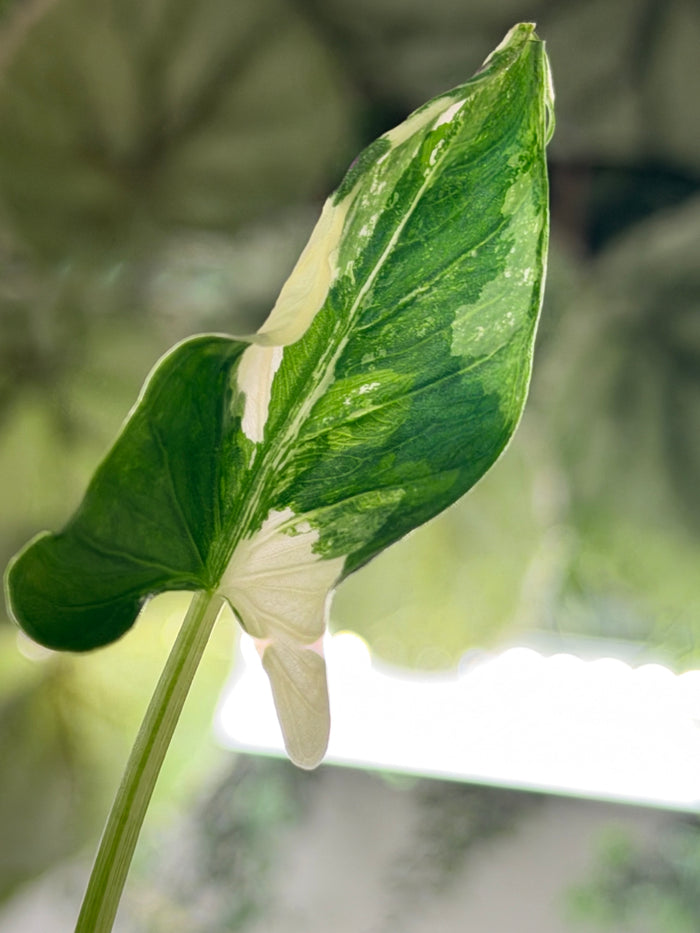
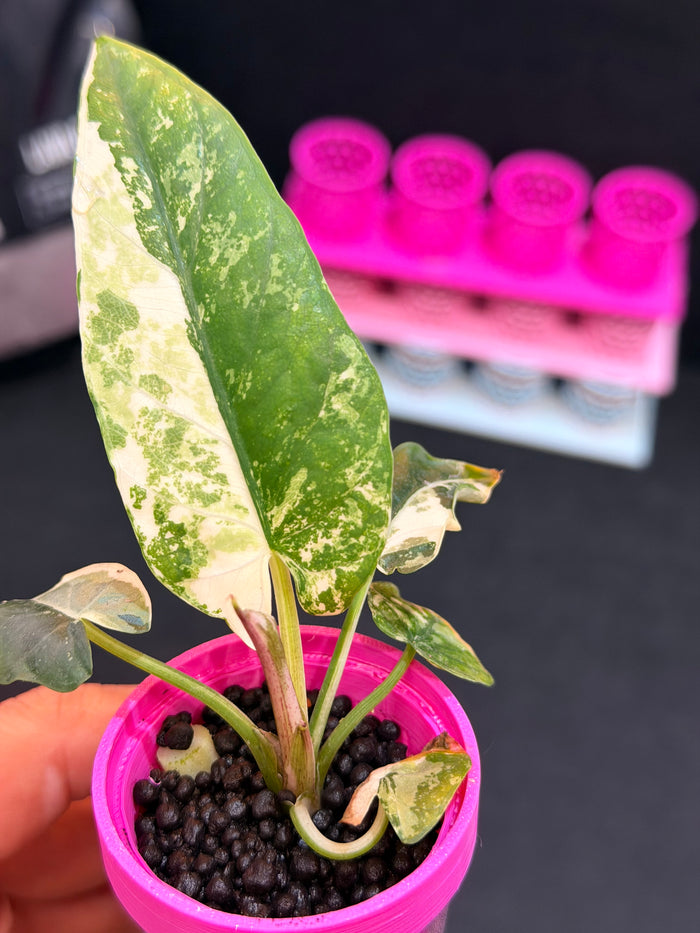
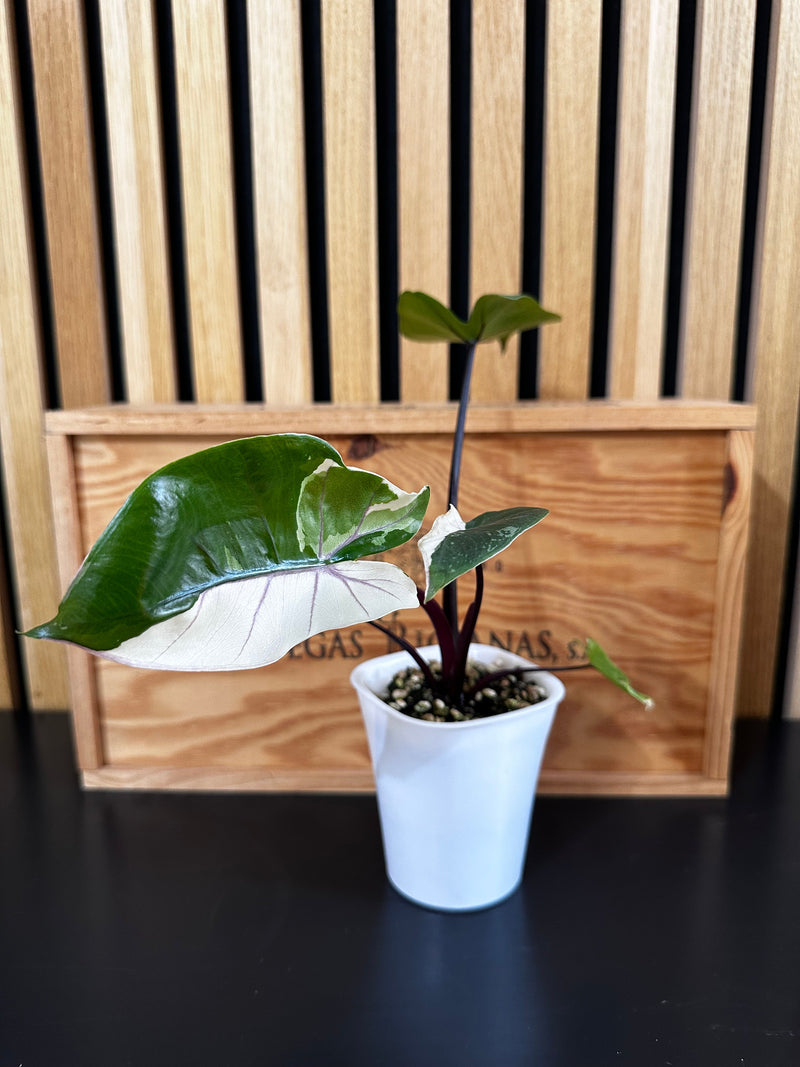
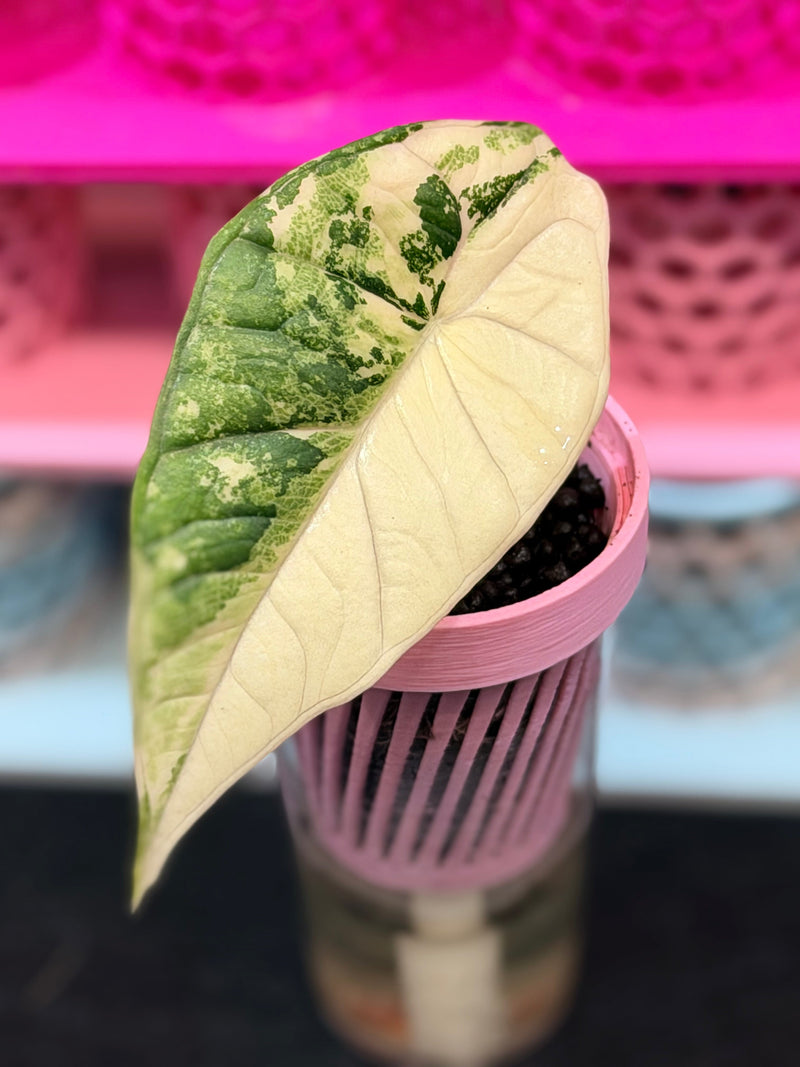
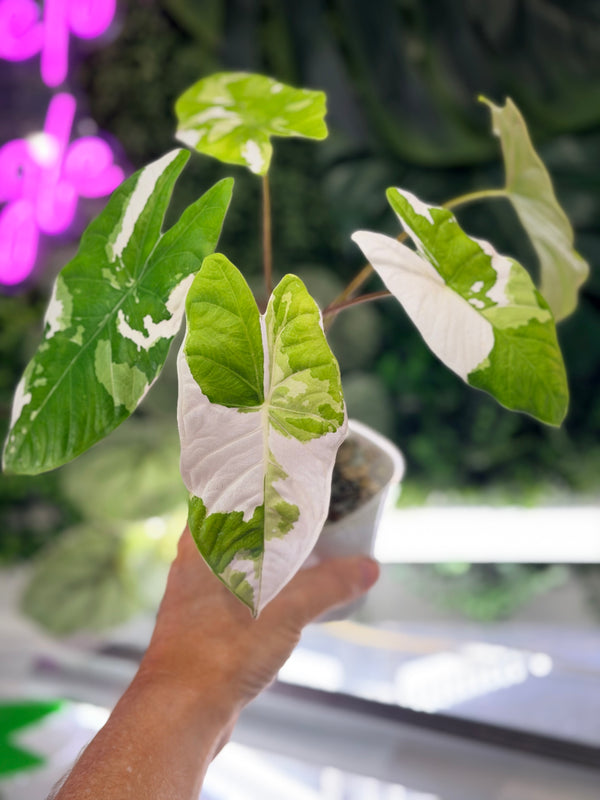
It is Alocasia fornicata carrying albo variegation: sectors of white or cream tissue that contain no chlorophyll, set against the normal green of the leaf. In its standard form the species is one of the more graceful in the genus, an elegant, slightly arching plant with ovate-lanceolate leaves on soft pink-blush petioles, appreciated for its refinement rather than its drama. In the albo form the same leaves carry a high-contrast pattern of white or cream sectors across the blade, and the soft pink of the petioles reads differently against the white and green than it does against purely green foliage. Aroidpedia records no variegated forms for the species and lists no accepted infraspecific taxa, so there is no cultivar-specific entry for the albo plant. Its origin as a variegated plant, its parentage and its history in cultivation are not documented there, and we do not attempt to supply them.
Albo variegation is chimeric, so the white is distributed unevenly. It follows the mechanism seen across the genus: a somatic mutation in the plastid genome causes certain cell lineages to lose the ability to make chlorophyll, producing white or cream sectors on an otherwise green leaf. One leaf might carry a broad sweep of white, the next only streaks or flecks, and the pattern can shift as the plant grows. That variability is how the plant is built rather than a sign of a problem. Our guides to albo variegation and all the Alocasia variegation types explain the mechanism.
Origin and naming of Alocasia fornicata
Aroidpedia lists the native range as Assam, Bangladesh, the East Himalaya, India (including Manipur, Mizoram and Tripura), Laos, Myanmar, Sri Lanka, Thailand and Vietnam. The climate it describes is humid and subtropical, with humidity of around 60 to 70 percent through the year and a pronounced wet period followed by a drier one. This is a notably wide range compared with the narrow island endemics that dominate collector lists.
On naming, Aroidpedia gives the earliest name as Arum fornicatum, described by William Roxburgh in Flora Indica (1832). The species has also been treated as Colocasia fornicata, and Aroidpedia cites an 1841 publication in Enumeratio plantarum as the primary protologue, without naming the author of the Alocasia combination. In our understanding Schott transferred it to Alocasia, and the 1841 name was published by Kunth. A separate plant that Robert Wight called Arum fornicatum in 1846 is treated as a synonym of Alocasia decipiens, not of this species. The epithet comes from the Latin fornix, meaning arched or vaulted.
The plant has a place in local food culture, and has been cultivated as a food plant in North-East India for generations. It is known as Shola kachu in Bengali and as Baibing in Mizo, and in Mizoram, Manipur and Tripura the spadix is collected and cooked as a vegetable. That is a fact about the green species in its native range; it has nothing to do with the albo plant as an ornamental, and the plant should not be eaten at home, as Alocasia contain calcium oxalate and are toxic if chewed or swallowed.
How to identify Alocasia fornicata
Aroidpedia describes the following features:
- Stems of about 30 to 90 cm, inclined or prostrate, around 2.5 cm across.
- Ovate-lanceolate, sagittate leaves of roughly 20 to 30 cm by 10 to 13 cm, with basal lobes much shorter than the anterior lobe.
- Slightly waved leaf margins and 6 to 8 pairs of lateral veins.
- Petioles of 20 to 30 cm.
- A greenish-yellow spathe of 7.5 to 10 cm, with a spadix nearly as long.
Aroidpedia does not describe petiole colour; in the plants we grow the petioles are a soft pink blush, which matters most to the albo form, because it gives the white sectors something warmer than plain green to sit against. The inclined, creeping stem is a useful identifier: unlike many upright Alocasia, this plant leans and spreads, producing horizontally spreading stolons, so it shows its leaves best from a pot that gives it room, and it can look quite different from a compact, tidy plant. In its native range the plant can reach 60 to 90 cm in height under optimal conditions.
The albo variegation on this species
White sectors have no chlorophyll, so they add nothing to growth and the remaining green tissue carries the whole plant. A plant with a lot of white needs steady bright indirect light, ideally supplemented with LED grow lights on a daily schedule, to keep growth going. The slightly waved margin of the species means white at the edge of a leaf produces a gently rippled outline rather than a straight cut, which is part of this plant's character.
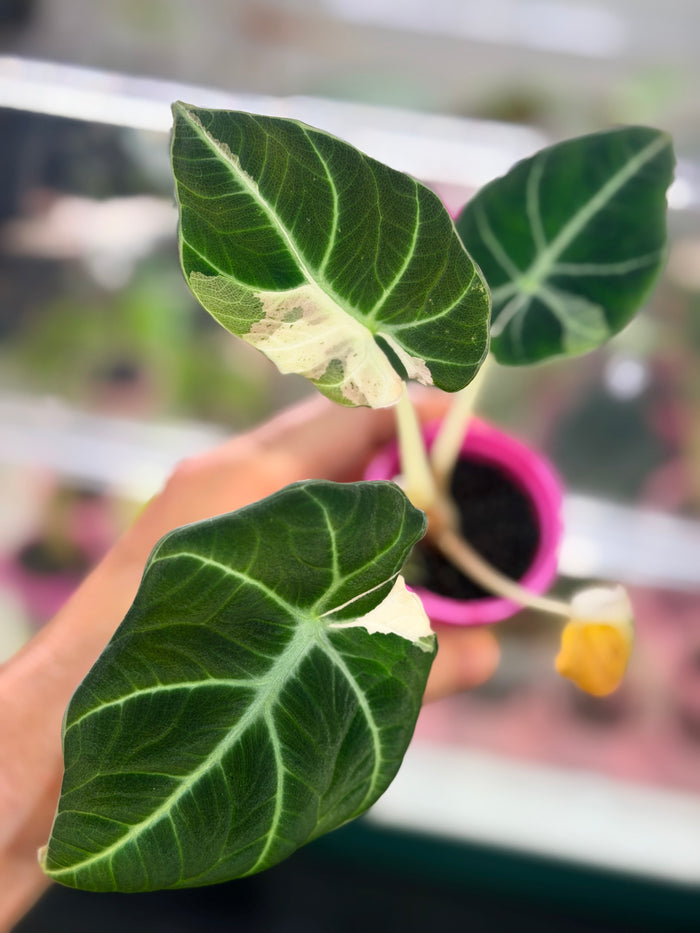
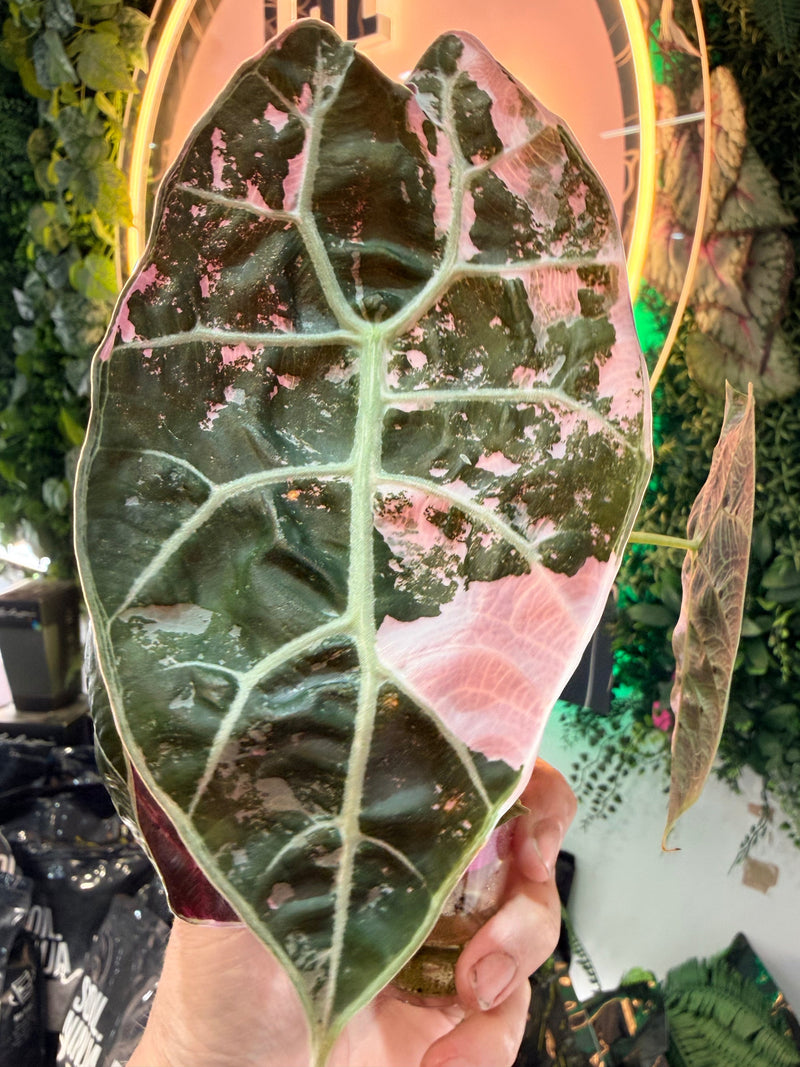
What distinguishes the look of albo on this species is its colouration. The medium-green blade and soft pink petioles give the white sectors a warmer, less stark context than the very dark green or near-black foliage of species like the Black Velvet or Ninja. For collectors who find the extreme contrast of some albo forms visually aggressive, Fornicata Albo offers chimeric white variegation in a softer register.
Because the variegation is chimeric, it is not guaranteed to carry over to every new plant grown from a corm. Browse the albo variegated Alocasia collection to see the range, and see Alocasia flemingiana albo for a comparable thin-leaved albo species from Java.
Alocasia fornicata albo care
This is general Alocasia care that applies to this plant; Aroidpedia gives climate data for the species but no cultivation instructions.
Light. Bright, indirect light with LED supplementation each day. In UK conditions, supplementation is strongly recommended, maintaining 10,000 to 15,000 lux for 12 to 14 hours per day. Keep the plant out of direct sun.
Temperature and humidity. Aim for 20 to 27°C and humidity of 60 to 80 percent. The species tolerates 18 to 27°C with a minimum of 13 to 15°C, somewhat more tolerant than strictly tropical species given its subtropical distribution. Humidity of 60 to 70 percent is the target, and a dedicated humidifier is the most reliable solution for UK collectors. A heat mat is useful if the room runs cool.
Watering. Water thoroughly when the top 2 to 3 cm of substrate has dried, and let it drain. Our root rot guide explains what to do if the roots are struggling.
Substrate. Fluval Stratum is our preferred substrate; see the substrates and growing media collection.
Feeding. Feed at half strength with our Alocasia feed from the plant feed range. Albo plants have less green tissue, so modest, regular feeding suits them better than strong doses. A CalMag supplement can help where the water is soft.
For the full picture, see our ultimate Alocasia care guide.
Propagating Alocasia fornicata albo from corms
Our Alocasia corm propagation guide explains the process in full. We use the self-wicking method, with the corm in Fluval Stratum inside the Corm Keeper, which supplies moisture evenly without leaving the corm in water. Our posts on growing corms in Fluval Stratum and how long a corm takes to sprout help set expectations, and the corms collection is there to browse. Expect that some corms from an albo plant will grow plain green.
How it compares with similar plants
Fornicata albo has a lighter, more relaxed look than the dense, dark foliage of plants such as the Alocasia ninja albo, where white sits against much darker green. For other albo options, see Alocasia fornicata mint albo or the wider Alocasia house plants collection.
We release plants through our drop model. Join the collector list to hear about releases, and see our Alocasia fornicata albo listing.
Frequently asked questions
Where is Alocasia fornicata from?
Aroidpedia lists north-east India, Bangladesh, the East Himalaya, Laos, Myanmar, Sri Lanka, Thailand and Vietnam.
Who first described it?
Aroidpedia credits William Roxburgh with the earliest name, Arum fornicatum, in Flora Indica in 1832.
What does fornicata mean?
It comes from the Latin fornix, meaning arched or vaulted.
How big does it get?
Aroidpedia gives stems of about 30 to 90 cm, inclined or prostrate, with leaves of 20 to 30 cm.
Is the albo form documented in the literature?
Aroidpedia records no variegated forms for the species, so cultivar-specific detail is not documented.
Will corms keep the white variegation?
Not reliably. Chimeric variegation does not always carry over to corm-grown plants.
Questions about Alocasia fornicata albo? Contact our team for guidance from specialists who grow rare Alocasia in our UK-based private nursery. We are glad to help with care and propagation.