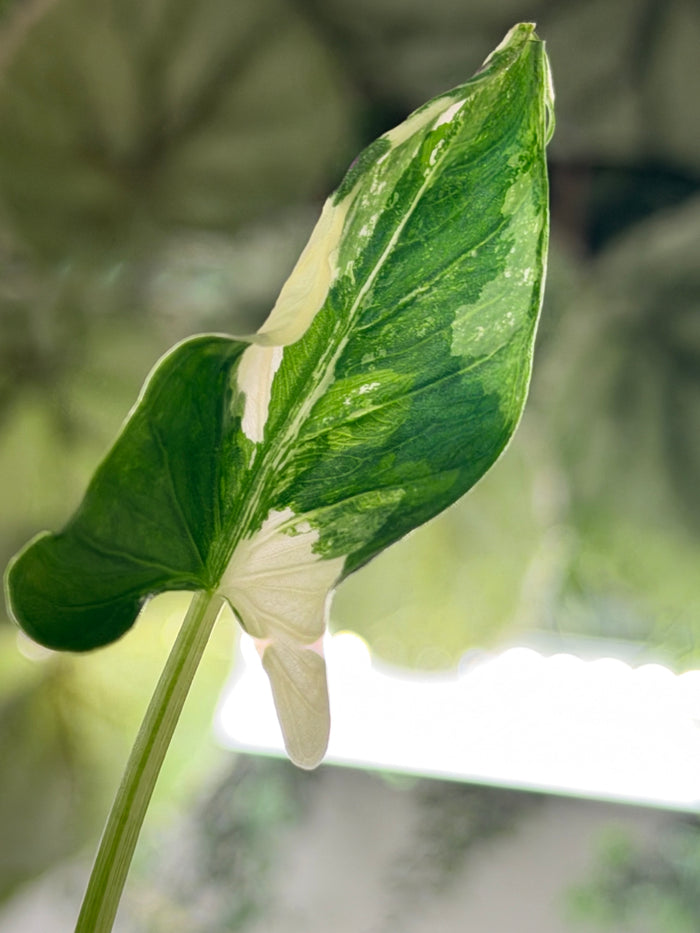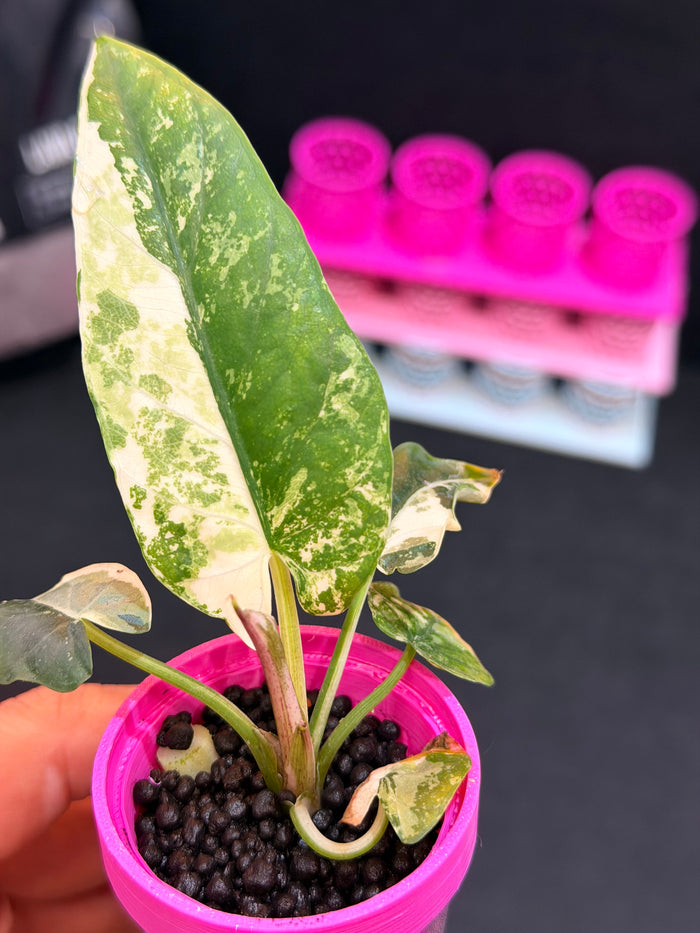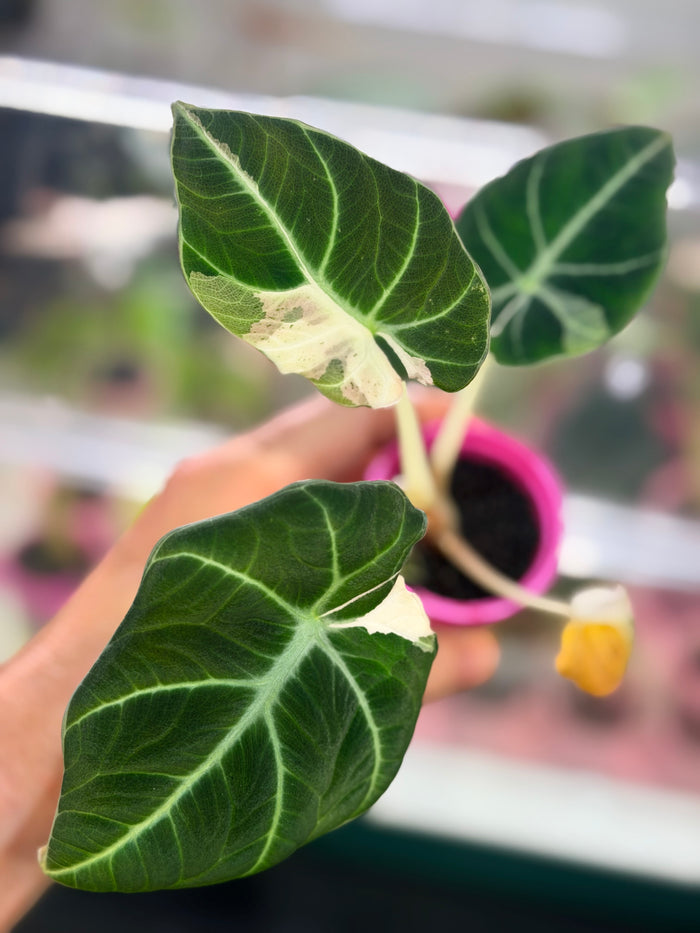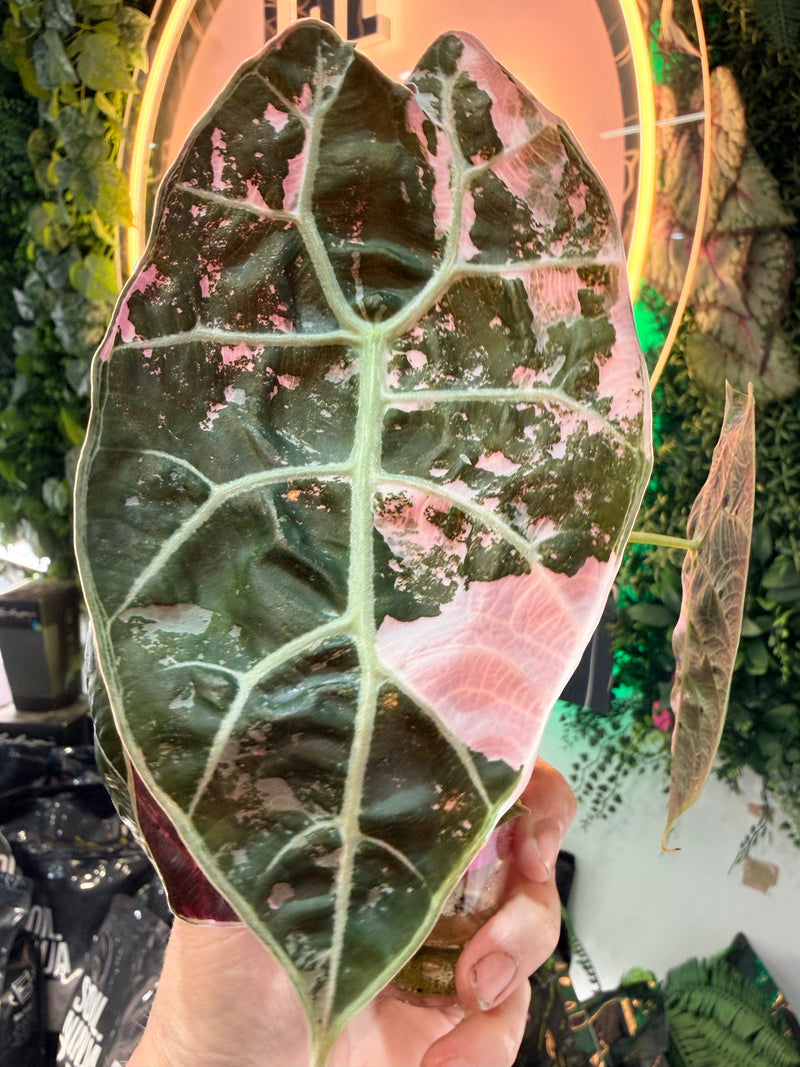

Alocasia flemingiana albo is a white-variegated form of Alocasia flemingiana, a small, thin-leaved Javan species that is far less often discussed than the better-known jewel and giant Alocasia. This guide covers what the species is, where it comes from, how it is named, what Aroidpedia documents about its variegated form, and how to look after it. Where the documentation is thin, we say so rather than fill the gap.
What is Alocasia flemingiana albo?
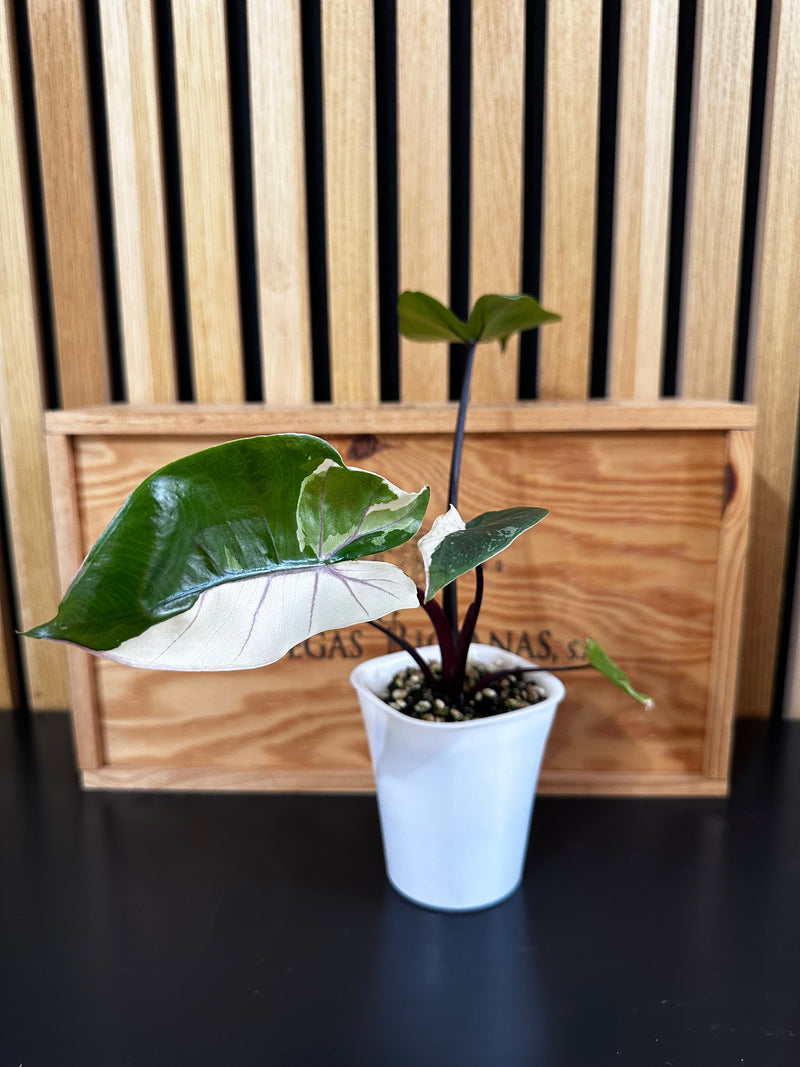
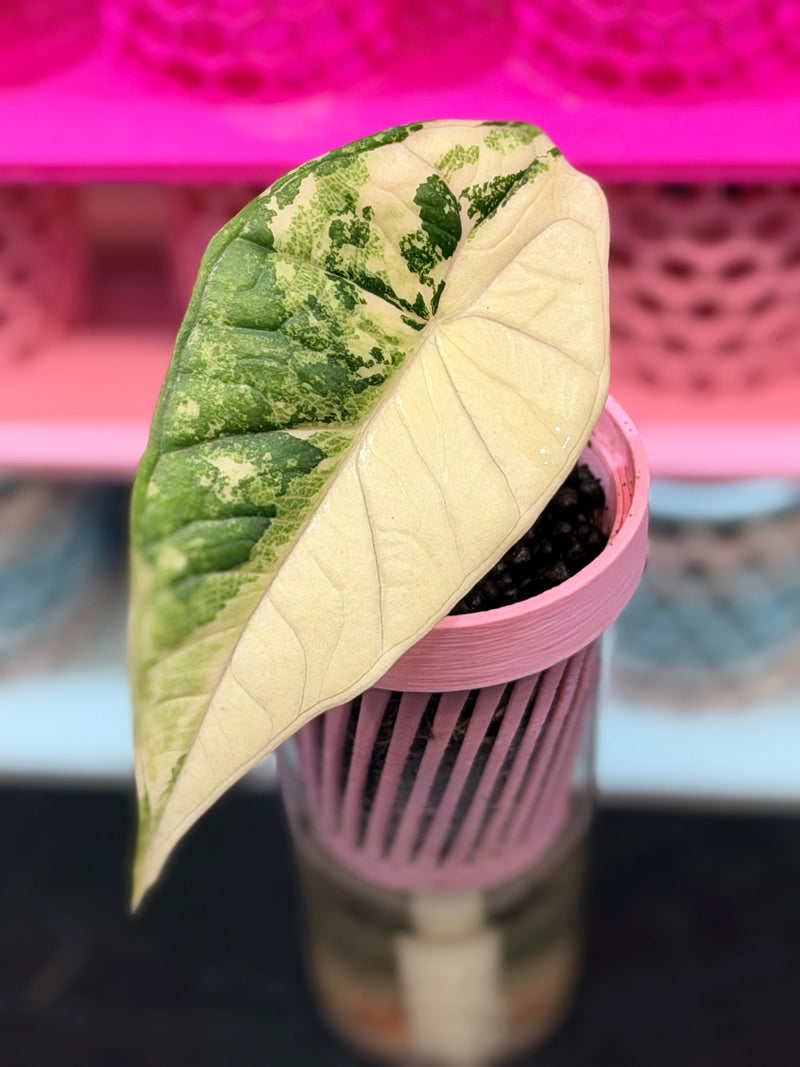
The plant is the species Alocasia flemingiana carrying albo variegation, meaning sectors of white tissue that contain no chlorophyll. Aroidpedia lists a white variegated form of the species and shows it with a photograph, but gives no further detail: no parentage, no origin story for the variegated plants in cultivation and no named cultivar information. Aroidpedia also lists no cultivars or hybrids for the species. Anything beyond that, such as how a particular plant arose or how stable it is, is simply not documented, and we do not want to invent it.
Like all chimeric albo plants, the pattern is unpredictable from leaf to leaf. Some leaves carry broad white panels, others only a little marbling, and the balance between white and green can shift as the plant grows. Our guides to albo variegation in Alocasia and to all the main variegation types explain the mechanism in more depth.
Origin and naming of Alocasia flemingiana
Aroidpedia records Alocasia flemingiana as native to Java, Indonesia, where it is described as widespread in West Java and sporadic in Central Java. It grows in teak forest, swamp forest and disturbed forest, on volcanic soils and sometimes on limestone, from sea level up to around 1,000 metres. It is not a Philippine species, which is a claim sometimes repeated about it.
The species was published in the Gardens' Bulletin Singapore in 1998. The type specimen was collected in West Java, near Bogor, in 1961. The epithet honours Conrad D. Fleming, who sponsored field work on Malesian Araceae, including fieldwork in Java by the botanist Yuzammi in 1997. Aroidpedia also notes that earlier botanists had misidentified the plant as Alocasia heterophylla; the two differ in leaf shape and in the size of the synandrodia, the sterile structures in the male part of the flower.
The habitat climate Aroidpedia gives is humid subtropical, with humidity of around 60 to 70 percent through the year. That is a helpful guide to the conditions the plant is built for, and it sits comfortably alongside the general care described below.
How to identify Alocasia flemingiana
Aroidpedia describes a small herb of about 50 cm in height with a rhizome up to roughly 3.5 cm across and several leaves held together. The key features it records are:
- Petioles of 25 to 55 cm, green, sometimes mottled reddish purple or streaked with purple, and sheathing for about a quarter to a third of their length.
- A blade that is sagittate to broadly ovate-sagittate, thin and membranous, mid-green above and yellowish green beneath, with an entire (smooth) margin.
- A leaf that is only peltate when young; mature leaves are not.
- An anterior lobe of around 25 cm by 19 cm, with posterior lobes up to about 16 cm.
- Inflorescences in pairs among the foliage leaves, with a white to greenish-white spathe of 10 to 15 cm, and orange berries after flowering.
It is worth stating plainly that this is not an elongated, narrowly lanceolate plant. The blade is an arrow-shaped to broadly oval-arrow form, thin in texture rather than thick or leathery. If you are comparing it with Alocasia fornicata, which has longer, narrower leaves on an inclined stem, or with the broader Alocasia sanderiana, the thinner, softer leaf of flemingiana is a good distinguishing feature. For another view of a species with a long, narrow blade, see our Alocasia longiloba species guide.
The albo variegation on this species
On a thin, membranous leaf, white sectors are particularly noticeable, because the white tissue contributes nothing to photosynthesis and the remaining green has to carry the plant. In practice this means a plant with extensive white needs steady, bright, indirect light to hold its growth rate, and a thin leaf with large white areas can be more sensitive to scorch or marking than a thick-leaved plant. Giving the plant LED supplementation on a regular daily schedule is the simplest way to keep growth steady; our LED grow lights collection covers the options.
Chimeric variegation is a property of how the plant is built, not a guaranteed trait. A plant raised from a corm can revert to plain green or differ from its parent, so what you see on the parent leaf is not a promise for new growth. Our guide to albo variegated Alocasia shows the range of plants we work with.
Alocasia flemingiana albo care
This is general Alocasia care that applies to this plant, as Aroidpedia gives no cultivation guidance specific to the species.
Light. Bright, indirect light, supplemented with LED lighting for a consistent daily period. Keep the plant out of direct sun, particularly a white-variegated one.
Temperature and humidity. Aim for 20 to 27°C and humidity of 60 to 80 percent. If the room runs cool, a heat mat beneath the pot keeps the root zone comfortably warm.
Watering. Water thoroughly once the top 2 to 3 cm of substrate has dried, then allow it to drain. Constantly wet roots are the most common route to trouble; our root rot guide explains how to spot it and what to do.
Substrate. We prefer Fluval Stratum. See our substrates and growing media for related options.
Feeding. Feed at half strength using our Alocasia feed from the plant feed range, conservatively, at quarter to half strength every 2 to 3 weeks during the growing season. A white-variegated plant has less green tissue to work with, so steady, modest feeding is better than strong doses.
For the wider picture, our ultimate Alocasia care guide and the Alocasia plant care collection cover everything in more detail.
Propagating Alocasia flemingiana from corms
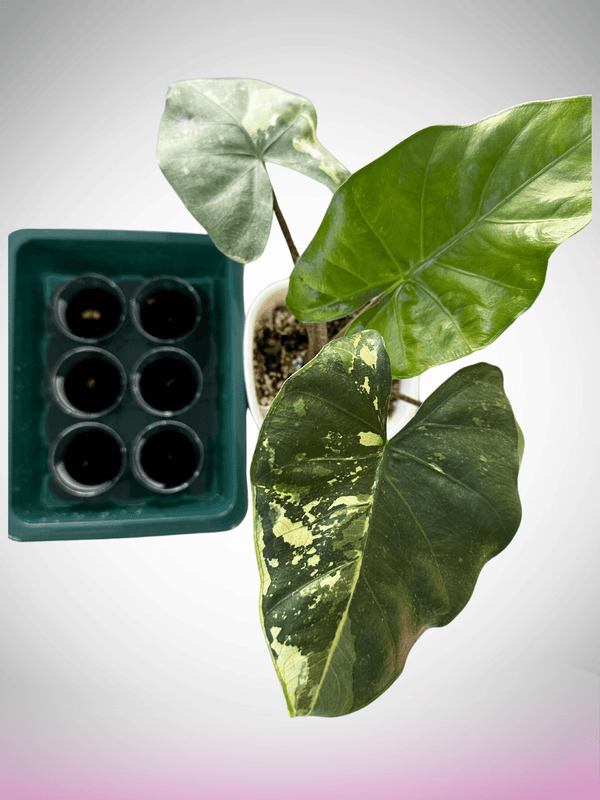
Alocasia produce small corms around the base, and these are the usual way to make more plants. Our Alocasia corm propagation guide sets out the process in full. In short, we use the self-wicking method: the corm sits in Fluval Stratum inside the Corm Keeper, which draws moisture up evenly without leaving the corm sitting in water. Our posts on growing corms in Fluval Stratum and how long a corm takes to sprout are useful companions. You can also browse the corms collection.
Remember that corms from a chimeric plant do not always carry the variegation across, so some will grow as plain green plants.
How it compares with similar plants
Flemingiana is a modest, small-growing plant compared with the giants of the genus, and its thin leaves are quite different from the thick, quilted foliage of many collector favourites. Its appeal is the combination of a lesser-seen Javan species with white variegation. If you like the soft, refined look of white on a thinner leaf, Alocasia fornicata albo is the nearest comparison in our guides. Browse the wider Alocasia house plants collection for others.
We release plants through our drop model. Join the collector list to hear about new releases, and see our Alocasia flemingiana albo listing.
Frequently asked questions
Where is Alocasia flemingiana from?
Aroidpedia records it as native to Java, Indonesia, mainly West Java, rather than the Philippines.
Who named Alocasia flemingiana?
The species was published in 1998 in the Gardens' Bulletin Singapore. The epithet honours Conrad D. Fleming, a sponsor of Malesian aroid field work. Aroidpedia does not name the describer.
Is the albo form a hybrid?
Aroidpedia lists no hybrids or cultivars for the species and records the white form as a variegated form of Alocasia flemingiana. Parentage is not documented.
How big does it get?
Aroidpedia describes a small herb of about 50 cm, with petioles of 25 to 55 cm.
Will corms keep the white variegation?
Not reliably. Chimeric variegation does not always carry over to corm-grown plants, so some will be plain green.
How much light does it need?
Bright, indirect light with LED supplementation. The white areas do not photosynthesise, so the green tissue needs good light.
Questions about Alocasia flemingiana albo? Contact our team for guidance from specialists who grow rare Alocasia in our UK-based private nursery. We are happy to help with care and propagation questions.