Alocasia sanderiana is one of the most recognisable leaves in the genus: dark, glossy and arrow-shaped, with deeply scalloped margins and bright silver-white veins. It is also surrounded by confusion: much of what is sold under its name is something else, and it has a near lookalike that has never been formally described. This page sets out the species, the plant traded as pseudosanderiana, how their care differs, and where to find each of our collector guides.
What defines Alocasia sanderiana
Alocasia sanderiana W.Bull was first published in 1884, in a nursery catalogue issued by William Bull, the London nurseryman. It is endemic to Mindanao in the southern Philippines, where it has been recorded from Misamis Occidental, including the Mount Malindang range, and from Bukidnon. In the wild it grows as a terrestrial plant in old forest, typically in damp ravines at low elevation.
It is reported on the IUCN Red List as Critically Endangered, with habitat loss from agricultural clearance and collection from the wild given as the main pressures. The species was once listed on CITES Appendix II, but was removed from the appendices in 1994. Cultivated, nursery-propagated stock is the only responsible source.
Leaf characters
- Arrow-shaped, peltate blades: the leaf is sagittate, and the stalk joins the blade just inside its margin between the two basal lobes.
- Scalloped margins: the edges are deeply undulate to almost pinnatifid, cut into rounded lobes.
- Silver venation: the midrib and primary veins are marked in white to yellowish silver against a deep, glossy green surface. The underside is purple.
- Few primary veins: usually three or four primary lateral veins on each side of the midrib. Alocasia × amazonica typically shows five or more, which is one of the more reliable ways to tell them apart.
- Modest size: leaves reach around 40 cm long, a few at a time.
'Nobilis', the Kris plant and × amazonica
'Nobilis' traces back to Alocasia sanderiana var. nobilis, a name published by André in 1895 and now treated as a synonym of the species. It is not an accepted cultivar, but remains widely used in the trade for sanderiana forms.
The common name Kris plant comes from the wavy leaf margin, which recalls the blade of the kris (kalis) sword.
Alocasia sanderiana is one of the two parents of Alocasia × amazonica, bred in Florida in the 1950s by Salvadore Mauro of Amazon Nursery from A. sanderiana and A. longiloba 'Watsoniana'. A great many plants labelled sanderiana are in fact × amazonica or its compact form 'Polly'. Our A to Z of rare Alocasia lists the hybrid forms we have covered.
'Bully' and 'Bull'
'Bully' and 'Bull' are trade names, not registered cultivars. In the trade they are applied to sanderiana forms selected for larger, bolder leaves with strong vein contrast, and 'Bully' also appears on plants sold as pseudosanderiana. We have not found a published account of where either name began, so we treat them as descriptive trade labels rather than a guarantee of a particular clone.
A note on 'Simpo'
'Simpo' is often sold alongside the sanderiana forms, but it does not belong with them. It is a hybrid bred in Malaysia by Wawan Santoso, with a suspected parentage of Alocasia sinuata × 'Lukiwan', and no sanderiana in its background. Our guides to 'Simpo' Albo and 'Simpo' Aurea cover it in full.
Alocasia 'pseudosanderiana': the false sanderiana
The name pseudosanderiana is widely used as though it were a species, but it has never been formally published with a description. It is best treated as a nomen nudum, a name without botanical standing. The most substantial account remains David Burnett's 1984 article "The Cultivated Alocasia" in Aroideana, which records it being sold in the United States as "The False Sanderiana" and as Alocasia 'ariozavica', and in Australia as 'Philippinensis'.
It is grown widely in the Philippines, though it has not been traced to a wild population. A natural hybrid between A. sanderiana and A. heterophylla has been suggested. Burnett disagreed, pointing out that the plant lacks the leaf texture of sanderiana and grows far larger than either proposed parent; he considered it more likely an undescribed species. The question is still open.
In practice, pseudosanderiana differs from true sanderiana in several visible ways:
- Size: it grows considerably larger, with longer, broader leaves.
- Leaf attachment: it lacks the peltate leaf base that marks sanderiana.
- Habit: it tends to hold more leaves at once and to clump, where sanderiana carries only a few.
Growing sanderiana and pseudosanderiana: what is different
The fundamentals in our complete Alocasia care guide all apply. A few points matter more with this group:
- Warmth: sanderiana is a lowland tropical plant and dislikes cold more than most. Keep it warm and steady all year, away from draughts and cold glass. If growth stalls in winter, our winter care and dormancy guide explains what is normal.
- Humidity: high, consistent humidity helps new leaves open cleanly and keeps the scalloped edges from browning. A cabinet or grow tent suits the smaller plants well.
- Light for the venation: bright, indirect light gives the strongest silver contrast and the darkest leaf. In low light the leaves open smaller and the veins look flatter; direct sun can scorch the glossy surface. Our guide to LED grow lights covers the UK winter.
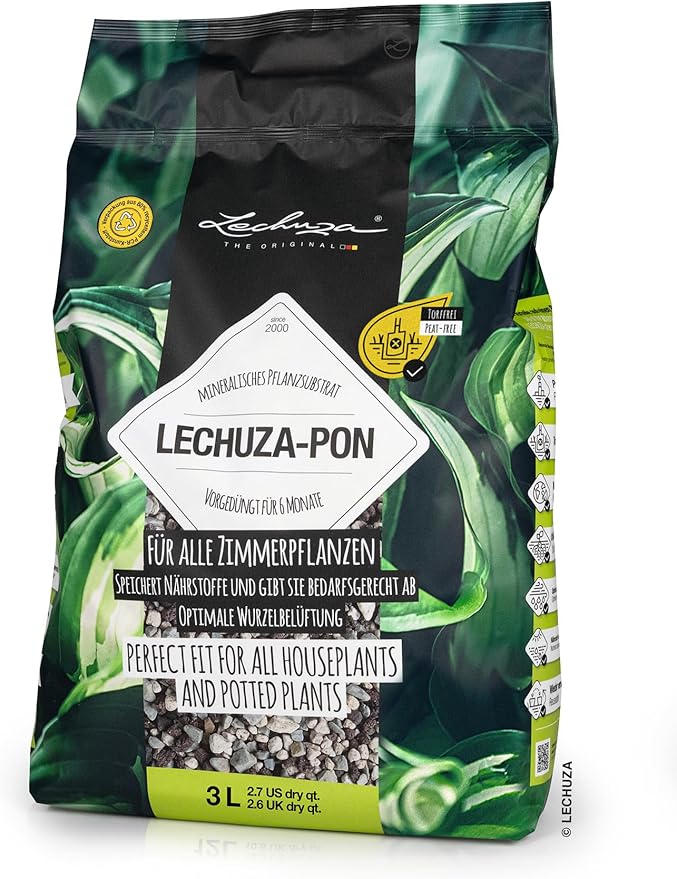
- Substrate and watering: an open, fast-draining mix matters more than pot size. We grow in our own pon mix, blended from the Soil Ninja range, and our substrate guide explains the blend.
- Pests: the thin-veined leaves are a favourite of spider mite, particularly in dry, warm rooms. Check the undersides regularly; our pest guide covers what to look for.
- Feeding: little and often through the growing season, following our balanced feed programme.
Pseudosanderiana is the more forgiving of the two and needs more room. Variegated forms of either carry less chlorophyll than green plants, so they grow more slowly and do best towards the brighter end of the light range, short of direct sun.
Our Alocasia sanderiana collector guides
| Name | Variegation type | Collector guide | Availability |
|---|---|---|---|
| Alocasia sanderiana 'Nobilis' Pink | Pink | Read the guide | View the plant |
| Alocasia sanderiana 'Bully' Pink Albo | Pink and albo | Read the guide | Join the drop list |
| Alocasia sanderiana 'Bull' Aurea | Aurea | Read the guide | Join the drop list |
Our pseudosanderiana collector guides
| Name | Variegation type | Collector guide | Availability |
|---|---|---|---|
| Alocasia 'pseudosanderiana' Aurea | Aurea | Read the guide | View the plant |
| Alocasia 'pseudosanderiana' Pink | Pink | Read the guide | View the plant |
| Alocasia 'pseudosanderiana' 'Bully' Aurea | Aurea | Read the guide | Join the drop list |
A note on variegation in this group
Every form in the tables above is defined by its variegation, and each type behaves differently. Pink variegation is typically unstable, so the amount of colour can shift from leaf to leaf. Aurea brings yellow tones, and albo leaves carry white sections with no chlorophyll at all, which makes them more prone to browning. Our explainers on pink variegation, aurea variegation and albo variegation go into each in detail, and the complete guide to Alocasia variegation types compares them.
Frequently asked questions
Is Alocasia 'Nobilis' a different plant from Alocasia sanderiana?
No. 'Nobilis' comes from A. sanderiana var. nobilis, a name now treated as a synonym of the species. It is still widely used in the trade for sanderiana forms.
Is pseudosanderiana a real species?
Not in a formal sense. The name has never been validly published, so it has no botanical standing. The plant is real and widely grown in the Philippines, but whether it is an undescribed species or a hybrid is still unresolved.
How can I tell sanderiana from × amazonica?
Count the primary lateral veins. Sanderiana usually has three or four on each side of the midrib, whilst × amazonica typically has five or more.
Is Alocasia sanderiana endangered?
It is reported on the IUCN Red List as Critically Endangered in the wild, where it is confined to parts of Mindanao. Plants in cultivation are nursery-propagated, and that is the only source collectors should consider.
Are 'Bully' and 'Bull' cultivars?
They are trade names rather than registered cultivars, applied to larger, bolder sanderiana-type forms. We have not found a published origin for either name.
If you are looking for a particular sanderiana or pseudosanderiana form, or would like help identifying one already in your collection, get in touch. We are always happy to talk about this group.