
If your Alocasia is dropping leaves between October and February, it is most likely responding to the UK winter rather than dying. Short days, weak light, cool windowsills and dry, radiator-heated air all slow these tropical aroids down, and some cultivars will shed most or all of their foliage and rest as an underground corm or rhizome until spring. The key to Alocasia winter care in the UK is telling genuine dormancy apart from rot, then adjusting light, warmth and watering so the plant comes through intact.
Below we cover reading the signs, adjusting your routine, variegated cultivars, and bringing a resting plant back into growth. If you are newer to the genus, our ultimate Alocasia care guide covers the year-round basics this article builds on.
Why Alocasia slow down in a UK winter
Alocasia are aroids from the tropical and subtropical forests of South East Asia and Australasia, where temperatures stay warm all year and daylength barely changes. A British winter removes almost everything they rely on for active growth. Around the December solstice, London receives under eight hours of daylight and Edinburgh roughly seven, and much of that light arrives at a low angle through cloud. Even a plant on a bright windowsill is receiving a small fraction of the light it had in June.
Temperature compounds the problem. Growth in most Alocasia slows noticeably below about 15 to 16°C, and prolonged exposure below around 10°C risks cold damage. Many UK homes dip below that first threshold overnight, particularly near glass or once the heating goes off.
With less energy coming in, the plant stops producing new leaves, withdraws resources from older foliage and, in some cultivars, retreats entirely into its storage organ. This is a response to conditions, mainly light and temperature, rather than a fixed seasonal clock: a plant kept warm under a good grow light may barely slow down, while the same cultivar on a cold north-facing sill may lose every leaf by January.
Dormant or dying: how to tell
This is the real question behind most searches for Alocasia dormancy, and it matters because the two need opposite responses: a dormant plant should be left largely alone, a rotting one needs prompt intervention.
Signs of normal winter dieback
Dormancy tends to be gradual and orderly. The oldest leaves yellow first, usually evenly across the blade, and are withdrawn one at a time as their petioles soften and fold. New leaves may emerge smaller than usual or stall mid-unfurl. The stem or corm at soil level stays firm, and there is no unpleasant smell from the pot.
Signs of rot or decline
Rot moves faster and looks messier. Watch for several leaves collapsing at once, dark water-soaked patches spreading from the base of the petioles, a stem that feels soft or hollow when gently squeezed, compost that stays wet for weeks, and a sour or musty smell. Browning that starts at the edges and spreads inward alongside fine speckling on the undersides points to spider mite rather than dormancy, which we cover in our pest patrol guide.
The corm test
When in doubt, check the storage organ. Ease the plant from its pot and brush away the substrate. A healthy dormant corm or rhizome is firm to the touch, much like a fresh potato, with a clean earthy smell. If you need to look inside, a thin slice with a sterile blade should reveal pale cream or white tissue. Rotting tissue is soft, wet, brown or black, and often smells unpleasant. Early rot does not always smell, so firmness is the most reliable single indicator. If you find soft areas, our Alocasia root rot guide sets out how to cut back to healthy tissue and set the plant up for recovery.
Light
Light is the biggest factor in how well an Alocasia gets through a British winter, and the one most growers underestimate. Our eyes adjust so well to dim rooms that a spot which looks bright can be receiving very little usable light; a lux meter app on your phone gives a useful comparison between positions.
Move plants as close to your brightest window as you can without leaves touching the glass. South, east and west aspects that would be too harsh in July are often ideal from October to March. Clean the windows, open net curtains by day, and rotate pots every week or two.
For a serious collection, supplementary lighting changes winter from a holding operation into a growing season. A full-spectrum LED such as the Barrina T5 LED grow light, mounted above a shelf and run on a timer for 12 to 14 hours a day, will keep most Alocasia in active growth through winter provided they are also warm enough. See our LED grow lights range; our article on whether LED grow lights are worth it explains placement and running costs in more detail.
Temperature and draughts
Aim to keep Alocasia at 18°C or above through winter, and treat 15°C as the practical minimum. Below that, growth stalls, roots take up water more slowly, and the risk of rot rises sharply because the compost stays wet for longer.
The windowsill is both the brightest and the coldest place in most UK homes. On a clear night the air by the glass can be several degrees colder than the room, worse with single glazing or when drawn curtains trap the plant in a cold pocket. Either move sill plants back into the room at night or leave the curtains open. A minimum and maximum thermometer at leaf height for a few nights shows exactly what your plants experience.
Radiators create the opposite problem. A plant directly above or beside one sits in a column of hot, very dry air, which scorches leaf edges and encourages spider mite. Keep pots at least a metre from active radiators and away from the airflow of fan heaters. Check for draughts from external doors and vents too; Alocasia dislike sudden cold air far more than a steady cool temperature.
Where a room genuinely cannot be kept warm enough, a heat mat under the pot keeps the root zone active even when the air is cool. This is particularly useful for corms and smaller juvenile plants.
Watering in winter
More Alocasia are lost to winter overwatering than to cold. A plant that is growing slowly, or not at all, uses a fraction of the water it did in summer, and a routine that worked in August will keep the root zone saturated in December.
Water by checking, never by calendar. Let the top few centimetres dry before watering again, and let resting plants dry further than you would in summer. Lifting the pot is a reliable guide once you know its wet and dry weights. Use room-temperature water, not straight from a cold tap. A leafless corm needs only enough to stop the substrate going bone dry.
Substrate choice makes a real difference in winter. An open, mineral-based mix drains quickly and keeps air around the roots, giving a far wider margin for error than dense peat-based compost. We use our own pon mix, blended from the Soil Ninja range, because it is so forgiving when growth slows.
Humidity and central heating
Central heating dries indoor air considerably. Heated UK homes in winter commonly sit somewhere around 25 to 50% relative humidity, well below the 60% and above that most Alocasia prefer. Low humidity rarely kills outright, but it causes new leaves to stick as they unfurl, browns margins, and favours spider mite.
A hygrometer among your plants tells you where you stand. The most effective fix is a humidifier near the collection, ideally on a humidistat so windows do not stream with condensation. Grouping plants helps a little, and a cabinet enclosure suits smaller, more demanding specimens. Misting has little lasting effect and leaves water sitting on leaves in cool rooms, so we would not rely on it.
Check leaf undersides weekly through winter: fine pale stippling or faint webbing are early signs of spider mite, which is far easier to deal with at that stage. See our pest control range.
Feeding: reduce or pause
Feeding should follow growth, not the calendar. Fertiliser a plant cannot use builds up as salts in the root zone, where it is more likely to damage roots than help them.
If your Alocasia are under grow lights and still producing leaves at a steady pace, continue feeding at reduced strength, roughly half your summer dose, and at longer intervals. If growth has slowed noticeably, drop to a quarter strength or feed only occasionally. If the plant has lost its leaves or is resting as a corm, stop feeding entirely until new growth appears in spring.
Our Alocasia feed programme sets out the six products we use and their summer dilutions, which you can scale back proportionally for winter. Components aimed at root health, such as Superthrive, can still be useful at low strength for plants that are growing under lights. Our guide to the best fertiliser for Alocasia explains the reasoning behind each element if you want to adjust the balance yourself.
Variegated cultivars in winter
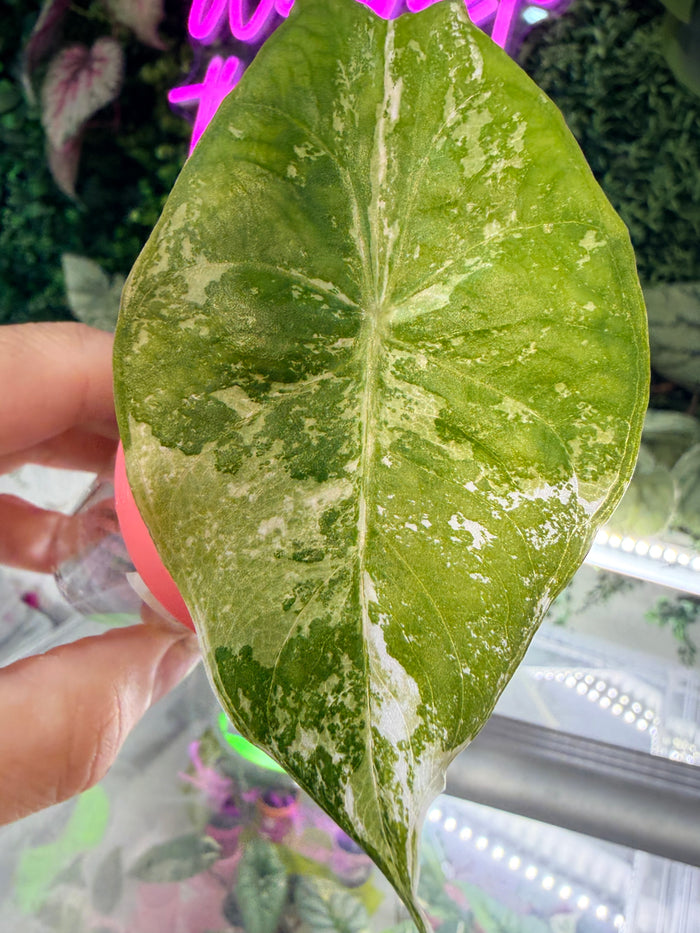
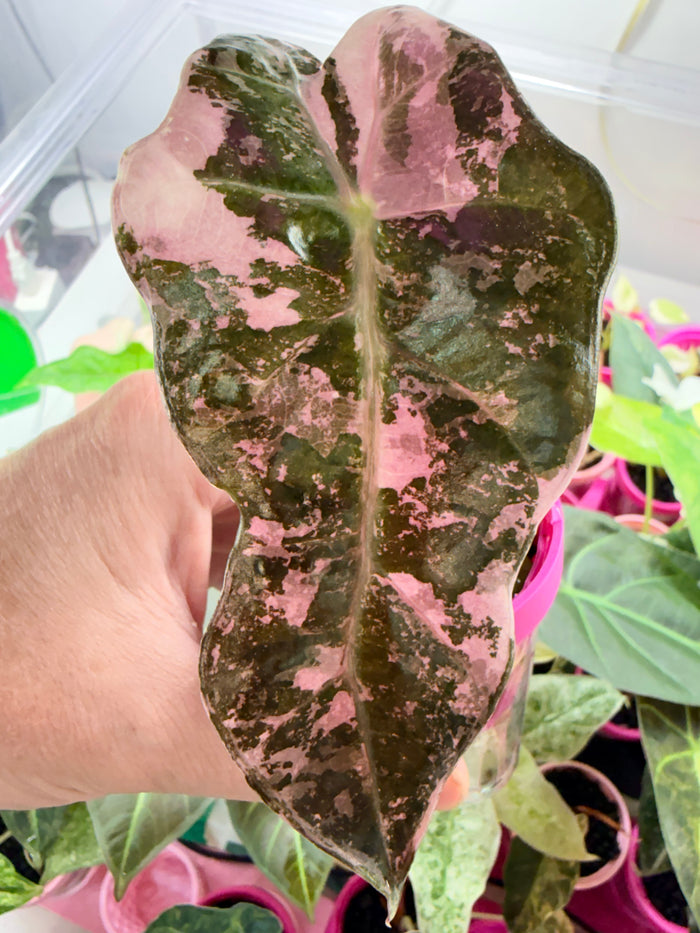
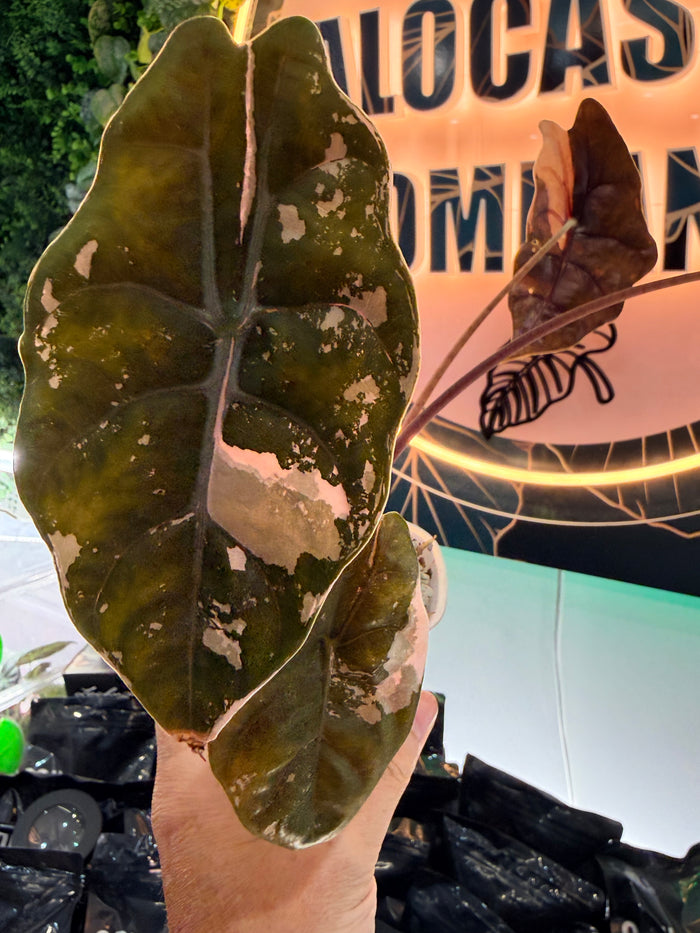
Variegated Alocasia need particular care in winter. The white, cream, pink or yellow sectors that make them so sought-after carry little or no functional chlorophyll, so a leaf that is half albo is in effect photosynthesising with half a leaf. In summer the plant can make up the shortfall; in a UK December, heavily variegated specimens run short of energy much faster than green ones.
Give variegated plants your best light: the brightest window or the prime spot under a grow light. Expect slower growth than green plants in the same conditions, and be more cautious with watering, since slower growth means slower water uptake. Pale sectors are also more prone to browning when humidity is low.
There is a collector's consideration too: new leaves produced in very low light can come through with washed-out sectors, so keeping light levels up helps protect the pattern you paid for. Our complete guide to Alocasia variegation types explains the differences between albo, pink and aurea forms, and how each behaves under stress. Current plants are listed in our albo variegated, pink variegated and aurea variegated collections.
When only the corm is left
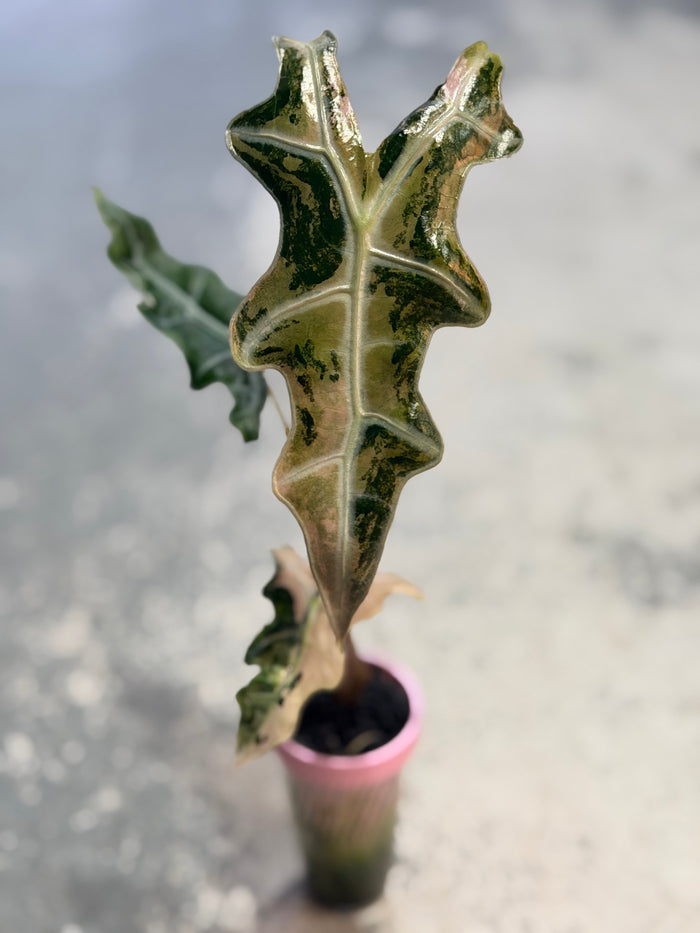
Some Alocasia are far more willing to go fully dormant than others. Cultivars such as Alocasia reginula 'Black Velvet', Alocasia micholitziana 'Green Velvet' (widely sold under the misnomer 'Frydek'), Alocasia zebrina and Alocasia × amazonica 'Polly' are commonly reported to lose all their leaves in a cool, dim winter. An empty pot can be alarming, but if the corm or rhizome is firm, the plant is very often still alive.
Leave the corm in its pot unless you suspect rot. Keep it warm, ideally 18°C or above, and water only enough to stop the substrate drying out completely. Light matters less while there are no leaves, but warmth matters a great deal: a cold, damp corm is the classic route to rot, which is where a heat mat earns its place.
If a plant has collapsed and you have lifted it to check the roots, any healthy, firm corms you find can be started separately. Loose corms are well suited to a humid propagation setup, and our Corm Keeper rack holds corm pots upright and together so they are easy to check and water. The Corm Keeper and Corm Crown guide explains the full system. If you are working with Alocasia corms this winter, be patient: warmth drives sprouting far more than anything else, and our article on how long it takes for a corm to sprout sets out realistic timescales, while why your corms are not sprouting covers the common reasons for a stall.
Waking up in spring
Most dormant Alocasia start to stir between March and May, as days lengthen and indoor temperatures rise. You cannot force a corm to break dormancy on a set date, but you can make sure conditions are right when it is ready.
From early March, move resting plants to your brightest, warmest position or under a grow light. Warmth at the root zone is the strongest signal, so a heat mat can bring things forward. Increase watering gradually, and only as the substrate dries more quickly. The first sign of waking is usually a pointed shoot from the top of the corm or the base of the old stem.
Hold off feeding until that first new leaf has fully unfurled, then restart at around a quarter of your normal strength and build back up over the following weeks. Spring is also the right time to repot, since fresh roots colonise new mix quickly. If you are moving sprouted corms on, our guide on when to move a corm to pon or soil covers timing and technique.
The first leaves after dormancy are often smaller than those the plant lost. That is normal, and each successive leaf through spring and summer should be larger. Our guide to knowing whether your Alocasia is happy covers the signs of a plant back in full growth.
Frequently asked questions
Is my Alocasia dormant or dead?
Check the corm or the base of the stem. Firm, pale inside and odourless means the plant is almost certainly dormant and will regrow in spring. Soft, mushy, dark inside or sour-smelling means rot has set in and needs cutting back to healthy tissue.
Why is my Alocasia dropping leaves in winter?
Lower light and cooler temperatures reduce the energy an Alocasia can produce, so it withdraws resources from older leaves. Losing lower leaves one at a time is normal in a UK winter; several collapsing together, especially in wet compost, points to overwatering or cold damage.
Should I water a dormant Alocasia?
Yes, but very sparingly: just enough to stop the substrate drying out completely, usually a small amount every few weeks. Keeping a cool, leafless corm wet is the most common cause of winter rot.
Should I feed my Alocasia in winter?
Only if it is still actively growing, for example under grow lights in a warm room, and then at half strength or less. Plants resting as a corm should not be fed until new growth appears in spring.
What temperature is too cold for Alocasia?
Growth slows markedly below about 15 to 16°C, and prolonged temperatures below around 10°C risk damage. Aim for 18°C or above, and be wary of windowsills at night, which can be several degrees colder than the room.
How do I wake an Alocasia from dormancy?
From March, give it your warmest, brightest spot, ideally with bottom heat from a heat mat, and increase watering as the substrate dries faster. Once the first new leaf has unfurled, resume feeding at low strength and build up over several weeks.
Questions about winter dormancy, a plant that has lost its leaves, or setting up grow lights for your collection? Contact our team for guidance from growers who manage a full collection of rare Alocasia through every British winter in our UK-based private nursery. Send us a photo of the plant and the corm, and we will help you work out what is happening and what to do next.