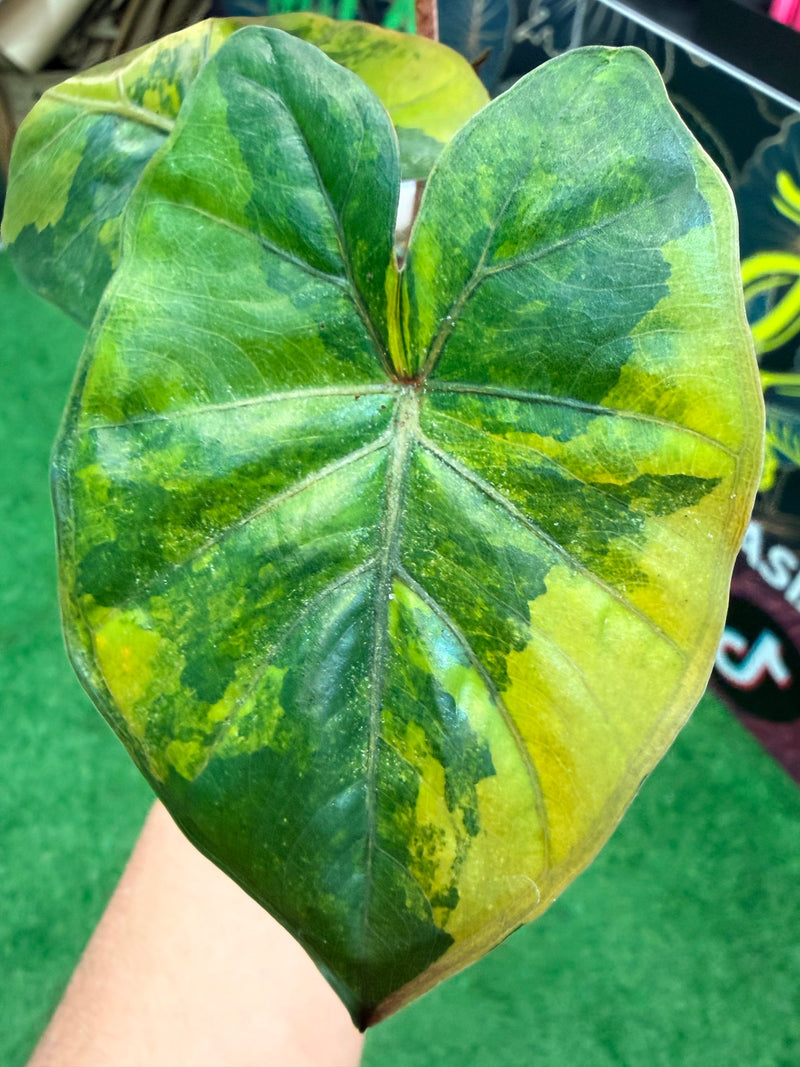
Alocasia macrorrhizos is the giant taro: the largest Alocasia most growers will ever keep, and one of the oldest in cultivation. Where the jewel Alocasia are small, slow and particular, macrorrhizos is big, quick and comparatively forgiving. It is also the parent species behind several of the variegated plants collectors ask us about most, from the whip-tipped 'Stingray' to the dark-stemmed 'Black Stem' and the purple-toned 'Plumbea'. This page brings them together: what defines the species, how its care differs from the smaller Alocasia, and where to find each of our collector guides.
What defines Alocasia macrorrhizos
The accepted name is Alocasia macrorrhizos (L.) G.Don. Linnaeus first described the plant as Arum macrorrhizon, and George Don moved it into Alocasia in 1839. Kew's Plants of the World Online gives the native range as central Malesia to Queensland: the Philippines, Borneo, Sulawesi, Maluku, New Guinea, the Bismarck Archipelago, the Solomon Islands and the Murray Islands of far northern Queensland. It has since been introduced across much of the tropics.
Few ornamental Alocasia have a history like it. Giant taro has been grown as a food crop for thousands of years, with the starchy stem roasted, baked or boiled, and it remains part of traditional agroforestry in parts of the Pacific and South Asia. Alastair Hay, whose work underpins modern Alocasia taxonomy, has suggested the domesticated form most likely arose in the Philippines. Elsewhere it is grown mainly as an ornamental.
Macrorrhizos or macrorrhiza?
You will see both spellings on labels and in older books. The correct form is macrorrhizos, and it is the spelling Kew uses. The epithet is a Greek-derived compound adjective meaning "large-rooted"; its "-os" ending already agrees with the feminine genus, so it should not be changed to "-a". "Macrorrhiza" is common in the trade, and several of our product listings still carry it, but it is a misspelling rather than a different plant.
Plant characters
- Size: a large, evergreen plant with a thick, fleshy, upright stem. In the tropics it can reach around 4 metres, with leaf blades a metre or more long. Indoors in the UK it stays far smaller, but it is still a big plant.
- Leaves: broadly arrow-shaped to heart-shaped, glossy and held upright or angled on long, stout petioles.
- Growth: fast, with a new leaf every few weeks in good conditions, and a root system to match.
'Stingray', 'Black Stem' and 'Plumbea'
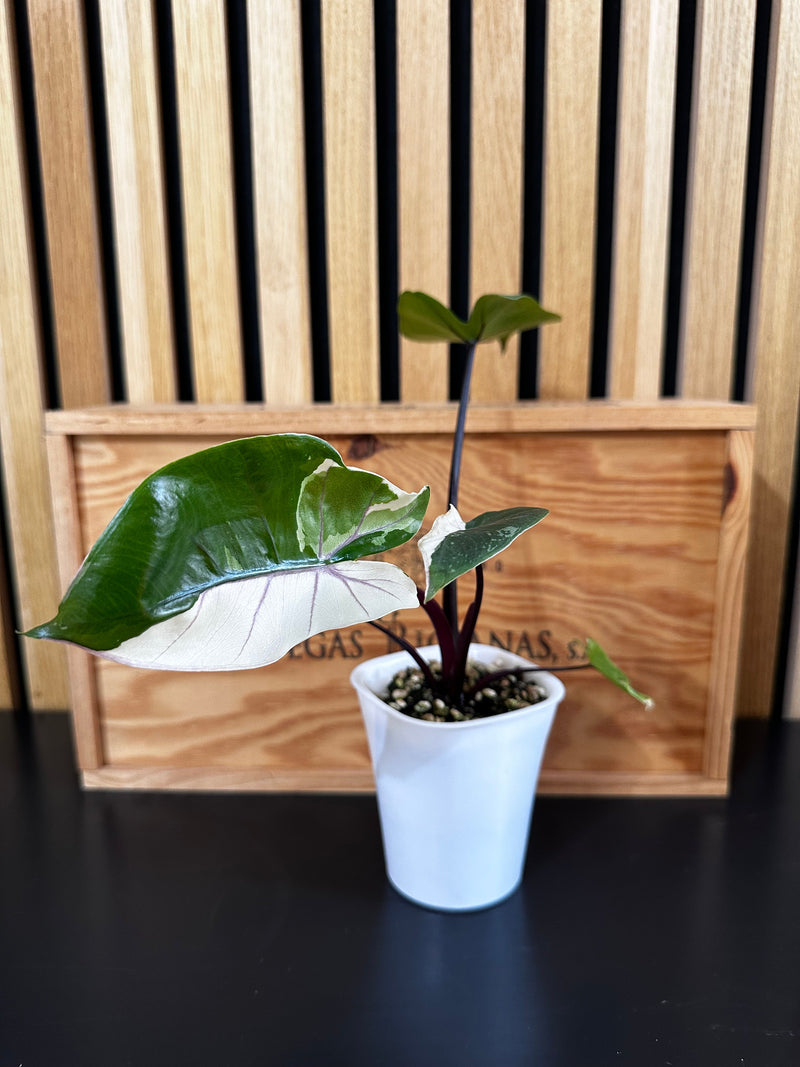
The three named forms in our guides are all Alocasia macrorrhizos. 'Stingray' is a mutant form in which the leaf blade is rounded and cupped, with wavy margins, and the tip narrows abruptly into a long, thin, tail-like extension of the midrib. It is reported to have come into the trade from Southeast Asia and to have reached Western growers in the early 2000s. 'Black Stem' is named for its very dark, almost black petioles; the name is established in the trade even though the colour is on the leaf stalks rather than a true stem. 'Plumbea' is one of the oldest named forms, documented in the 1850s and once published as Alocasia plumbea, a name Kew now treats as a synonym of the species. It is known for dark, purple-toned petioles and a bronze to purplish cast to the leaves, especially on the underside. It is also traded as 'Nigra' or 'Plumbea Nigra', and you will often see it written as 'Plumbeas'; 'Plumbea' is the usual spelling.
A note on toxicity
Like most aroids, giant taro contains needle-shaped crystals of calcium oxalate. The sap can irritate skin, mouth and throat, and the plant is harmful if eaten raw; where it is grown as food, it is always cooked or processed first. Keep it away from pets and children, and wear gloves when trimming it or handling the corm.
Growing Alocasia macrorrhizos: what is different
The fundamentals in our complete Alocasia care guide all apply. A few points matter more with macrorrhizos than with the jewel species:
- Space and pot size: this plant needs room overhead and around it. It fills a pot with roots quickly, so move it up in size as it grows, and choose a heavy or wide pot that will not tip once the leaves are large.
- Feeding: a hungry plant. Feed regularly through the growing season following our balanced feed programme; our fertiliser guide covers the options.
- Light: bright light, towards the upper end of what you would give most Alocasia. Mature plants tolerate some gentle direct sun, but variegated forms scorch more easily. In a UK winter, supplementary light makes a clear difference; see our guide to LED grow lights.
- Tolerance: it copes with lower humidity and a normal room far better than the jewel types. It still dislikes cold, draughts and roots sitting wet.
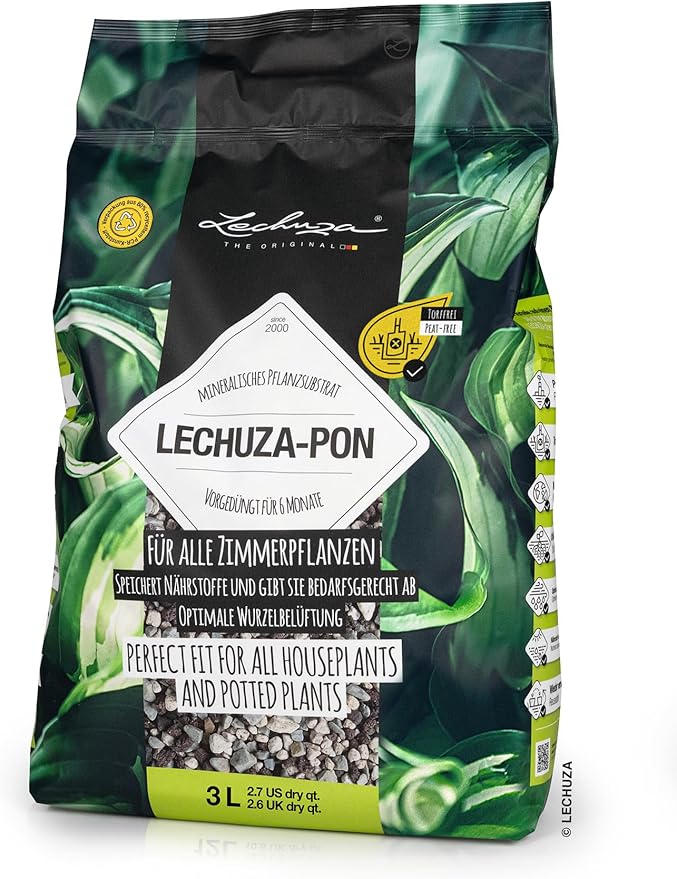
- Substrate: an open, free-draining mix that still holds enough moisture for a thirsty, fast-growing plant. Our substrate guide explains the blend we use.
- Winter: as light levels fall, growth slows and a plant may lose its older leaves or pause almost entirely. This is normal. Reduce watering and feeding to match, and read our winter care and dormancy guide before the clocks go back.
Variegated forms carry less chlorophyll than the plain species, so they grow more slowly, need the brighter end of the light range and are less tolerant of rough treatment.
Our Alocasia macrorrhizos collector guides
| Name | Variegation type | Collector guide | Availability |
|---|---|---|---|
| Alocasia macrorrhizos 'Stingray' Aurea | Aurea | Read the guide | View the plant |
| Alocasia macrorrhizos 'Stingray' Albo Pink | Albo and pink | Read the guide | View the plant |
| Alocasia macrorrhizos 'Black Stem' Albo | Albo | Read the guide | View the plant |
| Alocasia macrorrhizos 'Plumbea' Aurea | Aurea | Read the guide | View the plant |
For every other species and form we have written about, see our rare Alocasia A to Z.
A note on variegation in macrorrhizos
The variegated macrorrhizos forms fall into two main groups. Aurea variegation gives yellow to cream sectors and marbling, and our explainer on aurea variegation covers how it behaves. Albo variegation gives white sectors, which carry no chlorophyll at all; see our guide to albo variegation. In both, the pattern can shift from leaf to leaf, and heavily white or yellow leaves are the most prone to browning at the edges. On a plant this large, a balance of green and colour is what keeps it growing strongly. The complete guide to Alocasia variegation types sets out how the patterns differ.
Frequently asked questions
Is it Alocasia macrorrhiza or Alocasia macrorrhizos?
Alocasia macrorrhizos is the correct spelling and the one Kew uses. "Macrorrhiza" is a common misspelling, not a separate species.
How big does Alocasia macrorrhizos grow indoors?
In the wild it can reach around 4 metres. Indoors in the UK it is limited by light, warmth and pot size, but a well-grown plant can still become large enough to need a room corner of its own. Variegated forms are generally smaller and slower.
Is 'Stingray' a separate species?
No. 'Stingray' is a mutant form of Alocasia macrorrhizos, grown and traded under that name for its cupped leaves and long, tail-like leaf tip.
Is Alocasia macrorrhizos toxic?
Yes, if eaten raw. The plant contains calcium oxalate crystals that irritate the mouth, throat and skin. Keep it away from pets and children, and wear gloves when trimming it.
Why is my macrorrhizos losing leaves in winter?
Lower light slows growth, and the plant often drops older leaves or pauses until spring. Cut back watering and feeding, keep it warm, and add supplementary light if you can. Soft stems or a soft corm are a different matter: see our root rot guide.
If you are looking for a particular macrorrhizos form, or would like advice on one already in your collection, get in touch. You can also join the drop list to hear when new plants are released.