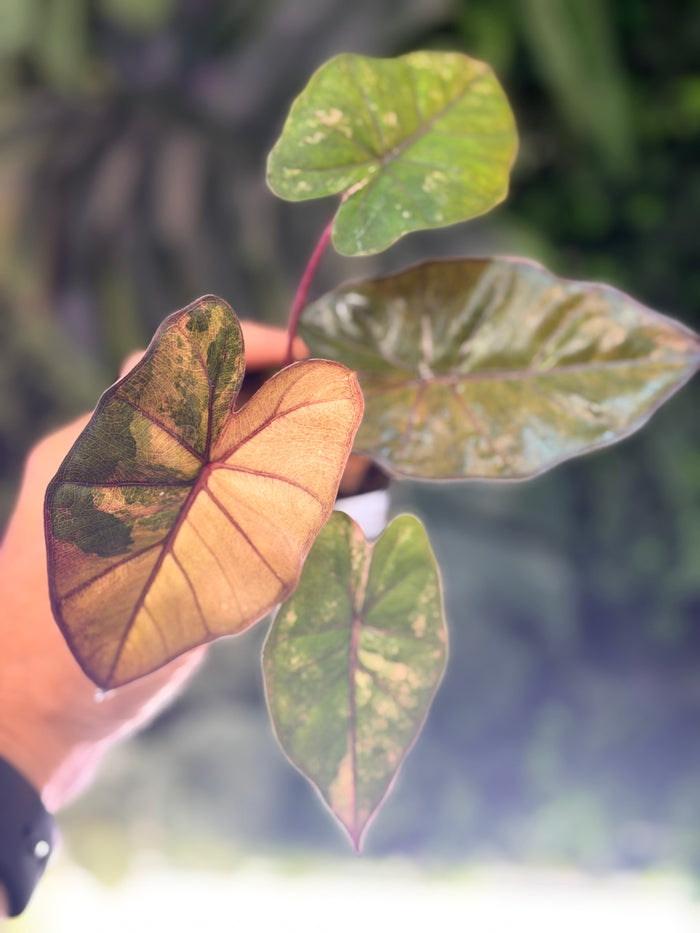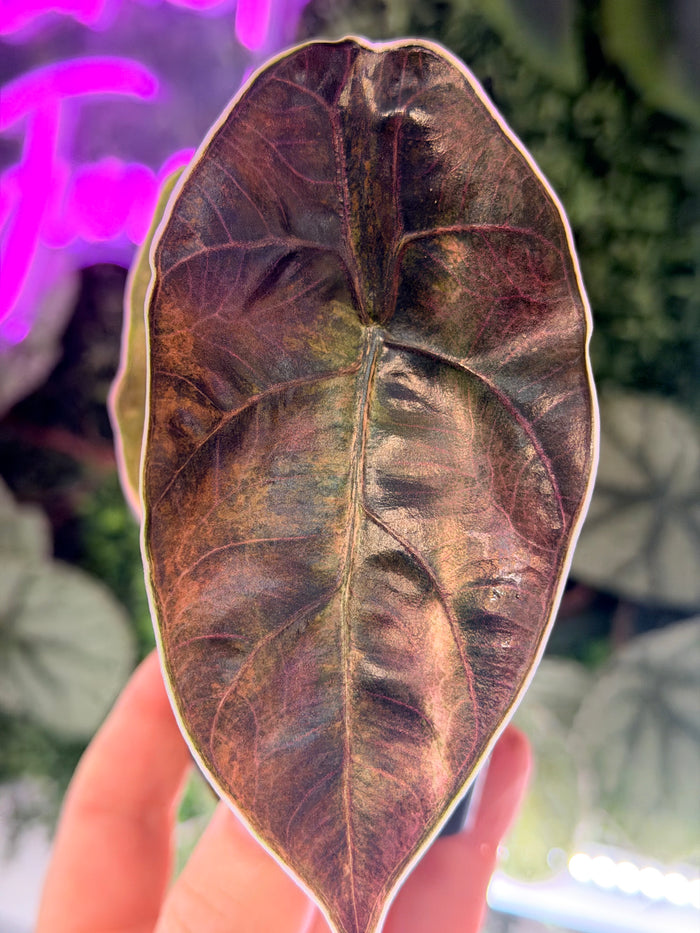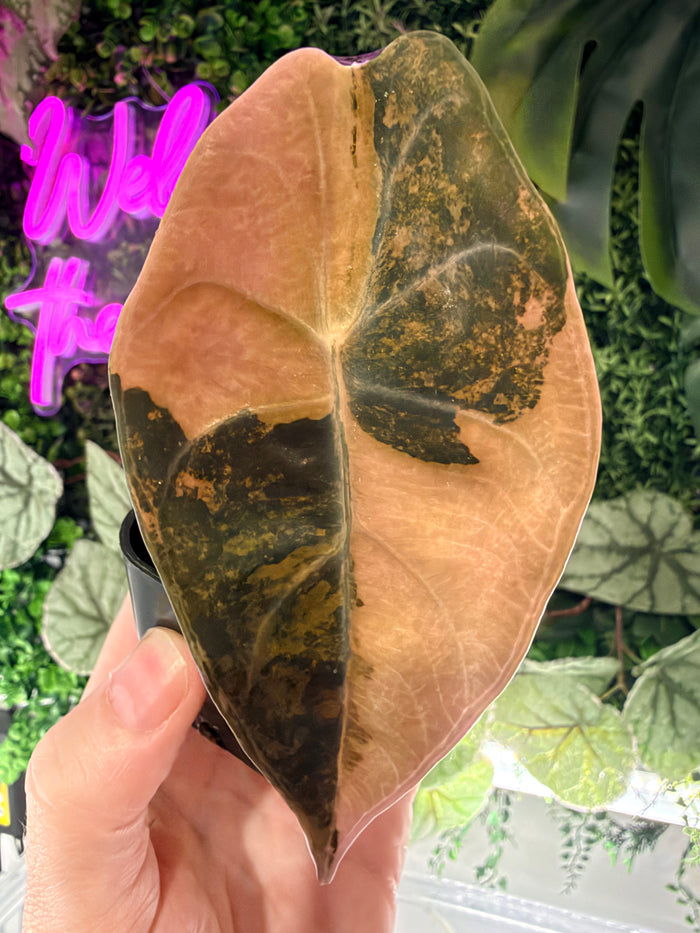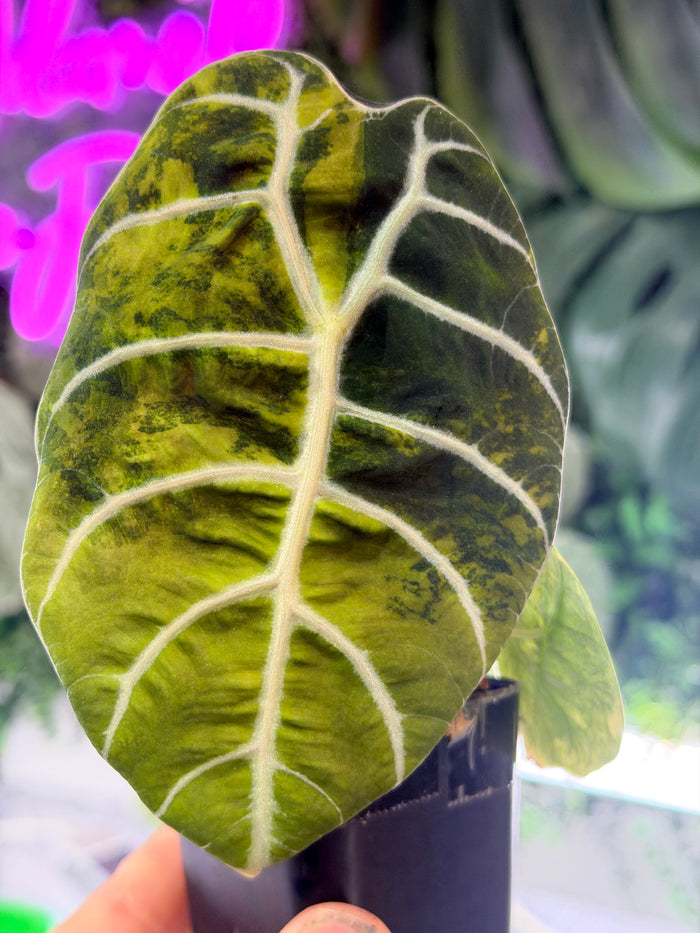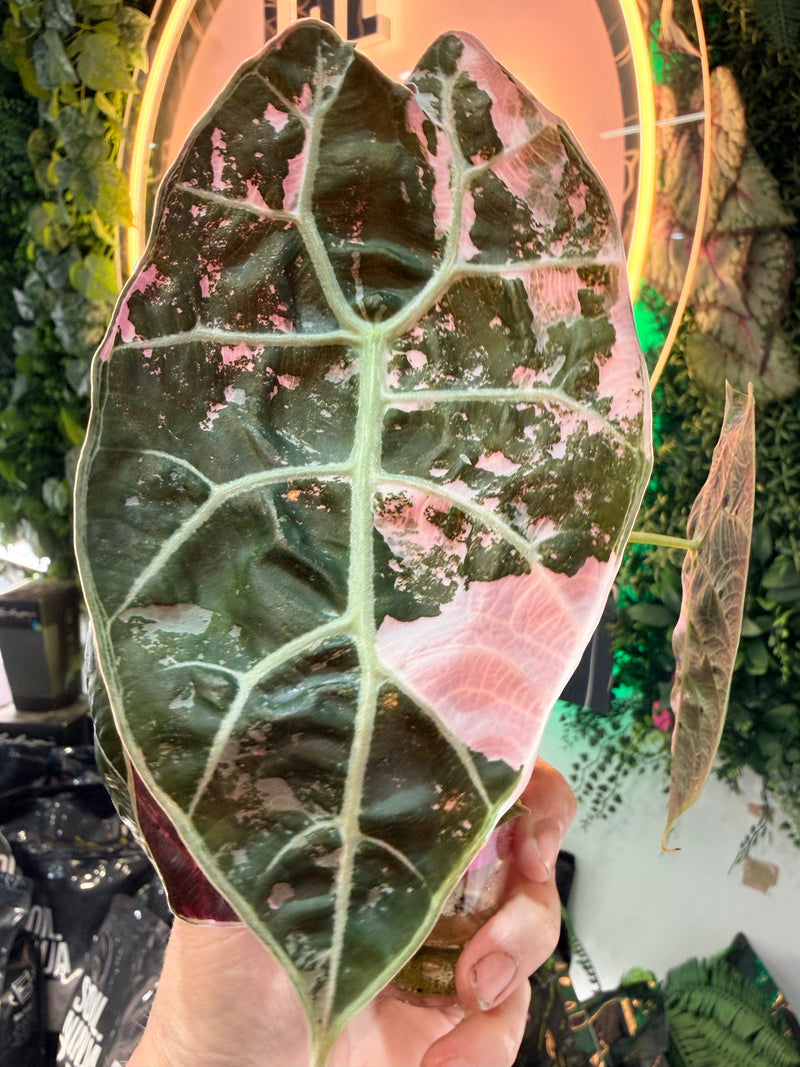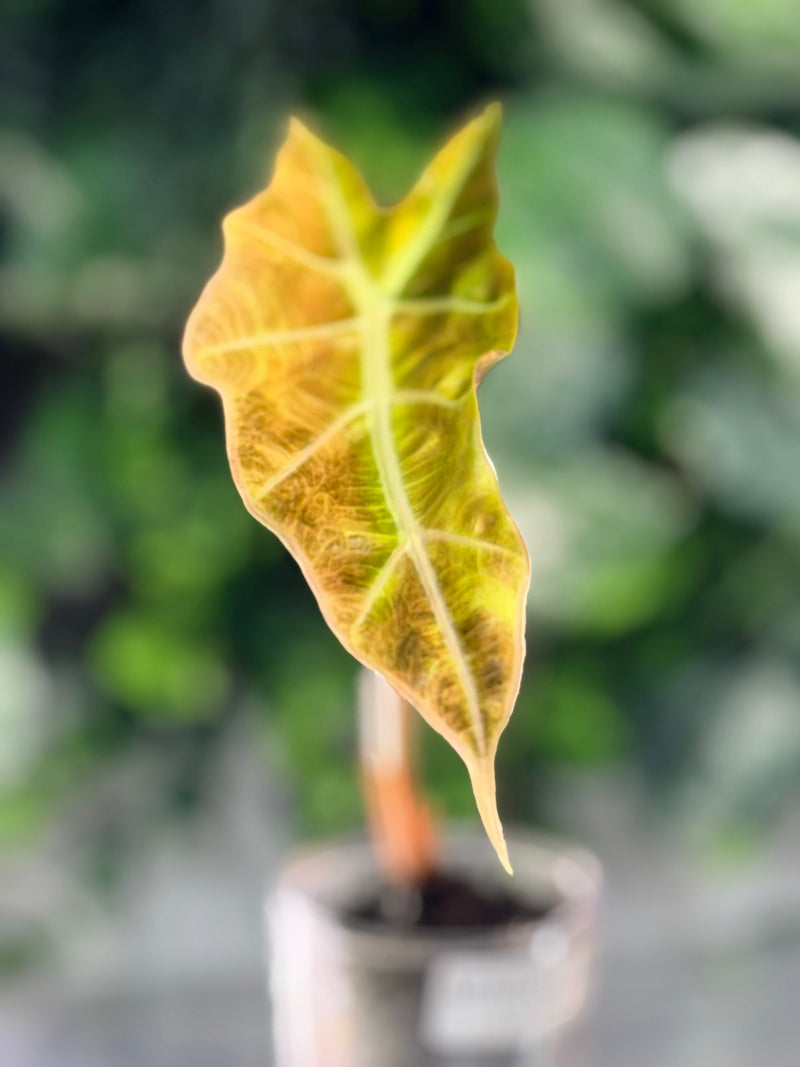


The Alocasia Plumbeas Aurea is a golden (aurea) variegated form of Alocasia macrorrhizos 'Plumbea', a very old cultivar of the giant taro. This guide covers what Aroidpedia documents about 'Plumbea', the species behind it, what aurea variegation means, and how to care for the plant.
What is Alocasia macrorrhizos 'Plumbea'?
Aroidpedia describes 'Plumbea' as one of the oldest known cultivars of Alocasia macrorrhizos. The earliest illustration it cites appeared in the German journal Berliner allgemeine Gartenzeitung in 1857. Aroidpedia describes it as having green upper leaf surfaces, bronze undersides and reddish petioles. The page does not give a size, parentage or care notes, and it does not list a variegated form.
Aroidpedia has no separate entry for an aurea 'Plumbea'. Everything specific to the aurea form below therefore rests on general knowledge of aurea variegation, not on a documented cultivar record.
Where does the name Plumbea come from?
Aroidpedia says the name refers to the leaf undersides, whose colour resembles leaded bronze, from the Latin word for lead. It lists several synonyms, including 'Plumbea Nigra', Alocasia atropurpurea and Alocasia metallica. It also warns that Alocasia cuprea was published under the same Latinised name around the same time, so the two should not be confused.
The species: Alocasia macrorrhizos
Aroidpedia gives the native range of Alocasia macrorrhizos as the Bismarck Archipelago, Borneo, Maluku, New Guinea, the Philippines, Queensland, the Solomon Islands and Sulawesi, and notes it is widely introduced elsewhere in Asia. It was described by Robert Sweet in Hortus Britannicus in 1839. The epithet comes from Greek words meaning large and root.
It is a large, evergreen plant that can form a trunk reaching about 4 m, with leaf blades commonly 70 cm to over 1 m long. Wikipedia adds that it is also native to the Murray Islands group in the Torres Strait, and that giant taro was domesticated early in the Philippines, by Austronesians thousands of years ago, and spread through Maritime South-East Asia into the Pacific, where it became a staple starch crop. Its sap contains needle-like calcium oxalate crystals that irritate skin, so handle it with care, and keep it away from pets and children. Our Alocasia macrorrhizos species guide covers the species in more depth.
What does aurea variegation look like?
Aurea variegation is yellow to golden tissue with reduced chlorophyll, where carotenoid pigments are retained. It differs from albo, where sectors are white and contain no chlorophyll, and from pink, which is anthocyanin-based. Aurea sectors are chimeric and can be unstable, and chimeric variegation might also not carry over to plants grown from corms.
Our guide to aurea variegation in Alocasia explains the mechanism, and the complete guide to variegation types compares all the forms. You can browse the range in our aurea variegated Alocasia collection.
How does it compare with similar plants?
Aroidpedia's 'Plumbea' page includes an illustration comparing four often-mislabelled plants: Alocasia sarawakensis, Alocasia 'Yucatan Princess', 'Plumbea' and Alocasia 'Serendipity'. Our guides to Yucatan Princess Pink Variegated and Serendipity could help you compare them. Another aurea selection on a large species is Melo Aurea.
How to care for Alocasia Plumbeas Aurea
This is general Alocasia care, and it applies to this plant as it does to our other rare Alocasia.
- Light: bright indirect light with LED grow light supplementation. Variegated tissue needs good, steady light to hold its colour.
- Temperature: 20 to 27°C, with a heat mat if the room runs cool.
- Humidity: 60 to 80%, maintained with a dedicated humidifier.
- Watering: water when the top 2 to 3cm has dried, and never leave the pot standing in water, which invites root rot.
- Substrate: Fluval Stratum is our preferred choice.
- Feeding: our Alocasia feed from the plant feed range, at half strength.
Our ultimate Alocasia care guide goes through each of these in detail.
Propagating from corms
Our Alocasia corm propagation guide describes the self-wicking method: corms sit in Fluval Stratum inside the Corm Keeper, which draws moisture up evenly. See also growing corms in Fluval Stratum.
Frequently asked questions
Is Plumbeas Aurea a species or a cultivar?
It is a variegated form of Alocasia macrorrhizos 'Plumbea', itself a cultivar of that species.
Is 'Plumbea' really dark?
Aroidpedia describes green upper surfaces with bronze undersides and reddish petioles, so a near-black upper surface is not what the record supports.
Is there an Aroidpedia entry for the aurea form?
No. We found an entry for 'Plumbea' and for the species, but not for an aurea selection.
How large does it grow?
Aroidpedia gives the species a trunk up to about 4 m. No size is documented for this cultivar, so treat it as a large plant.
Is it toxic?
The species contains calcium oxalate raphides in its sap, which can irritate skin and mouth. Avoid ingestion.
Will the gold colour be stable?
Not reliably. Chimeric aurea sectors can change, and corm-grown plants might not keep them.
Our listing
We release Plumbeas Aurea through our drop model. Join the collector list and view our Alocasia Macrorrhizos Plumbeas Aurea listing.
Questions about Alocasia Plumbeas Aurea or the macrorrhizos family? Contact our team for guidance from specialists who grow rare Alocasia in our UK-based private nursery. We will always say plainly what is and is not documented.
From the nursery