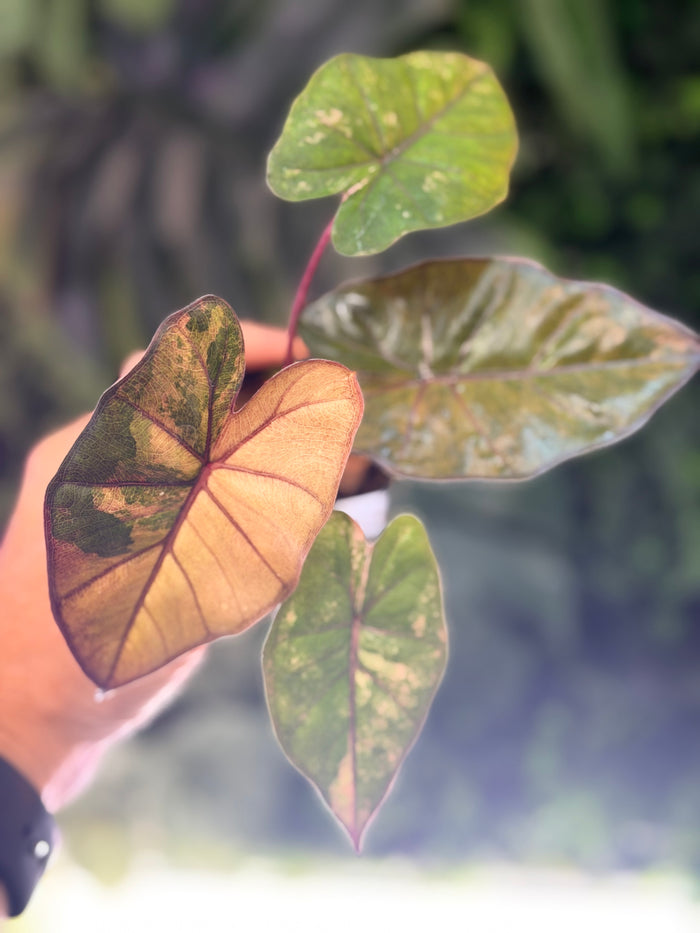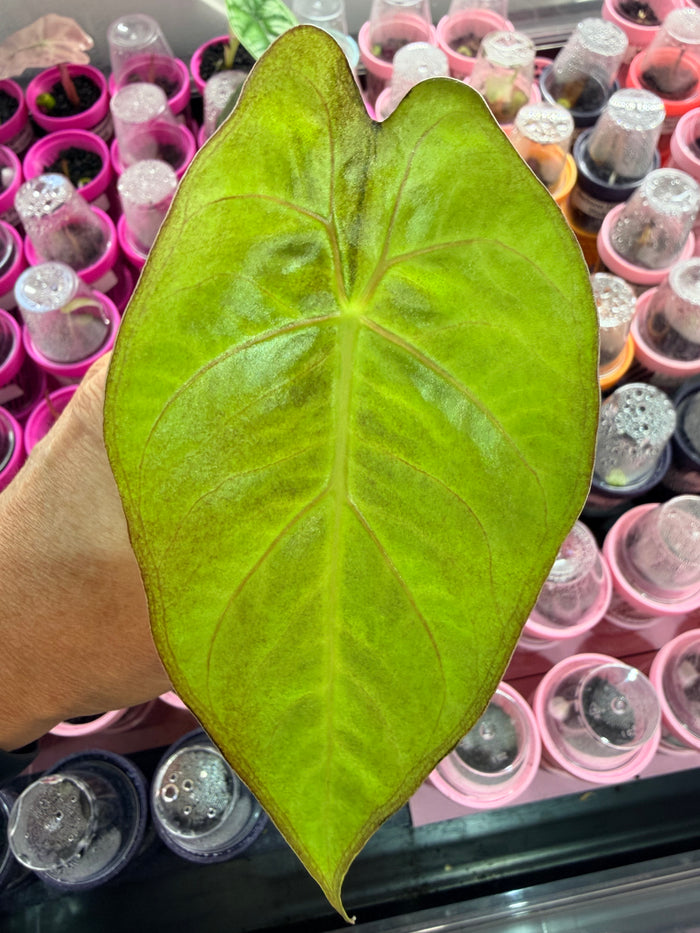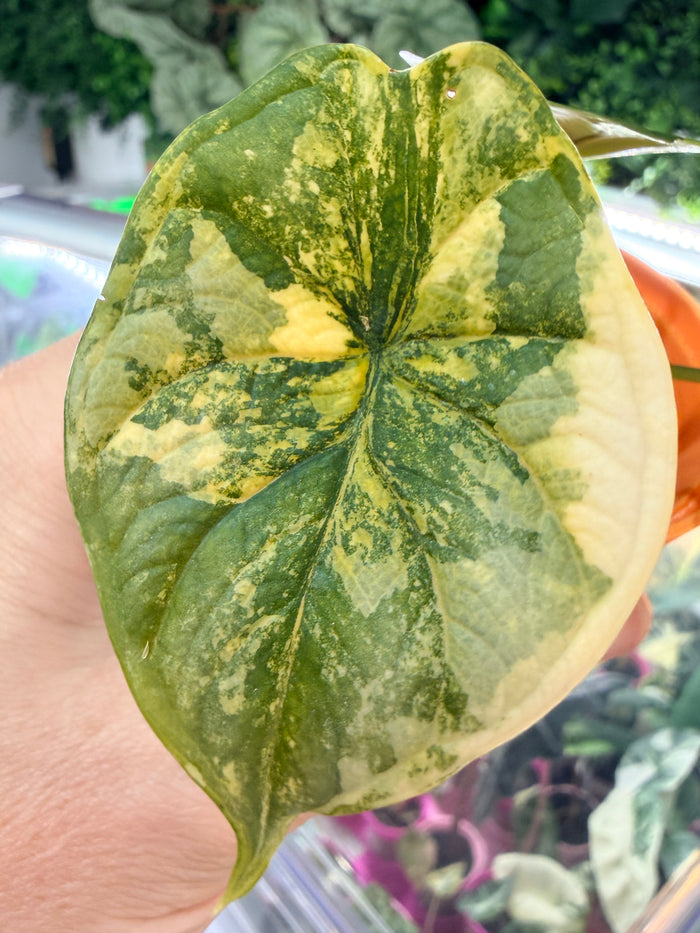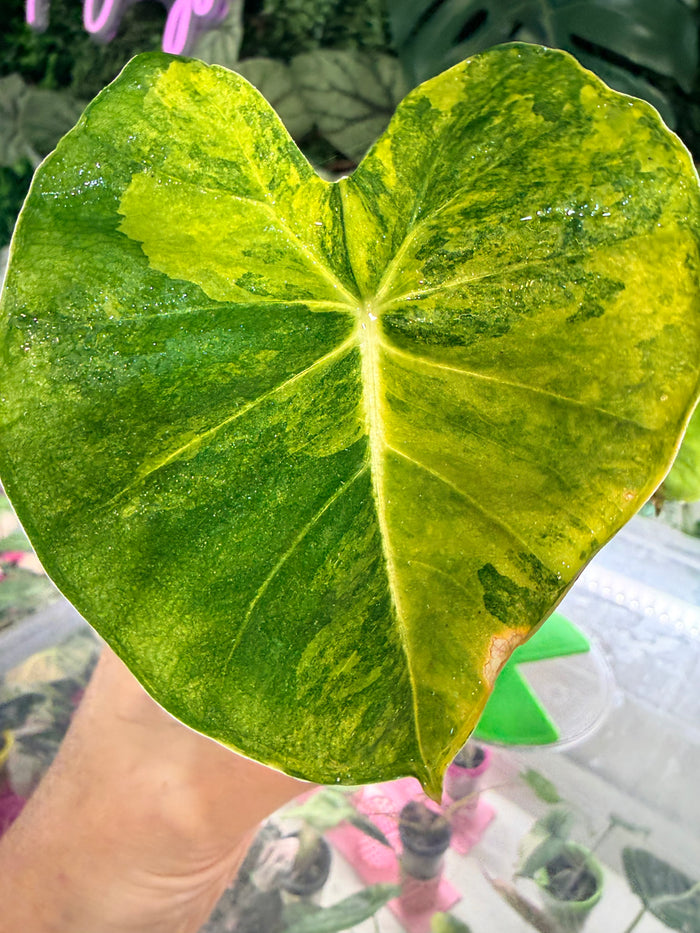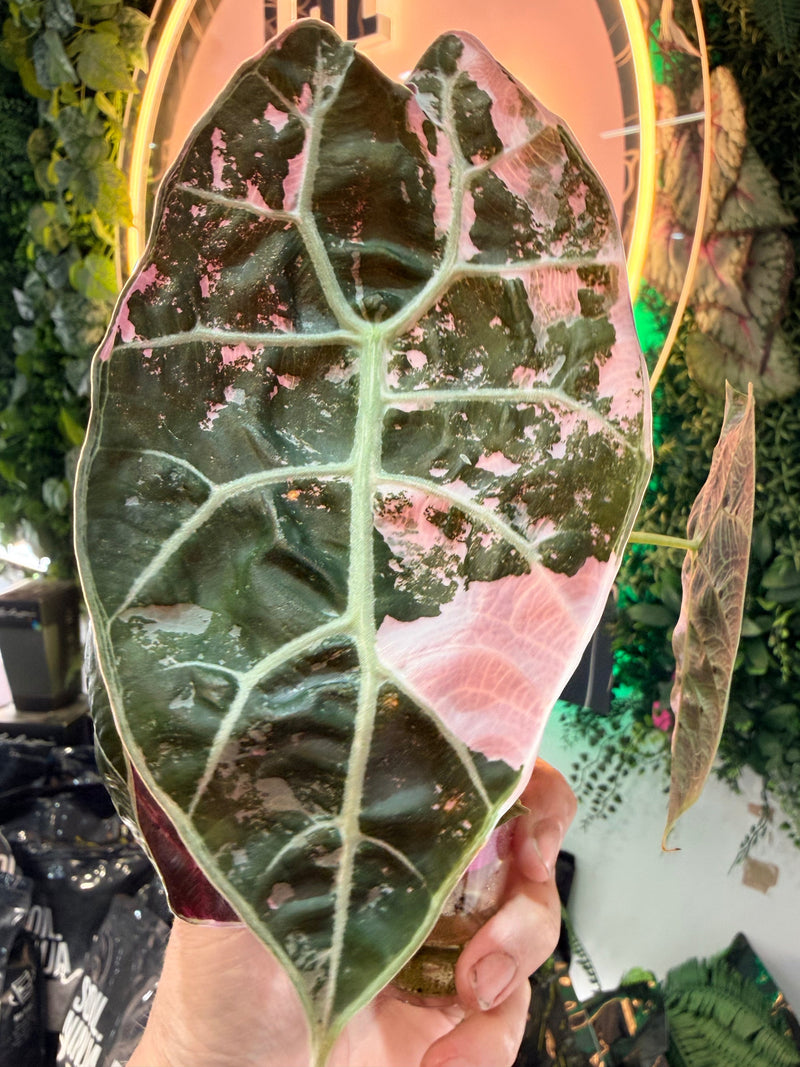

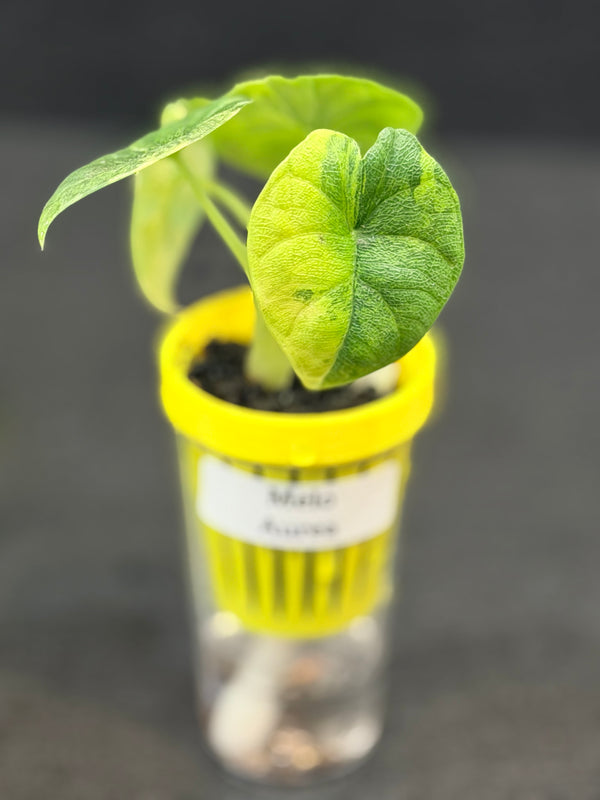
The Alocasia Melo Aurea represents one of the most visually surprising combinations in the current collector Alocasia world. Alocasia melo, endemic to the ultramafic substrate habitats of Sabah, Malaysian Borneo, is a species characterised by near-circular, deeply corrugated, blue-grey to jade-green foliage of exceptional thickness and durability. Its visual character is architectural and geological: a leaf that looks carved rather than grown, cool-toned, structural, and precise. Against this base, golden-yellow aurea sectors create a contrast that is unexpected and genuinely striking, warm light flooding what would otherwise be a composition of cool and deep tones, the carotenoid pigments of aurea variegation appearing almost luminous against the particular depth of melo's natural colouration.
This guide covers the Melo Aurea specifically, the nature of its aurea expression, how it interacts with this species' extraordinary leaf character, and the specific care requirements for maintaining vivid golden variegation on this demanding but rewarding specimen. Those new to Alocasia melo are encouraged to read our guide to the Melo Albo Variegated first, which covers the species background and ecological context in full detail.
Aurea Variegation on Alocasia melo: The Visual Character
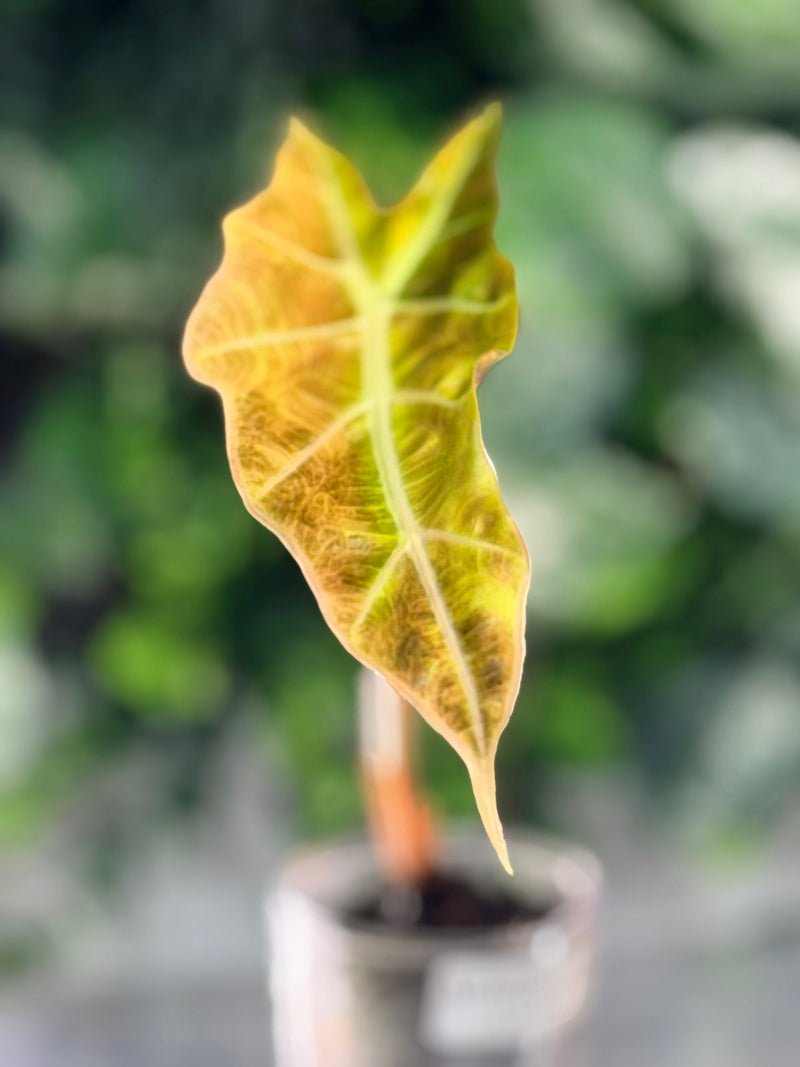
Aurea variegation in Alocasia produces golden-yellow sectors through the accumulation of carotenoid pigments, xanthophylls and carotenes, in tissue where chlorophyll synthesis has been partially suppressed. Unlike chimeric albo variegation, where affected cells have entirely lost chlorophyll production capability, aurea sectors retain some photosynthetic capacity. The golden colouration arises because without the masking effect of full chlorophyll concentration, the carotenoid pigments in the cell become visually dominant, producing the warm yellow expression that characterises this variegation type.
On Alocasia melo, the aurea expression interacts with the species' distinctive leaf character in specific and visually interesting ways. The deeply corrugated surface of the blade means that golden sectors appear within a three-dimensional landscape, ridges and valleys that catch light differently in yellow sectors versus the surrounding blue-grey green tissue. The contrast between warm yellow and the cool, slightly metallic base green of Alocasia melo is more dramatic than it would be on a warmer-toned base species, because the specific colouration of melo's foliage sits at the opposite end of the warm-cool spectrum from the golden aurea sectors.
The aurea sectors in the Melo Aurea vary in distribution between leaves, some leaves will carry broad golden panels; others will show smaller, more dispersed patches or streaking across portions of the blade. The three-dimensional corrugation of the surface makes even small aurea sectors visually significant, because they pick up light differently at different points across the rippled surface, creating a shifting, dynamic quality that changes as viewing angle changes.
For the broader context of aurea variegation across the Alocasia genus, the mechanisms, stability factors, and comparison with other variegation types, our dedicated aurea variegation guide provides a comprehensive overview. Our complete variegation guide covers all four Alocasia variegation types in the context of the wider genus.
Vigour and Growing Character
The Melo Aurea tends to be more vigorous than the Melo Albo, for the same reason aurea forms are generally more vigorous than albo forms across the genus: the golden sectors retain some photosynthetic capacity, contributing to the plant's overall energy production rather than representing a purely non-photosynthetic load. This means that the Melo Aurea can sustain somewhat more active growth than the Melo Albo under equivalent conditions, and it tends to be somewhat more forgiving of brief periods of suboptimal care.
That said, Alocasia melo is fundamentally a slow-growing species regardless of variegation type. Its ultramafic substrate origin, in habitats characterised by nutrient poverty, has shaped a growth strategy that prioritises durable, long-lived leaves over rapid foliage production. Collectors who approach this species expecting the growth rates of an Amazonica or a Frydek will be disappointed; those who appreciate the arrival of each new, perfectly formed leaf as the event it is will find the Melo Aurea enormously rewarding.
The light-responsiveness of aurea expression is a useful growing guide. Under optimal light conditions, the golden sectors of the Melo Aurea are vivid and saturated, distinctly yellow against the blue-grey green base. Under reduced light, the residual chlorophyll in the aurea sectors becomes proportionally more dominant, and the sectors progressively greener and less distinctly yellow. Monitoring the saturation of aurea expression is therefore a useful proxy indicator of whether the plant is receiving adequate light, a greening of the aurea sectors before any other symptoms appear is an early signal to increase light provision.
Light Requirements
As with all aurea Alocasia, consistent bright indirect light is the most important environmental requirement for maintaining vivid aurea expression in the Melo Aurea. For UK collectors, this means a position within one to two metres of an east- or west-facing window throughout the year, with LED grow light supplementation.
Alocasia melo's ultramafic, partly exposed habitat means it is naturally accustomed to somewhat higher light levels than forest-floor jewel species. This is reflected in its tolerance for brighter light conditions, it benefits from, rather than suffers from, light levels that would be excessive for a strictly forest-floor species. The target remains bright indirect rather than direct sun, but within the indirect range the Melo Aurea benefits from the brighter end of the spectrum. A full-spectrum LED at 12,000-15,000 lux for 12-14 hours per day represents excellent supplementation for this species.
Direct sun should still be avoided, even the thick cuticle of Alocasia melo will not prevent photodamage to the aurea sectors under sustained direct exposure, and the golden tissue is less protected than fully green tissue.
Temperature, Humidity and Substrate
Temperature and humidity requirements for the Melo Aurea follow the species standard: 20-27°C optimal, 15°C minimum, and ambient humidity maintained at 60-70%. The consistently warm, humid conditions of Sabah's lowland ultramafic forests establish the environmental template, and UK collectors need to actively manage both temperature and humidity to meet these requirements year-round.
Central heating reduces indoor humidity significantly. A dedicated humidifier maintaining 60-70% around your collection is the most reliable solution. Positioning the Melo Aurea away from cold draughts, external walls, poorly insulated windows, and frequently opened doors, protects both the root zone and the foliage from temperature shocks that can cause immediate leaf damage on even this exceptionally durable species. A heat mat beneath the pot maintains root zone warmth.
Fluval Stratum provides the free-draining, well-aerated, mineral-based substrate that Alocasia melo's ultramafic origins require. The key characteristic to maintain is excellent drainage, the species is adapted to substrate through which water moves freely, and any compaction or waterlogging will quickly cause root deterioration. For established specimens, our Lechuza self-watering system with Lechuza PON substrate delivers controlled moisture delivery well matched to the species' needs.
Watering and Feeding
Water thoroughly when the top 2-3cm of substrate is dry, ensure complete drainage, and never allow standing water. Alocasia melo's ultramafic-adapted root system is tolerant of brief dry periods but cannot cope with sustained waterlogging, root rot develops rapidly in poorly draining conditions and the slow growth rate of this species means recovery from root damage takes proportionally longer than in faster-growing Alocasia.
Feed at quarter to half strength balanced liquid fertiliser, significantly less than standard Alocasia feeding recommendations, in respect of the species' evolutionary adaptation to nutrient-poor ultramafic substrate. Over-feeding causes mineral toxicity and root damage in Alocasia melo that can be difficult to diagnose and slow to resolve. Our plant feed range includes balanced formulations appropriate for careful use with this species. Reduce feeding to minimal or zero when growth is at its slowest.
The Melo Aurea in a Collection Context
The Melo Aurea pairs naturally with the standard Alocasia melo and the Melo Albo to demonstrate the range of variegation expression on this species. Within the broader aurea variegated Alocasia collection, it occupies a distinctive position, the only aurea form with the specific corrugated, near-circular leaf architecture of Alocasia melo, creating a visual effect unlike any of the other golden-variegated specimens in the genus.
For collectors interested in the Alocasia melo complex more broadly, the Melo Aurea connects naturally to Alocasia 'Maharani', the Peter Boyce hybrid of Alocasia reginula × Alocasia melo, and to the Maharani Aurea form. Understanding melo as a species is foundational context for appreciating the melo-derived hybrids, and the aurea form demonstrates how dramatically variegation transforms the species' visual character without altering its fundamental leaf architecture.
We release Melo Aurea specimens through our collector drop model, with subscriber list members receiving advance notification and early access. View our current Alocasia Melo Aurea listing for availability, and explore our full rare Alocasia collection for related jewel specimens.
Many collectors build their collection from corms, and propagating them successfully is simpler than it looks. Our Alocasia corm propagation guide covers the self-wicking method we use in the nursery, from choosing a firm corm to keeping it in the right conditions until it sprouts.
Questions about Alocasia melo Aurea, aurea variegation care, or growing ultramafic-adapted Alocasia in a UK environment? Contact our team for expert guidance from specialists who work with rare Bornean jewel Alocasia daily at our UK-based private nursery.