Alocasia Yucatan Princess Pink Variegated: The Complete Collector's Guide

The Alocasia Yucatan Princess Pink Variegated is a pink chimeric form of a plant whose own identity is still unsettled. This guide sets out what is documented about the base plant, 'Yucatan Princess', what is and is not known about its pink variegated form, and how to care for it. Where a detail is not documented, we say so rather than fill the gap.
What is Alocasia 'Yucatan Princess'?
Aroidpedia lists 'Yucatan Princess' on a species-style page marked as undescribed, and states that it is uncertain whether the plant is an undescribed species or a hybrid. Its parentage is not established, so any claim of a confirmed cross should be treated with caution. Aroidpedia's geographic tags point to Indonesia, Malesia and Sulawesi, but the entry does not give a native locality.
In practical terms, it is best understood as a named cultivar of uncertain origin that circulates among collectors. If you are comparing it with the wider group, our rare Alocasia A to Z is a useful starting point.
Where does the name come from?
Aroidpedia says the origin of the epithet is uncertain. It also points out an obvious problem: Alocasia is an Old World genus, so a reference to the Yucatan Peninsula in the Americas cannot describe a natural origin. The name should be read as a trade name rather than a clue to where the plant grows wild.
History and attribution
Aroidpedia credits the hybridiser Brian Williams of Brian's Botanicals with finding the plant, and records that he introduced it into tissue culture with Agristarts around 2011 to 2012. For a time it was sold as a cultivar of Alocasia sarawakensis. Aroidpedia states that the two are unrelated and look quite different, so older labels using that name are best disregarded.
How to identify Alocasia 'Yucatan Princess'
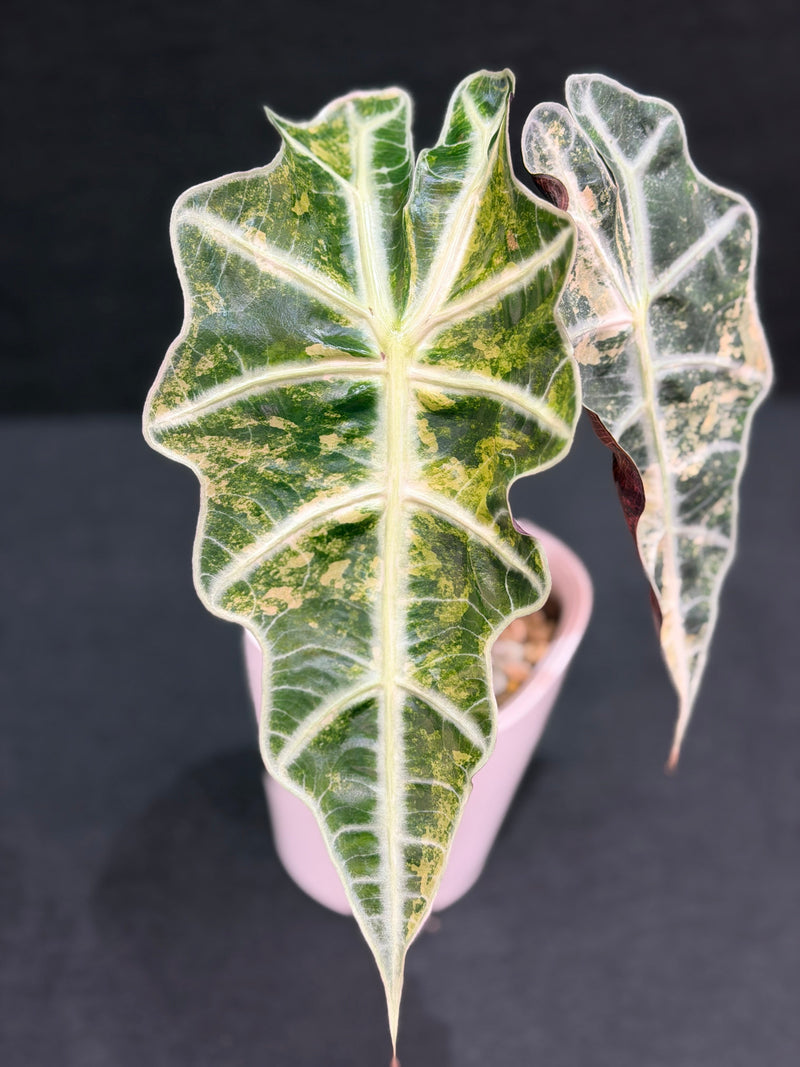
Misidentification is the main caution recorded for this plant. Aroidpedia says it is frequently confused with Alocasia macrorrhizos 'Plumbea' and with Alocasia 'Serendipity', and its comparison rests on two points:
- It has a lower number of primary veins than those look-alikes.
- Its leaf texture is puckered.
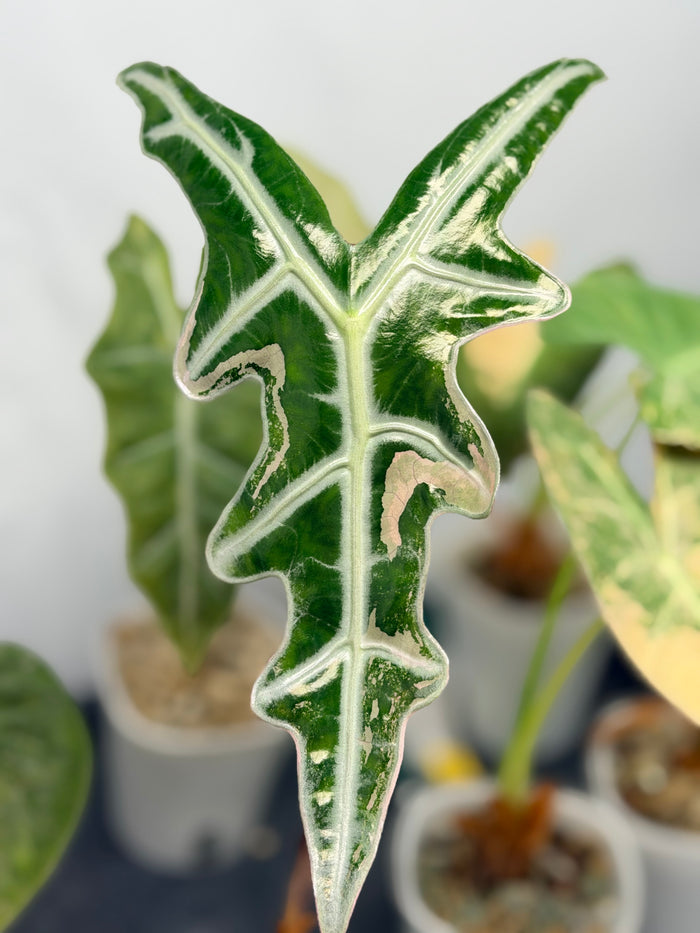
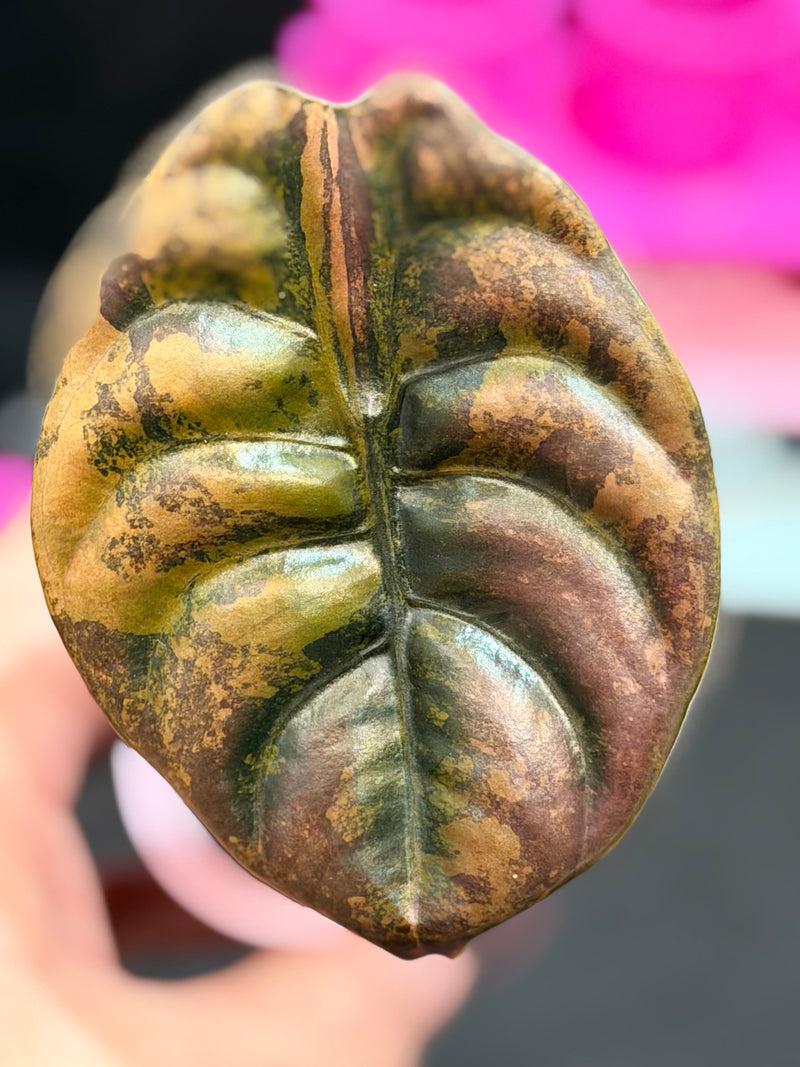
Aroidpedia gives no further leaf description and no mature size, so we do not quote figures for either. In our experience the leaves are dark with a metallic tint and a glossy, leather-like surface, which gives mature specimens a commanding presence. If you want to compare it with those similar plants directly, see our guides to Plumbeas Aurea, which is built on 'Plumbea', and Serendipity.
The pink variegated form
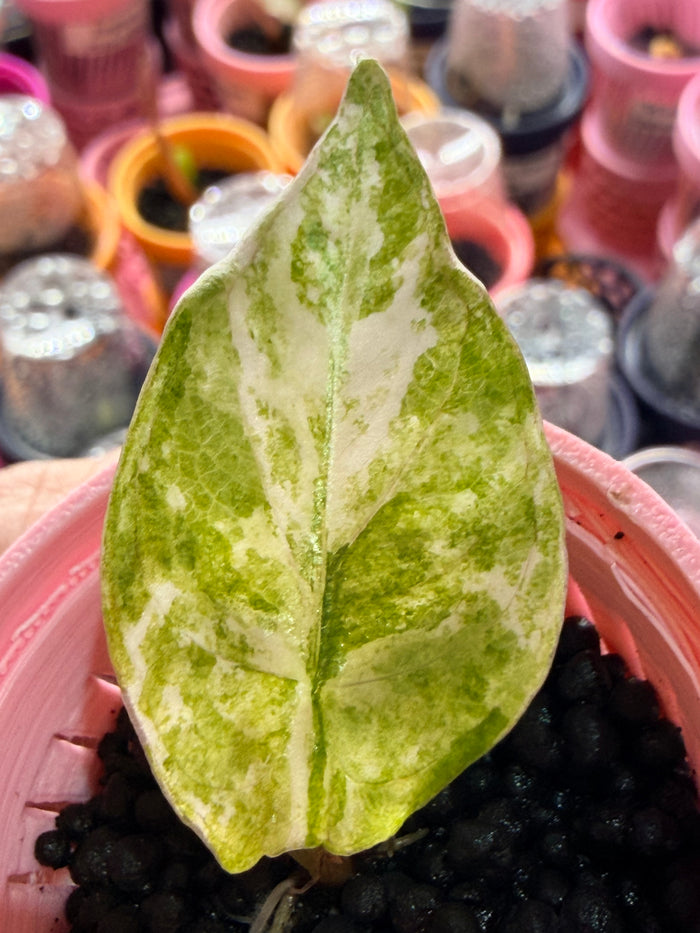
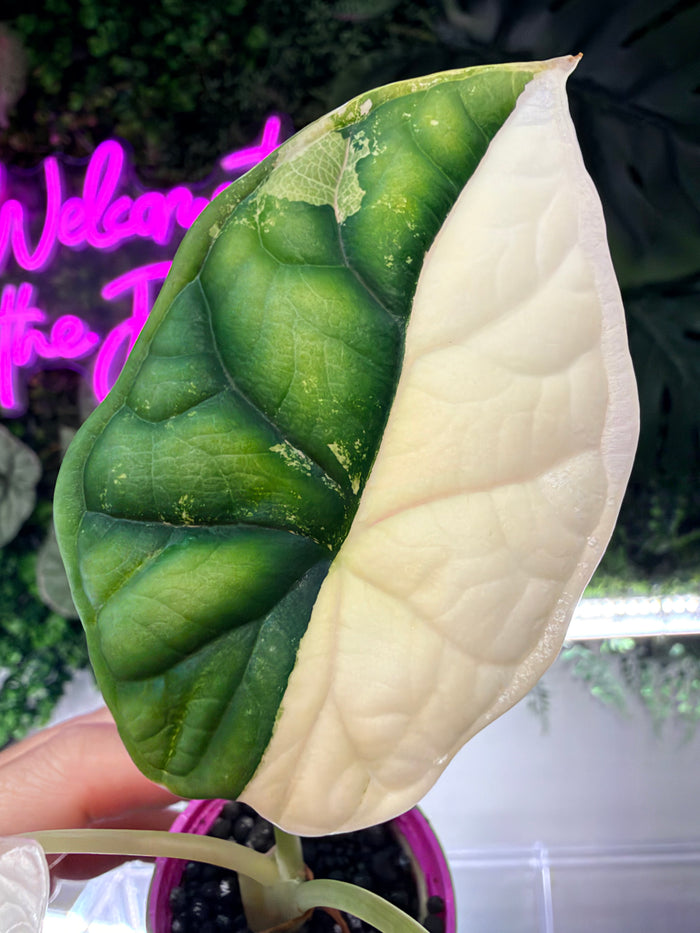
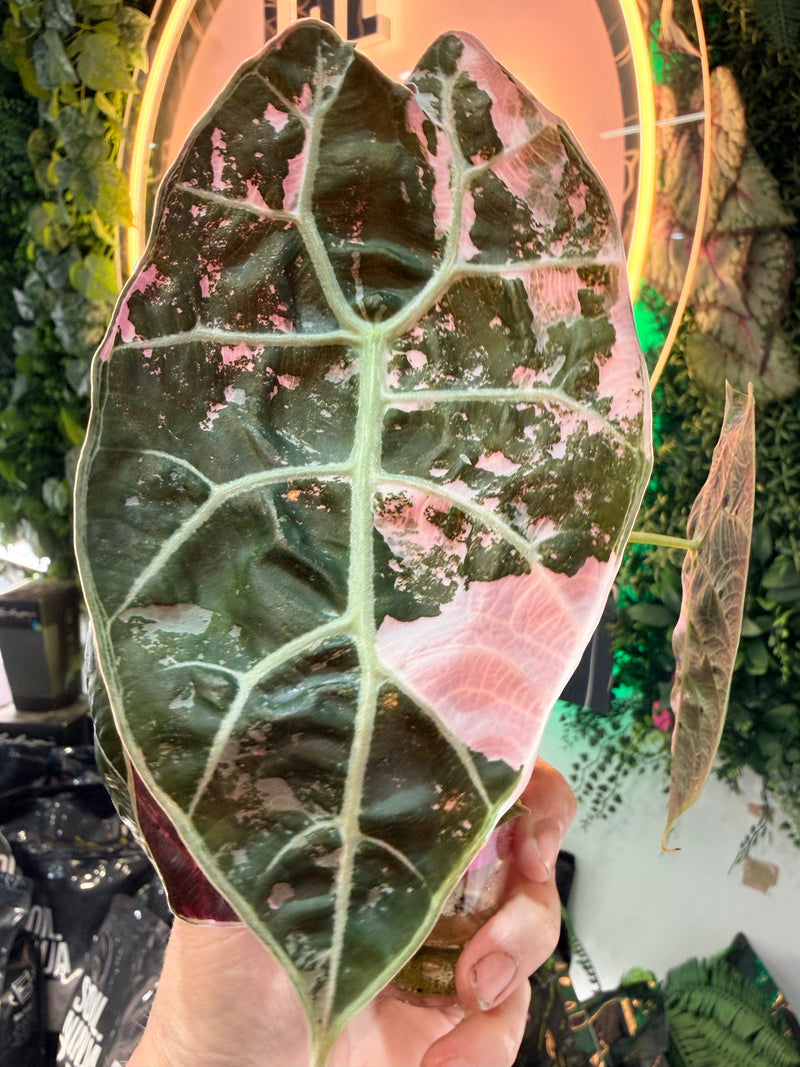
Aroidpedia's entry for the base plant lists mint as its documented variegated form. A pink form is not described there, and we are not aware of a published account of where the pink variegated selection arose. What we can say is general to pink variegation in Alocasia: pink sectors are anthocyanin-based, chimeric, and can be unstable, so the amount and placement of pink varies from leaf to leaf and can change over time. On the dark, metallic base the pink sectors read as an intensely warm disruption of a deep, rich colour, where on a lighter-based species pink reads as a warm accent against a neutral or cool green. The combination has a jewel-like quality, as though the pink sectors are lit from within against the darker surrounding tissue, and the puckered leaf texture adds physical dimension, the ridges and hollows creating light and shadow within the pink areas as they do in the darker base tissue. Pink chimeric sectors retain chlorophyll, which makes this form relatively vigorous.
Chimeric variegation might also not carry over to plants grown from corms, which is worth bearing in mind if you are considering propagating by that route. Our guide to pink variegation in Alocasia explains the mechanism in more depth, and the complete guide to variegation types covers the other forms. You can browse the wider range in our pink variegated Alocasia collection.
How to care for Alocasia Yucatan Princess Pink Variegated
This is general Alocasia care, and it applies to this plant in the same way as to our other rare Alocasia.
- Light: bright indirect light, supplemented with LED grow lights where daylight is limited. Steady light matters for variegated plants. The deep-coloured base means light is especially important: the dark leaves absorb rather than reflect, so adequate light levels are essential for both healthy growth and vivid pink expression. Our article are LED grow lights worth it goes into detail.
- Temperature: 20 to 27°C. If the room runs cool, a heat mat beneath the pot supports the roots.
- Humidity: 60 to 80%.
- Watering: water when the top 2 to 3cm of the substrate has dried, and never leave the pot standing in water. If you suspect problems at the roots, read our root rot guide.
- Substrate: we prefer Fluval Stratum. See also our guide to the best substrate for rare Alocasia.
- Feeding: our Alocasia feed or the wider plant feed range, used at half strength. Our plant feed guide explains the reasoning.
For the full picture, see the ultimate Alocasia care guide and our Alocasia plant care collection.
Propagating from corms
Corms are a practical way to grow more Alocasia, with the caveat above that chimeric pink might not carry through. Our Alocasia corm propagation guide sets out the self-wicking method: corms are kept in Fluval Stratum in the Corm Keeper, which wicks moisture up evenly. For timing, see how long a corm takes to sprout and growing corms in Fluval Stratum.
Frequently asked questions
Is Yucatan Princess a hybrid or a species?
That is not settled. Aroidpedia lists it as undescribed and notes that it could be either a species or a hybrid.
Does it come from the Yucatan?
No. Alocasia is an Old World genus, and Aroidpedia notes the origin of the epithet is uncertain.
How do I tell it apart from Plumbea and Serendipity?
According to Aroidpedia, look for fewer primary veins and a puckered leaf texture.
Is pink variegation stable?
Not reliably. Anthocyanin-based chimeric pink can shift, fade or be lost, and might not carry over to corm-grown plants.
Is it related to Alocasia sarawakensis?
No. It was once sold as a cultivar of Alocasia sarawakensis, but Aroidpedia states the two are unrelated.
Is the pink form documented by Aroidpedia?
Not that we have found. The base plant's entry lists a mint variegated form only.
Our listing
We release Yucatan Princess Pink Variegated through our drop model. Join the collector list and view our Alocasia Yucatan Princess Pink Variegated listing.
Questions about Alocasia Yucatan Princess or its botanical background? Contact our team for guidance from specialists who grow rare Alocasia in our UK-based private nursery. We will always tell you plainly what is and is not documented.
From the nursery