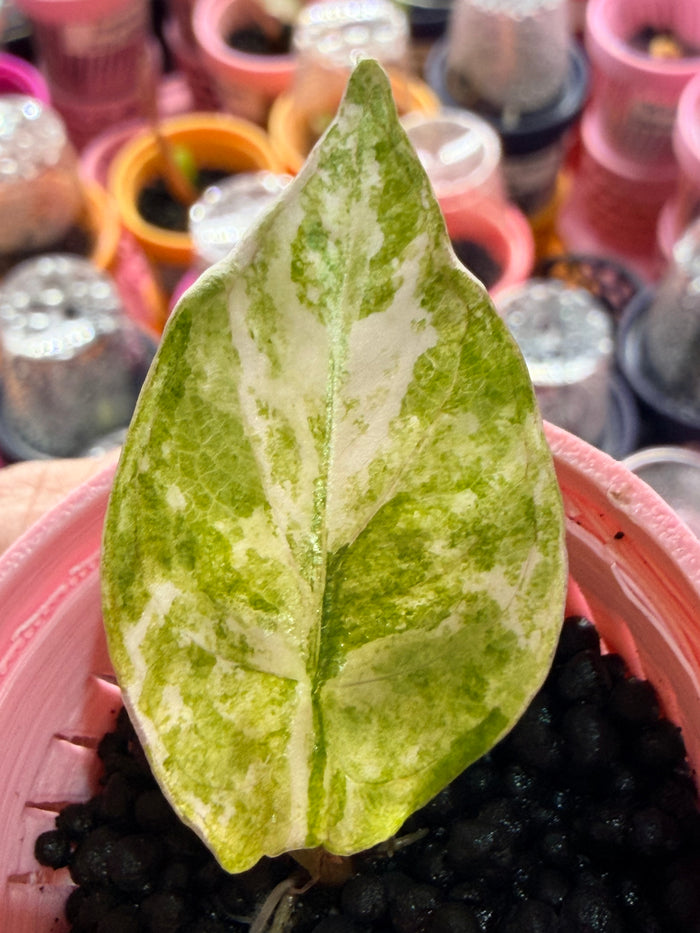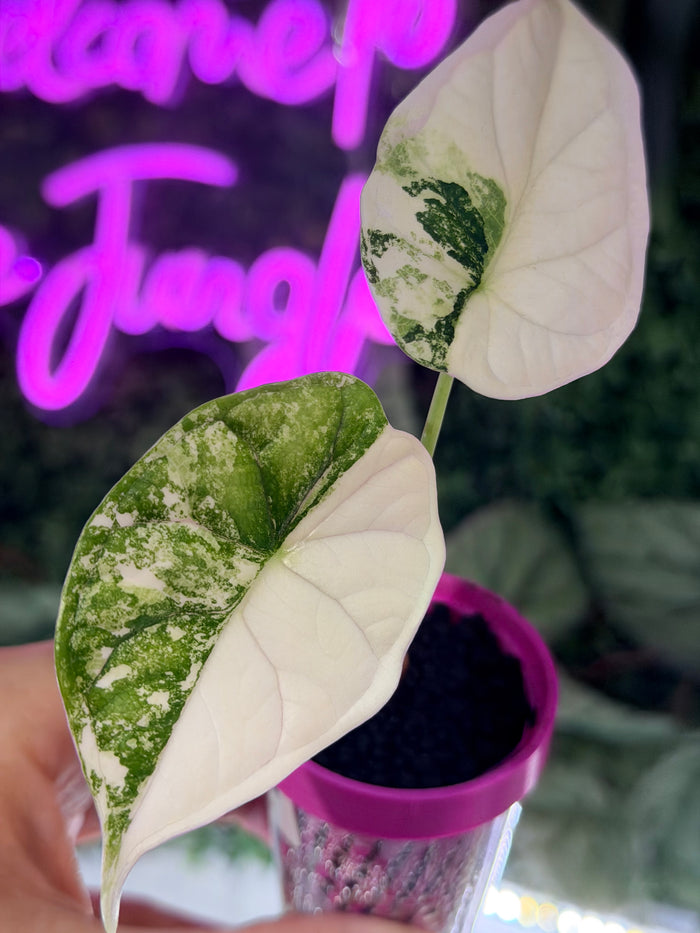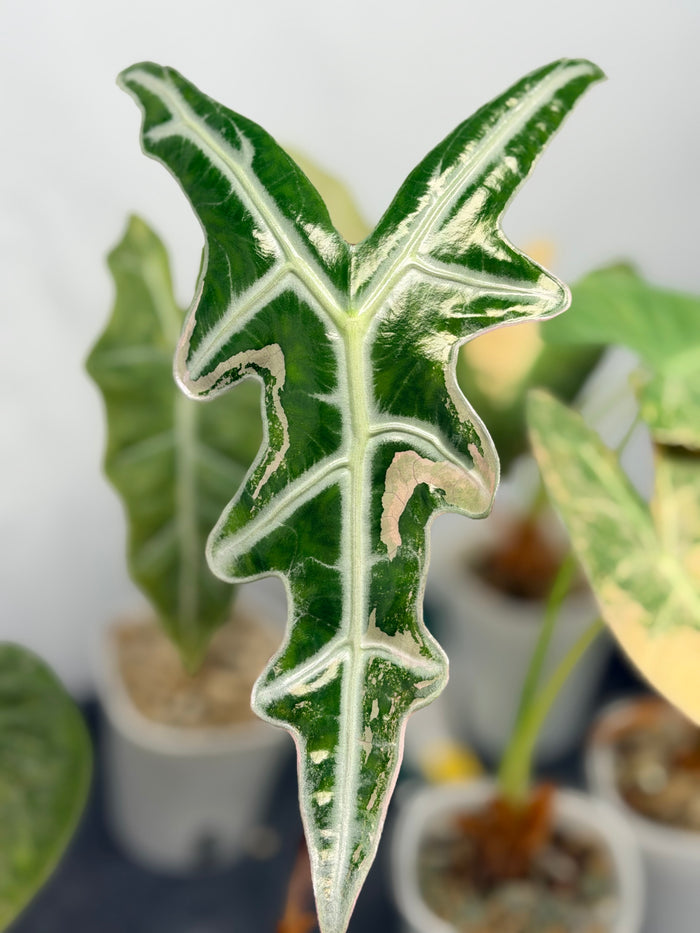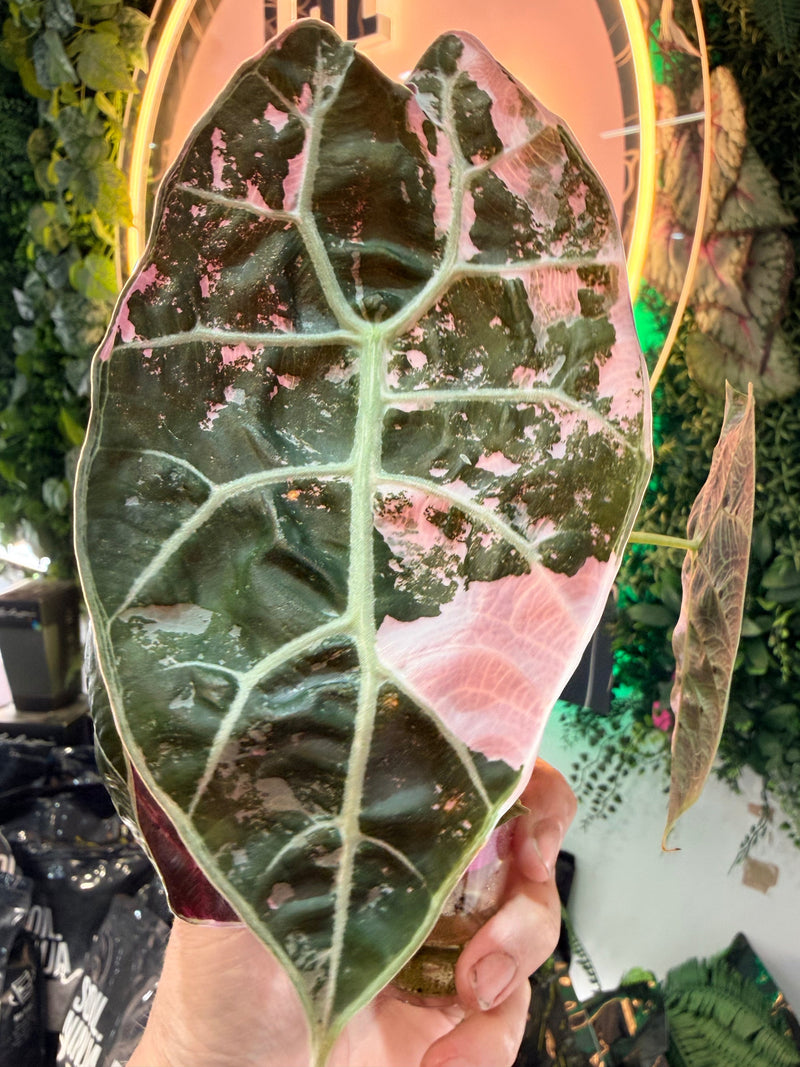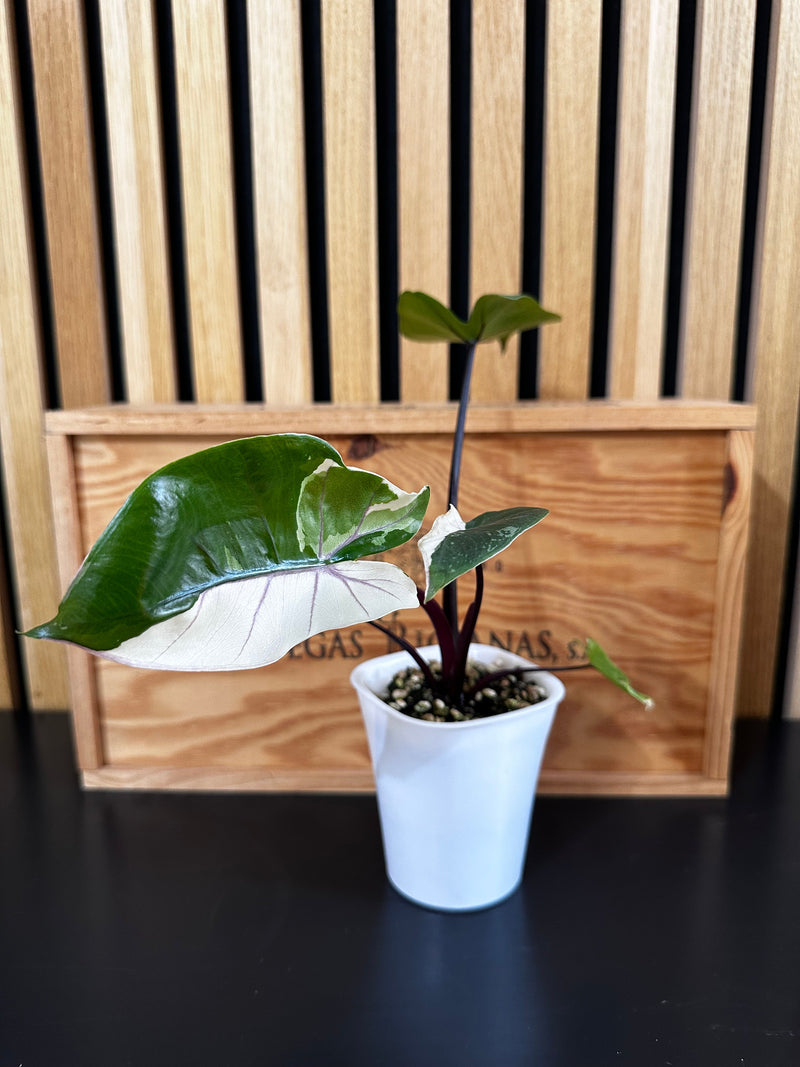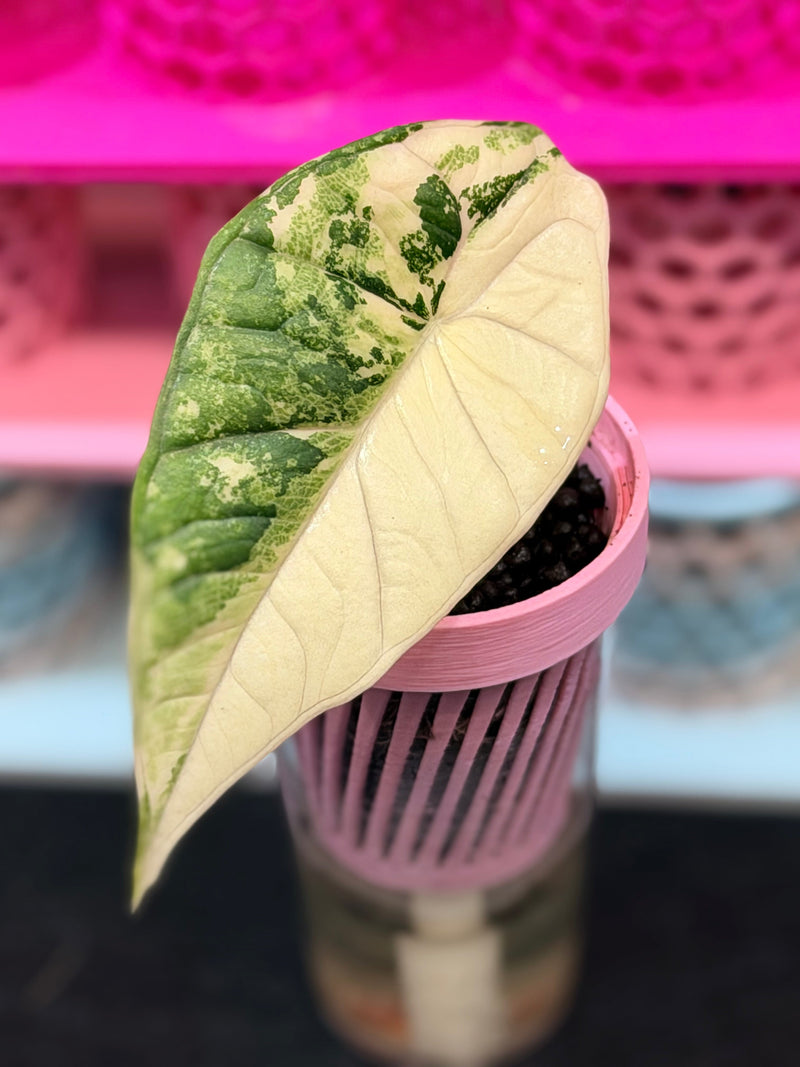

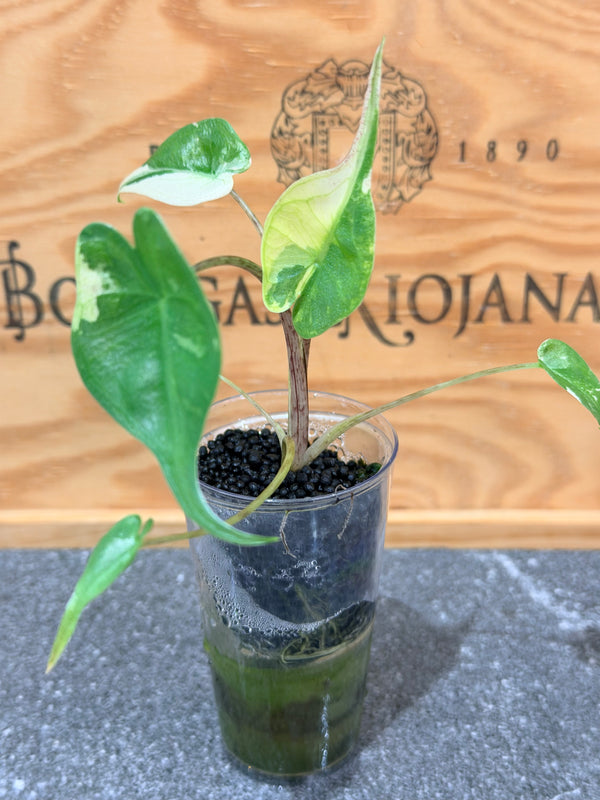
There are Alocasia that announce themselves through sheer scale. There are others that earn attention through colour, texture, or botanical rarity. Alocasia macrorrhizos 'Stingray' does something different, it earns its place through pure structural eccentricity. The silhouette of a 'Stingray' leaf is unmistakeable: broad and orbicular, with deeply undulate margins, a cupped profile, and that single, elongated apical drip tip extending away from the blade like a ray's tail caught mid-glide. It is one of the most immediately recognisable cultivar forms in the entire genus.
The Alocasia Stingray Albo Pink takes that already exceptional foundation and adds something rarer still. Chimeric albo variegation, white to cream sectors and splashes distributed across the dark green blade, is combined in some specimens with pink expression in the variegated areas, creating a tri-dimensional colour play against the glossy, architectural background. For collectors who want large-format drama rather than jewel-scale precision, this is one of the most compelling options available.
This guide covers the botany of Alocasia macrorrhizos and the 'Stingray' mutation, how the Albo Pink variegation works, and everything you need to know to grow this cultivar successfully in a UK collection. If you are already familiar with the rare and exotic Alocasia category, this one sits firmly at the architectural, space-filling end of the spectrum.
The Species: Alocasia macrorrhizos
Distribution and Botanical Background
Alocasia macrorrhizos is one of the most widely distributed species in the genus. Its range extends from the subtropical eastern Himalayas through tropical and subtropical Asia into the western Pacific and parts of eastern Australia, placing it across an extraordinarily diverse range of tropical and subtropical habitats. The species name macrorrhizos comes from the Greek makros (large) and rhiza (root), directly referencing its massive rhizome system, one of the largest in the genus.
In its natural habitat, Alocasia macrorrhizos occupies a wide ecological range. Unlike the compact jewel forms from specialised limestone habitats, this is a species adapted to primary and secondary tropical forest environments, transitional zones, forest clearings, and even disturbed areas, growing in rich, humus-laden soil with consistent moisture availability. The natural climate across much of its range is characterised by high humidity, abundant rainfall, and warm temperatures with averages between 20°C and 35°C. This ecological flexibility translates, in cultivation, to a plant that is considerably more forgiving of variable conditions than many of the rarer jewel or specialist Bornean forms.
The species has significant cultural importance across its natural range as a food crop. The rhizomes and corms of Alocasia macrorrhizos are consumed in many parts of Southeast Asia and the Pacific after thorough cooking, which neutralises the calcium oxalate crystals present throughout the plant. The common name "Giant Taro" or "Upright Elephant Ear" reflects this dual role as both food plant and ornamental species.
The Stingray Cultivar
Alocasia macrorrhizos 'Stingray' is documented by Aroidpedia as a mutant cultivar characterised by deeply undulate margins, an orbicular and cupped leaf form, and, most distinctively, an abnormally elongated apical drip tip. Aroidpedia records that it was first discovered in the Sarawak region of Malaysian Borneo, where several variations of the plant were found growing in small villages. It is listed as a synonym Alocasia macrorrhizos 'Sting Ray', confirming the informal variation in spelling seen across the trade. The Sarawak origin represents a natural mutation rather than deliberate hybridisation, this is a sport of the type species, not a cultivated cross.
From Sarawak, the 'Stingray' gained initial horticultural traction in Thailand, where growers recognised its visual potential and began propagating it deliberately. By the early 2000s it had reached the United States and quickly became sought after among collectors of architectural tropical plants. Its availability in European markets followed in subsequent years, and it is now consistently available within the specialist Alocasia trade.
The distinctive leaf form results from the unusual elongation of the apical drip tip, the pointed extension at the leaf's furthest point from the petiole insertion. In the type species, macrorrhizos has a conventional sagittate leaf with a standard pointed apex. In 'Stingray', this tip is dramatically extended and often gently curved, giving the leaf its characteristic ray-like profile when viewed from above. The margins are additionally undulate and cupped rather than flat, which adds to the sense of organic, flowing movement in even a static specimen. The petioles are long, upright, and carry the mottled or striped patterning characteristic of the macrorrhizos group, adding a further visual layer at stem level.
In terms of scale, this is not a small plant. In the right conditions, Alocasia macrorrhizos 'Stingray' can reach 1.5 to 2 metres in indoor cultivation, and potentially larger in sheltered outdoor tropical conditions. Each individual leaf can reach 60 cm in length. This is an architectural statement plant that requires space and commitment.
The Variegation: Albo Pink Expression
Chimeric Albo Variegation in Alocasia macrorrhizos
Albo variegation in Alocasia macrorrhizos 'Stingray' results from chimeric mutation in the apical meristem, the same mechanism responsible for albo expression in species like the Dragon Scale Albo or the Ninja variants, but expressed across a dramatically larger leaf canvas. In chimeric variegation, genetically distinct cell populations coexist within the meristem. Cells carrying the mutation cannot produce functional chlorophyll in the standard quantities, meaning areas of the leaf that develop from these mutant cell lines express white, cream, or pale colouration rather than green.
The critical cellular mechanism is the complete or near-complete absence of chlorophyll in the variegated sectors, rather than its reduction or modification. This is what distinguishes albo variegation from aurea (which involves carotenoid pigments remaining visible after chlorophyll reduction) or green-on-green (tonal variation within functional photosynthetic tissue). Albo sections contain no meaningful photosynthetic capacity, which has direct implications for the plant's care requirements: reduced overall photosynthetic area means increased sensitivity to low light, and the variegated areas are more vulnerable to environmental stress.
For a full explanation of the cellular mechanisms across all variegation types in the genus, our complete guide to Alocasia variegation and albo variegation in Alocasia guides cover the science in full.
The Pink Component
The "Albo Pink" designation reflects specimens that show a second layer of colour expression alongside the white and cream albo sectors. In areas where chlorophyll is absent, other pigments become visible rather than being masked by dominant green. In some cell populations within the chimeric meristem, anthocyanins, the red and purple accessory pigments present in many Alocasia species, can express in the de-greened areas, producing shades from blush pink through to deeper rose. This is the same mechanism responsible for dedicated pink variegated Alocasia forms, but here it appears alongside the albo expression rather than as the primary variegation type.
The result, white, cream, and pink sectors distributed across a dark green, glossy, architecturally shaped leaf, is genuinely complex visually. Each leaf expresses these tones in a different proportion and arrangement, meaning no two leaves across the plant's lifetime will be identical. Some leaves will show predominantly albo expression; others will emphasise pink; many will carry both across different sectors of the same blade.
The pink expression in albo variegated Alocasia is not always consistent across successive leaves. Conditions including temperature, light levels, and the plant's overall metabolic state can influence whether pink tones appear prominently or fade toward cream and white. Lower temperatures and higher light often correlate with more vivid pink expression. For context on how pink variegation behaves in other Alocasia cultivars, our pink variegation guide is a useful companion read.
Variegation Stability and Reversion Risk
Chimeric variegation in large-format Alocasia can be less stable than in compact jewel forms, partly because larger plants with more active growth cycles provide more opportunity for chimeric drift, the gradual shift in cell population proportions within the meristem over successive leaf productions. Stress events including significant repotting, root damage, pest attack, or dramatic environmental change can trigger reversion toward more heavily greened leaf production. This does not mean permanent loss of variegation, the chimeric cell populations remain present in the meristem, but it does mean heavily greened periods are possible and should be managed by stabilising growing conditions rather than discarding the plant.
Growing Alocasia Stingray Albo Pink in the UK
Light Requirements
Given the large leaf area and significant proportion of non-photosynthetic tissue in heavily variegated specimens, light provision is the most important variable in successfully growing this cultivar. Alocasia macrorrhizos in its non-variegated form is more tolerant of lower light than jewel types, its ecological background includes primary forest clearings and secondary growth environments with variable light. The 'Stingray' Albo Pink is considerably less forgiving of low light due to its reduced chlorophyll content.
Position this plant in the brightest available indirect light, ideally close to a large south or east-facing window without the exposure being direct. UK conditions will likely require supplemental lighting through LED grow lights to maintain growth momentum and prevent the plant from shutting down growth entirely. A grow light positioned to supplement rather than replace window light, running 12 to 14 hours daily, makes a significant practical difference.
Substrate and Watering
The macrorrhizos background makes 'Stingray' more tolerant of moisture than the limestone-dwelling jewel forms, but the variegated form is still vulnerable to root rot and substrate saturation. A well-draining mix is essential, we recommend Fluval Stratum as the primary substrate, modified if necessary with additional perlite or orchid bark to open the structure for this larger-rooted plant. The substantial root system of macrorrhizos appreciates more volume than jewel forms, so pot size should be proportionate to the plant's above-ground mass.
Water thoroughly when the top 2–3 cm of substrate dries, and ensure drainage is complete. This plant is large enough that it will consume water faster than jewel forms during active growth, but when growth slows the reduced evapotranspiration rate means watering frequency should drop significantly. Never allow standing water to accumulate in the base of a decorative pot or saucer.
Temperature and Humidity
The tropical and subtropical distribution of macrorrhizos translates to a plant that is comfortable across a broader temperature range than the Bornean specialists. A comfortable indoor range of 18°C to 28°C suits this cultivar well in UK conditions. It will tolerate brief drops toward 15°C without significant damage, but sustained cold, particularly cold substrate, will slow growth significantly and increase disease risk.
Humidity in the 60 to 80 percent range supports the best growth and leaf quality. This is achievable through grouping plants together, using a nearby humidifier, or choosing an inherently more humid room. The large leaf area of mature specimens makes them somewhat self-maintaining in terms of micro-humidity near the foliage, but at establishment or in very dry conditions, active humidity management is worthwhile.
Feeding
A balanced liquid feed at half to two-thirds strength every two to three weeks supports healthy growth without overloading the substrate. The large root system and active growth of macrorrhizos means it responds well to regular feeding when light and warmth are adequate. Reduce feeding to monthly or stop entirely when growth slows. Our plant feed collection has appropriate options for large-format Alocasia.
Propagation
Alocasia macrorrhizos propagates readily from corms and offsets. In variegated forms, corms have the potential to carry the variegation genetics, though expression in corm-grown plants is variable. The same principle of chimeric unpredictability applies here as in jewel forms, some corm offspring will express strong variegation, others will be largely green. Established plants occasionally produce offset pups at the base, which can be carefully separated once they have developed their own root system.
Pests and Common Problems
Spider Mites and Thrips
Large-format Alocasia grown indoors in UK conditions are consistently vulnerable to spider mites, particularly when central heating reduces ambient humidity to levels that mites find ideal. On the Stingray Albo Pink, where the large leaf area and variegated sectors provide abundant feeding surface, mite populations can establish rapidly if conditions are not managed. Inspect the undersides of leaves regularly, and maintain humidity above 60 percent as a preventative measure.
Thrips are increasingly common in mixed UK plant collections. They are characterised by silvery directional streaking across the upper leaf surface and distorted new growth. The glossy macrorrhizos surface shows thrips damage relatively clearly, any unexplained surface scarring warrants a close inspection for thrips or their frass in the leaf sheaths and on undersides. Isolate affected plants immediately and treat with appropriate insecticidal solutions at the intervals specified by the product to break the egg-to-adult cycle.
Root Rot Recovery
Root rot in large-format Alocasia can develop more slowly than in jewel forms, the larger root mass takes longer to become fully compromised, but it is also more difficult to reverse once established. If you identify root rot through soft or mushy rhizome material at the base of the plant, act promptly: remove the plant, cut away all affected tissue with clean scissors, allow the cut surfaces to callous briefly, and repot into fresh, dry Fluval Stratum. Our root rot recovery guide provides the step-by-step process in detail.
Practical Collector Notes
Scale Planning
This plant will eventually dominate a significant amount of floor or shelf space. If your growing environment is limited, this is worth considering before acquisition. At full expression in a UK indoor setting, a mature Stingray Albo Pink will produce leaves that require a wide clearance area and preferably a position where the architectural silhouette can be appreciated from multiple angles. A corner position with good ambient or supplemental light is ideal.
Comparing to Other Variegated Macrorrhizos Forms
The 'Stingray' Albo Pink sits alongside other variegated large-format Alocasia in the collection context. Alocasia macrorrhizos 'Stingray' Aurea, which carries golden rather than white and pink variegation on the same distinctive silhouette, is the most direct comparison. The albo pink form provides the higher contrast, higher drama visual against the dark green base; the aurea form offers a warmer, sunlit quality that reads differently depending on the collection aesthetic you are building.
Both variegated forms of 'Stingray' reward patience considerably. New leaves unfurl slowly relative to the eventual scale of the blade, and the suspense of watching an emerging Stingray leaf, particularly one from a variegated form where you cannot know the pattern until the leaf fully hardens, is one of the genuinely pleasurable aspects of growing at this scale.
For the broader care fundamentals that apply across both large-format and jewel forms, our Alocasia care guide is the reference point for new and experienced growers alike.
For a step-by-step method that works for any cultivar, see our Alocasia corm propagation guide, which covers corm selection, the self-wicking set-up and the conditions that bring a corm into growth.
Questions about Alocasia Stingray Albo Pink, large-format variegated Alocasia care, or substrate and light setups for architectural specimens? Contact our team for guidance from specialists who grow this cultivar at our UK-based private nursery. We can advise on everything from initial establishment to long-term management of large-format collectors' plants.
From the nursery