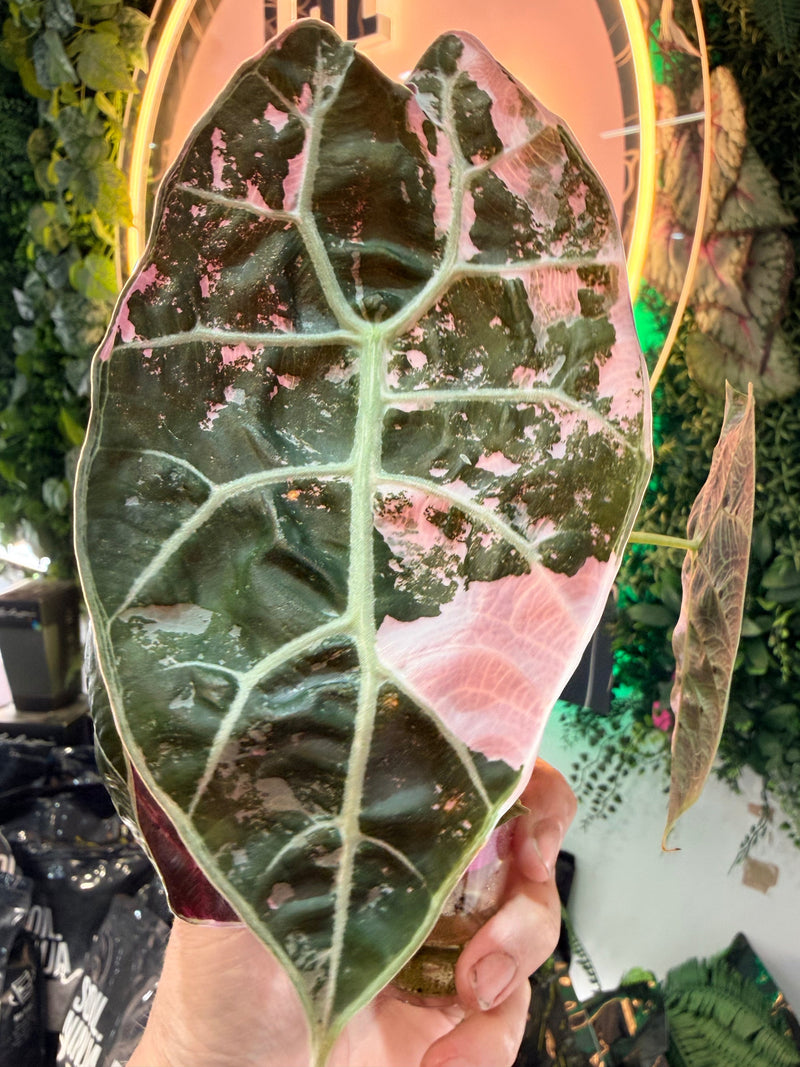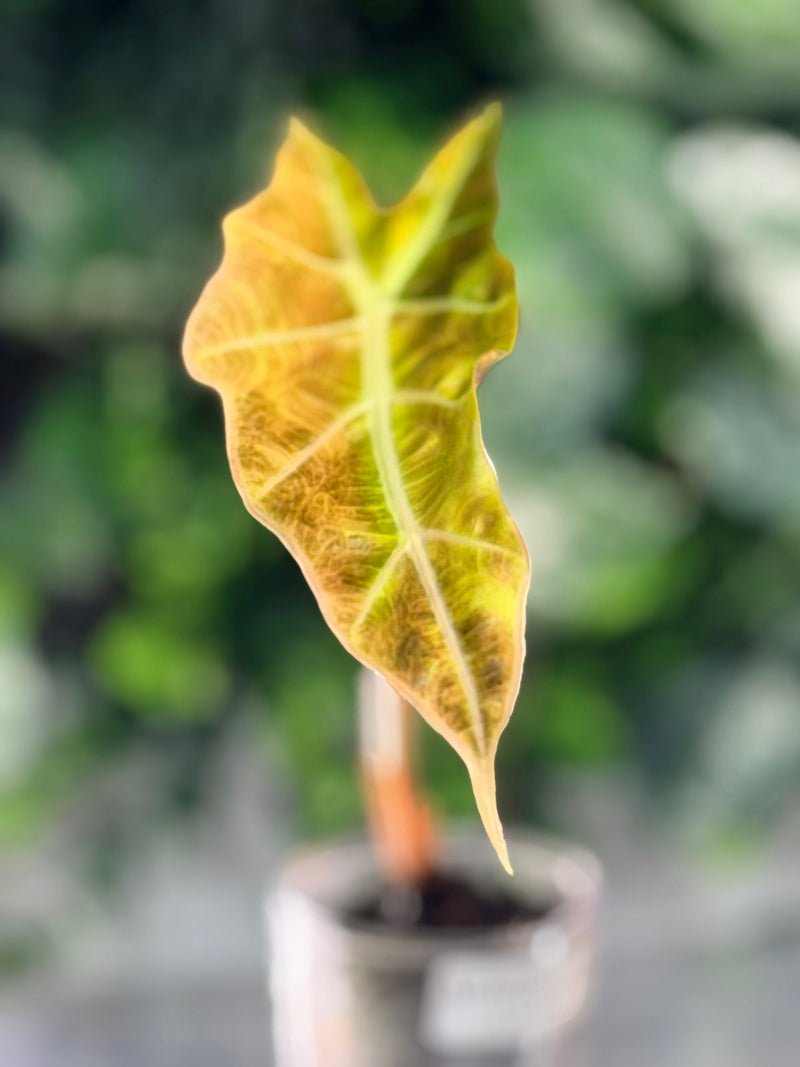

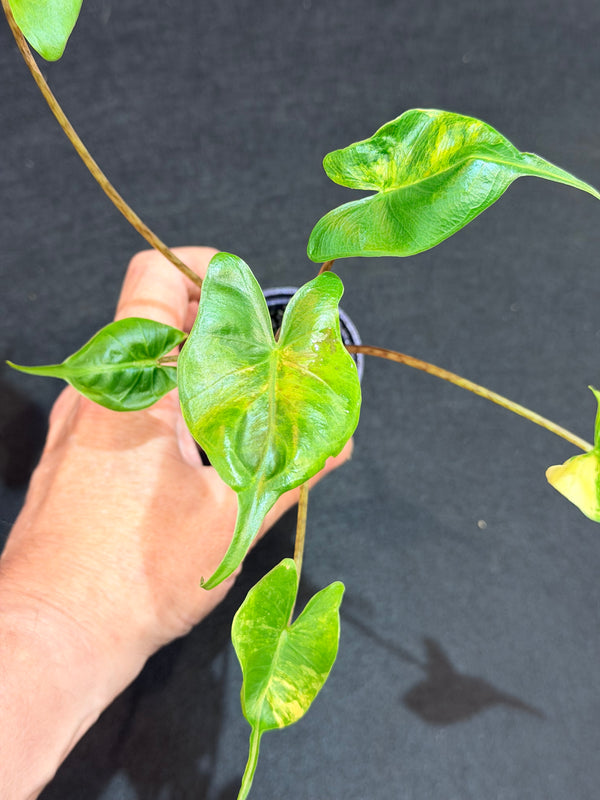
Alocasia 'Stingray' Aurea combines golden-yellow aurea variegation with one of the most recognisable leaf shapes among collector Alocasia. This guide explains what Aroidpedia records about the 'Stingray' cultivar, how aurea variegation works, and how to care for the plant. Where the record is thin, particularly for the aurea form itself, we say so.
What is Alocasia 'Stingray' Aurea?
Aroidpedia lists Alocasia macrorrhizos 'Stingray' as a mutant cultivar of Alocasia macrorrhizos, with the synonym 'Sting Ray'. The Aurea form is a golden-yellow variegated plant of that cultivar. Aroidpedia has no separate entry for the aurea form, so the cultivar-specific detail below comes from the base 'Stingray' entry, supplemented by our own experience where we say so, and the variegation detail is general Alocasia knowledge.
Origin and naming of 'Stingray'
Aroidpedia records that 'Stingray' was first found in the Sarawak region of Malaysian Borneo, where several variants grew in small villages, that it became popular after being propagated in Thailand, and that it reached the United States by the early 2000s. Note that the Aroidpedia account links to a commercial vendor page rather than an independent source, so treat the finer details of that history with some caution. No breeder is named; it is described as a field-found mutant, not a bred hybrid.
The name refers to the leaf. Aroidpedia describes an elongated apical drip tip that resembles the tail of a stingray, and the cultivar name is simply a description of what the leaf looks like.
Where does the species come from?
Alocasia macrorrhizos is native, according to Aroidpedia, to the Bismarck Archipelago, Borneo, Maluku, New Guinea, the Philippines, Queensland, the Solomon Islands and Sulawesi, and it has been widely introduced across the rest of Asia. The original description is attributed to Robert Sweet in 1839. Aroidpedia lists many cultivars of the species, including 'Plumbea', 'Black Stem' and 'Baby Ray', and our Alocasia macrorrhizos species guide covers the wider group.
How to identify Alocasia 'Stingray'
Aroidpedia describes the leaves as having deeply undulate margins, an orbicular shape and a cupped form, with the abnormally elongated drip tip as the defining trait. The species itself is a large plant; Aroidpedia gives the species an erect trunk of up to about 4m and light green leaf blades, though it gives no dimensions for 'Stingray'. For container growing, the RHS gives a height and spread of 1 to 1.5m for this cultivar, which is a useful indication of what an indoor specimen may reach.
Where standard Alocasia macrorrhizos produces large, broadly ovate, upward-pointing leaves on robust stems, the 'Stingray' leaf is quite different in character: it has the wing-like lobes of the macrorrhizos form but with a dramatically extended, slender, whip-like tail emerging from the apex, and the combination gives a silhouette that is unmistakably stingray-like.
Aroidpedia does not describe the petioles or the leaf colour of 'Stingray'; what we say about striping and shades of green comes from our own experience of the plant, below.
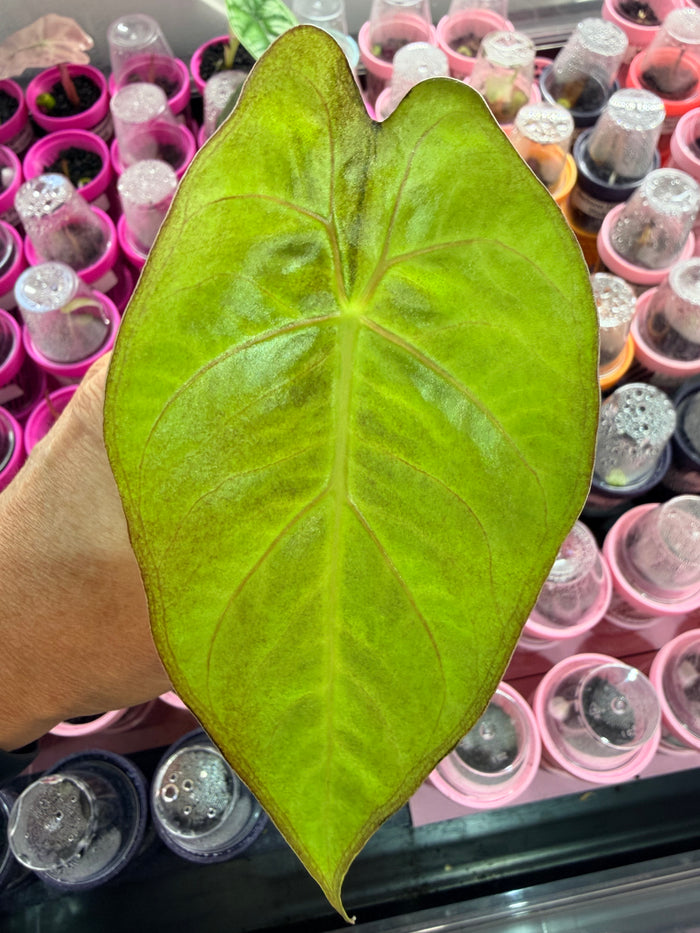
From our own experience of the plant, which Aroidpedia does not cover, the petioles are marked with the same zebra-like striping seen on Alocasia zebrina and in the 'Sarian' cultivar, and the leaves are a vibrant fresh green, lighter in tone than many of the dark-leaved jewel Alocasia. In cultivation 'Stingray' typically reaches 90 to 150cm, a substantial indoor specimen, and the combination of unusual leaf architecture and striped petioles makes it immediately recognisable in any collection.
Aurea variegation on 'Stingray'
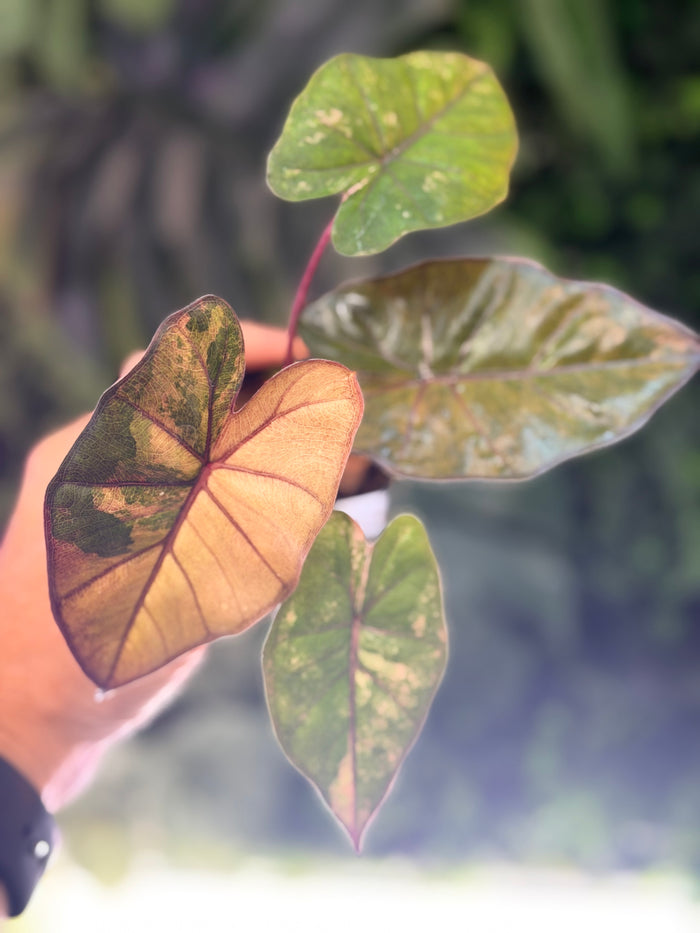
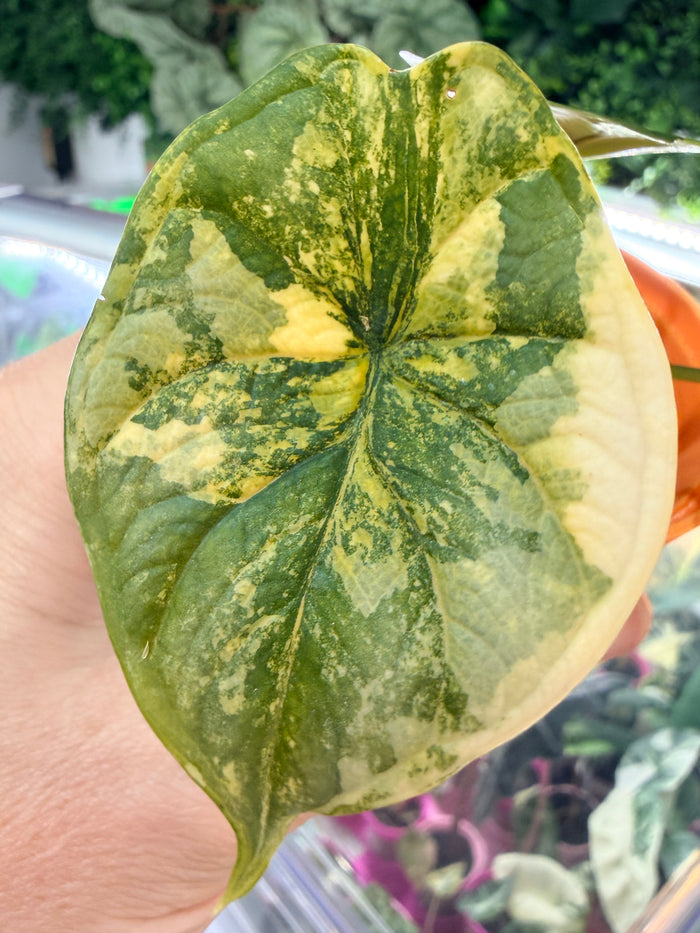
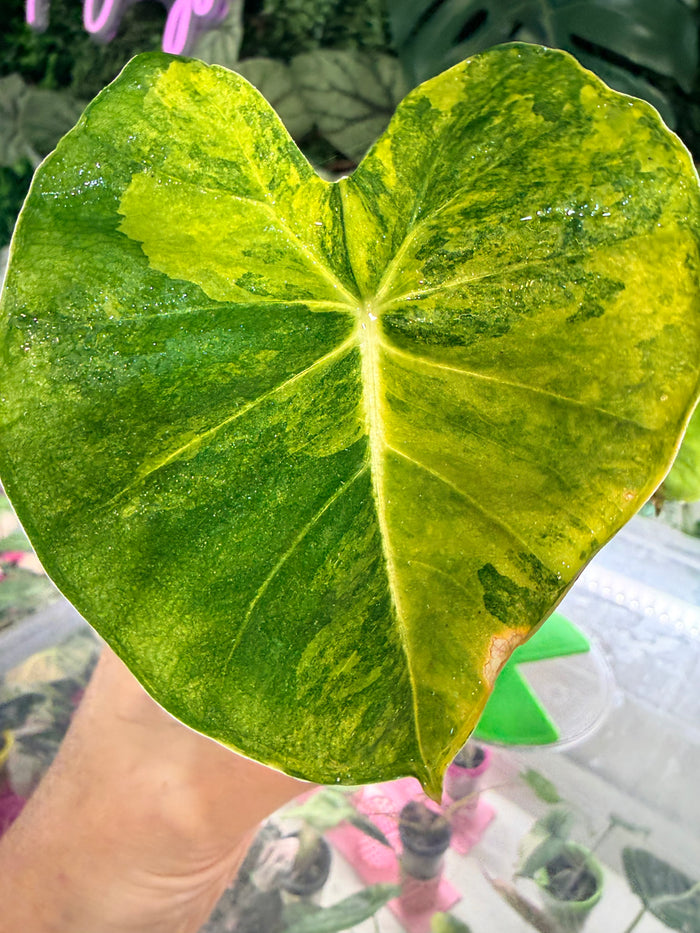
Aurea variegation shows as yellow or golden tissue with reduced chlorophyll, where carotenoid pigments are retained. The sectors still photosynthesise, but less efficiently than green tissue, and the depth of colour tends to follow the light the plant receives. On a plant with a long drip tip and cupped blade, the golden sectors can follow the leaf's unusual outline, although how any individual leaf is marked varies. The golden sectors can spread across the wing-lobes and along the tail, interacting with the cultivar's bold venation, so that the plant commands attention from across a room rather than only up close. The elongated tail is the most distinctive element of the leaf: large aurea panels can develop on the broad lobes, and the gold then runs down the tapering tail, reading against the narrowing blade in a dramatically foreshortened perspective. In good light the golden sectors glow against the green base, while in reduced light the distinction between sector and base tissue becomes progressively less vivid as residual chlorophyll dominates the aurea tissue. Chimeric variegation like this may not carry over to plants grown from corms. Our guide to aurea variegation in Alocasia explains the mechanism in full, and our guide to variegation types compares aurea with albo and pink.
Alocasia 'Stingray' Aurea care
This is general Alocasia care, and it applies to this plant. Give bright indirect light, supplemented with LED grow lights, at 20 to 27°C and 60 to 80% humidity. Water when the top 2 to 3cm of substrate has dried. We prefer Fluval Stratum as a substrate, and a heat mat helps if the room runs cool. Feed at half strength from our plant feed range, which can go up to two-thirds strength every 2 to 3 weeks.
The Stingray's larger scale means spider mites are a persistent risk on the broad leaf undersides, so check them regularly, as with any Alocasia, and treat pests promptly with our pest control range. For more, see our ultimate Alocasia care guide.
Propagating from corms
Our Alocasia corm propagation guide describes the self-wicking method, in which a firm corm sits in Fluval Stratum in the Corm Keeper so that moisture is drawn up gently without waterlogging. See also how long a corm takes to sprout.
How it compares with similar plants
The same cultivar is also grown with other variegation. Our Stingray Albo Pink guide covers a different variegated form, and our Black Stem Albo Macrorrhizos guide covers another macrorrhizos cultivar.
Frequently asked questions
Is 'Stingray' a species or a cultivar?
A cultivar. Aroidpedia lists it as a mutant cultivar of Alocasia macrorrhizos.
Who bred 'Stingray'?
No breeder is recorded. It is described as a field-found mutant first noted in Sarawak.
How large does it grow?
Aroidpedia gives no size for the cultivar. The RHS gives a height and spread of 1 to 1.5m for container growing.
Is the aurea form documented separately?
No. Aroidpedia has no entry for the aurea form, so cultivar detail comes from the base 'Stingray' entry and our own experience.
Will the golden variegation carry through corms?
Not reliably, because chimeric variegation may not carry over to corm-grown plants.
Is it safe for pets?
No. Alocasia contain calcium oxalate crystals that irritate the mouth and skin, so keep it away from pets and children.
Where to find Stingray Aurea
We release Stingray Aurea through our drop model. Join the collector list for early access, and view our Alocasia Stingray Aurea listing. Our aurea variegated collection gives broader context.
Questions about Alocasia 'Stingray' Aurea or aurea variegation? Contact our team for guidance from specialists who grow rare Alocasia in our UK-based private nursery. We are happy to talk through care and identification.