Alocasia Pseudosanderiana 'Bully' Aurea: The Complete Collector's Guide

Alocasia pseudosanderiana 'Bully' aurea is a golden-variegated plant sold under the name Alocasia pseudosanderiana with the trade designation 'Bully'. This guide sets out what is documented about the base plant, what our own experience tells us about the 'Bully' name, and how to care for it.
What is Alocasia pseudosanderiana 'Bully' aurea?
There are three parts to the name. Alocasia pseudosanderiana is the base plant, 'Bully' is a trade designation, and aurea describes the yellow to golden variegation. Aroidpedia has an entry for Alocasia 'Pseudosanderiana' but none for a 'Bully' cultivar, and its cultivars section for the species is empty. That means what 'Bully' denotes, who selected it, and whether it is a distinct clone are not documented there, so the definition that follows is our own nursery knowledge rather than Aroidpedia's.
In collecting, though, 'Bully' as a designation, applied to pseudosanderiana and, separately, to Alocasia sanderiana, typically describes plants selected for a broader, more substantial leaf form, stronger petioles and a more overtly impressive growth habit than standard specimens of the same species. In the pseudosanderiana group it is used for a larger-growing, more robust form, with bolder leaf form, more substantial petioles and a more forceful overall presence than the standard plant, and it is a horticultural selection rather than a separate species. That is collector and nursery knowledge, which Aroidpedia does not record.
Browse our aurea variegated Alocasia collection for related golden forms.
Origin and naming of Alocasia pseudosanderiana
Aroidpedia records that the species is not yet accepted, though it is widespread in cultivation in the Philippines. It lists no synonyms, and the description, ecology, variegated forms, cultivars and hybrids sections are empty. The name therefore operates in horticulture without a formal botanical standing behind it.
It is grown all across the Philippine Islands, semi-wild in some areas. It appears in the literature essentially once, in David Burnett's 1984 Aroideana article 'The Cultivated Alocasia', the first and effectively only formal published reference. Burnett noted the proposal that the plant arose as a natural hybrid between Alocasia heterophylla and Alocasia sanderiana, and argued against it on several grounds. The name is technically a nomen nudum, published without the formal botanical description the International Code of Botanical Nomenclature demands, which leaves it without valid species status.
According to Aroidpedia, the epithet joins pseudo and sanderiana, meaning that the plant is not the genuine Alocasia sanderiana. That is the only documented explanation; parentage is not given, so we treat it as unknown. The climate Aroidpedia lists for the range is tropical and humid, with humidity of around 60 to 70 per cent and temperatures staying above 7°C. In cultivation the species grows considerably larger than Alocasia sanderiana and lacks some of the sanderiana's most distinctive features, including the peltate leaf attachment, which supports the view that it is a distinct entity rather than a variant of it. Whether it is a hybrid, an undescribed species or a naturalised cultivar is still an open question in botanical research, which is part of what makes the plant interesting to serious collectors.
The 'Bully' name and the Bull connection
The names 'Bull' and 'Bully' both circulate for sanderiana plants, and they are used for the same larger, more robust selection. Aroidpedia's Alocasia sanderiana entry mentions William Bull only as the source of an 1884 catalogue listing, and it does not describe a 'Bull' or 'Bully' cultivar. Aroidpedia therefore does not record that 'Bully' means a larger, sturdier or different form; in our experience it does, as set out above. If size matters to you, ask us, and expect to judge the individual plant as well as the label.
See our guides to the sanderiana 'Bull' aurea and the sanderiana 'Bully' pink albo to see how those names are used on a related plant.
The aurea variegation
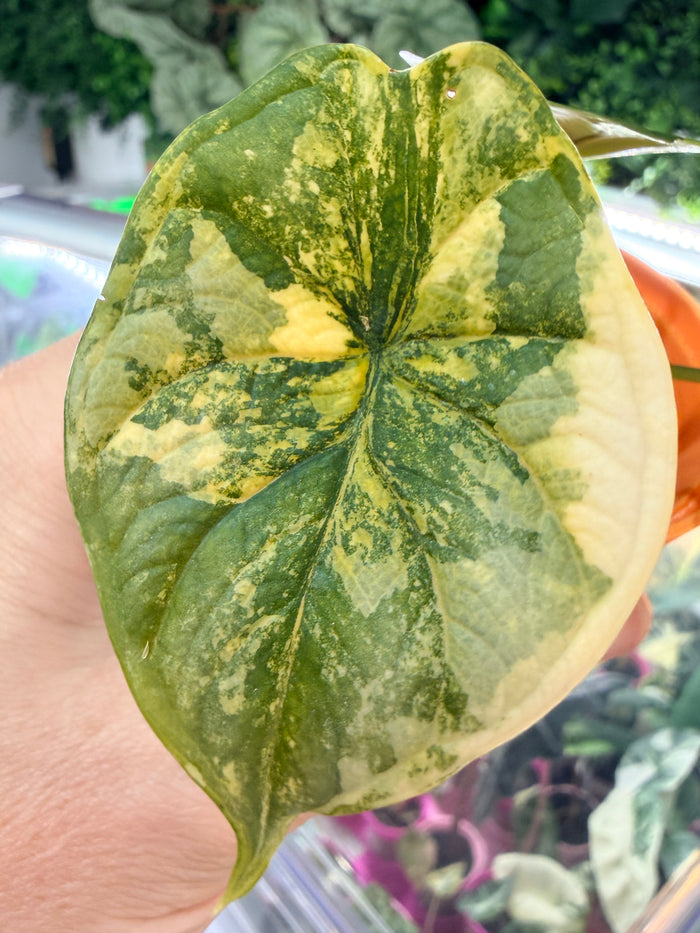
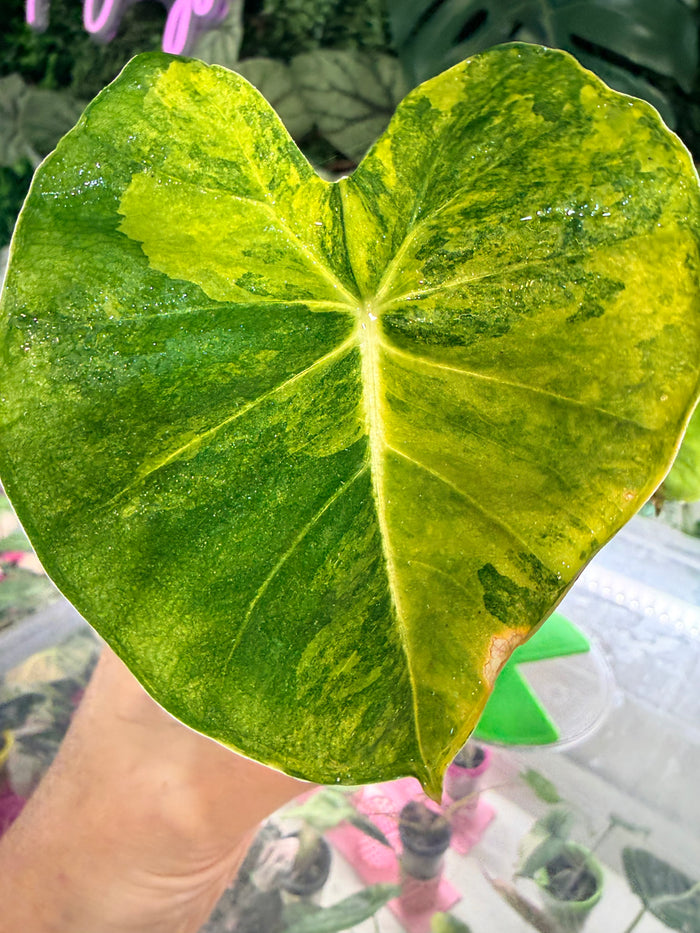
Aurea tissue is yellow because chlorophyll is reduced, not removed, and carotenoids remain visible. Since the sectors still photosynthesise to a degree, aurea plants usually grow more steadily than albo plants, which have white sectors with no chlorophyll. Strong light keeps the gold clear and poor light lets it green up.
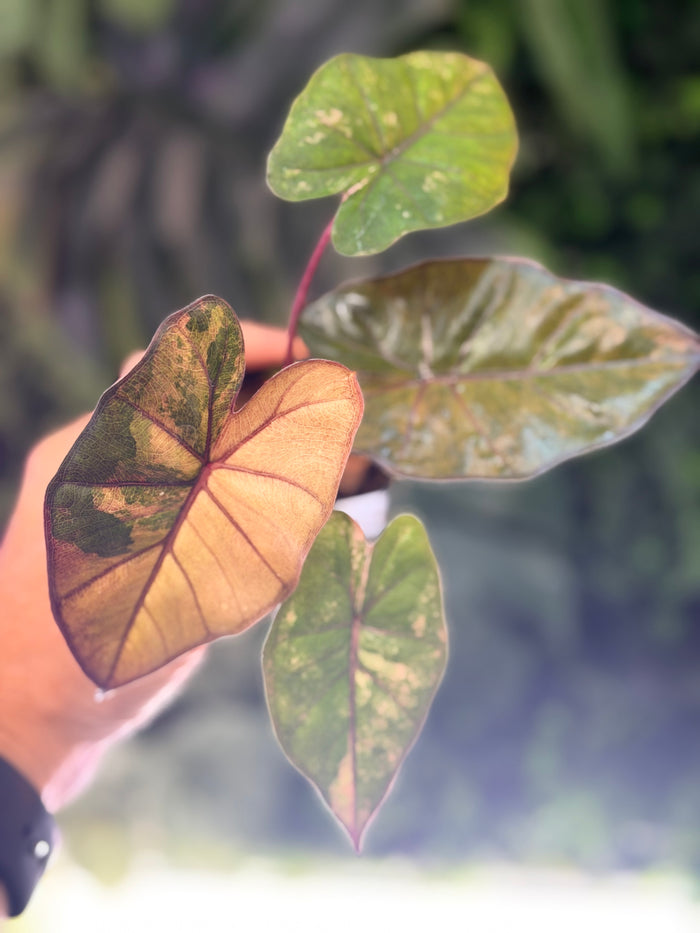
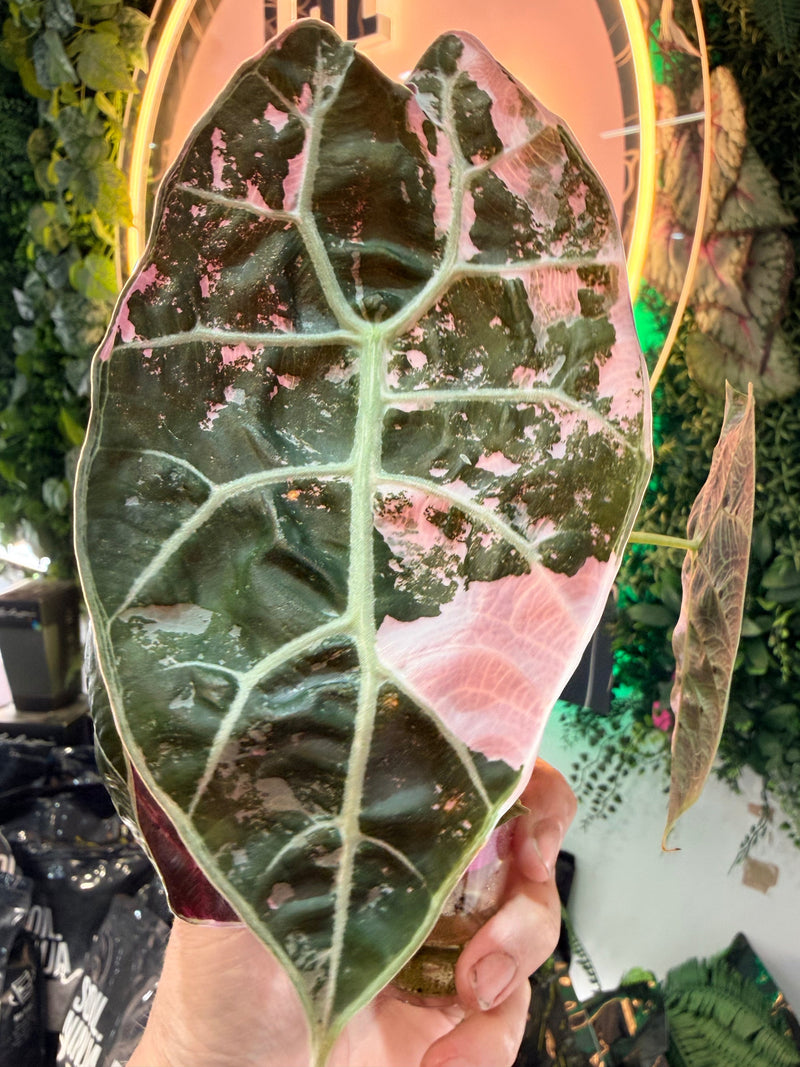
On the larger Bully form the same carotenoid-based expression applies, with golden sectors through partial chlorophyll suppression and carotenoid accumulation, but the greater leaf size means those sectors appear at greater scale, and the relationship between the golden areas and the white venation operates across a larger visual canvas. The Bully Aurea grows more substantially than the standard Pseudosanderiana Aurea, and a mature leaf can present significant golden sectoring across a broad blade with deeply undulate margins and prominent cream to white venation, a statement piece at room scale rather than a plant that needs close observation to appreciate.
Variegation like this can be chimeric and may not carry through to plants grown from a corm. Read our aurea variegation guide and the complete guide to variegation types for the mechanism.
How to identify it
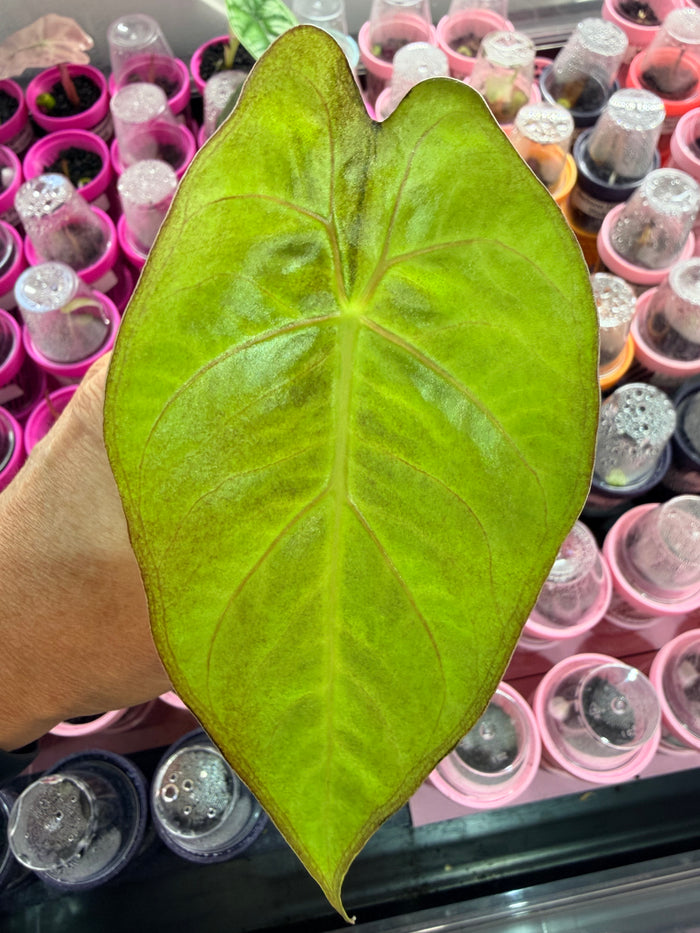
Aroidpedia gives no leaf description for the species, so what follows rests on trade listings and our own experience. Trade listings describe dark green leaves with golden marbled or sectoral variegation. Aroidpedia does not document how this plant relates to Alocasia sanderiana, which it describes as having arrow-shaped, deeply undulate blades with white to yellowish veins; in our experience the pseudosanderiana plant is the larger of the two. In leaf character the plant sits with the sanderiana group: bold, white-veined and deeply undulate, large and arrow-shaped, with sinuate to sub-pinnatifid margins, prominent cream to white venation, and deep green to near-black blade colour. Our pseudosanderiana aurea guide covers the standard golden form.
Alocasia pseudosanderiana 'Bully' aurea care
This is general Alocasia care, and it applies to this plant.
- Light: bright indirect light plus LED grow lights.
- Temperature and humidity: 20 to 27°C, humidity 60 to 80 per cent, with a heat mat if the room runs cool.
- Watering: water when the top 2 to 3cm has dried. Wet substrate that never dries invites rot; see our root rot guide. Larger pots dry more slowly than small jewel pots, so water thoroughly but let the top dry first.
- Substrate: Fluval Stratum, with more in substrates and growing media.
- Feeding: our Alocasia feed from the plant feed range at half strength, which can go up to two-thirds strength every 2 to 3 weeks.
- Pests: large leaves can harbour spider mites, so inspect the undersides and use our pest control range if you see them. The broad undersides of the Bully Aurea provide excellent mite habitat, so treat at the first sign of infestation.
The larger growth habit means this plant needs proportionally larger pots and substrate volumes than compact jewel species, and the greater leaf area means slightly higher water and nutrient requirements. Our ultimate Alocasia care guide goes further.
Propagation from corms
The Alocasia corm propagation guide explains the self-wicking method: the corm sits in Fluval Stratum in the Corm Keeper, which draws moisture up evenly. More in growing corms in Fluval Stratum.
We release plants through our drop model; see how drop access works.
Frequently asked questions
What does 'Bully' mean on this plant?
It is a trade designation that Aroidpedia does not document; in our experience it marks a larger, more robust horticultural selection of pseudosanderiana.
Is it a different species from pseudosanderiana?
Nothing documented suggests that. It is sold as a form of Alocasia pseudosanderiana, which Aroidpedia records as not yet accepted.
Is it the same as Alocasia sanderiana 'Bull'?
Yes. 'Bully' is the same as 'Bull': the two names are used for the same larger, more robust selection, though Aroidpedia does not document that.
Will the golden colour hold?
It depends on light. Bright light keeps it strong, and low light lets the leaves green up.
Is it pet-safe?
No. Alocasia in general contain calcium oxalate and are toxic if eaten.
Questions about Alocasia pseudosanderiana 'Bully' aurea? Contact our team for guidance from specialists who grow rare Alocasia in our UK-based private nursery. We will tell you plainly what is and is not documented.