Alocasia Sanderiana Bull Aurea Variegated: The Complete Collector's Guide

Alocasia sanderiana 'Bull' Aurea is a golden-variegated form of the Philippine kris plant, Alocasia sanderiana, sold under the 'Bull' or 'Bully' selection name. This guide explains what the species is, what is and is not documented about the 'Bull' name, how aurea variegation behaves on a dark, white-veined leaf, and how to look after it.
What is Alocasia sanderiana 'Bull' Aurea?
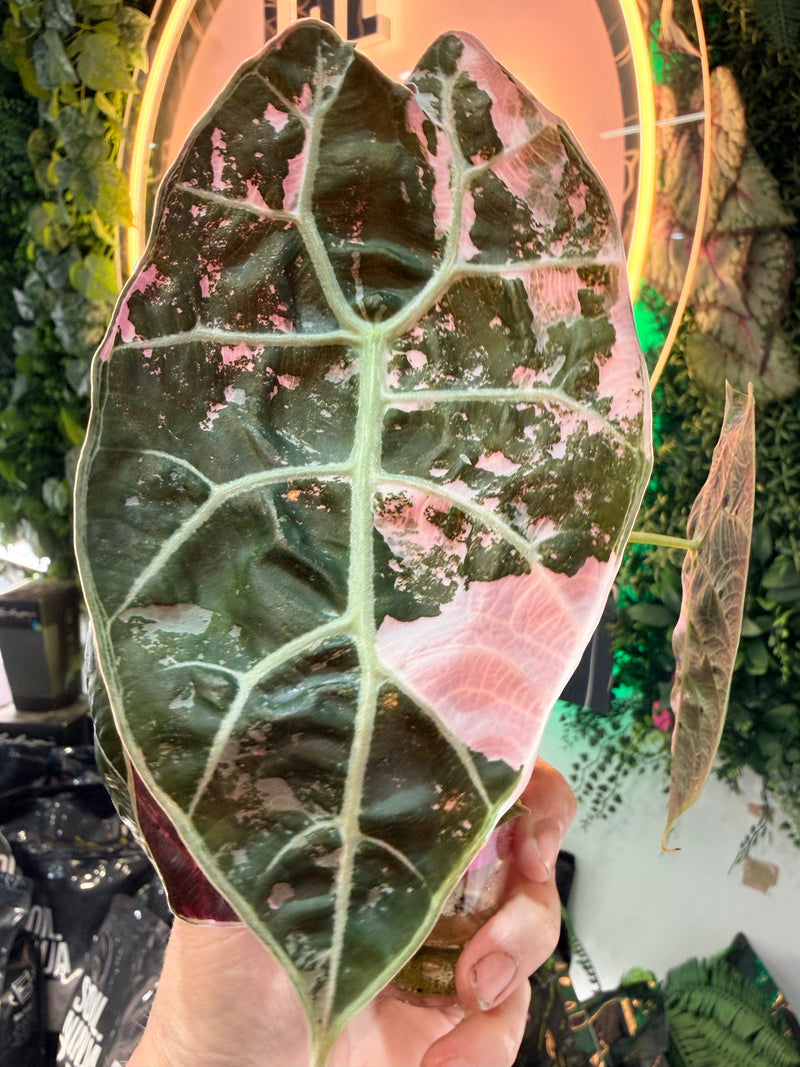
The plant combines two things: a species with a strong, instantly recognisable leaf, and aurea variegation, in which sectors of the blade turn yellow to golden. Aurea tissue has reduced chlorophyll but keeps its carotenoid pigments, so it still photosynthesises, unlike the pure white sectors of an albo plant. Aroidpedia, our primary reference for this species, lists Alocasia sanderiana with no accepted infraspecific forms and records its variegated forms as green and white; it does not mention a yellow or aurea form. The aurea character of this plant is therefore a trade observation rather than something Aroidpedia documents, and, as with every chimeric plant, it can vary between leaves and between individual plants.
Origin and naming of Alocasia sanderiana
Aroidpedia records Alocasia sanderiana as native to Mindanao in the Philippines, growing in old forest in damp ravines at low elevation. Wikipedia describes it as endemic to Northern Mindanao and lists it as Critically Endangered on the IUCN Red List, and notes that harvesting wild plants in the Philippines is illegal. That protection is serious: wild collection is controlled under the country's Wildlife Resources Conservation and Protection Act, with penalties of imprisonment and fines. The species was once CITES-listed, a status Aroidpedia notes it has since lost. That it now persists so widely in cultivation is a genuinely important ex-situ conservation outcome for a species whose wild population is severely threatened, and the tissue-culture derived populations in cultivation globally are an important part of that presence.
The name honours Henry Frederick Conrad Sander, born in Bremen and founder of the St Albans nursery firm Sanders, which sat at the centre of the late nineteenth-century European orchid trade. Aroidpedia traces the plant to the William Bull catalogue of 1884, where it was priced at two guineas, and notes a cultivated specimen at Kew in 1886. The species reached European cultivation in the 1880s. At the time it was in high horticultural demand and was used extensively in hybridisation. Collectors also call it the kris plant, after the deeply wavy leaf edge that resembles the blade of a kris or keris dagger.
Synonyms recorded by Aroidpedia include Alocasia sanderi, Alocasia urdanetensis and the old combination Schizocasia sanderiana. It also records the name var. nobilis, first seen in print in 1893, as not an accepted cultivar although it remains common in the trade. In the trade the name describes a particularly deep-lobed, architecturally pronounced expression of the species, maintained in cultivation ever since. Our own nobilis and sanderiana guide and sanderiana species guide cover the species in more depth.
What does 'Bull' mean?
Aroidpedia has no entry for 'Bull' or 'Bully' as a cultivar of Alocasia sanderiana. The word 'Bull' appears on that page only in the citation of the 1884 William Bull catalogue, and we do not claim any link between that catalogue and the trade name. In cultivation the names are used for plants grown as a larger, bolder expression of the species, but the cultivar-specific history, origin and parentage are not documented, so we describe the plant by the species record and say plainly where the detail runs out. 'Bully' selections are said to carry that emphasis further, prioritising substantial leaf scale and strong venation contrast.
How to identify it
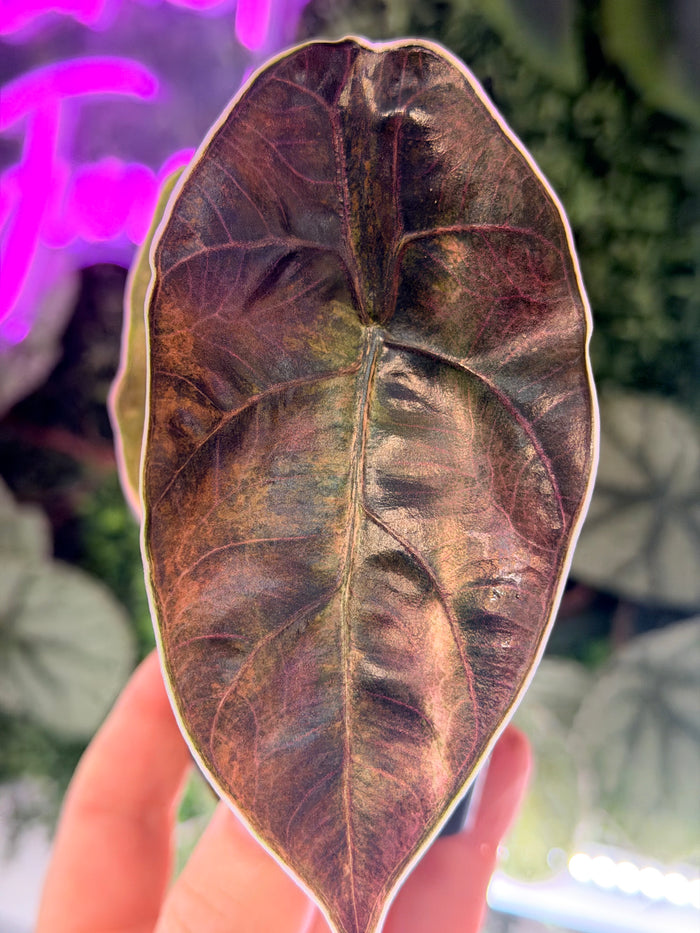
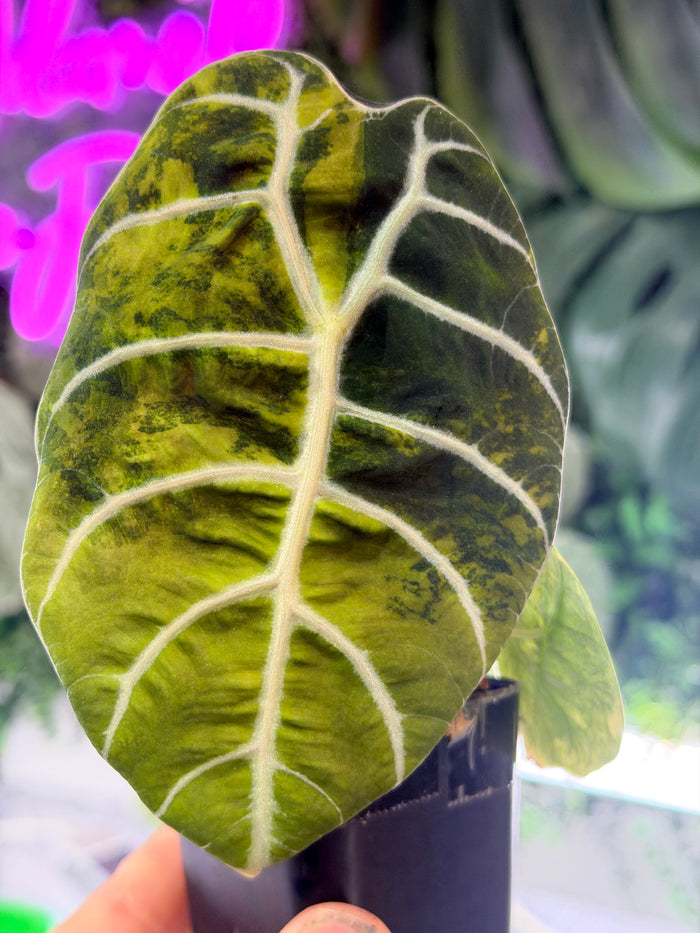
Aroidpedia describes Alocasia sanderiana as a moderately robust herb up to about 60cm tall, with a creeping to decumbent stem and petioles up to 60cm long. The blade is sagittate and glossy deep green above, with a purple underside that Aroidpedia queries as not universal. It reaches roughly 40 by 20cm, is peltate for part of the length of the rear lobes, and has a deeply undulate to almost pinnately cut margin. There are three to four primary veins per side, and they and the midrib are white to yellowish, which gives the leaf its graphic look.
On the aurea plant, golden tissue sits against that dark blade and white venation. Golden aurea sectors on a near-black base create one of the most dramatic warm-dark contrasts in the variegated Alocasia world. The wavy margin follows the colour boundary, so the edge of a golden sector is as scalloped as the leaf itself. Because this is chimeric variegation, one leaf may carry a bold golden sector while the next is nearly plain green, and a corm-grown plant may not carry the variegation at all.
Aurea variegation on a dark leaf
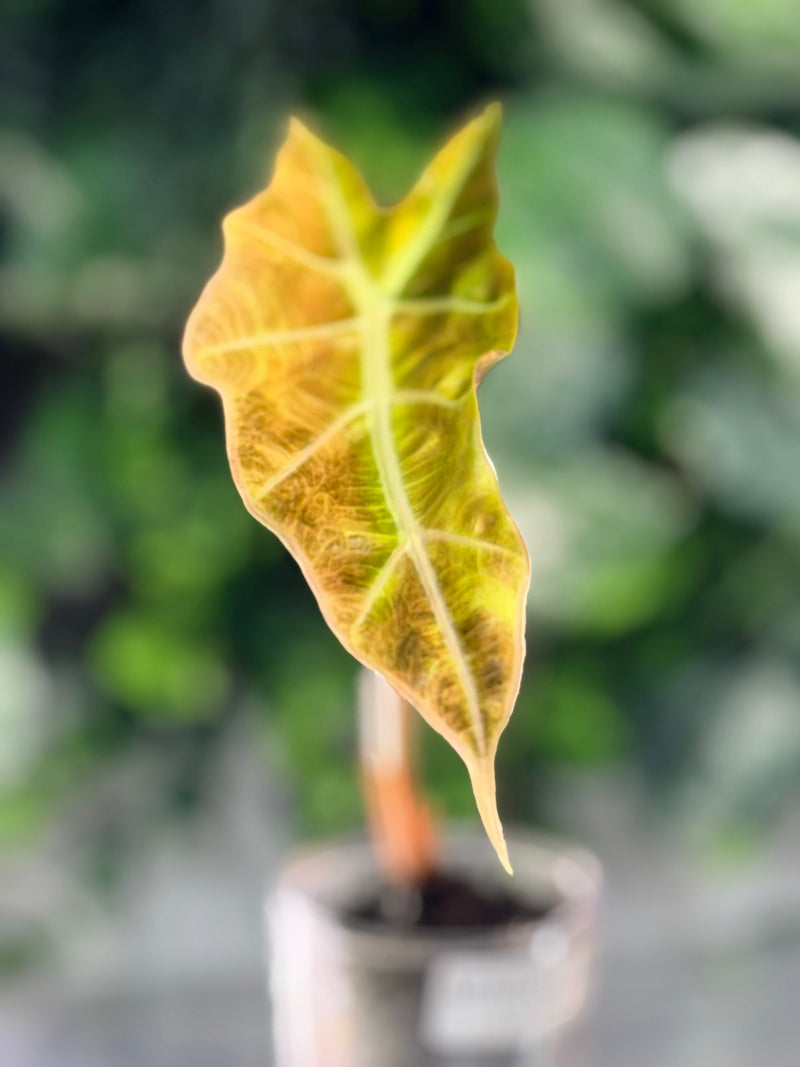
Aurea sectors keep some photosynthetic ability, so they generally behave more steadily than pure white tissue, but they are still less efficient than green. That retained capacity makes the Sanderiana Bull Aurea more vigorous than the pink albo form and somewhat more forgiving of brief care inconsistencies. Colour depends heavily on light: in weak light the gold tends to drift towards yellow-green and loses its contrast with the dark blade. Bright indirect light with LED grow light supplementation keeps the colour clear. Our aurea variegation guide explains the mechanism, and the complete guide to variegation types compares albo, pink, mint and aurea.
Alocasia sanderiana 'Bull' Aurea care
This is general Alocasia care, and it applies to this plant as it does to any other Alocasia in our collection. Aim for bright indirect light supplemented with LEDs, a temperature of 20 to 27°C and humidity of 60 to 80%. Water thoroughly when the top 2 to 3cm of the substrate has dried. We prefer Fluval Stratum as the substrate. If the room runs cool, a heat mat under the pot helps root health. Feed at half strength with our Alocasia feed from the plant feed range. Feeding every 2 to 3 weeks at half to two-thirds strength suits it.
The fuller routine is in our ultimate Alocasia care guide, and if leaves yellow or the base turns soft, read the root rot guide. Aroidpedia records humidity of about 60 to 70% in the wild habitat, which fits the range above.
Propagating from corms
Corms are an economical way to grow more Alocasia, and the method is the same for every cultivar. Our Alocasia corm propagation guide sets out the self-wicking method: the corm sits in Fluval Stratum inside the Corm Keeper, which draws moisture up to the corm without keeping it wet. Our posts on growing corms in Fluval Stratum and how long a corm takes to sprout cover what to expect. Browse the corms collection for available material.
How it compares to similar plants
Aroidpedia lists Alocasia sanderiana as a parent of many well-known hybrids, including 'Amazonica', 'Polly', 'Loco', 'Venom' and 'Chantrieri'. With its dark glossy blade, deeply sinuate margins and bold white to yellowish primary venation, it established the visual template for decades of Alocasia hybridisation, and it stands as a parent or indirect ancestor of some of the most widely grown decorative Alocasia in the world, including the African Mask line. If you like the white-veined dark leaf, our guides to the Amazonica group, Polly and Loco show how the species shows up in its descendants. The sanderiana 'Bully' Pink Albo guide covers the pink and white variegated version, and the pseudosanderiana 'Bully' Aurea guide covers a related plant sold under a similar name. Other golden forms are in the aurea variegated collection.
Frequently asked questions
Is Alocasia sanderiana 'Bull' a separate species?
No. Aroidpedia records no accepted infraspecific forms of Alocasia sanderiana, and 'Bull' or 'Bully' is a selection name used in cultivation rather than a documented cultivar.
Where does it come from?
The species is native to Mindanao in the Philippines. Plants in cultivation are propagated stock, and wild harvesting is illegal in the Philippines.
How large does it grow?
Aroidpedia gives up to about 60cm in height for the species, with blades of roughly 40 by 20cm. Size in a pot depends on light, feeding and root space.
Why is my golden variegation turning green?
Low light is the usual cause. Increase bright indirect light with LED supplementation. Chimeric variegation can also vary naturally from leaf to leaf.
Will a corm grow into a variegated plant?
Not necessarily. Chimeric variegation may not carry over to corm-grown plants, so a corm can produce a plain green plant.
Where can I find it?
We release plants through our drop model. Join the collector list for access to releases, and see the Alocasia Sanderiana Bull Aurea Variegated listing.
Questions about Alocasia sanderiana 'Bull' Aurea? Contact our team for guidance from specialists who grow rare Alocasia in our UK-based private nursery. We are happy to talk through light, substrate and variegation.
From the nursery