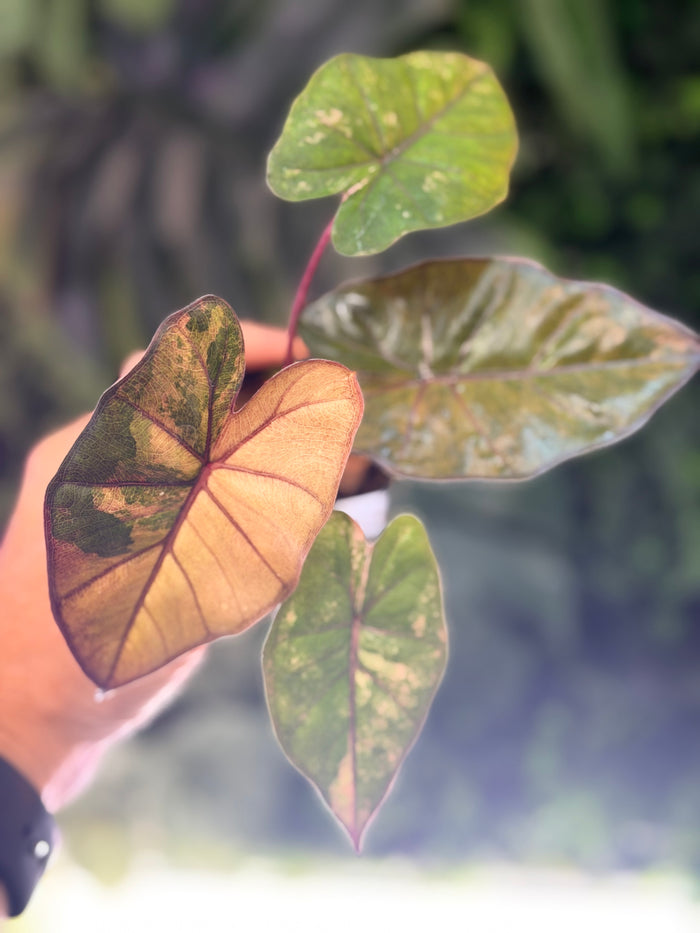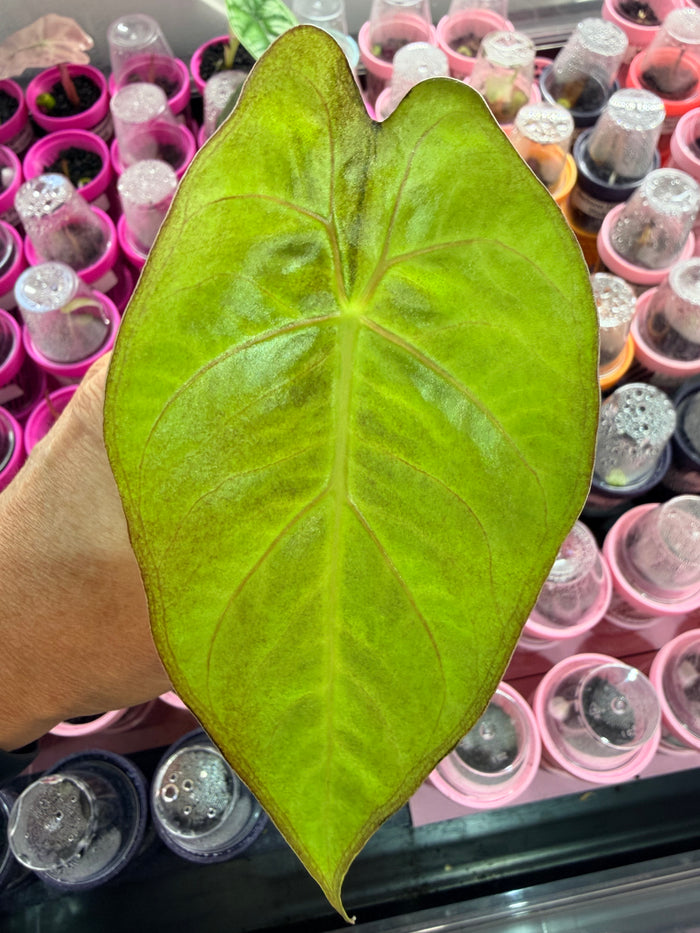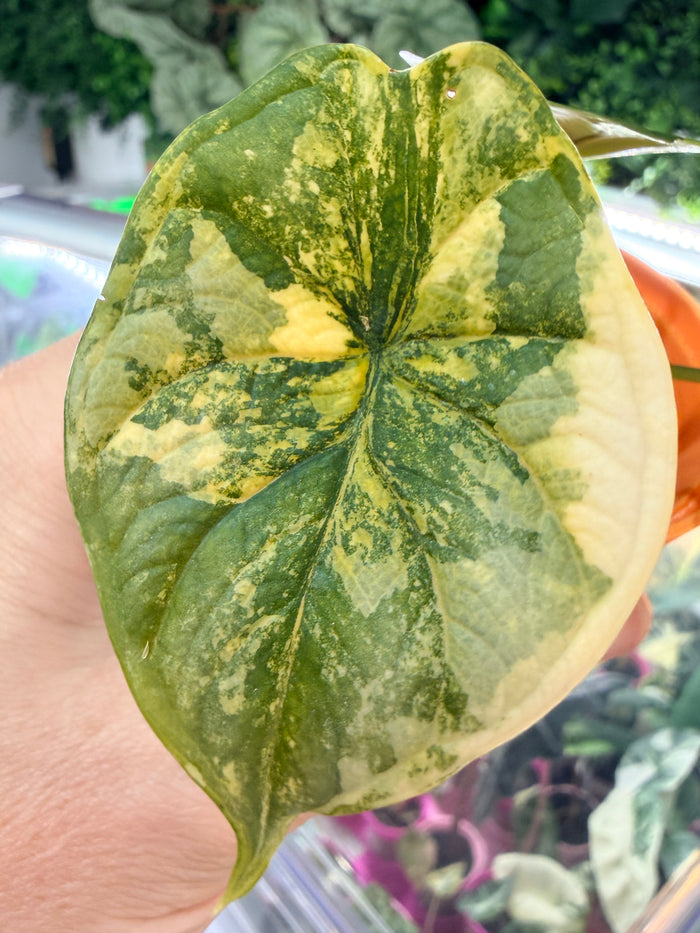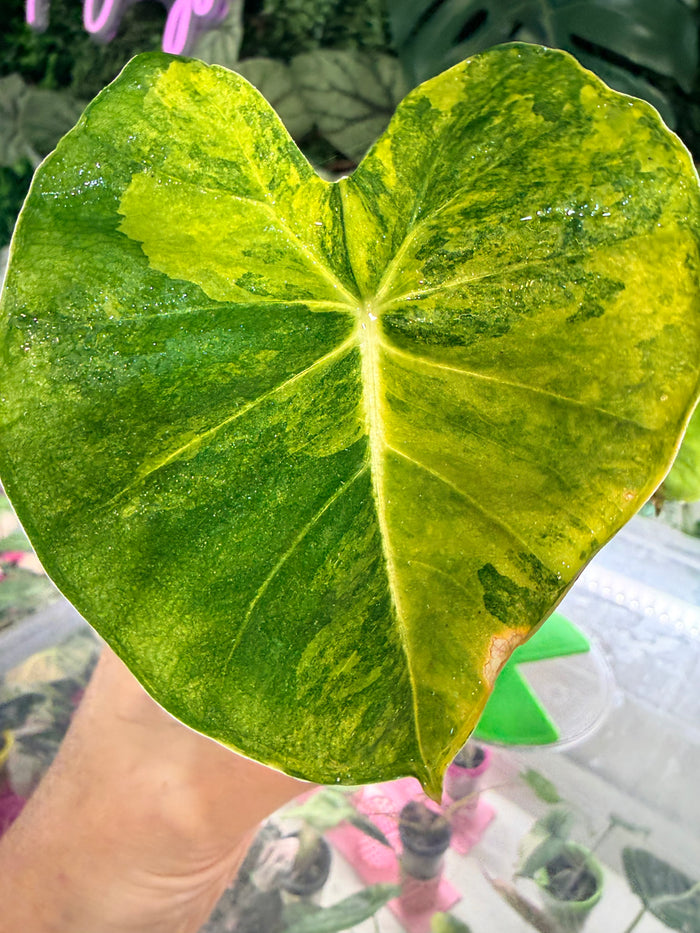

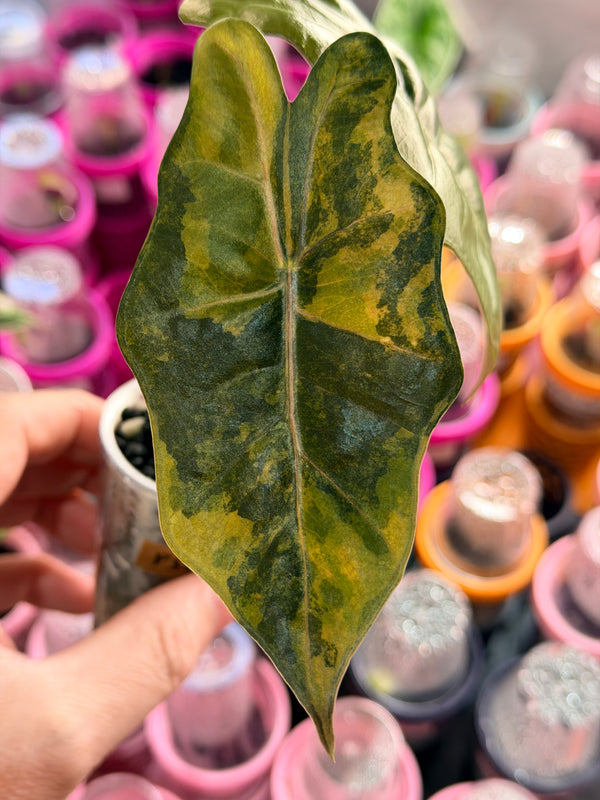
Alocasia pseudosanderiana aurea is a golden-variegated form of Alocasia pseudosanderiana, a Philippine plant whose botanical status is still unsettled. This guide explains what is and is not documented about the name, what aurea variegation means for the plant, how to look after it, and how it compares with the sanderiana plants it is so often mentioned alongside.
What is Alocasia pseudosanderiana aurea?
The plant combines two things: a base plant sold as Alocasia pseudosanderiana, and aurea variegation, the yellow to golden colouring that results from reduced chlorophyll with carotenoid pigments retained. The base plant is the better documented half, although even that is thin. Aroidpedia has an entry for Alocasia 'Pseudosanderiana' but no entry for an aurea cultivar, so cultivar-specific detail such as its origin, who first selected it, and how large it grows is not documented there; for size and appearance we draw on our own experience of growing the plant. The aurea form adds golden-yellow, carotenoid-based variegation to bold, white-veined, deeply undulate foliage that already commands serious collector attention.
Our aurea variegated Alocasia collection shows related golden forms, and the Alocasia pseudosanderiana aurea listing is the place to see the plant itself.
Origin and naming of Alocasia pseudosanderiana
Aroidpedia records that the species is not yet accepted, though it is widespread in cultivation in the Philippines. It lists no synonyms, and its description, ecology, variegated forms, cultivars and hybrids sections are empty. In practical terms that means the name is used in horticulture without a formal botanical standing behind it. The plant is grown widely across the Philippine Islands, in gardens and semi-wild in some areas, and it has been distributed in cultivation under multiple trade names for decades. It has been documented in horticultural literature since 1984, and yet has never been formally described under valid botanical nomenclature. In the USA it has been in cultivation under the names "The False Sanderiana" and Alocasia 'ariozavica', and in Australia as Alocasia 'Philippinensis'.
Aroidpedia gives the etymology: the epithet joins pseudo and sanderiana, meaning that the plant is not the genuine Alocasia sanderiana. That is a statement about how it has been named, and it is not a documented parentage. We have seen it suggested that the plant is a natural hybrid, but we could not find that supported in Aroidpedia, so we treat its parentage as unknown. David Burnett documented the plant in his 1984 Aroideana article 'The Cultivated Alocasia', the first and effectively only formal published reference, noting a suggestion that it might be a natural hybrid of Alocasia heterophylla and Alocasia sanderiana, a reading he himself disputed on several grounds. Whether it is a natural hybrid, an undescribed species or a widely naturalised cultivar, botanical research has not definitively resolved, and that open question is part of what makes the plant interesting to serious collectors.
The climate Aroidpedia lists for its range is tropical and humid, with humidity of around 60 to 70 per cent and temperatures that stay above 7°C. It is a useful reminder of the conditions the plant is adapted to: its origins in the warm, humid Philippines establish its environmental preferences as consistent warmth and humidity, rather than the cool-tolerance of more temperate species.
How to identify it
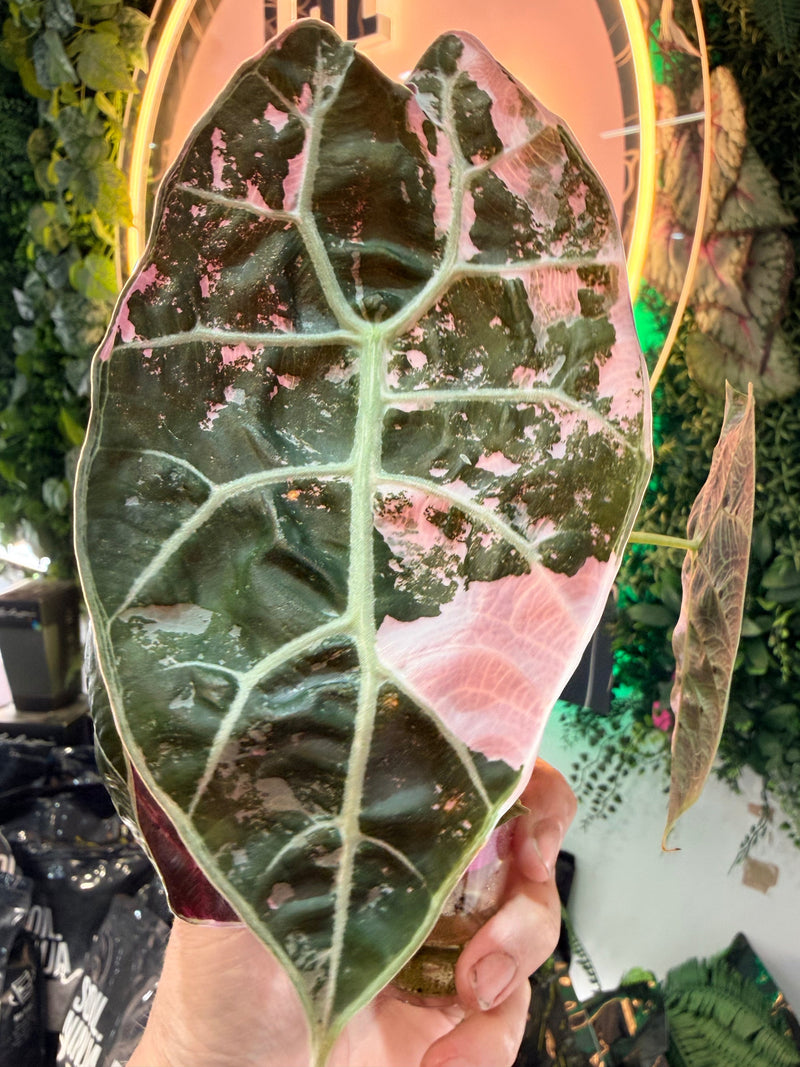
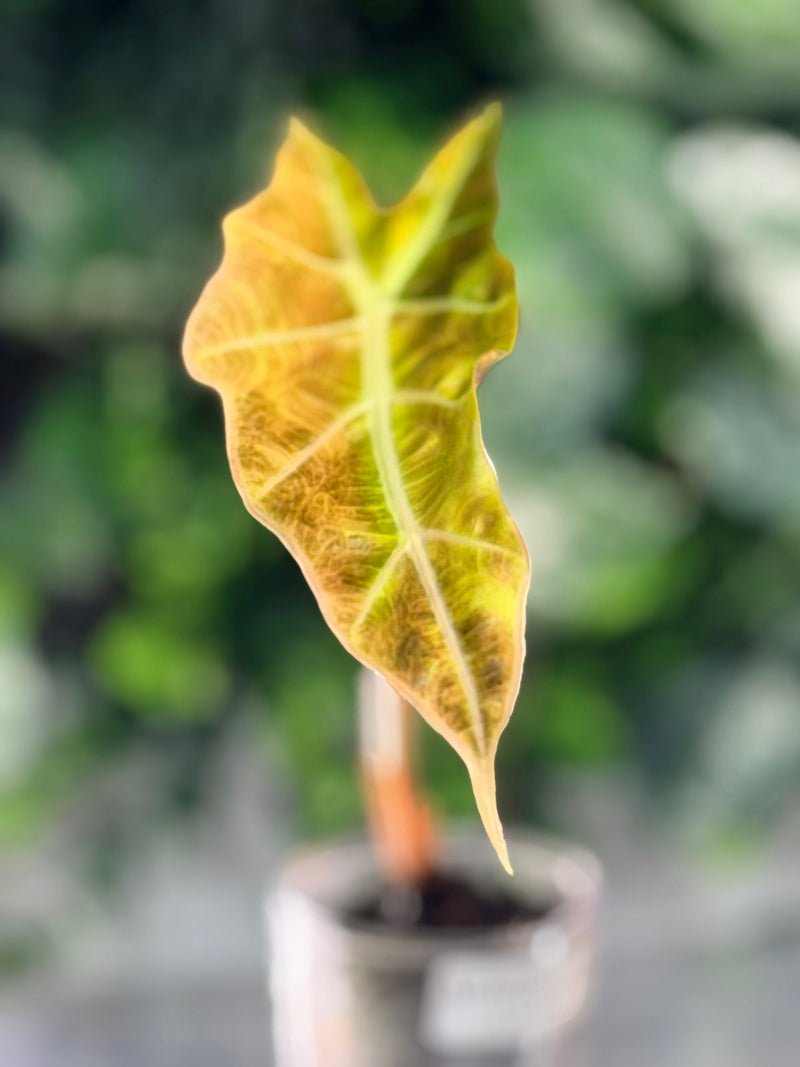
Aroidpedia gives no leaf, stem or size description for the species, so what follows rests on trade listings and our own experience of growing it. Trade listings commonly describe dark green leaves with golden marbled or sectoral variegation, and that matches what to look for: deep green blade tissue with irregular yellow to golden patches and veins that stand out against it. Individual plants vary, and the pattern on one leaf will not match the next.
Visually it belongs with the sanderiana group: large, arrow-shaped leaves with sinuate to sub-pinnatifid margins, prominent cream to white venation, and deep green to near-black blade colouration, which is the ground any colour expression here has to work against. Against Alocasia sanderiana it is markedly larger in cultivation, and it does without several of the sanderiana's signature features, the peltate leaf attachment among them, which argues for a distinct entity rather than simply a sanderiana variant.
Do not rely on the name alone. Plants sold as pseudosanderiana, sanderiana, 'Bull' and 'nobilis' are frequently confused, as our Alocasia sanderiana species guide and nobilis and sanderiana guide explain.
The aurea variegation
Aurea tissue is yellow because chlorophyll is reduced, not absent. Carotenoids remain, and the sectors keep some ability to photosynthesise. That is why aurea forms are generally steadier growers than albo forms, whose white sectors contain no chlorophyll at all. Golden colour is strongest in good light and tends to green up when light is poor. Because the aurea sectors retain photosynthetic capacity, the plant is more vigorous than albo forms of the same species and gives good growth rates under appropriate care.
The interaction between the golden aurea sectors and the existing white venation creates a particularly rich visual composition: warm yellow sectors, cool white venation and deep green base tissue form a three-tone palette that operates across the whole blade at once. The large, deeply undulate leaf margins, the sinuate to sub-pinnatifid edges that give the plant its resemblance to the sanderiana group, interact with the aurea sectors in a visually interesting way. Golden sectors along the margins pick up the undulation, creating a scalloped, dynamic boundary between variegated and non-variegated tissue that adds movement and fluidity to the overall effect.
Variegation of this kind can be chimeric, which means a plant may not reproduce the same pattern when grown from a corm. Treat any corm from a variegated plant as an unknown and expect variation. Our aurea variegation guide and the complete guide to Alocasia variegation types cover the mechanism in more depth.
Alocasia pseudosanderiana aurea care
This is general Alocasia care, and it applies to this plant in full. Good habits matter more than any cultivar-specific trick.
- Light: bright indirect light, with LED grow light supplementation to hold the golden colour.
- Temperature and humidity: 20 to 27°C and humidity of 60 to 80 per cent. A heat mat helps if the room runs cool.
- Watering: water thoroughly when the top 2 to 3cm of substrate has dried. Avoid leaving the pot standing wet; our root rot guide explains why.
- Substrate: Fluval Stratum is our preferred substrate. See our substrates and growing media.
- Feeding: use our Alocasia feed from the plant feed range at half to two-thirds strength, every 2 to 3 weeks.
For a wider introduction, read the ultimate Alocasia care guide, and use the plant care collection for supplies.
Propagation from corms
Our Alocasia corm propagation guide sets out the method in full. In short, the corm is placed in Fluval Stratum in the Corm Keeper, which wicks moisture up from below so the corm stays evenly damp without sitting in water. See also growing Alocasia corms in Fluval Stratum and how long a corm takes to sprout. Browse corms if you want to start that way.
How it compares with similar plants
The nearest comparison is Alocasia sanderiana. Aroidpedia describes that species as native to Mindanao, with arrow-shaped, deeply undulate leaves, white to yellowish veins and a petiole attached partly peltately. It also notes that its use in hybridisation produced plants such as 'Polly' and 'Venom'. Aroidpedia says nothing about pseudosanderiana in that entry; the comparison we draw between the two plants, including that pseudosanderiana grows larger than sanderiana, comes from our own experience of growing both.
Related guides on our site include the pseudosanderiana 'Bully' aurea guide, the pseudosanderiana pink variegated guide and the sanderiana 'Bull' aurea guide.
We release plants through our drop model; find out how drop access works.
Frequently asked questions
Is Alocasia pseudosanderiana an accepted species?
No. Aroidpedia records that the species is not yet accepted, although it is widespread in cultivation in the Philippines.
What does pseudosanderiana mean?
It means not the genuine Alocasia sanderiana, from pseudo and sanderiana.
Is the aurea form documented anywhere?
Not on Aroidpedia, which has no cultivar entry, so its origin and size are not recorded there; in our experience pseudosanderiana grows larger than sanderiana.
Will the gold colour fade?
Aurea colouring is light-dependent. Good light keeps it strong, and weak light lets the leaves green up.
Is it toxic?
Alocasia in general contain calcium oxalate crystals and are toxic if eaten, so keep plants away from pets and children.
Questions about Alocasia pseudosanderiana aurea? Contact our team for guidance from specialists who grow rare Alocasia in our UK-based private nursery. We are always glad to help you work out what you have.