Alocasia Pseudosanderiana Pink Variegated: The Complete Collector's Guide

Alocasia pseudosanderiana pink variegated is a collector form of a Philippine Alocasia whose botanical identity has never been formally settled. It is among the rarest collector expressions within the pseudosanderiana family: chimeric pink variegation, driven by elevated anthocyanin pigment expression in specific cell lineages, appearing on bold, deeply undulate foliage with prominent white venation. This guide covers what the name means, what the sources do and do not document, how pink variegation behaves on this plant, and how to care for it in UK cultivation.
What is Alocasia pseudosanderiana?
Alocasia 'Pseudosanderiana' is a plant widely grown in the Philippines. Aroidpedia lists it under the name with an asterisk and records that the name is not yet accepted, so it has no settled standing as a formally described species. It is nonetheless real, common in cultivation, and sold under this name throughout the hobby. The plant is grown widely throughout the Philippine Islands and has gone semi-wild in places; American growers have known it as "The False Sanderiana" and as Alocasia 'ariozavica', Australian growers as Alocasia 'Philippinensis'.
Aroidpedia gives very little beyond that. Its entry for the plant has no description, no size, no parentage and no list of cultivars or variegated forms. We therefore do not state a breeder or a date of introduction here, because neither is documented by the primary source we rely on; the hybrid suggestion and the leaf description below come from Burnett's 1984 account and our own experience. If you see confident claims about its parentage elsewhere, treat them as unverified.
The one substantial account is David Burnett's 1984 Aroideana article 'The Cultivated Alocasia', the first and effectively only formal published reference, in which he recorded the suggestion that this is a natural hybrid between Alocasia heterophylla and Alocasia sanderiana and disputed it on several grounds. Whether it is a natural hybrid, an undescribed species, or a widely naturalised cultivar has not yet been resolved by botanical research, and collectors drawn to the unsettled end of the genus tend to count that as part of the appeal.
Origin and naming
Aroidpedia places the plant across the Philippines and the wider Malesian region. The epithet combines pseudo with sanderiana, and Aroidpedia glosses it as meaning not the genuine Alocasia sanderiana. In other words, the name was given to a plant that resembles the true species without being it. For background on the true species, see our Alocasia sanderiana species guide and our guide to Alocasia nobilis and sanderiana.
Aroidpedia's notes for the climate of the region describe a tropical, humid environment with moderate humidity of around 60 to 70 per cent. That sits comfortably alongside the general care described below.
How to identify Alocasia pseudosanderiana
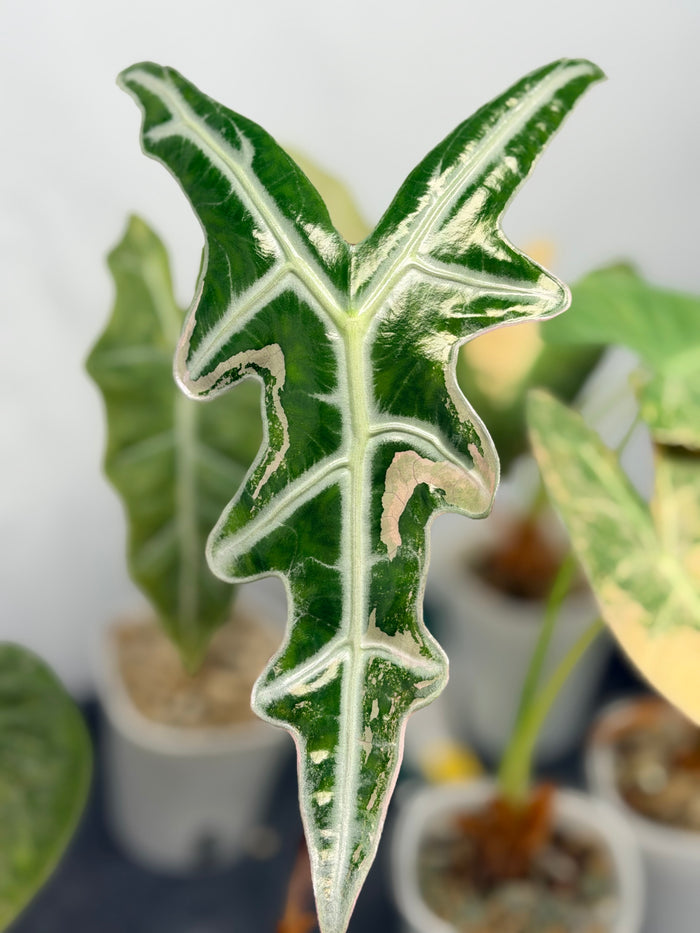
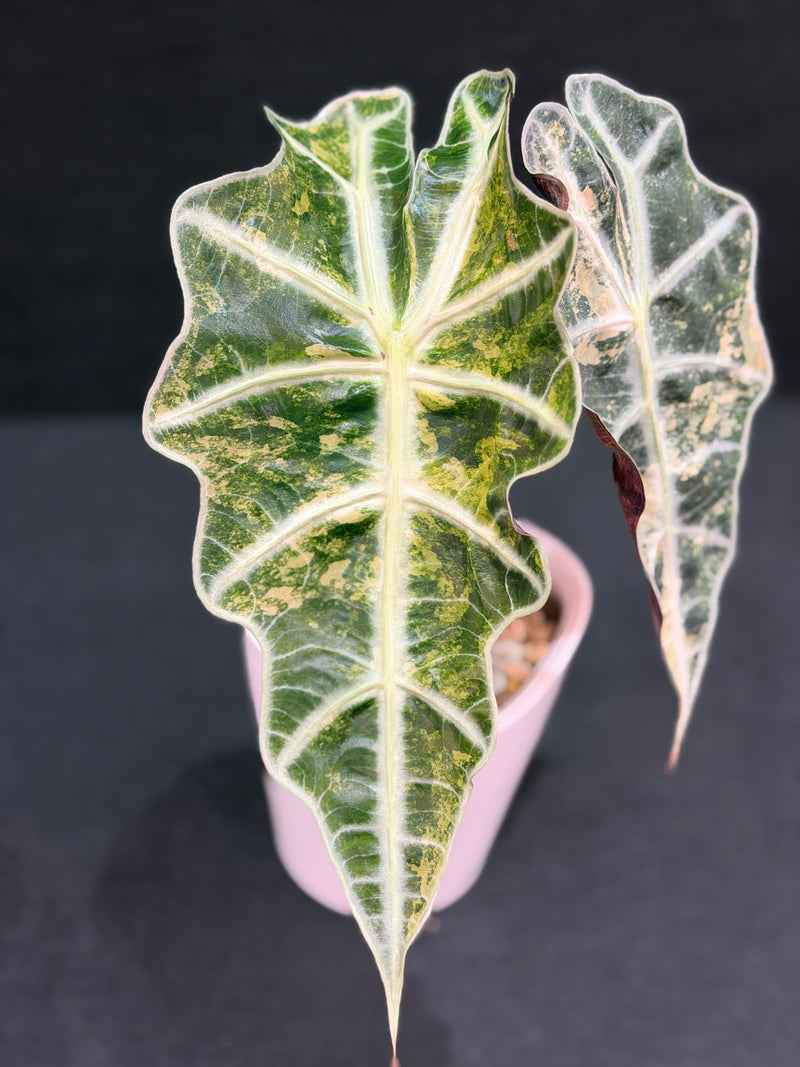
Aroidpedia does not provide a leaf description for this plant, so the description here is drawn from our own experience of growing it. Growers place it in the sanderiana look: a large, arrow-shaped leaf with pale venation. Its look places it firmly with the sanderiana group, bold white-veined and deeply undulate: large arrow-shaped blades, sinuate to sub-pinnatifid at the margin, with cream to white venation held prominent against deep green to near-black tissue. In cultivation it reaches a considerably larger size than Alocasia sanderiana, and it is missing some of that plant's defining features, the peltate leaf attachment included, which is evidence for treating it as a distinct entity rather than simply a sanderiana variant. The most reliable way to confirm identity is to compare it with other named forms in the same group, such as the pseudosanderiana aurea, the sanderiana bull aurea and the pseudosanderiana bully aurea.
Pink variegation on Alocasia pseudosanderiana
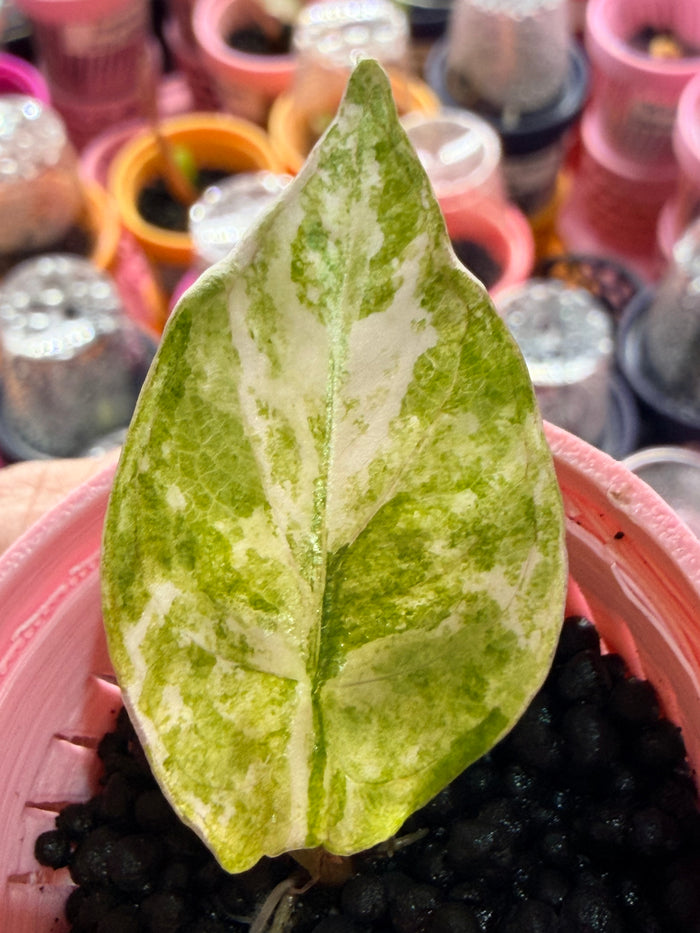
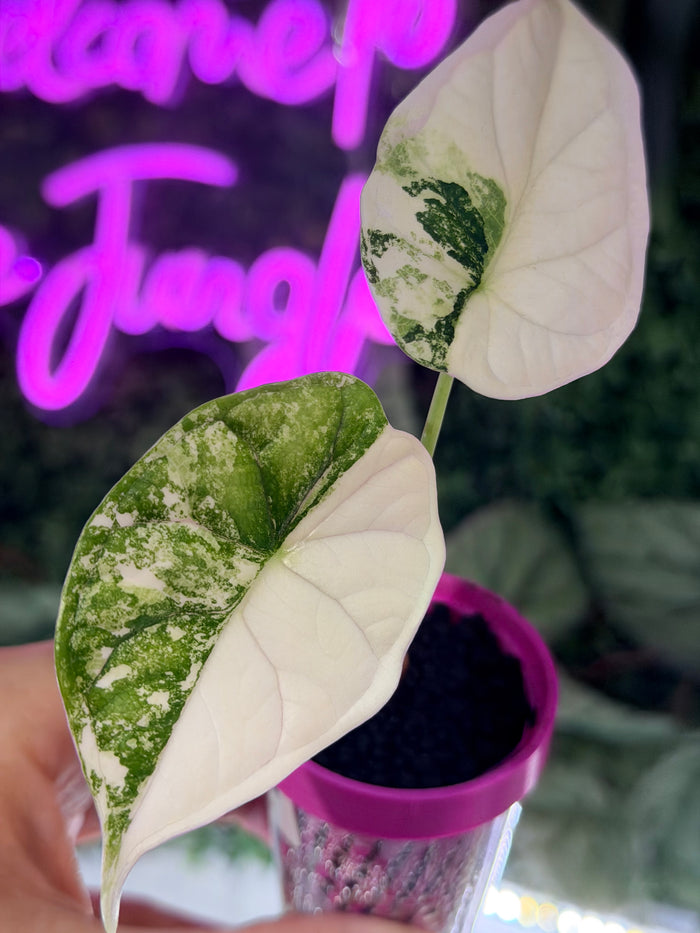
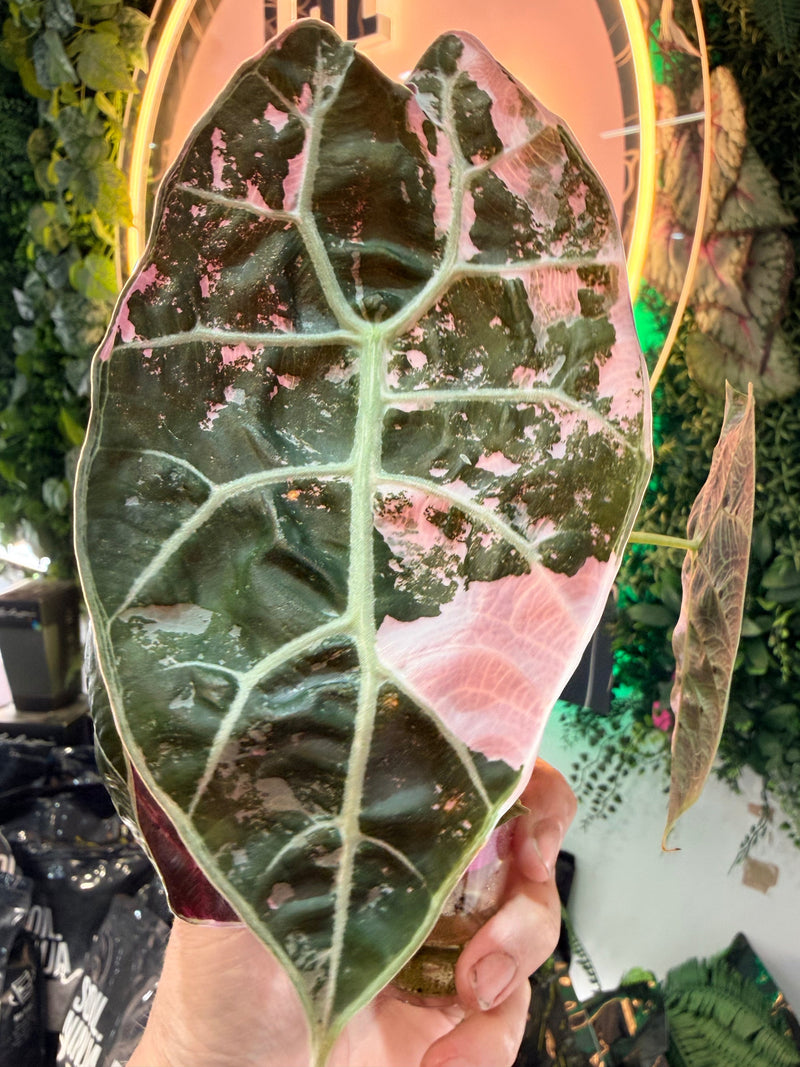
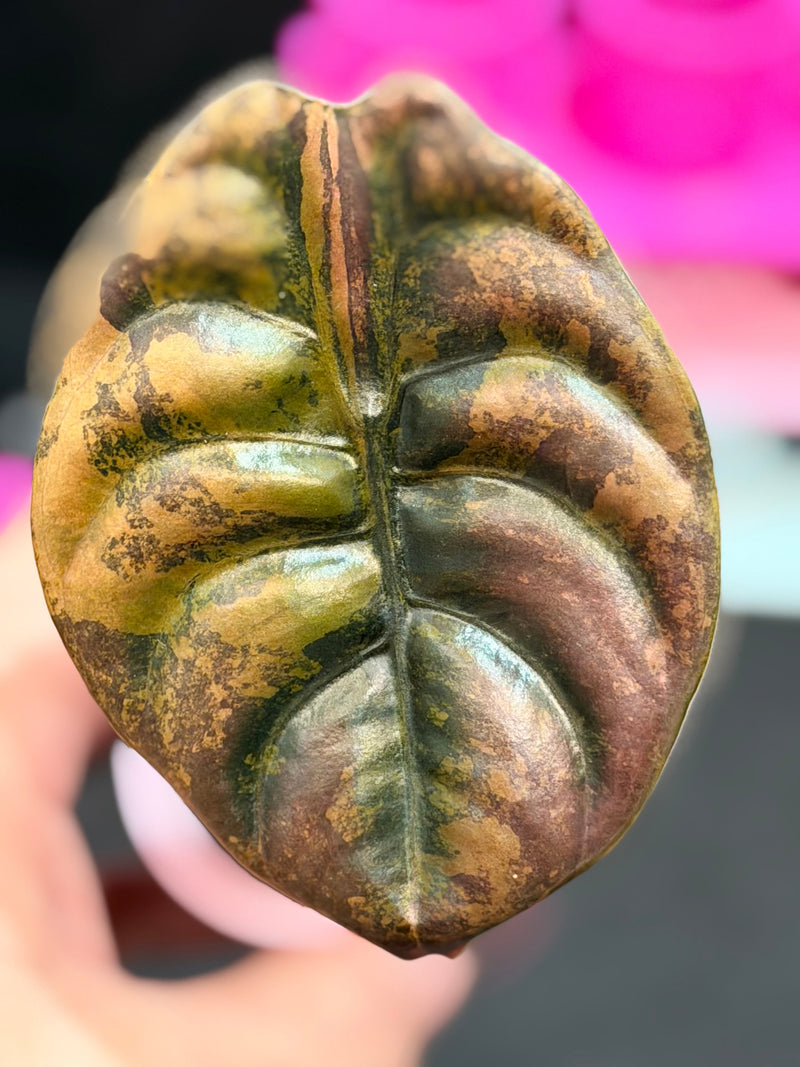
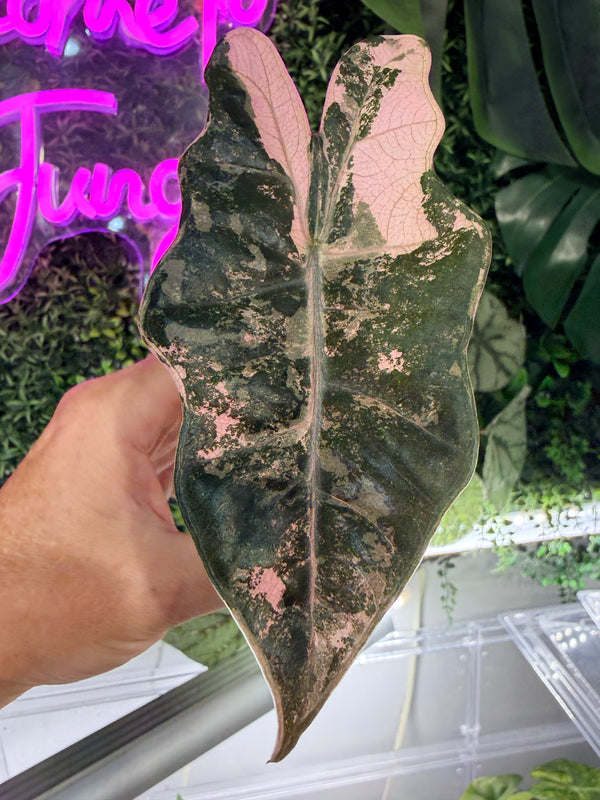
Pink variegation in Alocasia is anthocyanin-based and chimeric. It is the rarest and most unstable colour expression in the genus regardless of species, and on a botanically distinctive and taxonomically unresolved Philippine plant, the combination of inherent botanical interest and exceptional colour rarity creates a collector specimen that occupies a unique position in the variegated Alocasia world. Unlike albo variegation, where sectors have no chlorophyll at all, pink sectors keep their chlorophyll and carry additional red-purple pigment on top, so the colour reads as a tint over green rather than as a clean white. The pink is not a replacement of green but an overlay on it: the anthocyanin pigments sit above the chlorophyll-containing layer in the cell, tinting the green tissue pink through a phenomenon analogous to a coloured filter. That is why pink sectors often have a different visual depth from albo sectors: they are not white against green but pink-tinted green, with the depth of the green visible through the pink. Because the pattern comes from separate cell layers rather than from the whole plant, it is unstable: one leaf may carry broad pink areas and the next very little. Aroidpedia does not record a pink variegated form of this plant, so the existence of the form rests on collector practice rather than on a documented origin.
The visual relationship between the pink sectors and the white venation creates a composition where warm (pink) and cool (white) colour elements coexist within a dark base, a combination that is strikingly different from pink variegation on lighter-based species. The large leaf size and deeply undulate margins mean that pink sectors, when present, occupy significant portions of the blade and contribute materially to the plant's overall visual character rather than appearing as isolated spots or streaks. Some leaves will carry extensive pink areas and others minimal pink expression; this instability is the nature of chimeric pink variegation across the genus and should be expected as part of the plant's character.
Chimeric variegation may also fail to carry over to corm-grown plants, so a corm taken from a pink leaf should not be assumed to produce pink foliage. Our guide to the mystery of pink variegation in Alocasia explains the mechanism in detail, our complete guide to Alocasia variegation types compares pink with albo, aurea and mint, and our pink variegated Alocasia collection gathers related plants.
Alocasia pseudosanderiana care
This is general Alocasia care, and it applies to this plant.
- Light: bright indirect light, supplemented with LED grow lights where daylight is limited. Pink sectors, unlike albo sectors, retain chlorophyll and contribute some photosynthesis, which gives the Pink Variegated form somewhat more metabolic resilience than an albo form.
- Temperature: 20 to 27°C. If the room runs cool, a heat mat helps keep the roots warm.
- Humidity: 60 to 80 per cent.
- Watering: water when the top 2 to 3cm of the substrate has dried.
- Substrate: Fluval Stratum is our preferred substrate; see also our substrates and growing media.
- Feeding: our Alocasia feed from the plant feed range at half strength, every 2 to 3 weeks.
Our ultimate Alocasia care guide covers the fundamentals in full, and our guide to Alocasia root rot explains how to spot and recover from overwatering.
Propagating from corms
Alocasia produce small corms that can be grown on into new plants. Our Alocasia corm propagation guide describes the self-wicking method, in which the corm sits in Fluval Stratum inside the Corm Keeper. Our posts on growing corms in Fluval Stratum and how long a corm takes to sprout set out what to expect, and our corms collection is the place to browse.
How it compares to similar plants
Against Alocasia sanderiana, the pseudosanderiana name signals a different, less well defined plant. Against the aurea forms linked above, the pink form differs in pigment: carotenoid yellow in aurea, anthocyanin pink here. Both remain chimeric, so neither can be guaranteed to hold its pattern.
We release our rare plants through our drop model. Join the collector list for early access, and see the Alocasia pseudosanderiana pink variegated listing for the plant itself.
Frequently asked questions
Is Alocasia pseudosanderiana a true species?
Aroidpedia records that the name is not yet accepted, so it has no settled status as a formally described species, although the plant is widely grown in the Philippines.
What is its parentage?
Aroidpedia does not document any parentage or hybrid origin. David Burnett's 1984 article records a suggestion that it is a natural hybrid of Alocasia heterophylla and Alocasia sanderiana, which he disputed, so we treat the parentage as unresolved.
Why does the pink vary from leaf to leaf?
Pink variegation is chimeric and unstable, so the amount of pink changes between leaves and may fade or return.
Will a corm from a pink plant be pink?
Not necessarily. Chimeric variegation may not carry over to corm-grown plants.
Does pink variegation need different care from green plants?
No. The general Alocasia care above applies. Consistent bright indirect light and good grow lighting simply give the plant the best chance of strong growth and colour.
Is it toxic?
Like other aroids, Alocasia contain calcium oxalate crystals and are irritant if chewed, so keep them away from pets and children.
Questions about Alocasia pseudosanderiana pink variegated? Contact our team for guidance from specialists who grow rare Alocasia in our UK-based private nursery. We are happy to talk through care, variegation and propagation.
From the nursery