
Alocasia Simpo Aurea is the golden-yellow variegated form of Alocasia 'Simpo', a hybrid bred by Wawan Santoso and named after Bukit Simpo, the Simpo Hills in Malaysia, where one of the nurseries he worked at is located. This guide explains what the plant is, where it comes from, how to recognise it, how aurea variegation behaves on this particular hybrid and how to grow it well.
What is Alocasia 'Simpo' Aurea?
'Simpo' is a hybrid, not a wild species. Aroidpedia, the aroid reference we rely on for hybrid records, lists it under the hybrid category and credits Santoso as the hybridiser. The same breeder is also credited with Alocasia 'Lukiwan' and Alocasia 'Albatuwan'. Aroidpedia records the variegated forms of 'Simpo' as white and yellow. The yellow form is the one we call Simpo Aurea.
An honest note on sources: Aroidpedia has an entry for the base hybrid, but it does not have a separate entry for the aurea form, and it does not use the word aurea or describe the yellow form in further detail. Everything in this guide about the plant itself therefore comes from the base entry, and the notes on how aurea variegation behaves come from our own guide to aurea variegation in Alocasia.
Where does Alocasia 'Simpo' come from?
Aroidpedia gives the suspected parentage of 'Simpo' as Alocasia sinuata × Alocasia 'Lukiwan'. The word suspected matters: the entry states that Santoso does not remember the exact cross, so the parentage should be read as the best available account rather than a confirmed record.
'Lukiwan' is itself a Santoso hybrid. Aroidpedia records it as Alocasia alba × Alocasia sinuata, made while he worked at Chong Lee Nursery in Malaysia, and explains the name as a blend of his wife's name and his own. That makes 'Simpo' a plant with A. sinuata on both sides of the suspected cross. Alocasia sinuata is a Philippine species, recorded in limestone forest on Samar, Leyte and parts of Mindanao.
Aroidpedia does not give a date of origin, a release history or a registration for 'Simpo', so we have not stated one.
How to identify Alocasia Simpo Aurea
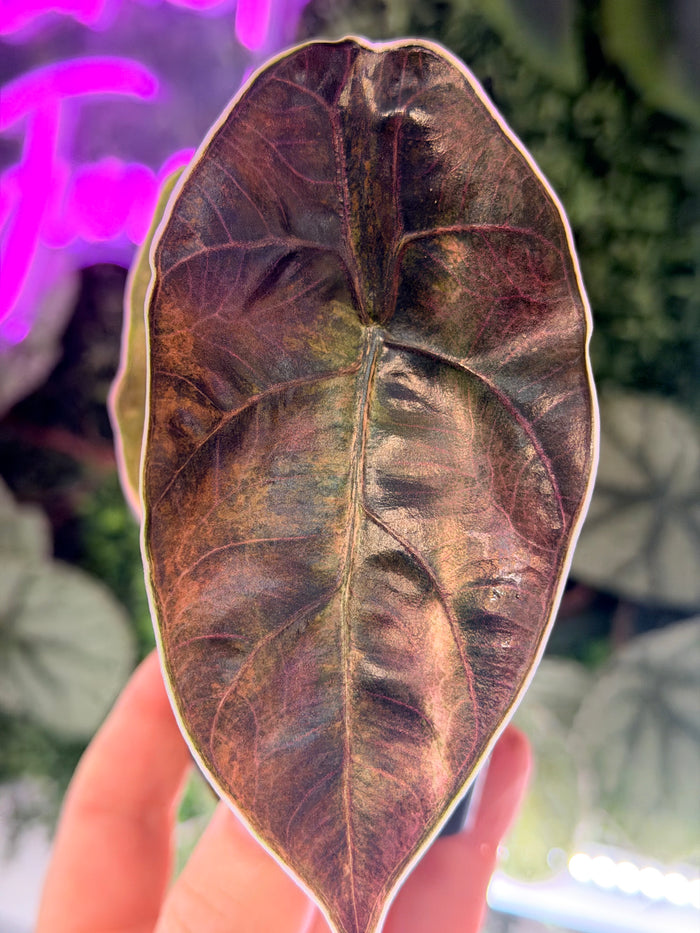
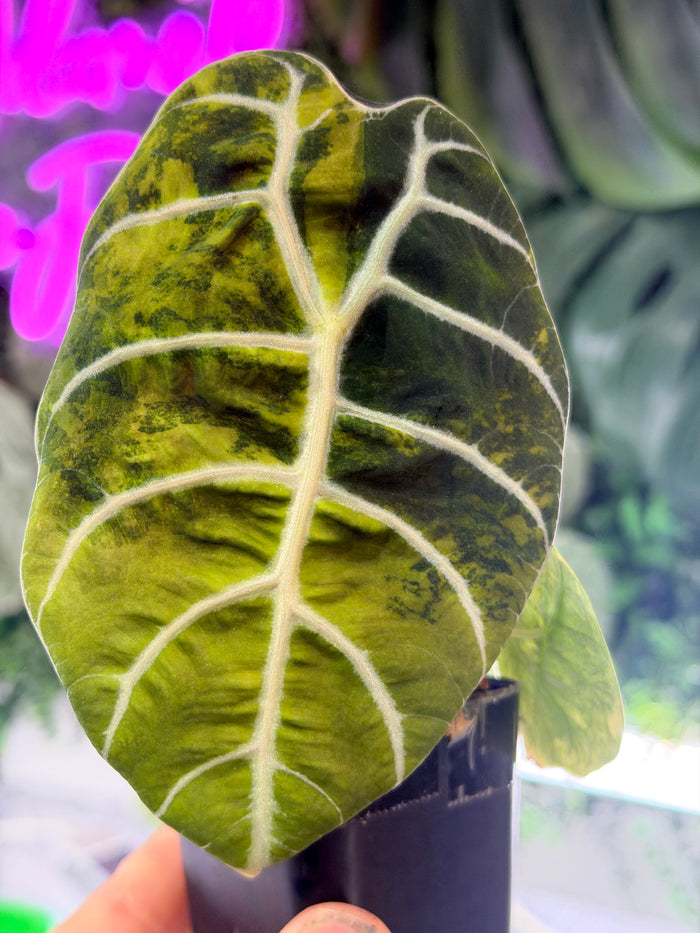
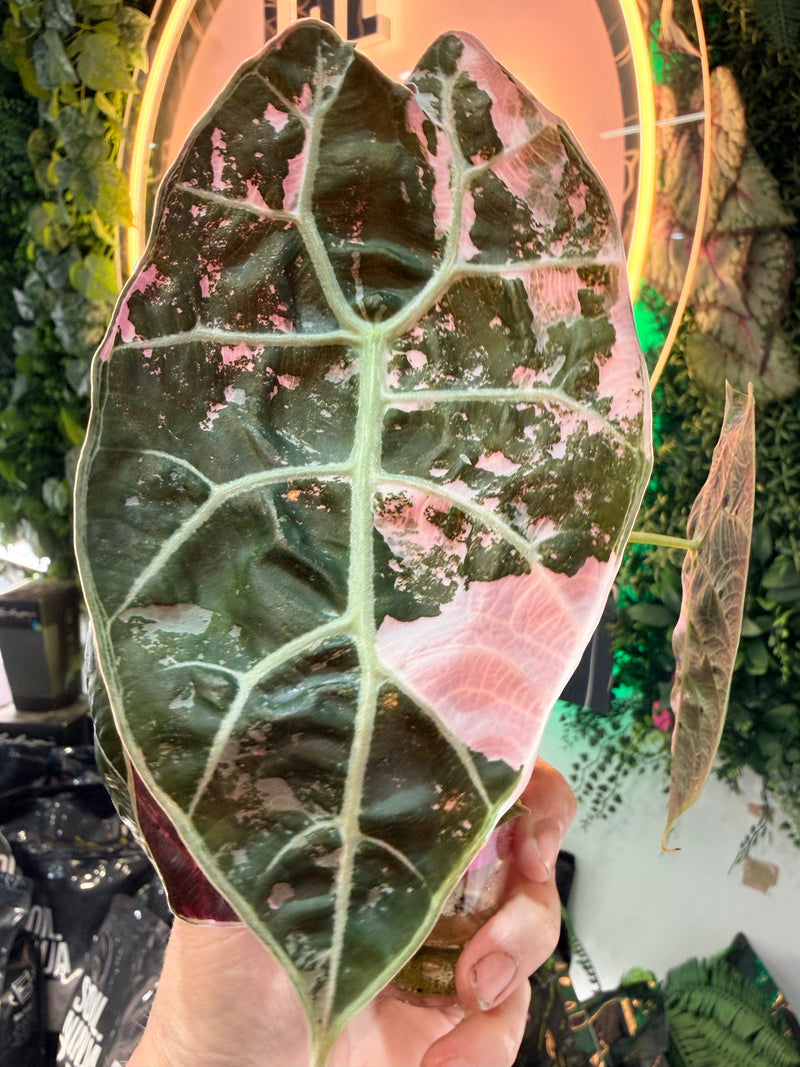
Aroidpedia describes 'Simpo' as retaining the highly bullate and glabrous character of A. sinuata and 'Lukiwan'. In plain terms, the leaf surface is raised and quilted between the veins and is smooth rather than hairy. Mature leaves develop an open sinus at the base, and the spathe and floral chamber are greenish white.
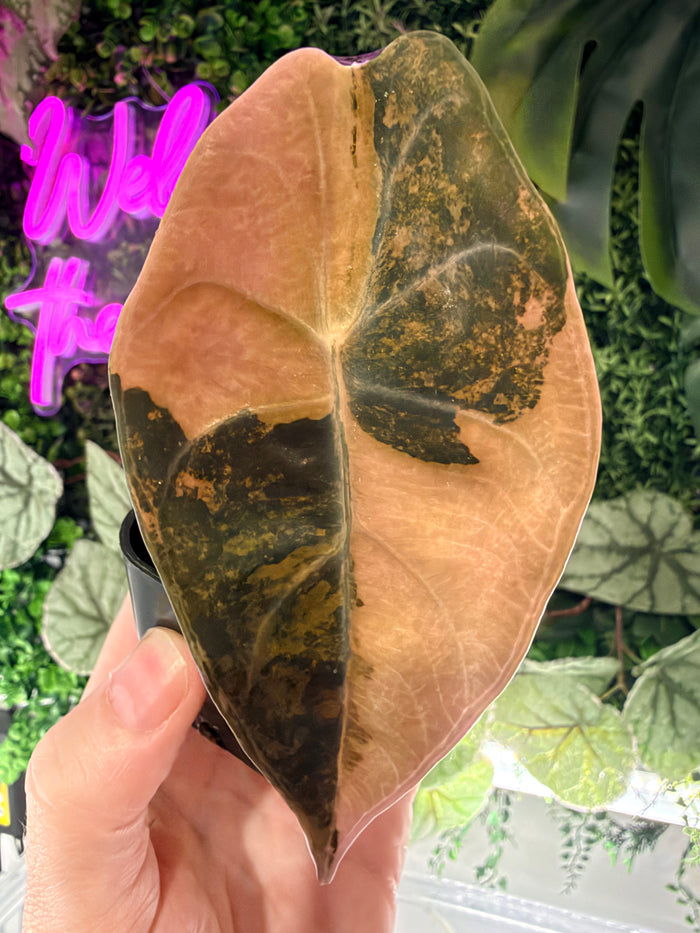
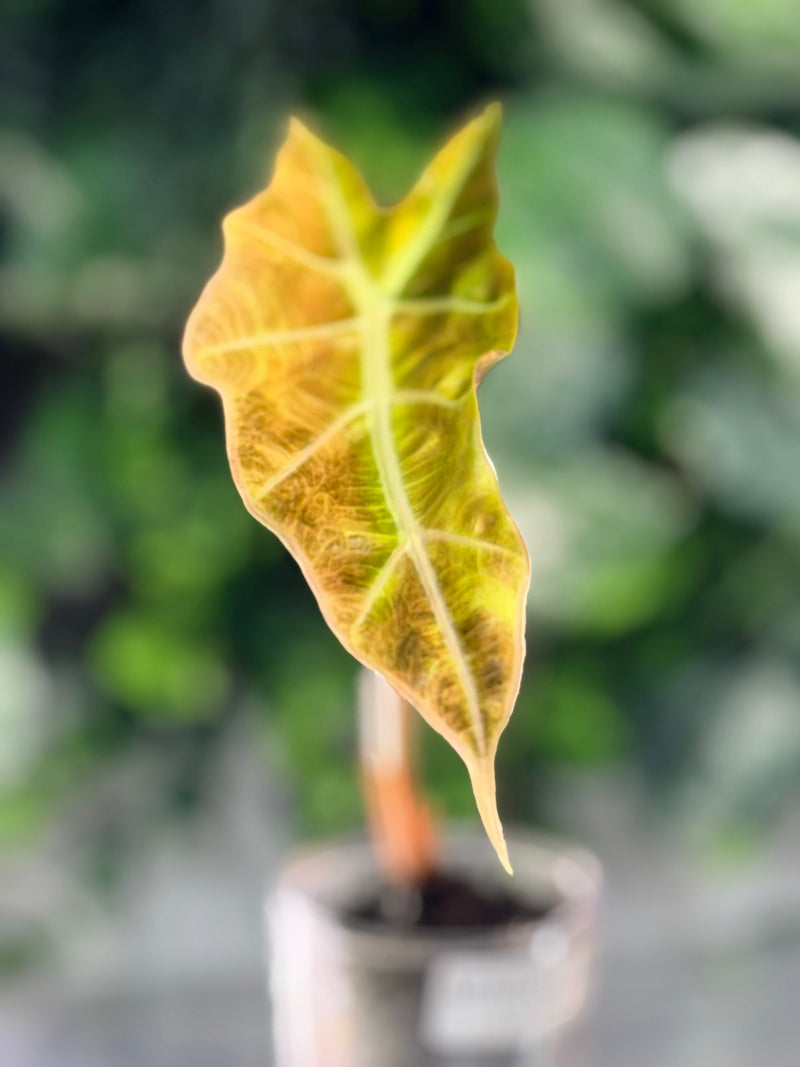
On the aurea form, the golden-yellow sectors sit across that raised quilting. Because the surface catches light differently on gold and on green, the variegation reads with some depth rather than as a flat blotch of colour. The pattern is not predictable from leaf to leaf, which is true of chimeric variegation in general: one leaf may be heavily marked and the next mostly green. When you compare plants, look at the quilting, the open basal sinus on mature leaves and the yellow, rather than white, sectors.
Aroidpedia does not give a size or growth habit for 'Simpo', so we do not quote one here.
How aurea variegation works on this hybrid
Aurea variegation comes from reduced chlorophyll with the yellow carotenoid pigments left showing through. The sectors are not empty tissue: they keep some photosynthetic machinery and contribute a little to the plant's energy, which is why aurea tends to be more vigorous than albo on the same base. Our aurea variegation guide sets out the mechanism in full, and the complete guide to Alocasia variegation types places it alongside the other expressions.
Light is the practical variable. Low light encourages greener growth, while direct sun can scorch the golden areas, so steady bright indirect light with LED supplementation gives the best chance of clear colour. If you are weighing up whether lamps are worth it, our article on LED grow lights covers it.
How does Simpo Aurea differ from Simpo Albo and other variegation?
The albo form of this hybrid has white variegation, and we cover its background and care in the Alocasia Simpo Albo guide. White sectors lack pigment altogether and cannot photosynthesise, so albo leaves are more demanding. Aurea sectors keep some capacity, so the plant is generally the more forgiving of the two, although it is still slower than an all-green plant.
If you are choosing between expressions, the albo variegation guide and our article on pink variegation explain the other two. You can browse the aurea variegated collection, the albo variegated collection and the pink variegated collection to compare them.
Alocasia Simpo Aurea care
This is general Alocasia care, and it applies to this plant. Our ultimate Alocasia care guide goes into each point in depth.
Light and temperature
Provide bright indirect light, supplemented with LED grow lights where daylight is limited. Keep temperatures between 20 and 27°C. If the room runs cool, a heat mat beneath the pot supports the root zone.
Humidity
Aim for 60 to 80% humidity, maintained with a dedicated humidifier. Dry air can brown the delicate golden areas first.
Substrate and watering
We prefer Fluval Stratum as a substrate. Water thoroughly when the top 2 to 3cm has dried, and never leave the pot standing in water. Persistently wet roots are the usual route to decline, so read our root rot guide if leaves yellow or collapse unexpectedly. You may also find a substrate or self-watering pot helpful for even moisture.
Feeding and pests
Feed with our Alocasia feed from the plant feed range, at a strength suited to a variegated plant, which has less green tissue to produce energy than a fully green one. Our plant feed guide explains the approach. Check the quilted leaf surface and the undersides regularly, because pests shelter in textured leaves, and keep pest control to hand. For other issues, see the troubleshooting guide.
Propagating Alocasia Simpo Aurea from corms
Our Alocasia corm propagation guide explains how to choose a healthy corm and what to expect while it sprouts. We use the self-wicking method with Fluval Stratum in the Corm Keeper, and you can read more in growing Alocasia corms in Fluval Stratum.
Be realistic about the result. Variegation of this chimeric kind may not carry over to a plant grown from a corm, so a corm-grown plant can come up fully green. Timing varies, as covered in how long a corm takes to sprout and why corms may not sprout.
Frequently asked questions
What is the difference between Alocasia 'Simpo' and Simpo Aurea?
'Simpo' is the base hybrid. Simpo Aurea is its golden-yellow variegated form, which Aroidpedia records among the yellow variegated forms of the hybrid.
What is Alocasia 'Simpo' bred from?
The suspected parentage is Alocasia sinuata × Alocasia 'Lukiwan'. The breeder does not remember the exact cross, so it is unconfirmed.
Is Simpo Aurea easier to grow than Simpo Albo?
Generally somewhat, because aurea tissue keeps some photosynthetic capacity. It still needs bright indirect light, steady warmth and careful watering.
Will a corm from a variegated plant be variegated?
Not necessarily. Chimeric variegation may not carry over, so corm-grown plants can be green.
Where can I find Simpo Aurea?
We release it through our drop model. Join the collector list and view our Alocasia Simpo Aurea listing. The aurea variegated collection includes related plants.
Questions about Alocasia Simpo Aurea? Contact our team for guidance from specialists who grow rare Alocasia in our UK-based private nursery. We are happy to help with identification, care and propagation questions.
From the nursery