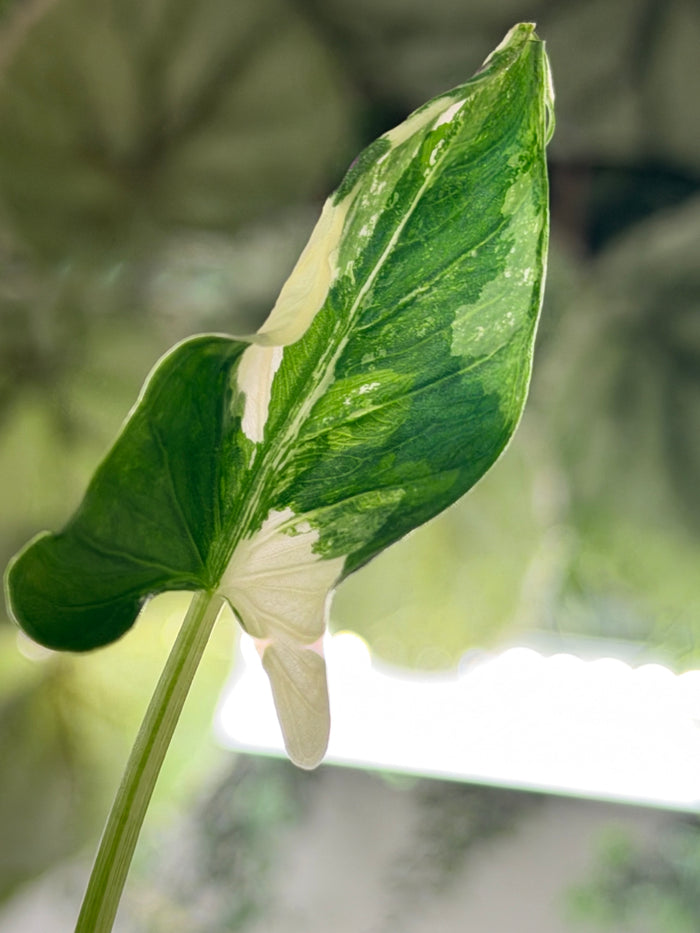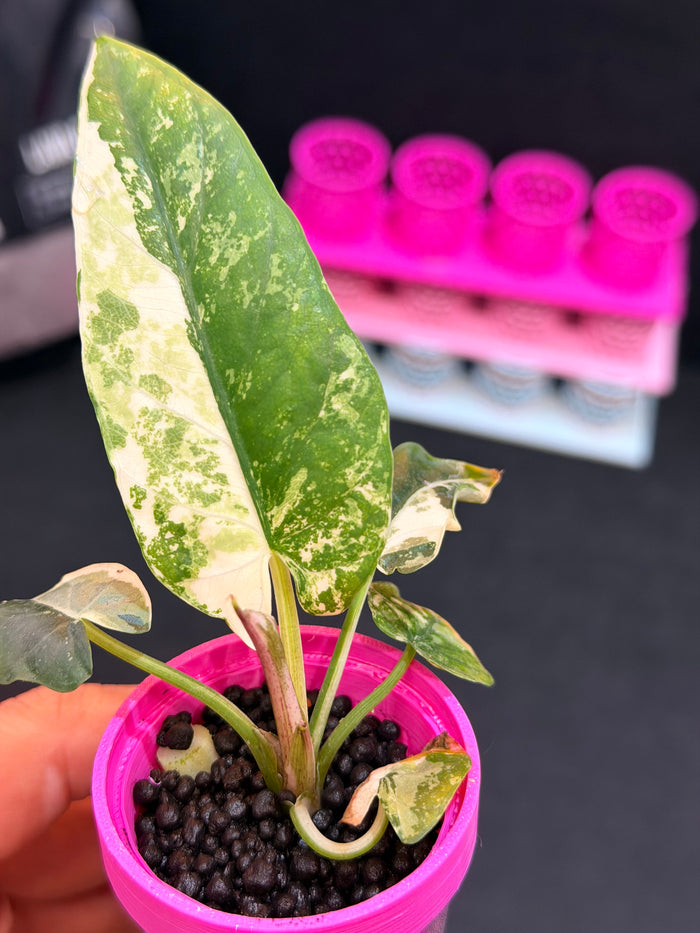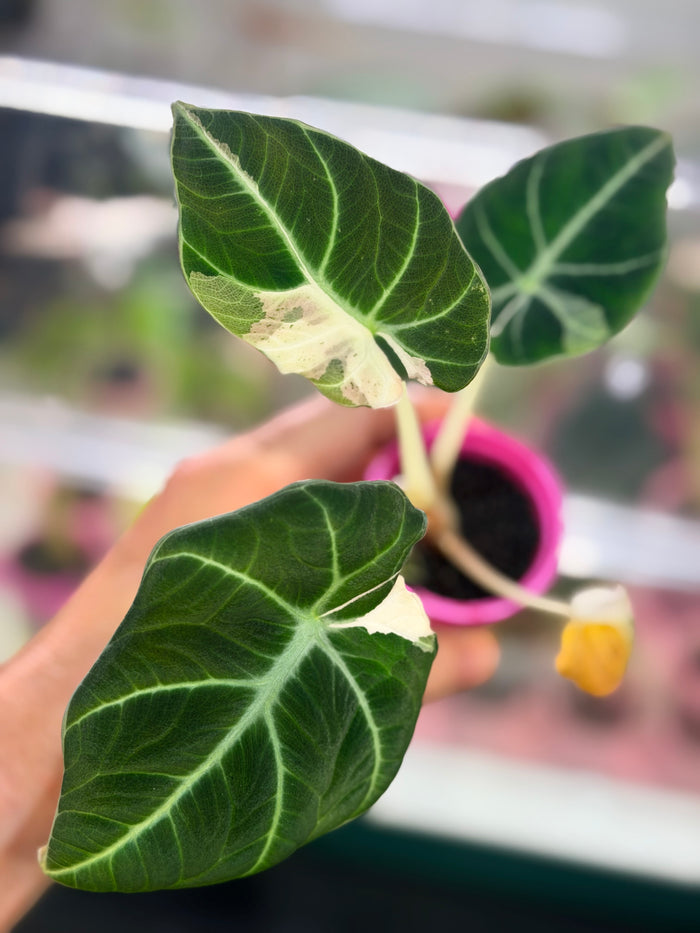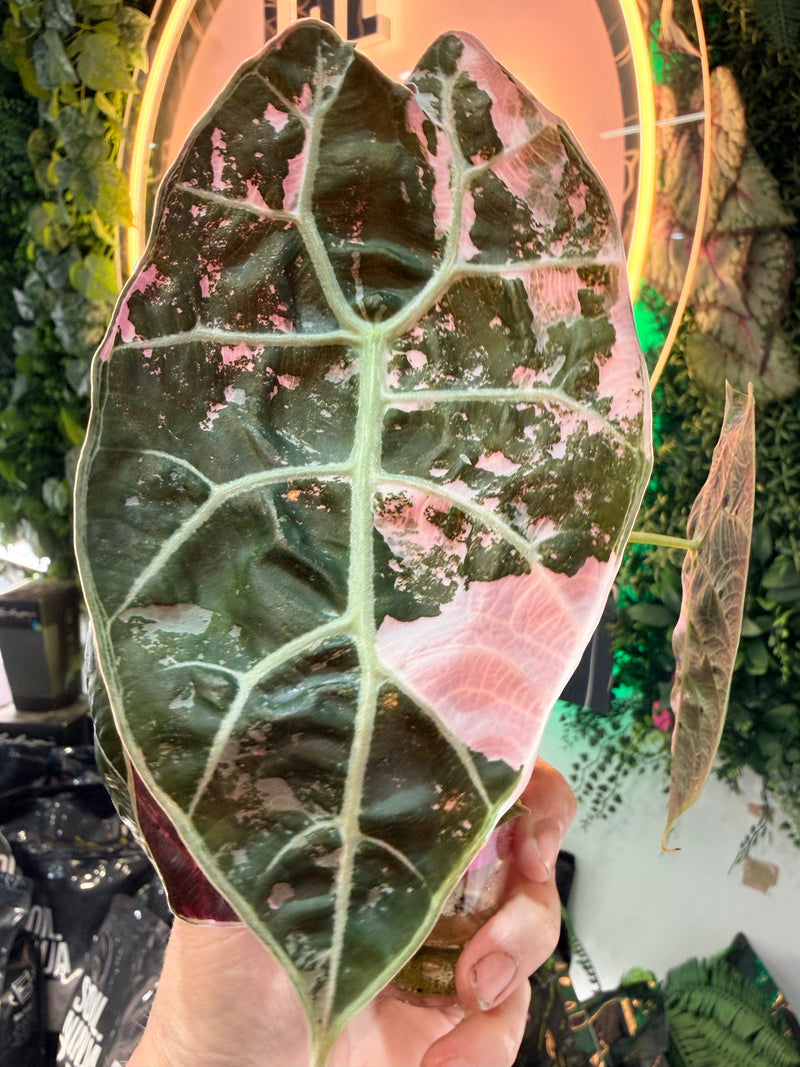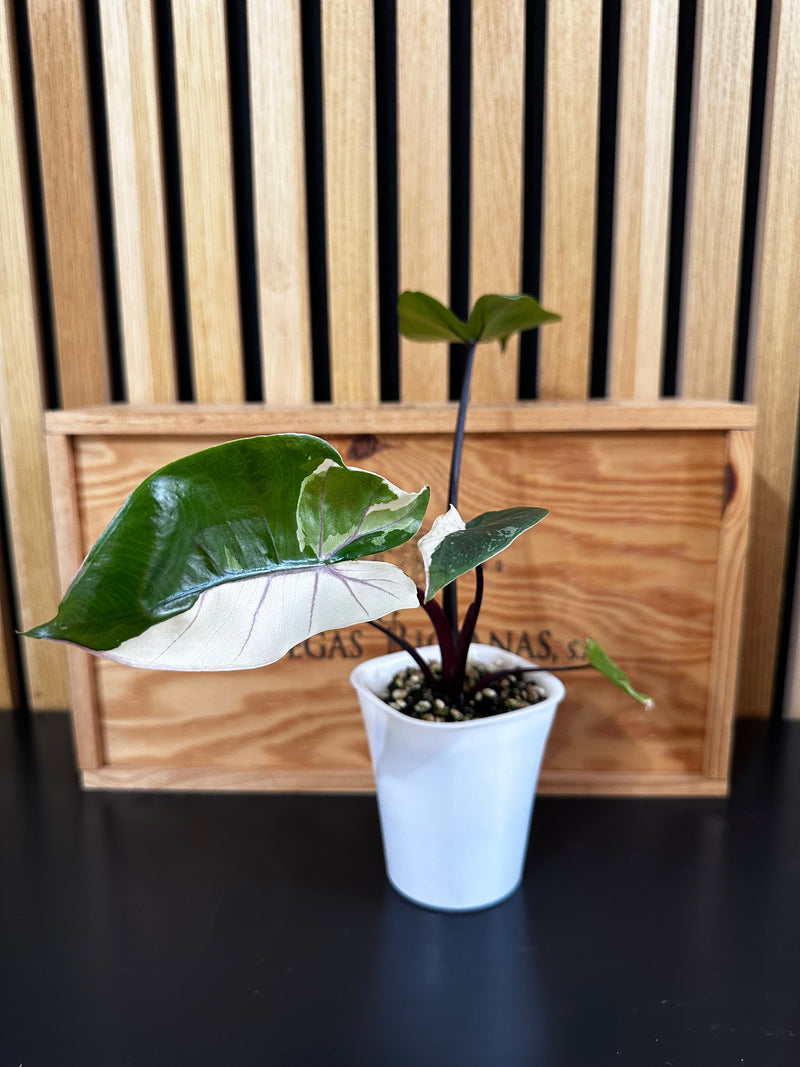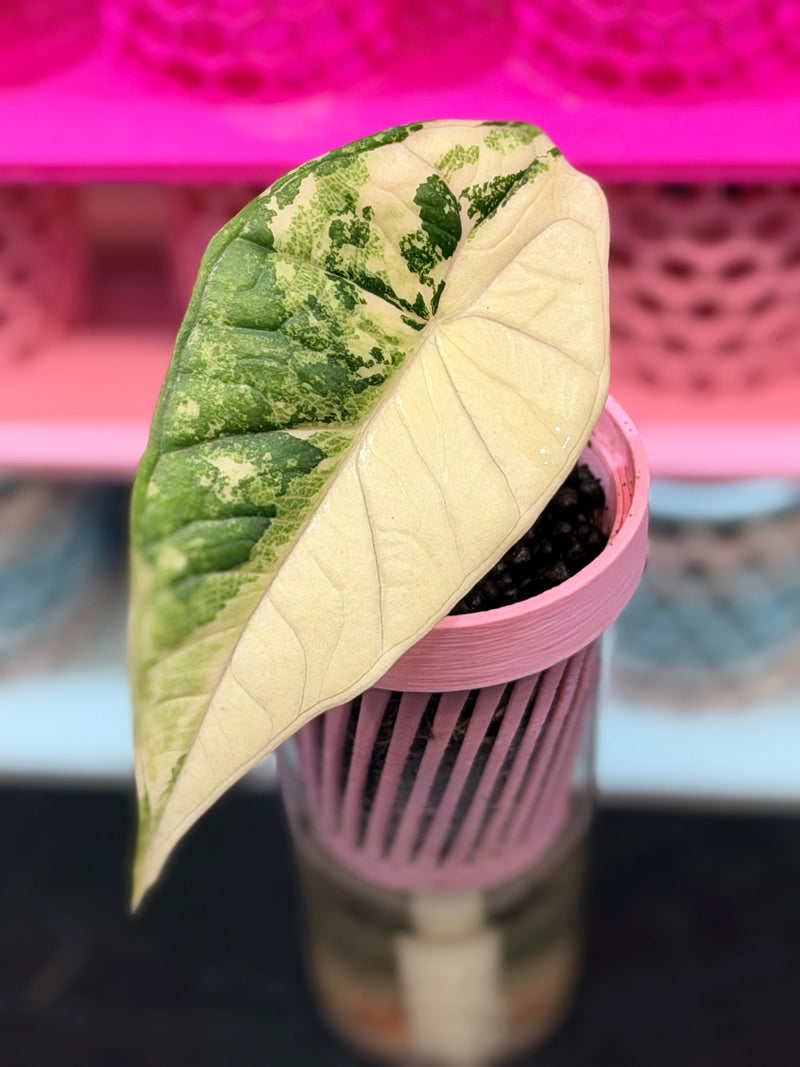

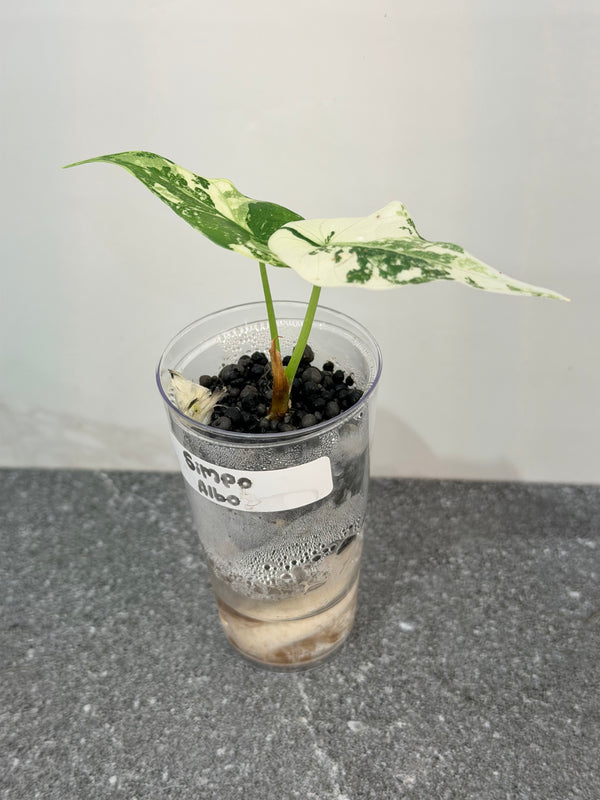
Alocasia 'Simpo' Albo is the white-variegated form of a Malaysian-bred hybrid, valued for a thick, puckered leaf that carries albo variegation well. This guide explains what is and is not documented about the plant: its breeder, its name, its suspected parentage, how to recognise it, how the albo variegation behaves, and how to care for it in UK homes.
What is Alocasia 'Simpo' Albo?
Aroidpedia records Alocasia 'Simpo' as a hybrid, with white and yellow variegated forms known. The albo form is the white one: sectors of leaf tissue that contain no chlorophyll, set against the plant's normal green. Our Alocasia 'Simpo' Aurea guide covers the yellow form.
Aroidpedia's entry for 'Simpo' is a base entry for the hybrid. It does not have a separate page for the albo form, so everything below about the variegation comes from general albo behaviour rather than a cultivar-specific record. If you would like to view our own Alocasia Simpo Albo listing, it is linked here, and we release plants through our drop model, which you can read about on the rare plant drops page.
Origin and naming: who bred 'Simpo'?
Aroidpedia attributes 'Simpo' to Wawan Santoso, who is also credited there with the hybrids 'Lukiwan' and 'Albatuwan'. Santoso produced a small group of hybrids while working in Malaysian nurseries, and 'Simpo', 'Lukiwan' and 'Albatuwan' are among the best known. The name honours Bukit Simpo, the Simpo Hills in Malaysia, where one of the nurseries Santoso worked at is located. In other words, the name is a place name rather than a description of the plant.
That is essentially the whole documented history. Aroidpedia gives no release date, no account of how the plant spread through collections, and no size. We have not found a reliable source for those details, so we do not state them here.
Parentage: what is actually known
The suspected parentage is Alocasia sinuata × Alocasia 'Lukiwan', itself a Santoso cross of Alocasia alba × Alocasia sinuata. Aroidpedia is explicit that this is suspected, because the breeder does not remember the exact cross. It should therefore be read as the most likely explanation, not as a confirmed record.
The suspected cross, A. sinuata × 'Lukiwan', would make Alocasia sinuata the dominant influence, since it appears on both sides: once as a direct parent and once as a parent of 'Lukiwan'. 'Simpo' is sometimes grouped with Alocasia sanderiana in the trade because of its lobed outline and pale venation. The recorded background does not support that: there is no sanderiana in its suspected parentage.
Alocasia sinuata is a Philippine species with thick, wavy, heavily textured leaves, and if the suspected cross is right, the 'Simpo' leaf shows exactly that influence. Our guides to Alocasia sinuata Variegated, sinuata Albo and sinuata Mint describe the species and its variegated forms.
How to identify Alocasia 'Simpo'
Aroidpedia describes the hybrid as keeping the highly bullate and glabrous character of both parents. In plain terms, the leaf surface is puckered and raised between the veins, and it is smooth rather than hairy. Mature leaves show an open sinus, meaning the two lobes at the base of the blade stand apart instead of meeting or overlapping. The spathe and floral chamber are greenish white.
These traits are the practical way to tell the plant apart from smoother-leaved Alocasia. They are also general descriptors: Aroidpedia does not give leaf colour, leaf dimensions or a mature height, and we would rather leave those out than guess.
The albo variegation explained
Albo variegation is chimeric. Part of the growing point carries cells that cannot make chlorophyll, so the leaf develops white sectors, patches or splashes next to green tissue. Because the pattern depends on how those cell layers are distributed when each leaf forms, no two leaves are the same: one may be boldly sectored, another half white, another almost entirely green.
On a puckered leaf the white areas catch light differently from the green, which can make the contrast look more three-dimensional than it does on a flat blade. White tissue does not photosynthesise, so heavily white leaves are weaker and more prone to browning than balanced ones. Chimeric variegation can also fade or revert to green over time, and it may not carry over to plants grown from corms. Our albo variegation guide, the complete guide to Alocasia variegation types and our albo variegated Alocasia collection explain more.
Alocasia 'Simpo' Albo care in the UK
This is general Alocasia care, and it applies to 'Simpo' Albo. Aroidpedia does not publish cultivar-specific growing requirements for this plant, so the guidance below is the care we give all of our Alocasia.
Light
Give bright, indirect light. Albo plants need good light because the white sectors contribute nothing to growth, but white tissue also scorches easily, so keep it out of hot direct sun. Where a window is not bright enough, add LED grow lights; steady supplementary light stops growth stalling and helps keep leaves balanced.
Temperature and humidity
Aim for 20 to 27°C and humidity of 60 to 80 percent. The thick, quilted leaves are reasonably tolerant of normal household conditions once established, but new leaves open more cleanly in steady humidity. If the room runs cool, a heat mat under the pot keeps the root zone warm, which matters more than air temperature for steady growth. Avoid cold draughts and dry air from heating.
Substrate and watering
We prefer Fluval Stratum for its drainage and aeration. Water when the top 2 to 3 cm has dried, and keep the pot proportionate to the root system, because surplus damp substrate invites rot. Our guides to Alocasia root rot and the substrates and growing media collection go further.
Feeding and pests
Feed with our Alocasia feed at half strength. Inspect the leaf underside regularly: the deep quilting creates hollows on the leaf underside where mites can shelter, and spider mite can settle in the hollows of a puckered leaf, so early treatment from our pest control range is much easier than dealing with an established infestation. Our complete Alocasia care guide covers the fundamentals.
Propagating Simpo Albo from corms
Alocasia produce corms, and corm-grown plants may not express the same variegation as the parent, as is true of any chimeric albo. The plant produces corms that carry the chimeric albo genetics; corm offspring may or may not express strong variegation, as is inherent to all chimeric propagation. For the method we use, see our Alocasia corm propagation guide. In short, the self-wicking method sets a firm corm in Fluval Stratum inside the Corm Keeper, so moisture is drawn up steadily rather than sitting around the corm.
How does Simpo Albo compare to similar plants?
The closest comparisons are its suspected relatives. The sinuata forms share the thick, textured leaf, while the Simpo Aurea carries the same hybrid in yellow instead of white. For a wider view of the genus, our rare Alocasia A to Z lists every guide.
Frequently asked questions
Who bred Alocasia 'Simpo'?
Aroidpedia credits Wawan Santoso, who also bred 'Lukiwan' and 'Albatuwan'.
Where does the name come from?
From Bukit Simpo, the Simpo Hills in Malaysia, where one of the nurseries Santoso worked at is located.
What is the parentage of 'Simpo'?
Alocasia sinuata × Alocasia 'Lukiwan' is the suspected cross. Aroidpedia notes the breeder does not remember the exact cross, so it is not confirmed.
What colours does 'Simpo' come in?
Aroidpedia lists white and yellow variegated forms. The albo is the white one.
Will corm-grown plants stay variegated?
Not reliably. Chimeric variegation may not carry over to corm-grown plants, so results vary.
How big does it get?
Aroidpedia does not give a size for 'Simpo', so we cannot state one with confidence.
Questions about Alocasia 'Simpo' Albo? Contact our team for guidance from specialists who grow rare Alocasia in our UK-based private nursery. We are happy to help with variegation, light and watering questions.