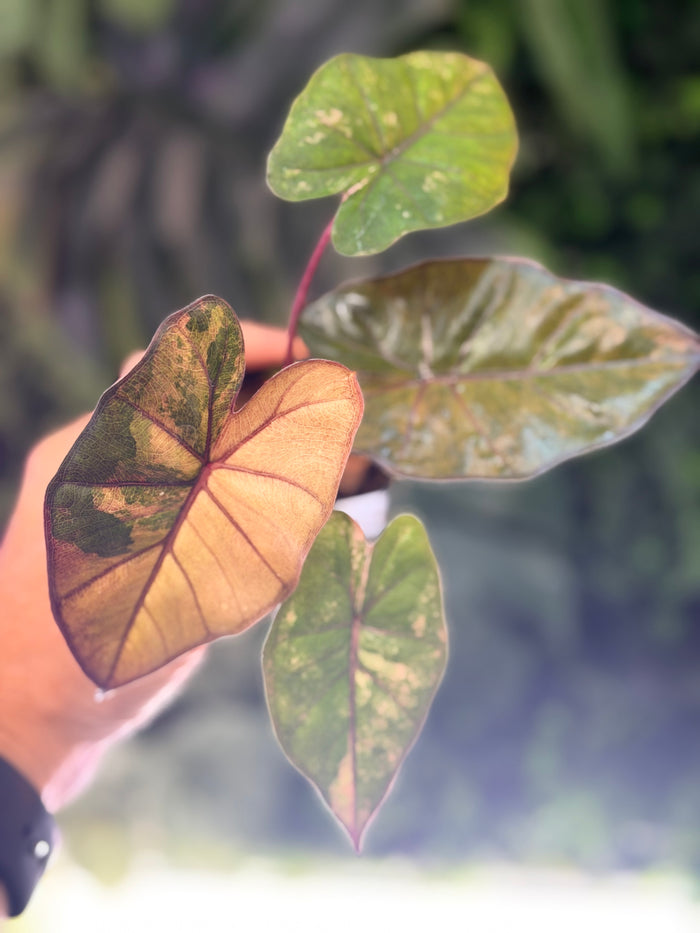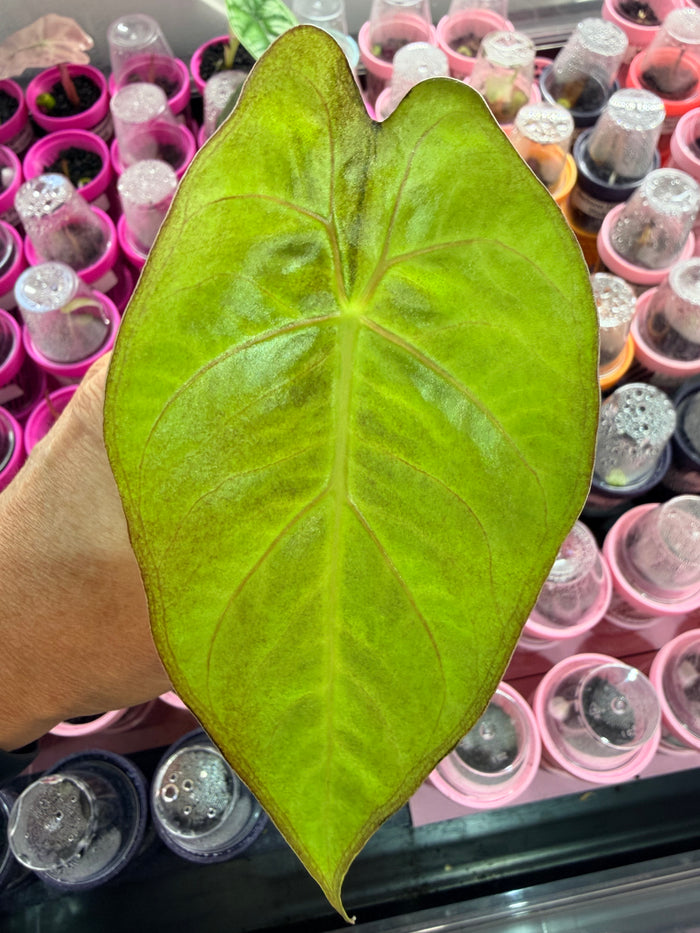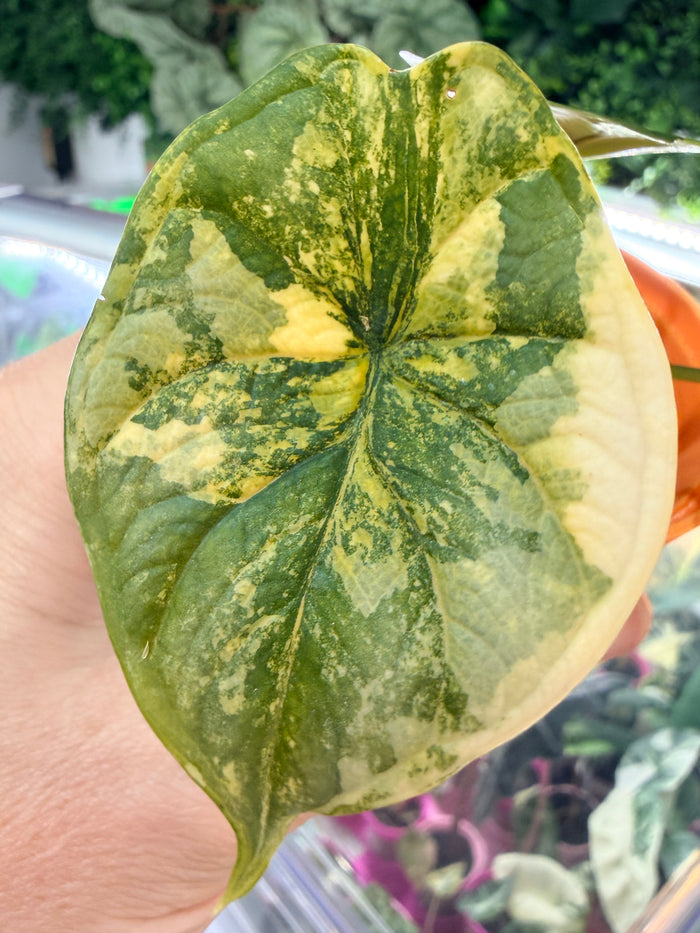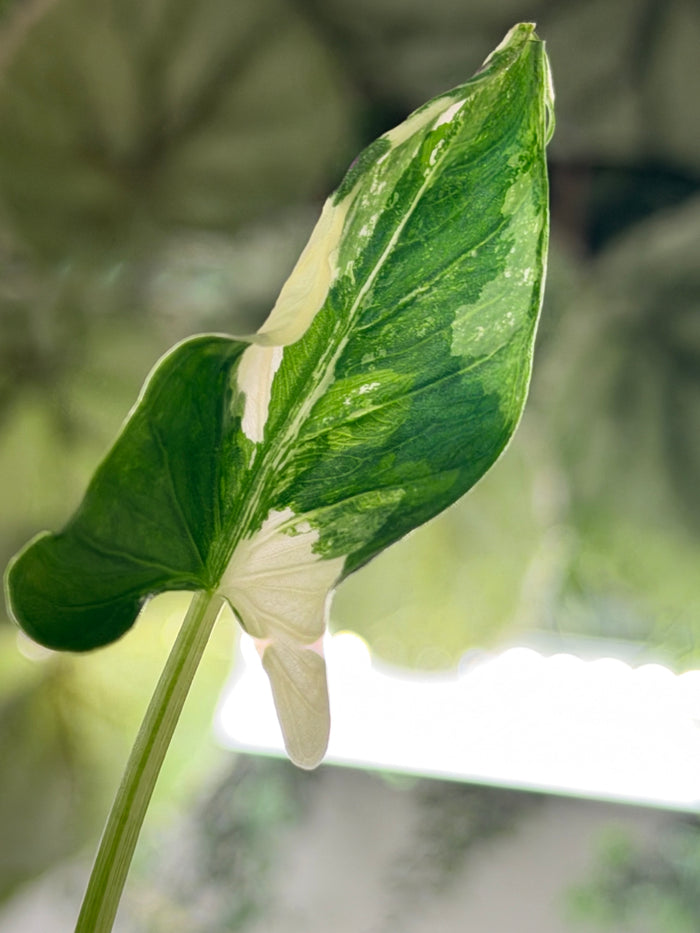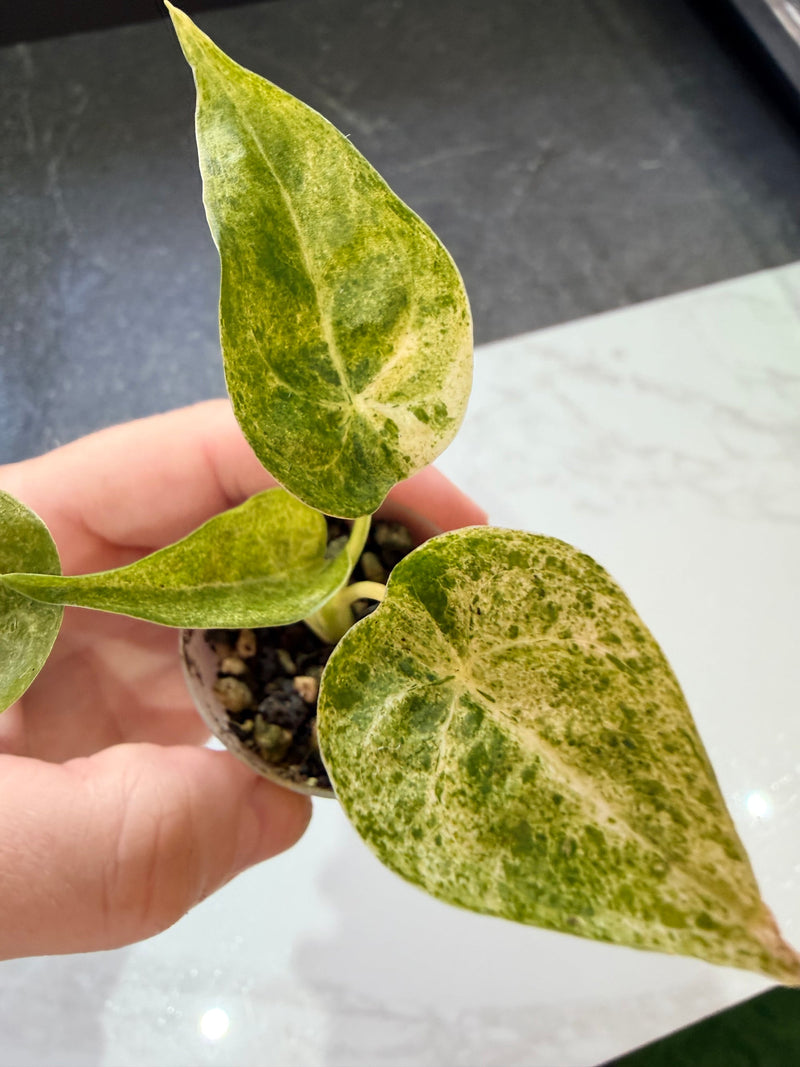

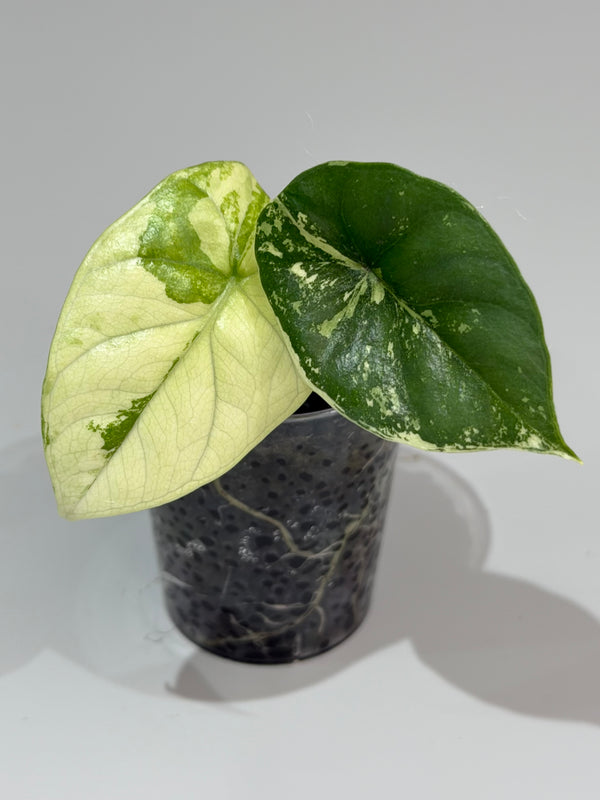
The Alocasia sinuata Mint Variegated represents an unusual position within the sinuata variegated family. Where the albo form creates maximum contrast, white sectors against dark metallic green, and the standard variegated form offers intermediate lighter green expression, the mint variegated form occupies a different chromatic register entirely: soft, cool mint-green sectors that interact with the deep, lustrous base foliage of Alocasia sinuata to create something closer to tonal harmony than high contrast. It is, in the best sense, a subtle specimen, and in a collecting world that often prizes dramatic contrast above all other visual qualities, subtlety done with this level of botanical precision is genuinely distinctive.
This guide covers the mint variegated form of sinuata specifically, the nature of its colour expression, how it differs from the albo and standard variegated forms, and the care approach that best maintains its particular mint colouration in UK indoor conditions. For full species background and general care detail, our guide to Alocasia sinuata Variegated provides the complete context.
Mint Variegation: Understanding the Colour Expression
Mint variegation in Alocasia, as seen in several cultivars including the sinuata Mint, Azlanii Mint, and Cucullata Mint forms, describes a specific type of variegation where affected sectors display a pale, cool mint-green or blue-green colouration rather than the warm yellows of aurea expression or the stark white of albo. The biochemical basis is a partial reduction of both chlorophyll and carotenoid pigments in the affected tissue, with the specific proportions of residual pigments and the particular species' underlying cell chemistry producing the characteristic mint tone.
On Alocasia sinuata, the mint expression appears against the species' distinctive deep, metallic green, a base colour that already has a cool, slightly grey-blue quality in mature specimens. The mint sectors, rather than clashing with this base, create a graduated effect: the cool mint picks up and amplifies the grey-blue undertones in the sinuata's dark green, and the result is a plant where the variegation feels like a natural extension of the species' existing colour character rather than an imposed addition. This coherence is part of what makes the mint form visually compelling despite its relative restraint.
The mint sectors retain significant chlorophyll content, more than albo sectors, and in a different spectral balance from aurea expression. This means the mint variegated sinuata has higher photosynthetic capacity in its variegated sectors than the albo form, and consequently tends to be more vigorous. This is consistent with what is observed across mint variegated Alocasia more broadly: these plants tend to grow with greater ease and stability than albo forms of the same species, making them somewhat more accessible to collectors who want the visual appeal of variegation without the more demanding care requirements of chimeric albo specimens.
The expression can vary between leaves and over time. Under optimal light conditions, the mint colour is well-saturated and clearly distinct from the surrounding green tissue. Under reduced light, the mint sectors may become greener as residual chlorophyll becomes relatively more prominent. Maintaining consistent bright indirect light is therefore important for sustaining vivid mint expression through the year, an argument for supplementary LED lighting that applies with particular force to this form.
How the Mint Form Differs From Albo and Standard Variegated
Collectors choosing between the three sinuata variegated forms are making a decision that is ultimately aesthetic, but the practical care differences are also worth understanding. The albo form offers the most dramatic visual impact, maximum contrast, rarity in supply, and the particular appeal of chimeric white sectors on the iconic bullate surface, but at the cost of reduced vigour and more demanding care requirements. The mint form offers a different kind of visual appeal, subtler, more cohesive, arguably more refined, with greater growing ease and more stable variegation behaviour.
The standard variegated form sits between the two: lighter green and cream expression that creates moderate contrast without the stark drama of albo or the cool elegance of mint. All three forms share the species' fundamental character, the bullate surface, compact habit, coriaceous foliage, and critically endangered Philippine provenance, but express it through different chromatic lenses.
In a collection context, the three forms complement each other. Each occupies a distinct visual niche, and seeing all three together demonstrates how dramatically colour expression transforms a single species without altering its fundamental character. Our broader rare Alocasia collection includes representatives from multiple variegated sinuata forms when availability permits.
Light and the Mint Expression
Light is the single most important variable for maintaining vivid mint variegation in the sinuata Mint form. The mint sectors' cool green colouration is dependent on the specific balance of residual pigments in the affected tissue, and that balance is modulated by the light environment the plant receives. Under bright indirect light, the mint expression is at its most vivid and well-differentiated from the surrounding green tissue. Under lower light, the residual chlorophyll in the mint sectors becomes proportionally more dominant, and the sectors progressively greener.
For UK collectors, this means bright indirect light year-round with LED grow light supplementation. A full-spectrum LED providing 10,000-15,000 lux for 12-14 hours per day maintains mint expression quality and supports the slow but steady growth rate that well-cared-for sinuata achieves.
An east-facing window position is ideal, good morning light, no direct afternoon sun exposure, and a stable ambient temperature that suits the species' preferences. Avoid positions near south-facing windows where direct sun can scorch even the leathery foliage of sinuata, particularly on the mint sectors where the lower chlorophyll content provides less protection against photodamage.
Temperature, Humidity and Substrate
The environmental requirements of sinuata Mint are identical to the species standard: 20-28°C optimal, 15°C minimum, and ambient humidity maintained above 60%. The limestone forest origins of Alocasia sinuata, coastal, consistently warm, reliably humid, establish the template, and the mint form is no more or less demanding than the standard species in these parameters.
UK collectors face the most significant challenge in humidity management, as central heating reduces indoor humidity to 30-50%. A dedicated humidifier is the most effective solution, supplemented by plant grouping and a pebble tray beneath the pot for localised moisture. A heat mat beneath the pot is a worthwhile addition for maintaining root zone temperature stability.
Fluval Stratum provides the free-draining, well-aerated substrate environment that sinuata requires. Water thoroughly when the top 2-3cm is dry, never allow standing water, and feed at half-strength balanced fertiliser with our plant feed range, the mint form's higher photosynthetic capacity compared to the albo means it can sustain slightly more generous feeding than a heavily white-sectored specimen, but a measured approach remains best practice for any variegated Alocasia.
The Sinuata Mint in a Collection Context
The sinuata Mint occupies a specific and underrepresented position in the world of mint variegated Alocasia. Mint variegation appears across multiple species and lineages, the Azlanii Mint, Cucullata Mint, Odora California Mint are all examples, but each expresses that mint colouration through a different species character. The sinuata Mint's particular combination of bullate surface, compact jewel scale, and the species' deep metallic green makes it unlike any of these other mint forms in its visual effect.
For collectors building a sinuata collection, the mint form pairs naturally with the albo and standard variegated forms to create a complete picture of variegation expression on this species. For collectors interested in mint variegated Alocasia more broadly, the sinuata Mint brings an entirely different species character to the group, compact and sculptural where the larger-leaved mint forms are expansive and dramatic.
We release sinuata Mint specimens through our drop model when quality material is available. Join our collector list for early access notifications, and view our current Alocasia Sinuata Mint Variegated listing for availability. Our full rare Alocasia collection includes related jewel specimens from multiple Philippine lineages.
If you would like to grow more plants of your own, our Alocasia corm propagation guide explains how to propagate Alocasia corms using the self-wicking method, including how to choose a healthy corm and what to expect while it sprouts.
Questions about the sinuata Mint, mint variegation care, or building a jewel Alocasia collection in the UK? Contact our team for expert guidance from specialists who work with rare Philippine endemics daily at our UK-based private nursery.