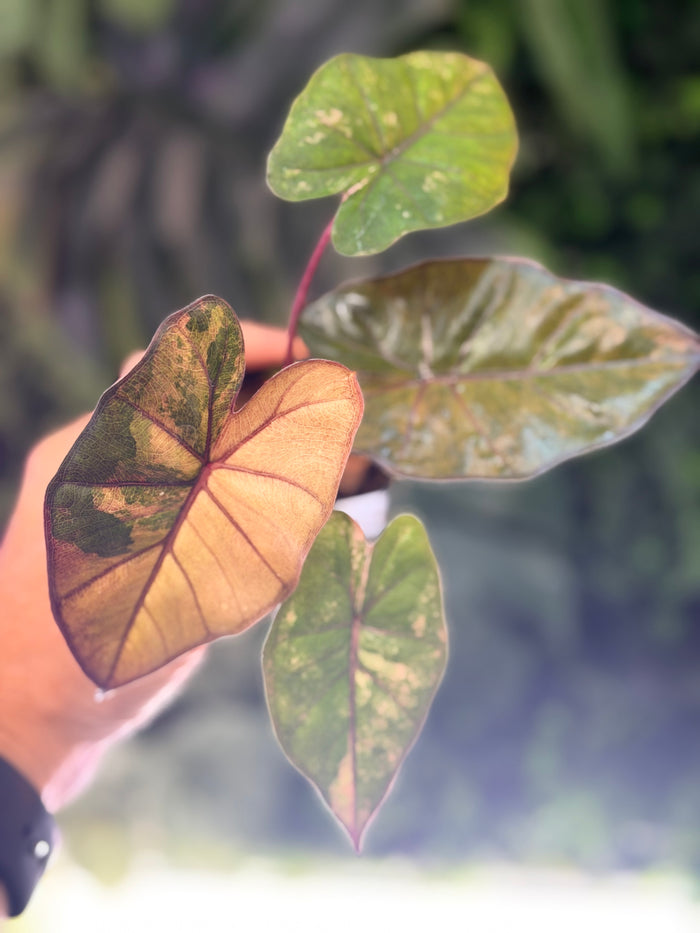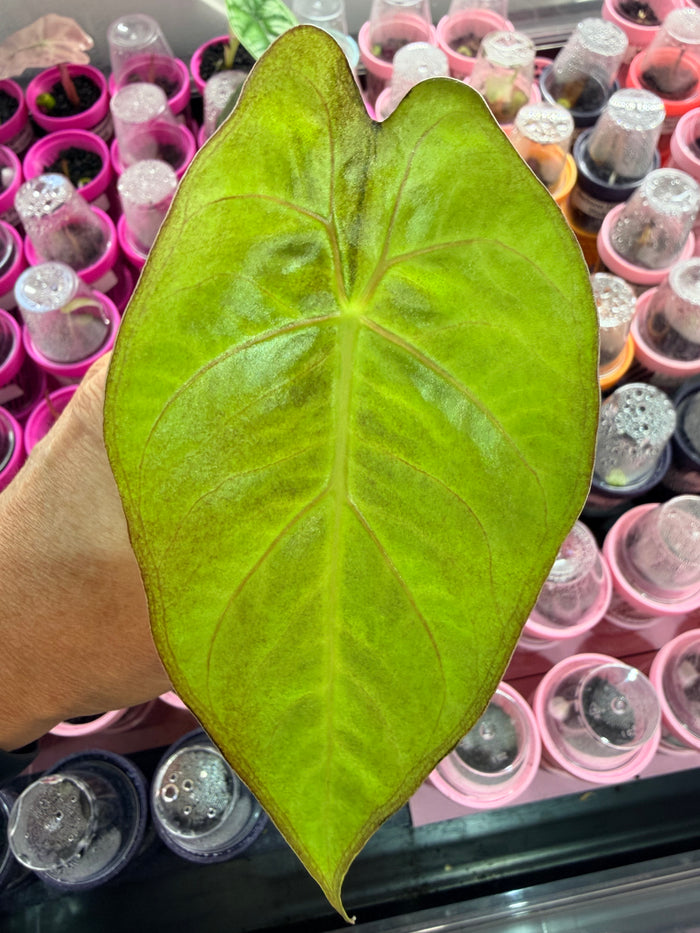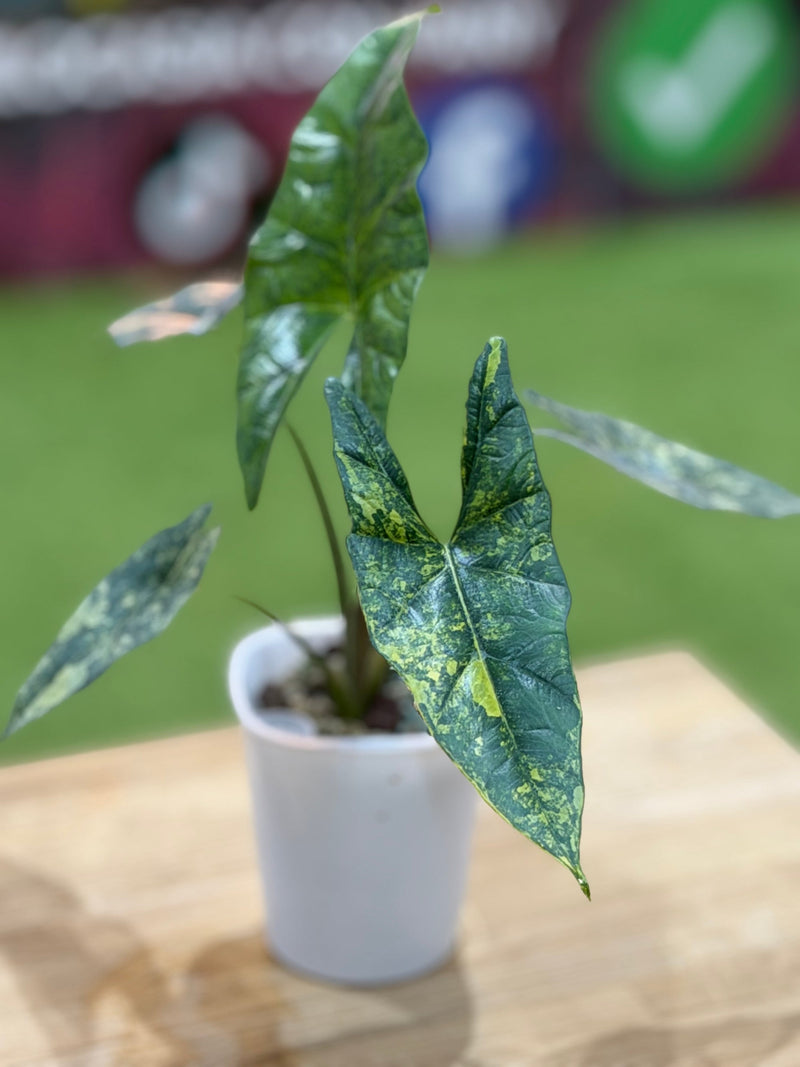

Alocasia sinuata is, in its standard form, already a plant that demands collector attention. Its bullate, thickly coriaceous foliage, deeply quilted and rippled across the blade surface, with a dark green colouration and subtle metallic sheen, represents one of the most distinctive leaf textures in the entire Alocasia genus. It is compact, precise, and structurally memorable in a way that far larger and more immediately dramatic specimens rarely achieve. The variegated form takes all of this and adds colour complexity that transforms a remarkable species into something genuinely extraordinary.
Understanding Alocasia sinuata Variegated properly means first understanding the species itself, its origins, its conservation status, its naming history, and the particular characteristics that make it so desirable in cultivation. The variegation sits on top of all of this context; it does not replace it. This guide covers both in full, and provides the detailed care information that UK collectors need to grow this exceptional specimen successfully.
Alocasia sinuata: Species Background and Origins
Alocasia sinuata is endemic to the Philippines, specifically to the limestone forests of Samar, Leyte, and parts of Mindanao. It is classified as critically endangered by the International Union for Conservation of Nature, a status that reflects the ongoing loss of its very specific habitat: low-altitude limestone forest, often near coastal areas, that has been significantly reduced by conversion to beach resorts and other development. This is not a species that exists across a wide geographic range with populations in multiple countries; it is confined to a narrow ecological niche in a handful of Philippine islands, and that niche is under sustained pressure.
The species was first formally described by Nicholas Edward Brown in 1885, from a cultivated specimen received at the Royal Botanic Gardens, Kew, which had been supplied by the nurseryman William Bull. Brown's original type notes stated a provenance of the 'Malay Archipelago', but this was subsequently corrected, in Brown's own hand on the type sheet, to the Philippines. This early provenance uncertainty contributed to a naming history that remained complicated for over a century and is worth understanding.
The name sinuata comes from the Latin for 'wavy' or 'sinuous', referring to the rippled margin and bullate surface of the leaf blade, the most immediately distinctive morphological characteristic of the species. In cultivation, the plant has accumulated a considerable list of synonyms and trade names over the decades: Alocasia bullata, 'Mirror Face', 'Quilted Dreams', 'Hawaii', and, most confusingly, 'Mythic Rumpelstiltskin', an incorrect renaming by Proven Winners that has no botanical validity. The name 'Quilted Dreams' in particular persists in some collections and sales contexts, but it is not an accepted cultivar name; it arose from historical naming confusion and does not describe a separate, distinct taxon.
In the wild, Alocasia sinuata is found at very low altitudes, typically near the beach, growing in the leaf litter and rocky crevices of limestone forest. This habitat preference, limestone substrate, dappled forest light, consistent warmth and high humidity from its coastal tropical setting, provides important guidance for cultivation. The species is adapted to well-drained, mineral-rich substrate with some alkaline influence from limestone, consistent warmth with minimal seasonal temperature variation, and the reliably high humidity of a tropical coastal forest.
In cultivation, the species is described as a herb to approximately 35cm tall, with 8-10 leaves crowded together and markedly bullate, thickly coriaceous blades that are dark green, sometimes with a darker colouration around the main veins, on the upper surface and paler beneath. The leaves are sagittate to ovato-sagittate, with a somewhat peltate attachment in some specimens, and the characteristic deep quilting of the upper surface creates an interplay of light and shadow across the blade that is fundamentally different from the smooth surfaces of most other Alocasia species. As the plant matures in cultivation, the foliage develops a subtle metallic grey patina that further intensifies its visual complexity.
Alocasia sinuata is sympatric with Alocasia scalprum on Samar and Leyte, both species occur in the same locations, and intermediate forms exist in the wild, complicating identification in some cases. The two species can generally be distinguished by leaf form: sinuata has a broader, more shield-like blade with pronounced bullation, while scalprum has a consistently narrower, more blade-like profile. Both species share the limestone forest habitat and similar care requirements in cultivation.
The Variegated Form: What to Expect
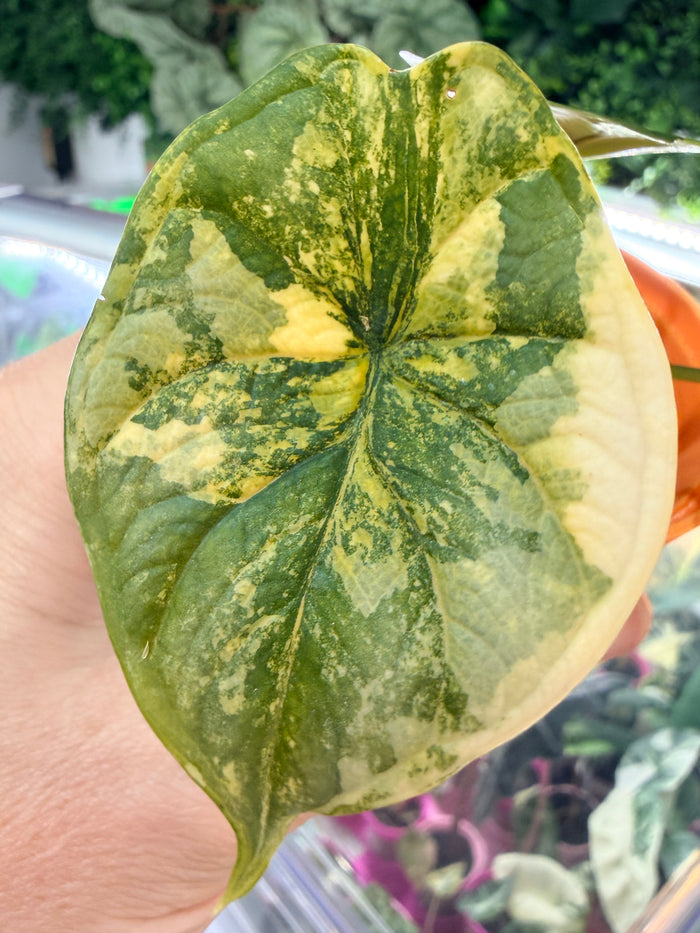
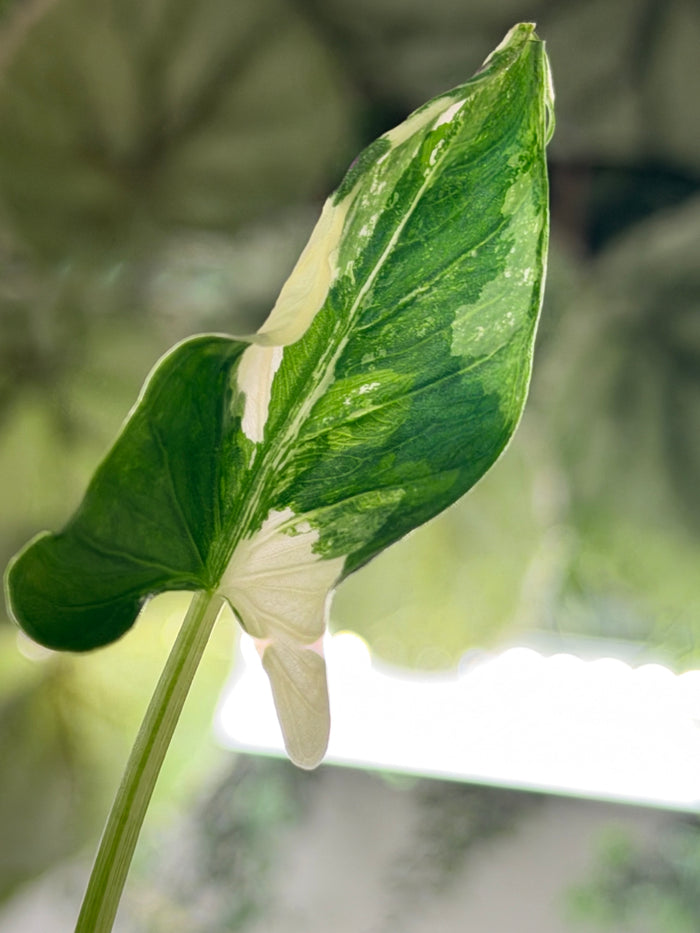
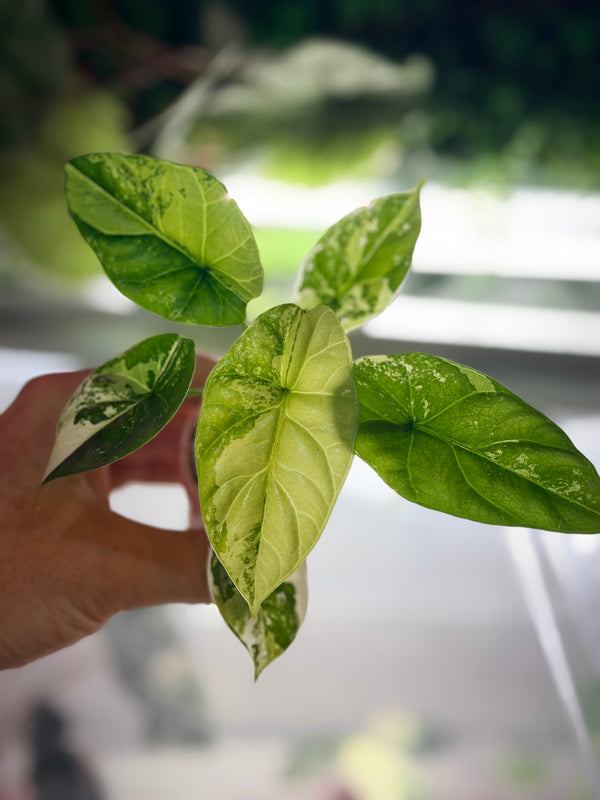
The standard Alocasia sinuata Variegated, as distinct from the specifically named albo and mint variegated forms, typically displays a sectoral or splash variegation pattern where lighter green, cream, or yellow-green sectors appear across the dark green blade. The exact character of this variegation varies between specimens and between individual leaves on the same plant: some leaves show broad, cleanly bounded lighter sectors; others display irregular streaking or marbling across portions of the blade; still others may emerge predominantly dark green with minimal variegation expression.
This variability is inherent to variegated sinuata and should be expected rather than treated as inconsistency. The bullate surface of the blade interacts with the variegation in a visually interesting way: the quilted texture creates a three-dimensional effect even before variegation is considered, and lighter sectors within that texture pick up light differently from darker sectors, creating an almost luminous quality where the two characteristics intersect. A well-variegated sinuata leaf in good light is a genuinely complex visual object, more complex, in some respects, than variegated Alocasia with simpler leaf surfaces.
The compact habit of the species means that the variegated form remains very manageable as a collector specimen. Typical heights in cultivation are 25-40cm with a similar spread, making it suitable for shelving, terrariums, or grouped displays where its intricate foliage can be appreciated at close range. This is a plant that rewards proximity, its textures and variegation patterns are best seen from near rather than far.
Our complete guide to Alocasia variegation types provides context for understanding how sinuata's variegation relates to other colour expression mechanisms across the genus.
Light Requirements
Alocasia sinuata's natural habitat, the forest floor of limestone coastal forest, under the canopy, provides the key reference point for light requirements. In the wild, this is a plant accustomed to dappled, filtered light: bright enough to sustain healthy growth in a species that has evolved to make efficient use of indirect light, but protected from the direct overhead sun by the canopy above. In cultivation, bright indirect light replicates this most accurately.
For UK collectors, this translates to a position within one to two metres of an east- or west-facing window, where the plant receives good ambient light without direct sun exposure. The variegated form requires somewhat more light than the standard green form, as the lighter sectors contribute less to photosynthesis and the green sectors carry a proportionally greater metabolic load. Consistent bright indirect light throughout the year is more important for variegated sinuata than for its green counterpart.
Supplementary LED grow lighting is strongly recommended for UK conditions. The low natural light levels in the UK create real challenges for tropical plants adapted to equatorial light regimes, and sinuata, a relatively slow-growing species in the best of conditions, will stall significantly without supplementary light. A full-spectrum LED at 10,000-15,000 lux for 12-14 hours per day will sustain the plant effectively.
Avoid direct sunlight, particularly on the lighter variegated sectors, which are more susceptible to photodamage. The thick, leathery leaves of sinuata are more durable than those of thinner-leaved Alocasia species, but even coriaceous foliage will show bleaching and scorching under sustained direct sun.
Temperature and Humidity: Matching the Limestone Forest
The coastal limestone forests of Samar and Leyte maintain relatively stable temperatures year-round, warm, without dramatic seasonal swings, and consistently humid from the maritime influence of their coastal setting. Replicating this stability is the key challenge for UK collectors.
Optimal temperatures for Alocasia sinuata are 20-28°C, with a minimum of 15°C. The species is not frost-tolerant and will suffer damage below 12°C. Cold draughts are particularly damaging, the thick leaves offer some physical protection against mechanical damage, but temperature stress at the root zone causes rapid deterioration in plant health regardless of how robust the foliage appears above the substrate surface.
Humidity should be maintained above 60%. The coastal limestone forest habitat of sinuata is naturally humid throughout the year, and the species has not evolved the drought tolerance of plants from more seasonally dry environments. In practice, UK homes with central heating often drop to 30-50% relative humidity, well below optimal, and the consequences for sinuata appear as crispy leaf margins and slowed growth. A dedicated ultrasonic humidifier maintaining 60-70% around your collection is the most reliable long-term solution.
A heat mat beneath the pot is a useful addition, maintaining substrate temperature and supporting root health.
Substrate: The Limestone Influence
Alocasia sinuata's limestone forest origins have a practical implication for substrate selection that is worth understanding. Limestone substrates tend toward slightly alkaline pH, and sinuata, uniquely among the jewel Alocasia, may be somewhat more tolerant of, or adapted to, a slightly higher substrate pH than the 5.5-6.5 range typically recommended for Alocasia. In cultivation, the species performs well in standard Alocasia substrates, but collectors who experience persistent micronutrient deficiency symptoms despite correct care may benefit from testing and slightly adjusting their substrate pH upward toward 6.0-6.5.
Fluval Stratum remains an excellent choice for sinuata, its volcanic mineral composition provides excellent aeration, drainage, and structural stability, and its mild acidity is well within the species' tolerance range. The key requirement, regardless of substrate type, is that it drains freely and does not compact or waterlog. Sinuata's roots, like all Alocasia, need well-aerated substrate and will deteriorate rapidly in dense, moisture-retaining mixes.
For established plants in a stable environment, our Lechuza self-watering planter system with Lechuza PON substrate provides consistent, controlled moisture delivery well suited to sinuata's preference for consistently moist but never waterlogged growing conditions.
Watering and Feeding
Water the sinuata thoroughly when the top 2-3cm of substrate has dried, ensuring complete drainage and never allowing the plant to stand in water. Despite its thick, coriaceous foliage, which might suggest drought tolerance, sinuata is not a drought-tolerant plant. Its natural habitat maintains consistent moisture levels, and in cultivation it performs best with consistent moisture rather than the significant wet-dry cycles that some other Alocasia species tolerate.
Feed with a balanced liquid fertiliser at half to two-thirds strength every 2-3 weeks. Reduce feeding when growth slows. Our plant feed collection includes balanced formulations appropriate for Alocasia, and a CalMag supplement is a useful addition for collectors in soft-water areas.
The Conservation Context
It is worth pausing to consider what critically endangered status means for a species in cultivation. Alocasia sinuata survives as a collector plant in vastly greater numbers globally than it does in its native limestone forests, where the primary threats, habitat conversion to resort development and low-level collection, continue to reduce wild populations. The extensive cultivation of this species in the UK, Europe, and elsewhere does not directly contribute to in-situ conservation, but it does ensure that the species and its characteristics are preserved, studied, and appreciated by a global community of collectors who care about it.
Collecting rare Philippine endemics responsibly means understanding their status, propagating specimens from cultivated sources rather than wild-collected material, and engaging with the broader conservation context around them. Our commitment at The Alocasia Company is to source only from cultivated nursery stock, never from wild-collected specimens. All sinuata variants in our collection are grown from existing cultivated material.
Acquiring Alocasia Sinuata Variegated
Variegated sinuata specimens are available through our collector drop model, with subscriber list members receiving advance notice before any wider availability. The compact size and exceptional visual complexity of this species make it a highly sought-after drop release, and availability is genuinely limited by the vegetative propagation constraints inherent to any variegated specimen.
Join our collector drop list to receive early access notifications, and explore our full rare Alocasia collection for related specimens that complement sinuata in a collection context.
Many collectors build their collection from corms, and propagating them successfully is simpler than it looks. Our Alocasia corm propagation guide covers the self-wicking method we use in the nursery, from choosing a firm corm to keeping it in the right conditions until it sprouts.
Questions about Alocasia sinuata, its variegated forms, or growing rare Philippine endemics in a UK environment? Contact our team for expert guidance from specialists who work with jewel Alocasia daily in our UK-based private nursery.