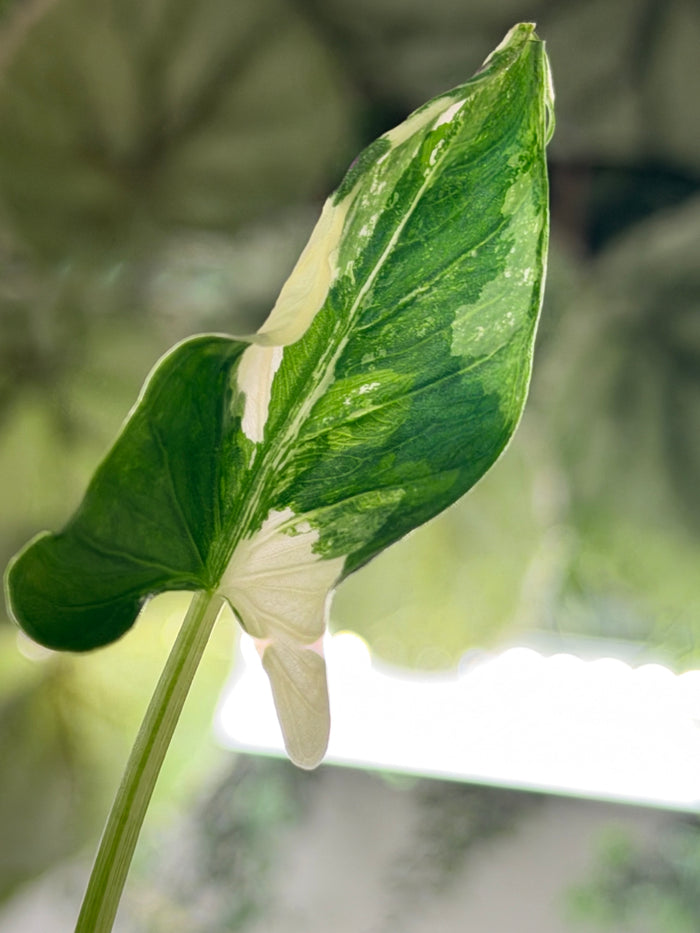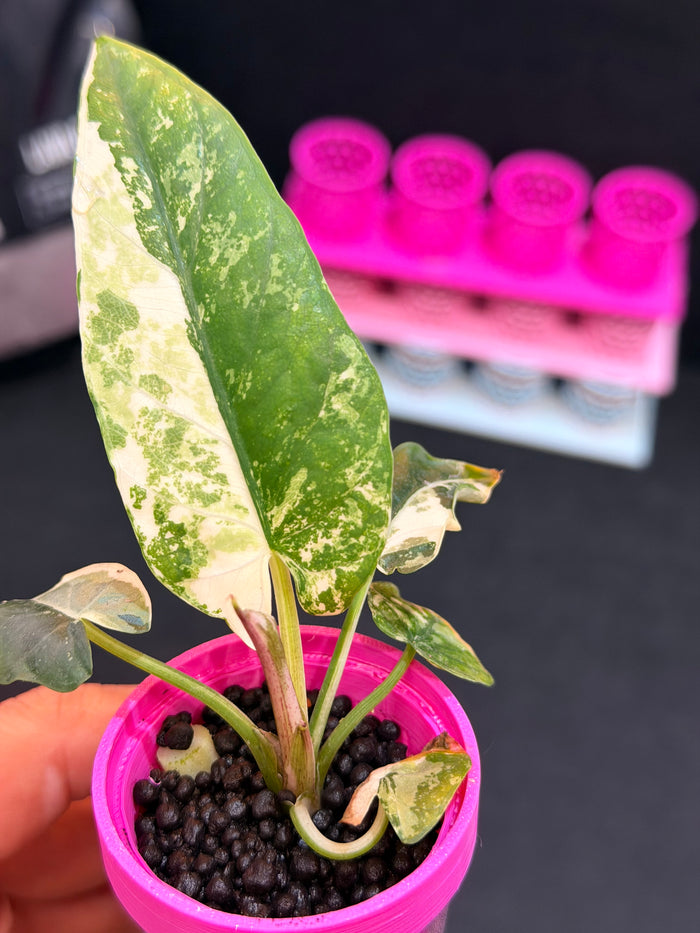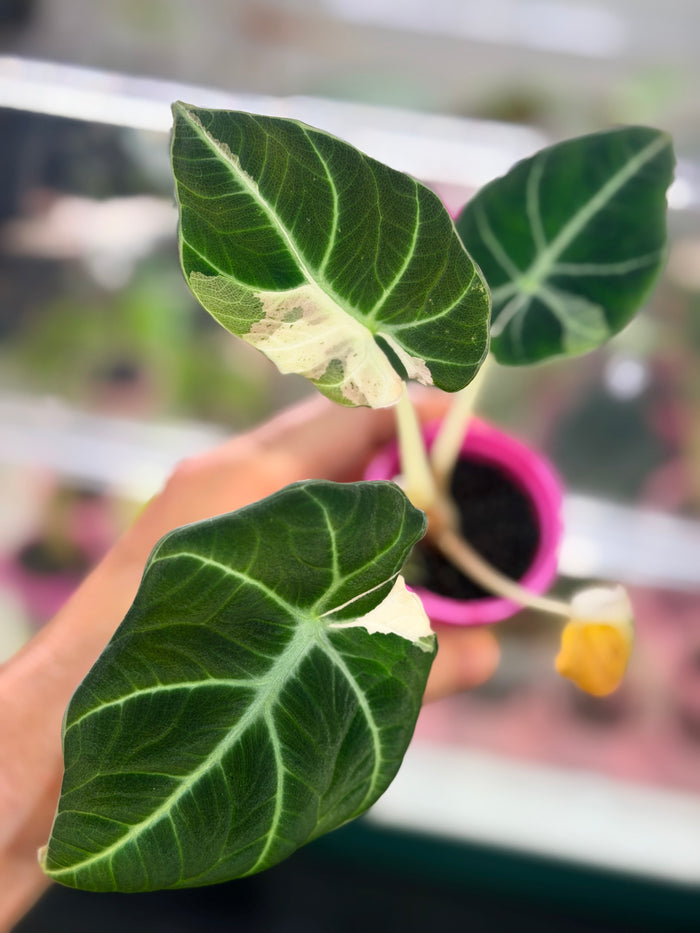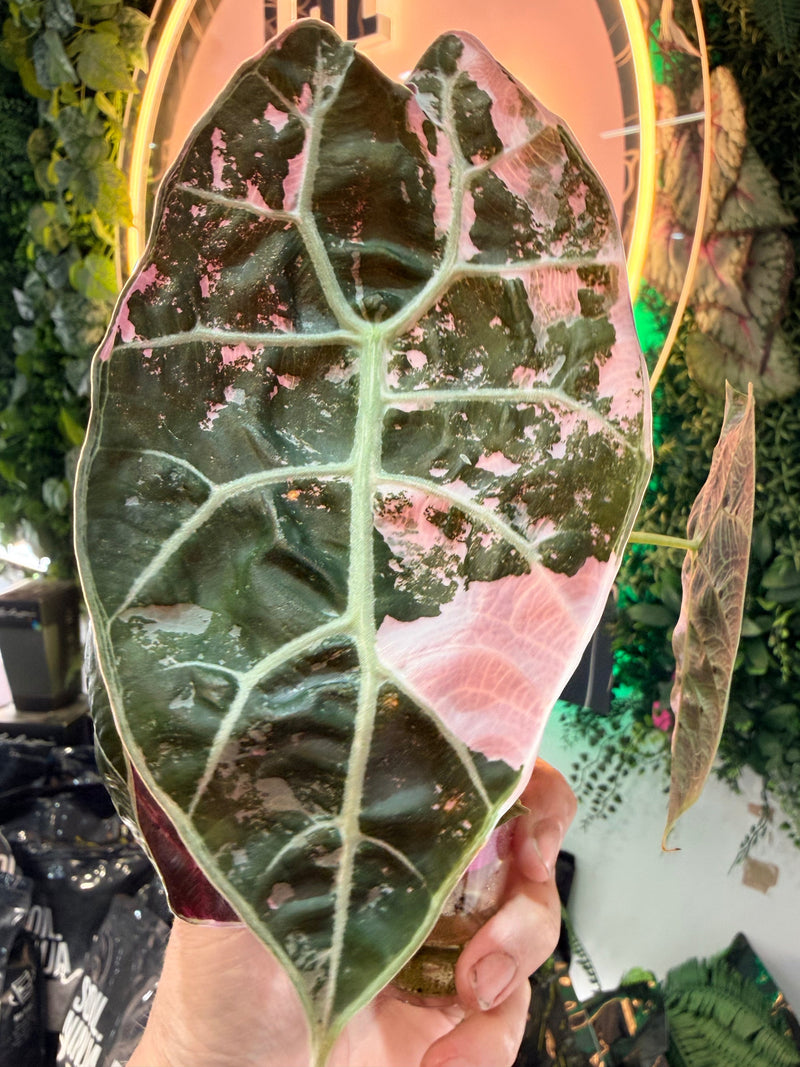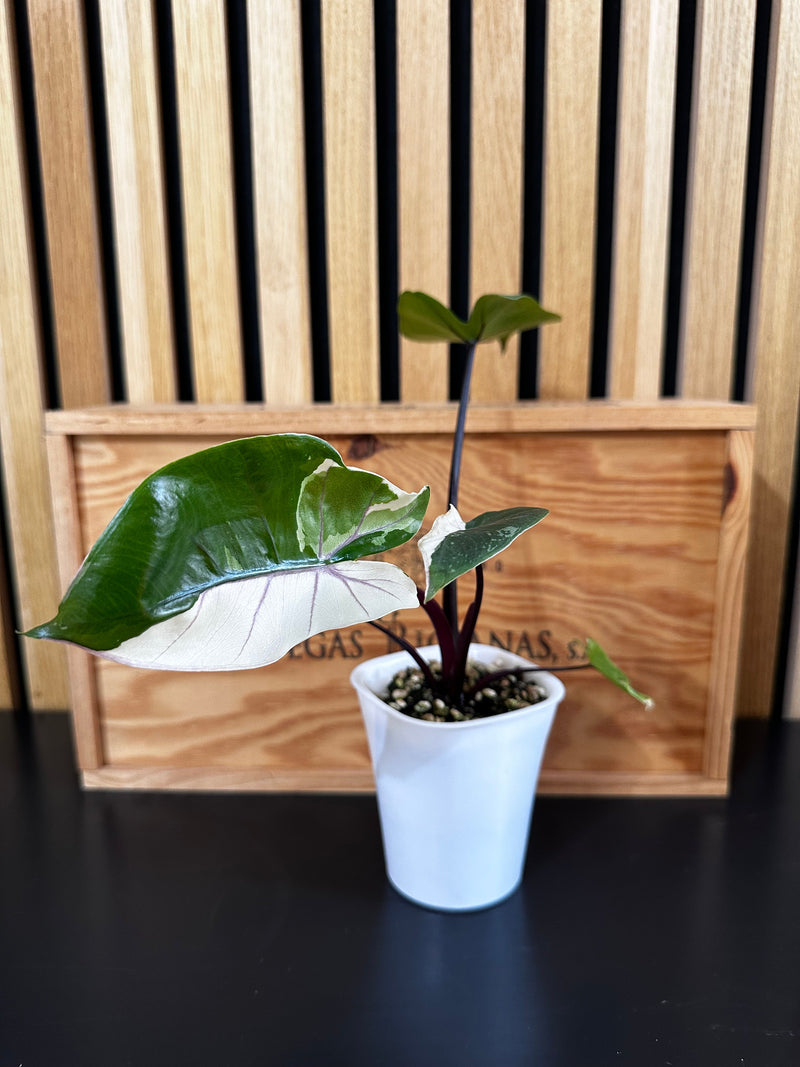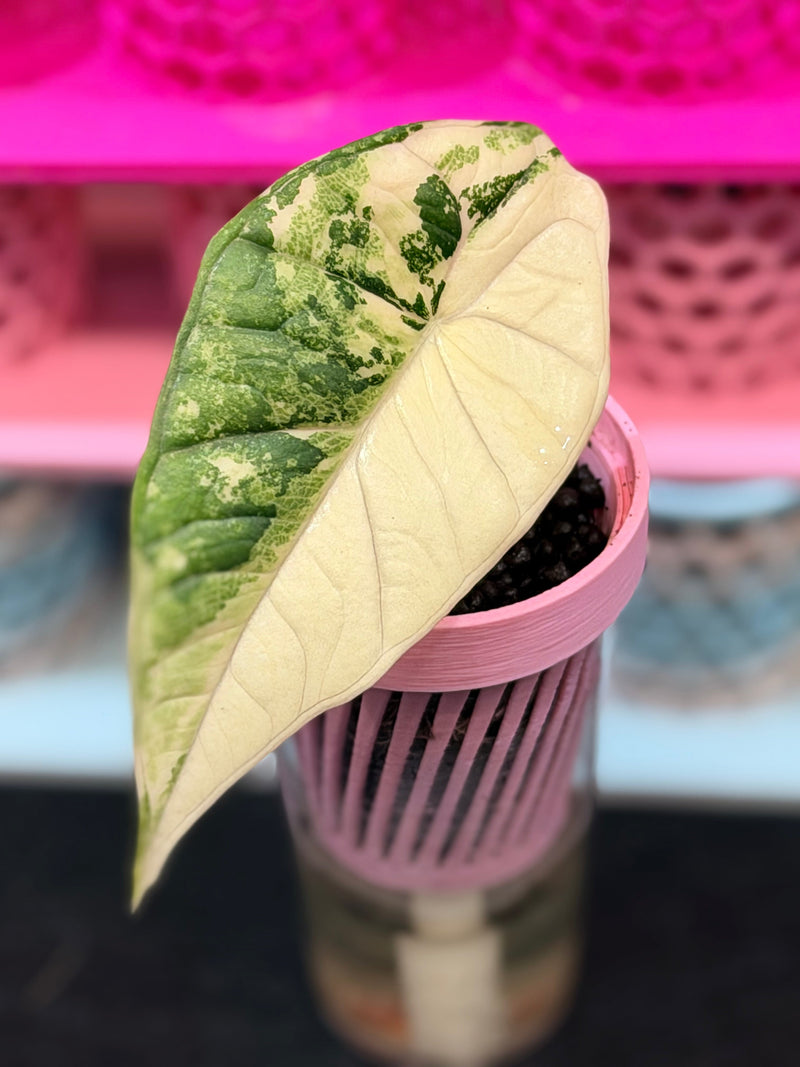

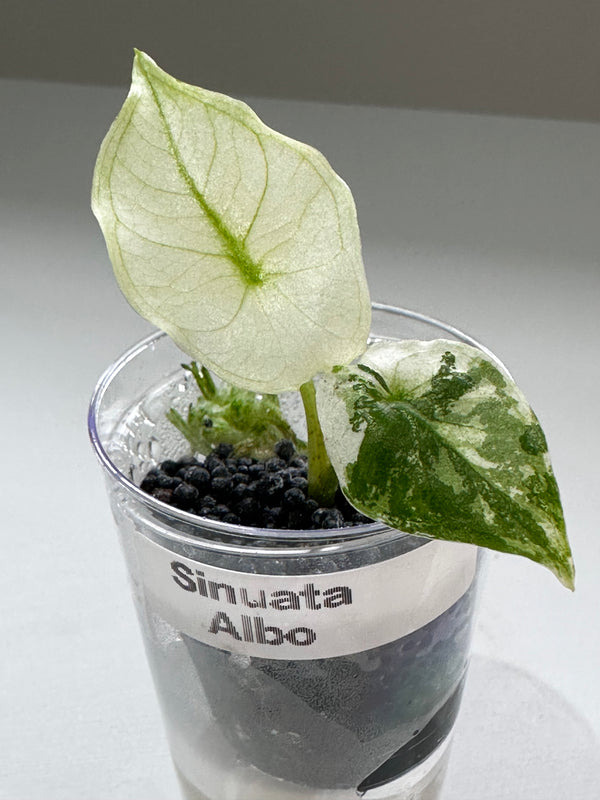
The Alocasia sinuata Albo Variegated is a collector specimen that represents a genuinely rare intersection of two already rare qualities. Alocasia sinuata, the critically endangered Philippine endemic known for its deeply bullate, quilted foliage and subtle metallic sheen, is exceptional in its standard form. Chimeric albo variegation, producing sectors of white or cream tissue through chloroplast genome mutation, is exceptional in any Alocasia. Together, they create a plant whose visual complexity is unlike anything else in current collector cultivation: the three-dimensional quilted surface and the clean white sectors interact to create an effect that shifts with every change in viewing angle and light.
This guide focuses specifically on the albo form of sinuata, the mechanisms behind its variegation, how that variegation behaves on this particular species, and the specific care requirements for maintaining both plant health and white sector expression in a UK growing environment. Those who have not yet read our main guide to Alocasia sinuata Variegated are encouraged to do so first, as it covers the species background, conservation context, and general care principles in full.
Chimeric Albo Variegation on Alocasia Sinuata
Albo variegation in Alocasia arises from a somatic mutation in the plastid genome, a change that affects the chloroplast DNA in specific cell lineages, causing those cells and their descendants to lack the ability to synthesise chlorophyll. The resulting sectors are white or cream rather than green because without chlorophyll, the underlying cell contents are visible without the masking effect of the photosynthetic pigment. This is chimeric variegation: the plant is not uniformly affected, but carries a mixture of normal and mutated cell lineages distributed across its tissue.
In most albo Alocasia, the visual effect is striking but relatively straightforward: white sectors appear on an otherwise green, smooth or lightly textured leaf surface. On Alocasia sinuata, the effect is more complex because the leaf surface is not smooth. The deeply bullate surface, ridges and valleys created by the differential growth rates of different tissue layers, means that white sectors appear within a three-dimensional landscape rather than on a flat plane. The ridges and valleys of the quilting catch and shadow differently in the white sectors than in the green sectors, and the result is a leaf that appears to have genuine three-dimensional depth rather than simply a flat surface with colour variation.
The contrast between the white albo sectors and the characteristic dark, near-metallic green of healthy sinuata foliage is particularly striking in this species. Most albo Alocasia display white against medium or bright green, the contrast is high but the base colour is relatively standard. Sinuata's deep, slightly lustrous green creates a more dramatic context for the white sectors, and the play between the two colours across the bullate surface has a jewel-like quality that is unique to this cultivar combination.
For a comprehensive explanation of the mechanisms and stability of albo variegation across the Alocasia genus, our complete variegation guide covers the science in full.
Variegation Stability: What to Expect
The albo variegation in sinuata Albo is chimeric and therefore inherently variable in its expression between leaves. Some leaves will carry broad white sectors, occasionally covering half or more of the blade. Others will show smaller, irregular patches of white or cream. Still others, particularly during periods of rapid growth or environmental stress, may emerge with minimal white expression. This variability is fundamental to the nature of chimeric albo variegation and should be accepted as part of the plant's character rather than treated as a problem to be solved.
The compact, slow-growing nature of Alocasia sinuata in cultivation has an interesting implication for albo variegation management. Because the species produces relatively few leaves per year, typically 4-8 in good conditions, each new leaf is a more significant event than in faster-growing Alocasia species. The patience required to grow sinuata is simply part of working with a jewel species that has evolved for slow, deliberate growth in a stable tropical environment, rather than for rapid colonisation.
Genuine reversion, where the plant loses its albo variegation permanently, is rare but possible. If four or more consecutive new leaves emerge entirely green without any white sectors, check whether the growth point producing green growth is the only active point on the plant. If the plant has multiple growth points and only one is producing green growth, removing that growth point can sometimes allow variegated points to continue developing. If all growth points are producing green leaves, the chimeric state may be genuinely lost in that portion of the plant.
Light: The Priority for Albo Sinuata
Light management is more critical for the sinuata Albo than for the standard variegated or green forms, for the same reason it is critical for all chimeric albo Alocasia: the white sectors contain no chlorophyll and cannot photosynthesise. Every unit of photosynthetic work falls to the green sectors alone, and those green sectors need to be operating at high efficiency to support the plant's metabolic requirements and drive new growth.
Bright indirect light is the target, within one to two metres of an east- or west-facing window, supplemented with LED grow lighting. The slow growth rate of sinuata is partly species-inherent, but it will be exacerbated significantly by insufficient light, and the white sectors will be maintained at greater stability under consistently good light conditions than under inadequate ones.
Protect the white sectors from direct sun exposure. The albo tissue in sinuata has no chlorophyll buffer against incoming light energy and is substantially more vulnerable to photodamage than the green sectors. Even on the thick, leathery foliage of sinuata, which offers more physical resilience than thin-leaved Alocasia, sustained direct sun will cause browning and collapse of white sectors.
Care Summary: Temperature, Humidity, Substrate and Water
The care requirements of sinuata Albo follow those of the species as described in full in our sinuata Variegated guide. In summary: maintain temperatures of 20-28°C with a 15°C minimum; keep ambient humidity above 60% using a dedicated humidifier; use Fluval Stratum or a well-aerated mineral substrate; water thoroughly when the top 2-3cm is dry and never allow standing water; and feed at half-strength balanced fertiliser every 2-3 weeks.
The albo form requires slightly more attentive care than the standard variegated form specifically because of the reduced photosynthetic capacity that comes with white sectors, feeding should be at the conservative end of the range, as the plant's reduced energy production makes it more sensitive to nutrient imbalances, and any environmental stress (cold, drought, low light) will show more quickly in the albo form than in the green or standard variegated forms.
A heat mat beneath the pot provides valuable root zone temperature stability. Our plant feed collection and CalMag supplement complete the nutritional support needed to maintain a healthy sinuata Albo through the year.
Propagation and Rarity
The sinuata Albo's rarity in cultivation reflects the compounding of two separate rarity factors. Alocasia sinuata is itself a critically endangered endemic species that grows slowly and propagates conservatively, it does not produce the rapid offset growth that makes some other Alocasia species relatively easy to propagate in volume. The chimeric albo mutation layer further restricts propagation, as it cannot be reliably transmitted through seed and requires vegetative propagation, division of the mother plant, to maintain the variegated trait. Offsets, when produced, may or may not carry the albo variegation at the same level as the parent.
This combination means that genuinely well-variegated sinuata Albo specimens are among the most supply-constrained of any Alocasia in cultivation. We release specimens through our drop model when quality material becomes available, with collector list subscribers receiving advance notification and first access.
View our Alocasia Sinuata Albo Variegated listing for current availability, and explore our full albo variegated Alocasia collection for related specimens.
Corms are one of the most economical ways to grow more Alocasia, and the method is the same whatever the cultivar. Our Alocasia corm propagation guide sets out the self-wicking approach we use ourselves, step by step.
Questions about the sinuata Albo, albo variegation care, or jewel Alocasia collecting in the UK? Contact our team, we work with rare variegated specimens daily and are happy to provide expert guidance for collectors at every level.