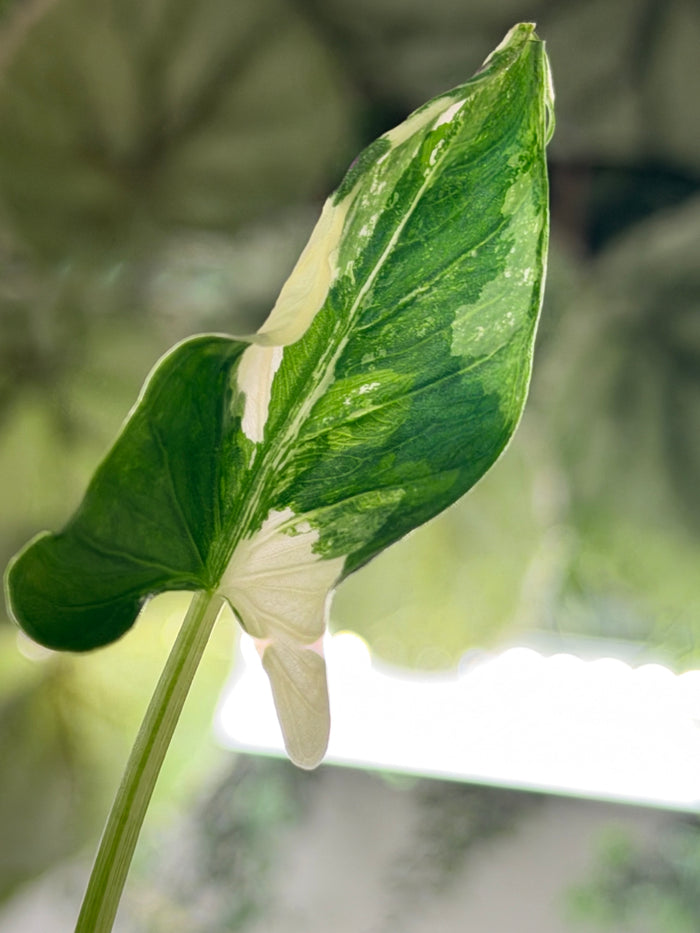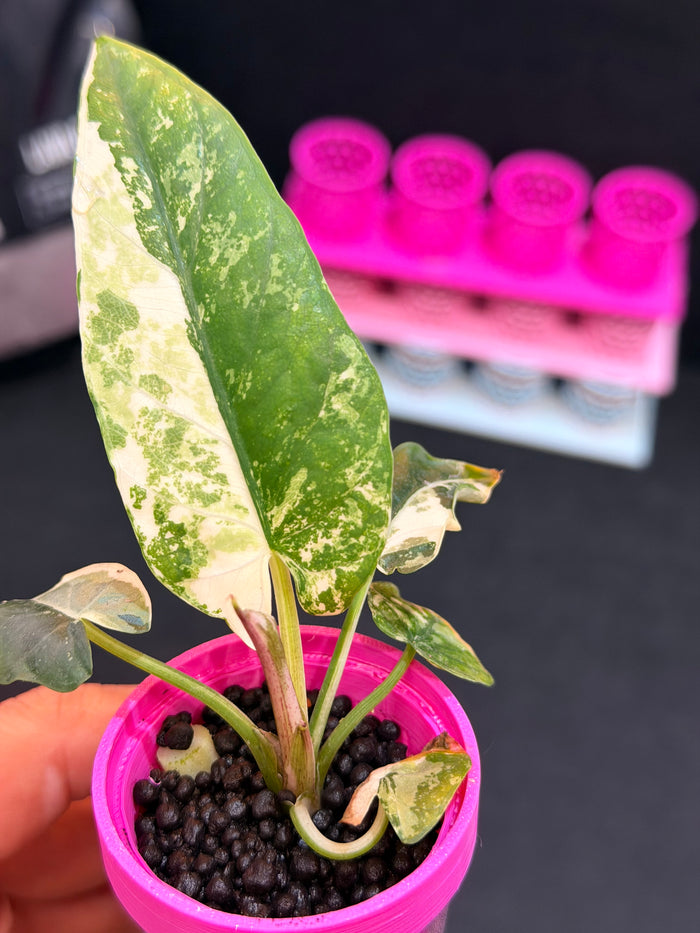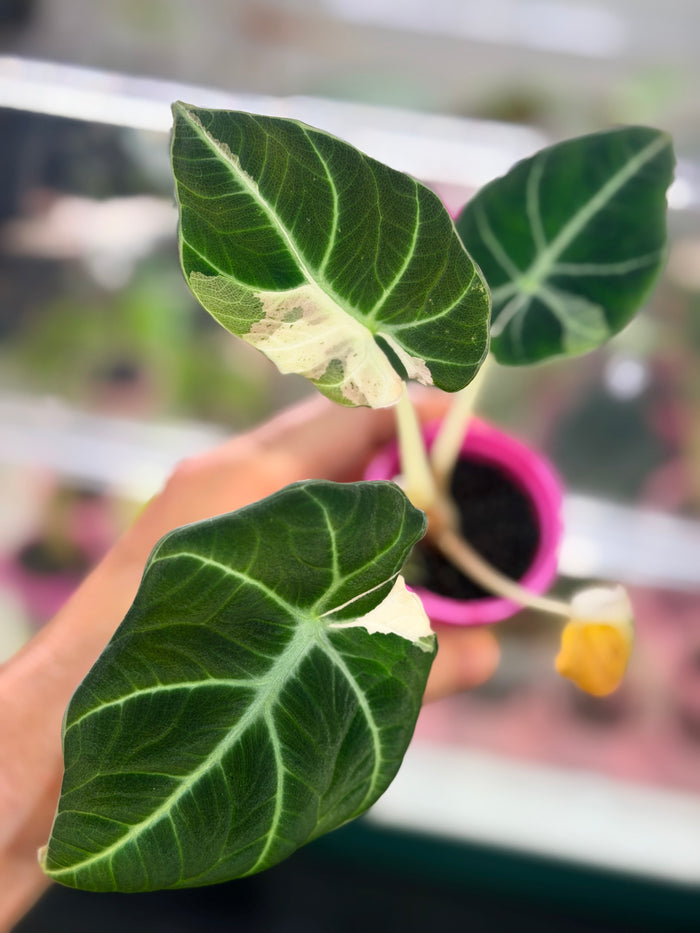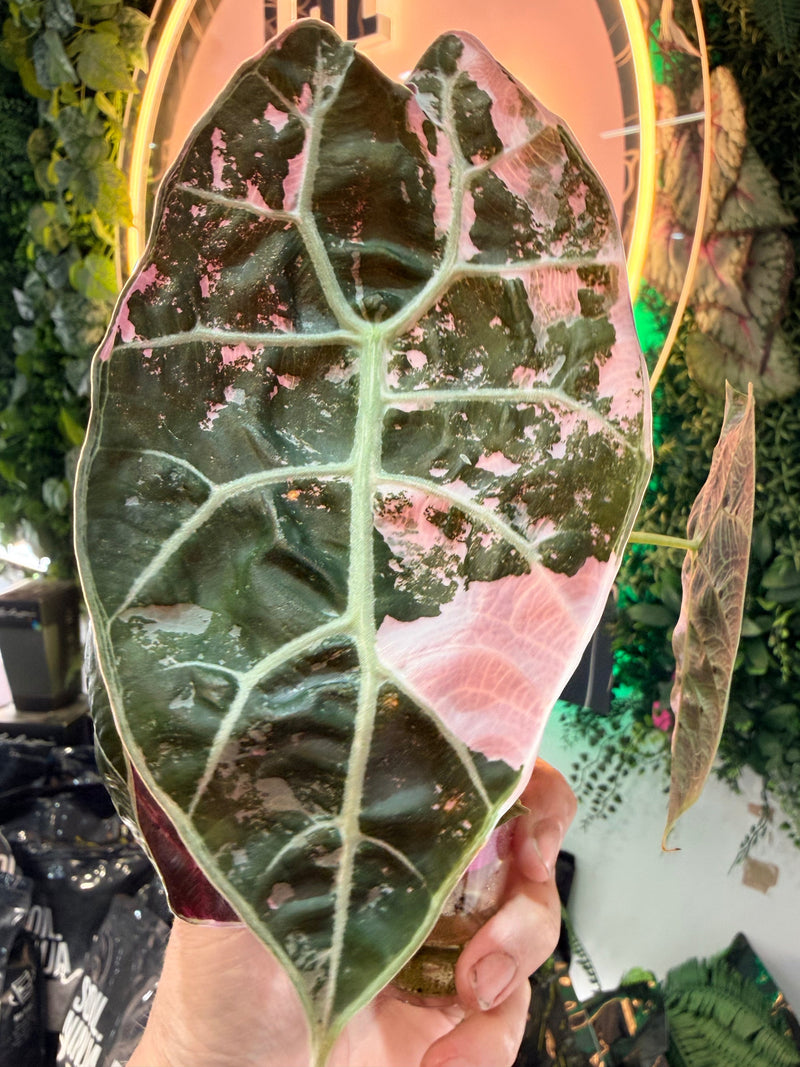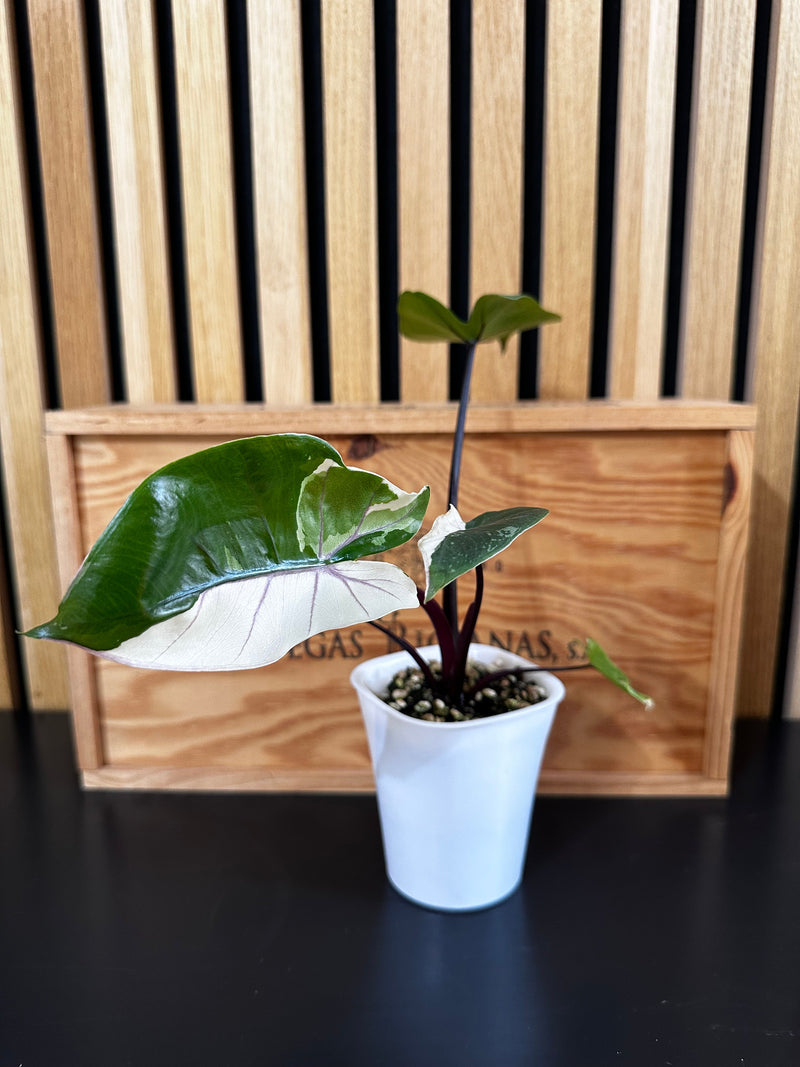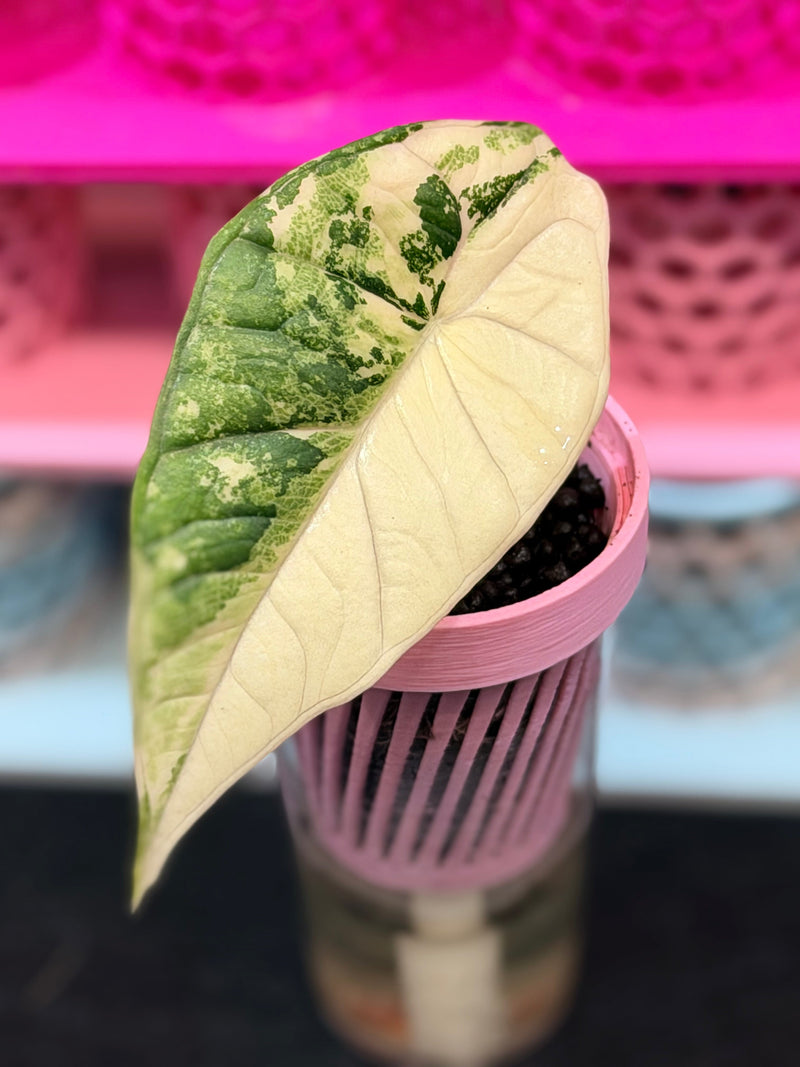

Alocasia fornicata Mint Albo is a variegated form of Alocasia fornicata that shows two kinds of colour change on the same plant: pale mint-green sectors and white albo sectors, set against the normal mid-green of the leaf. It is a collector's plant that rewards good light and steady care. This guide explains what the plant is, what is and is not documented about it, how to recognise the two kinds of variegation, and how to grow it.
If you are new to the species underneath, start with our complete guide to Alocasia fornicata. The single-colour forms are covered in our guides to Fornicata Albo and Fornicata Mint.
What is Alocasia fornicata Mint Albo?
Mint Albo is a trade name for a variegated Alocasia fornicata. Aroidpedia, which we treat as our primary reference, has a species entry for Alocasia fornicata but lists no cultivars, hybrids or variegated forms under it, and it has no separate entry for Mint Albo. That means the cultivar's origin, who first selected it and how it arose are not documented there, and we are not going to supply a story that the sources do not support. What can be said is grounded in the species and in how variegation works in general.
Dual-expression variegation of this kind is genuinely unusual in Alocasia: it requires two independent variegation mechanisms operating simultaneously within a single chimeric plant. The result is a collector specimen of exceptional rarity and visual complexity: white sectors, mint-green sectors and the medium green of normal tissue can all appear on the same blade, with soft pink petioles providing the warm-toned foundation that ties the composition together.
Origin and naming of the species
Aroidpedia records Alocasia fornicata as native to Assam, Bangladesh, the East Himalaya, India, Laos, Myanmar, Sri Lanka, Thailand and Vietnam, with Manipur, Mizoram and Tripura named within India. It describes a subtropical, humid climate with moderate humidity of roughly 60 to 70 per cent and an average rainfall of about 1,200 mm a year.
The same entry gives Roxburgh's Arum fornicatum (Flora Indica, 1832) and Colocasia fornicata as synonyms, and links the 1841 protologue in Enumeratio plantarum. It also warns that a different Arum fornicatum published by Wight is a synonym of Alocasia decipiens, so the two should not be confused. The epithet comes from the Latin fornix, meaning arched or vaulted.
Aroidpedia notes that in Mizoram, Manipur and Tripura the spadix is gathered and cooked as a vegetable, and that the plant is known as Baibing in Mizo and Shola kachu in Bengali. It is, in other words, an edible and culturally familiar aroid in its home range before it is a collector's plant. In its native range the plant can reach 60-90cm in height under optimal conditions.
How to identify the plant
Aroidpedia describes the species as having an inclined or prostrate stem of roughly 30 to 90 cm and about 2.5 cm across. The leaf blades are ovate-lanceolate and sagittate, about 20 to 30 cm long and 10 to 13 cm wide, with a slightly waved margin and six to eight pairs of veins. The basal lobes are much shorter than the front lobe, and the petioles are long, roughly 20 to 30 cm. The spathe is greenish yellow.
Those are the features that stay constant under any variegation, so they are the best way to confirm you have a fornicata and not a look-alike. Aroidpedia does not describe the petiole colour; from our own growing, the pinkish petioles described below are present on every leaf of this cultivar and are a trait worth looking for.
In cultivation the species is recognised for an elegant growth habit: sagittate leaves on slightly pinkish petioles, with the stem growing in an inclined or prostrate position and sending out horizontally spreading stolons. Those pinkish petioles are the constant in this cultivar's shifting palette, the one colour present on every leaf however the white and mint sectors happen to fall.
The variegation: mint and albo together
The two colours are different things and it helps to keep them apart. In most variegated Alocasia a single mechanism operates: either chimeric albo variegation producing white sectors, or carotenoid-based aurea or mint variegation producing yellow-green sectors. Mint Albo carries both at once, a chimeric plastid mutation creating white albo sectors alongside a separate carotenoid expression creating mint-green sectors. How these two mechanisms coexist in one plant is botanically interesting: they appear to represent independent variegation events within the same cellular lineage.
Albo sectors are white because they carry no chlorophyll. They cannot photosynthesise, so they are a cost that the green tissue has to carry. Our guide to understanding albo variegation goes into this.
Mint sectors are a pale green. They still carry some chlorophyll, which is why a mint area contributes more to the plant than a white one. The wider picture is in our complete guide to variegation types.
When both appear together, the pattern differs from leaf to leaf. One leaf can be mostly white-marked, the next mostly mint, and some carry both against green. Leaves where both are clearly present, with white and mint sectors distinct against the normal green tissue, are the most visually complex expression of the cultivar, and they are the leaves collectors acquire Mint Albo specifically to see. That unpredictability is part of the appeal. It also means the plant is chimeric, so the pattern is not guaranteed to carry through to a plant grown from a corm. Our guide to pink variegation explains why chimeric patterns can be unstable, and the principle applies here too.
Aroidpedia does not document how the combination arose or how stable it is over time; from our own growing, the two colours appear to be independent variegation events, as set out above.
General Alocasia care for Mint Albo
This is general Alocasia care, and it applies to this plant. A plant with white sectors has less working leaf area, so steady conditions matter more than precision. The white sectors are a genuine energetic load that the green and mint tissue must support, which makes Mint Albo somewhat more demanding to grow than the single-expression forms and the one that asks for the most attentive care of the fornicata variegated forms.
- Light: bright indirect light, topped up with LED grow lights so the plant is lit evenly every day. Weak light tends to push mint sectors towards plain green.
- Temperature and humidity: 20 to 27°C and humidity of 60 to 80 per cent, with 60 to 70 per cent suiting this plant well. A heat mat helps if the room runs cool.
- Watering: water when the top 2 to 3 cm of substrate has dried, then water thoroughly. Our root rot guide covers what to do if the roots suffer.
- Substrate: Fluval Stratum is our preferred substrate. See also our substrates and growing media.
- Feeding: our Alocasia feed from the plant feed range, at half strength or conservatively at quarter to half strength.
For the full picture, our ultimate Alocasia care guide covers the fundamentals.
Propagating from a corm
Alocasia can be grown on from corms, and our corm propagation guide sets out the method. In short, the corm is placed in Fluval Stratum in a Corm Keeper, which works as a self-wicking setup: the substrate draws moisture up steadily so the corm stays evenly damp without sitting in water. See also growing Alocasia corms in Fluval Stratum and how long a corm takes to sprout.
Because the variegation is chimeric, a new plant from a corm can come up plain green. Treat that as a possibility, not a fault.
How it compares with similar plants
The nearest relatives are the other fornicata forms: Fornicata Aurea and Fornicata Lime Aurea have a golden or lime tone. You can compare them across our albo variegated and aurea variegated collections.
We release this cultivar through our drop model. Join the collector list for advance notification.
Alocasia fornicata Mint Albo FAQ
What is Alocasia fornicata Mint Albo?
A variegated form of Alocasia fornicata with both white albo sectors and pale mint-green sectors on the same plant.
Is it a documented cultivar?
Aroidpedia has an entry for the species but not for Mint Albo, so its origin is not documented there.
Is it harder to grow than a plain green fornicata?
The basic needs are the same as for a plain green fornicata, but white sectors cannot photosynthesise, so Mint Albo is more demanding than single-expression forms and consistent light and steady watering matter more.
Will a corm produce the same variegation?
Not reliably. The variegation is chimeric, and a corm-grown plant can come up plain green.
How much light does it need?
Bright indirect light, supplemented with LED grow lights so that it is lit evenly every day.
Questions about Alocasia fornicata Mint Albo? Contact our team for guidance from specialists who grow rare Alocasia in our UK-based private nursery. We are happy to talk through light, substrate and corm propagation.