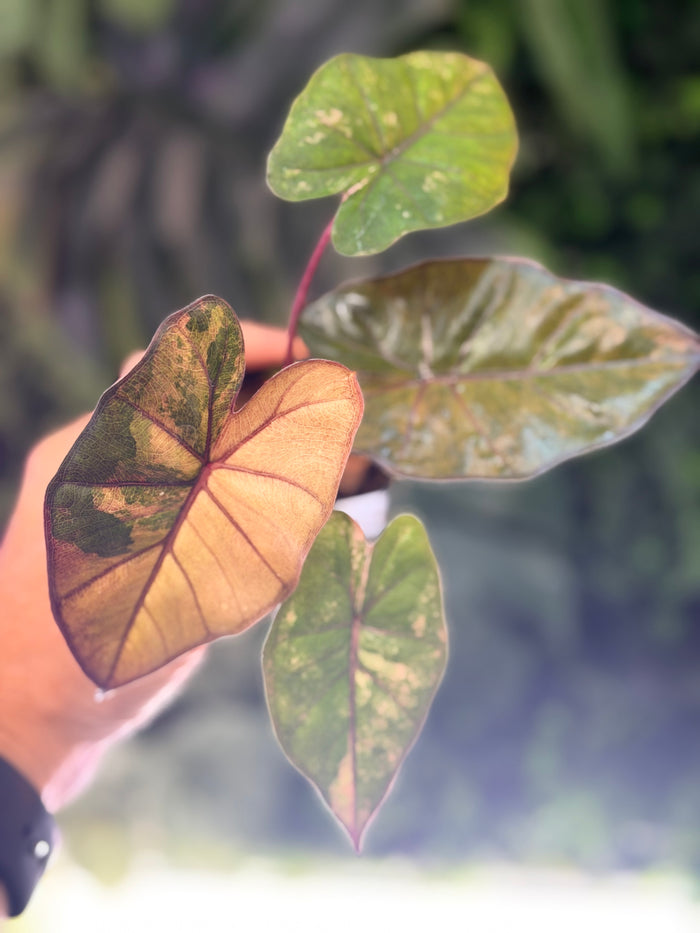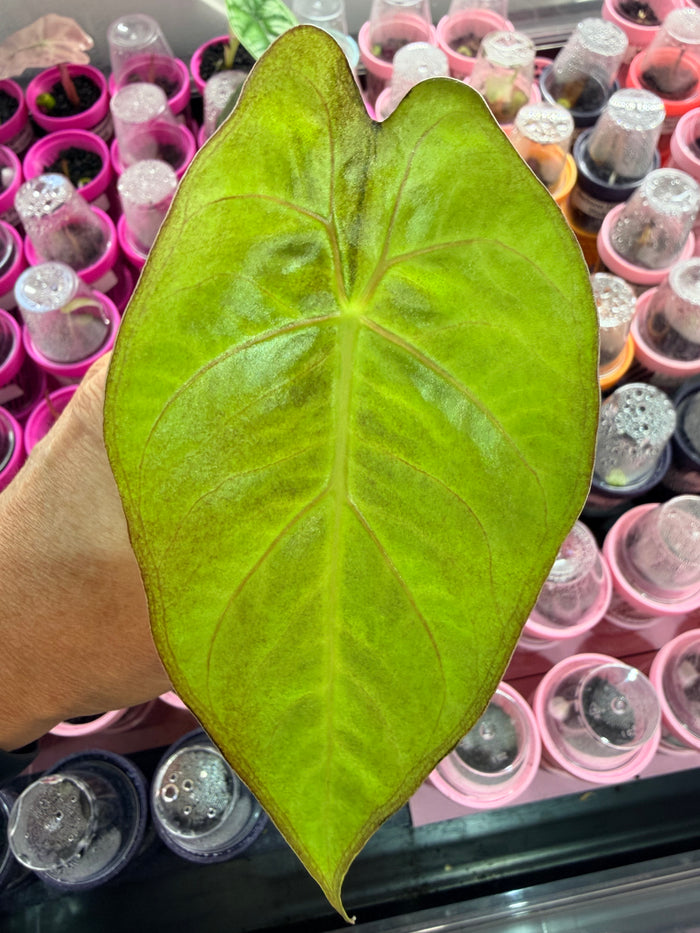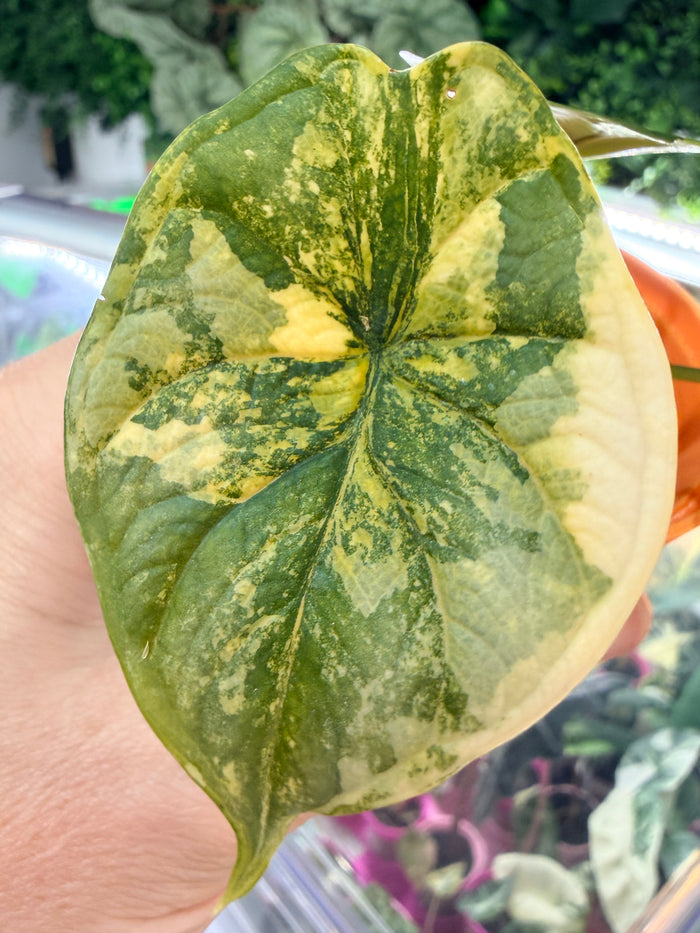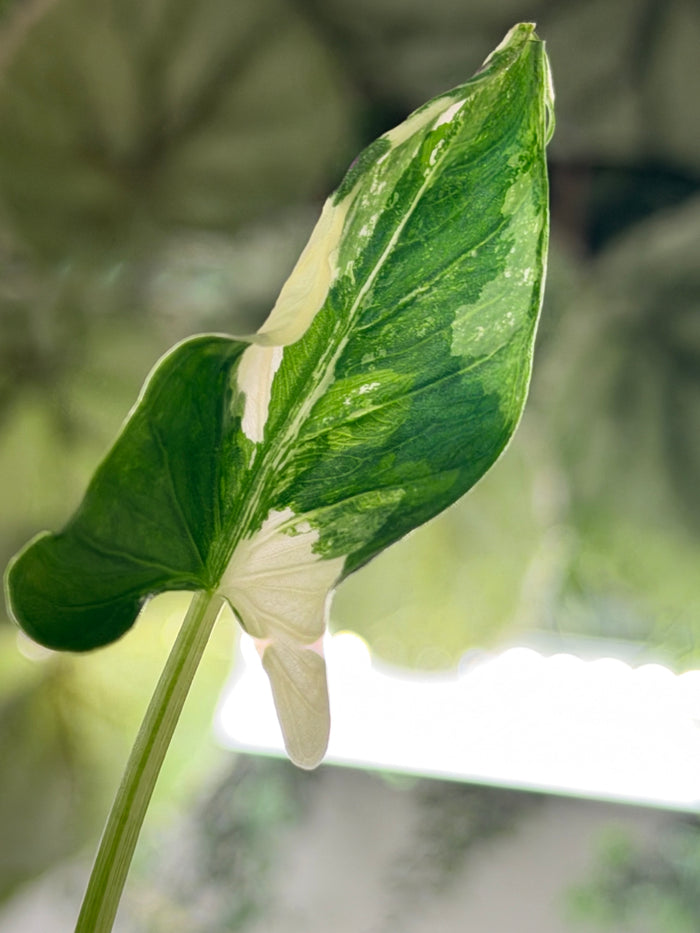

Alocasia fornicata Mint is a variegated form of Alocasia fornicata in which parts of the leaf are a pale mint green rather than the normal mid-green. It sits alongside the albo and aurea forms of the same species, and it is the gentlest of the three: the sectors are still green, so they keep working. It introduces a third distinct colour register to the fornicata variegated family, following the white sectors of the albo and the golden expression of the aurea. This guide covers what the plant is, what is documented about it, how to recognise it and how to grow it well.
For the species itself, read our complete guide to Alocasia fornicata.
What is Alocasia fornicata Mint?
Aroidpedia lists Alocasia fornicata as a species and records no cultivars, hybrids or variegated forms under it. There is no separate entry for Fornicata Mint, so the origin of this form, who selected it and when are not documented there. This guide therefore sticks to what can be supported, drawn from the species entry and from general knowledge of variegation.
Origin and naming of the species
According to Aroidpedia, Alocasia fornicata is native to Assam, Bangladesh, the East Himalaya, India (including Manipur, Mizoram and Tripura), Laos, Myanmar, Sri Lanka, Thailand and Vietnam. The climate there is humid and subtropical, with average rainfall of around 1,200 mm a year.
Roxburgh described it as Arum fornicatum in Flora Indica in 1832, and it is also recorded as Colocasia fornicata. The accepted Alocasia name is linked by Aroidpedia to an 1841 publication, Enumeratio plantarum. The epithet comes from the Latin fornix, meaning arched or vaulted. Aroidpedia also points out that Wight's Arum fornicatum is a different plant, a synonym of Alocasia decipiens.
In Mizoram, Manipur and Tripura the spadix is collected and cooked as a vegetable. It is called Baibing in Mizo and Shola kachu in Bengali. That combination, an edible species of cultural significance and a collector's plant in its variegated forms, is unusual in the Alocasia genus.
How to identify it
The species has an inclined or prostrate stem, ovate-lanceolate and sagittate leaves of roughly 20 to 30 cm in length, a slightly waved margin and six to eight pairs of veins. The basal lobes are much shorter than the front lobe. Aroidpedia gives the stem as 30 to 90 cm. It does not describe petiole colour or stolons, so we have not drawn on it for either; from our own plants, the petioles are slightly pinkish and horizontally spreading stolons extend from the stem.
These structural features hold whatever the colour, so they are the reliable way to separate a Mint from other pale-leaved Alocasia.
The mint variegation
Mint variegation is a pale green rather than white or gold. Affected sectors display cool chartreuse-green or blue-green tones rather than the warm yellows of aurea or the stark white of albo. The affected tissue has less pigment than the surrounding green, but it is not without chlorophyll. That is the practical difference from an albo, where white sectors have none and cannot photosynthesise. The basis is a partial reduction of both chlorophyll and carotenoid pigments in the affected tissue, with the residual proportions and the species' underlying cell chemistry producing the characteristic mint tone. Our guide to variegation types sets out the distinctions, and our guides to albo and aurea variegation cover the other two.
Where the plant's pinkish petioles show, the mint sectors give a cool-toned counterpoint to that warm stem colour. The warm-cool tension between the two is the defining visual characteristic of the Fornicata Mint: most mint variegated Alocasia present the mint expression against a neutral or dark green background without pink stems, so the colour relationship here is more complex and more interesting, and it sets the Fornicata Mint apart from the albo and aurea forms, which do not achieve that chromatic tension.
Two practical points follow from this:
- Because mint tissue still photosynthesises, a mint plant is generally less demanding than an albo, though it still needs good light to hold its colour. Mint sectors retain more chlorophyll than albo sectors and, in many cultivars, contribute more to photosynthesis than standard aurea sectors, which makes the Fornicata Mint relatively vigorous.
- Under weak light, pale sectors tend to green up as chlorophyll becomes more dominant.
Chimeric variegation is also not guaranteed to be passed on through a corm, so a corm-grown plant can come up plain green. Our article on pink variegation explains why chimeras can be unstable.
General Alocasia care for Fornicata Mint
This is general Alocasia care, and it applies to this plant.
- Light: bright indirect light, supplemented with LED grow lights so that colour holds.
- Temperature and humidity: 20 to 27°C with humidity of 60 to 80 per cent. Add a heat mat if the room runs cool.
- Watering: water when the top 2 to 3 cm has dried, and water through thoroughly. Staying too wet is the main risk to the roots, which our root rot guide explains.
- Substrate: Fluval Stratum is our preferred substrate; more options sit in substrates and growing media.
- Feeding: our Alocasia feed from the plant feed range, at half strength every 2 to 3 weeks.
More detail is in the ultimate Alocasia care guide.
Propagating Fornicata Mint from a corm
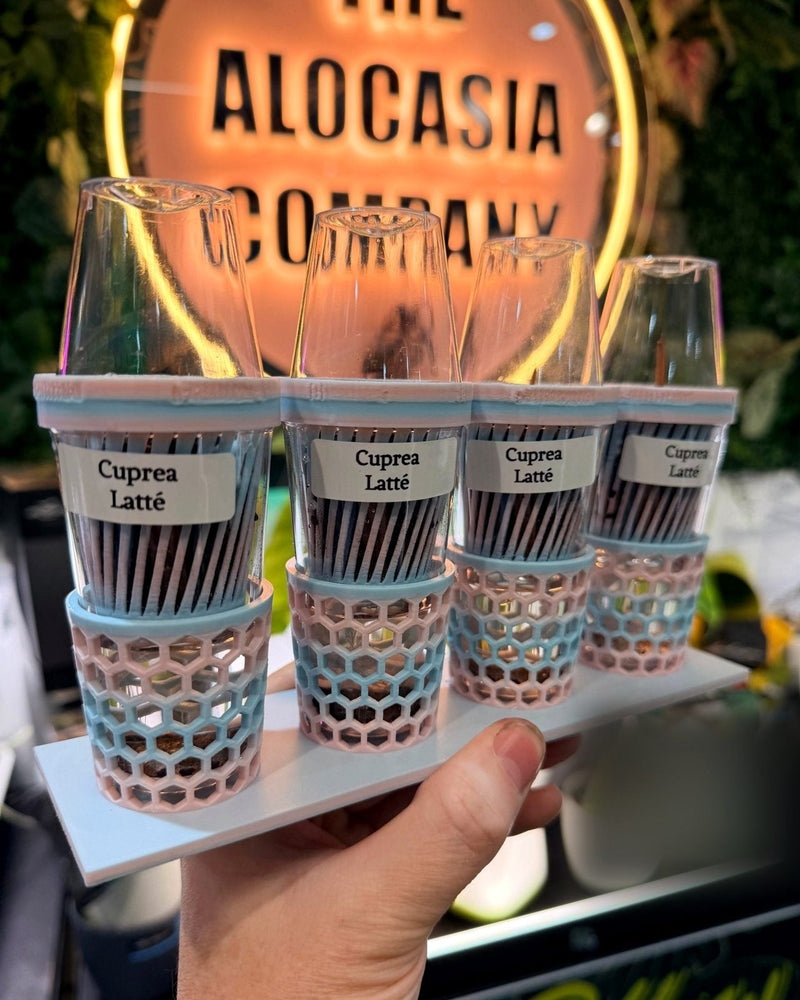
Our corm propagation guide describes the method we use. The corm sits in Fluval Stratum inside a Corm Keeper, a self-wicking setup in which the substrate draws water up so the corm stays evenly moist without standing in it. The articles on growing corms in Fluval Stratum and how long a corm takes to sprout add detail.
How it compares with similar plants
Beside the albo form, which is white-sectored, and the golden aurea, the mint is the quietest in colour. See Fornicata Albo, Fornicata Aurea and Fornicata Mint Albo, which combines mint and white. Our Alocasia house plants collection shows the wider range.
We release this cultivar through our drop model. Join the collector list for early access.
Alocasia fornicata Mint FAQ
What is Alocasia fornicata Mint?
A variegated form of Alocasia fornicata with pale mint-green sectors on otherwise mid-green leaves.
Is Fornicata Mint documented on Aroidpedia?
No. Aroidpedia has a species entry but lists no cultivars or variegated forms, so the cultivar's origin is not documented there.
Is it easier than the albo form?
Generally, yes, because mint sectors still carry chlorophyll. Good light is still needed to keep the colour.
Why did my mint sectors turn green?
Most often because of weak light. Brighter, more even light, including LED supplementation, usually helps new growth.
Will a corm give a mint plant?
Not reliably. The variegation is chimeric and a corm-grown plant can come up plain green.
Questions about Alocasia fornicata Mint? Contact our team for guidance from specialists who grow rare Alocasia in our UK-based private nursery. We are glad to help with light, substrate and corms.