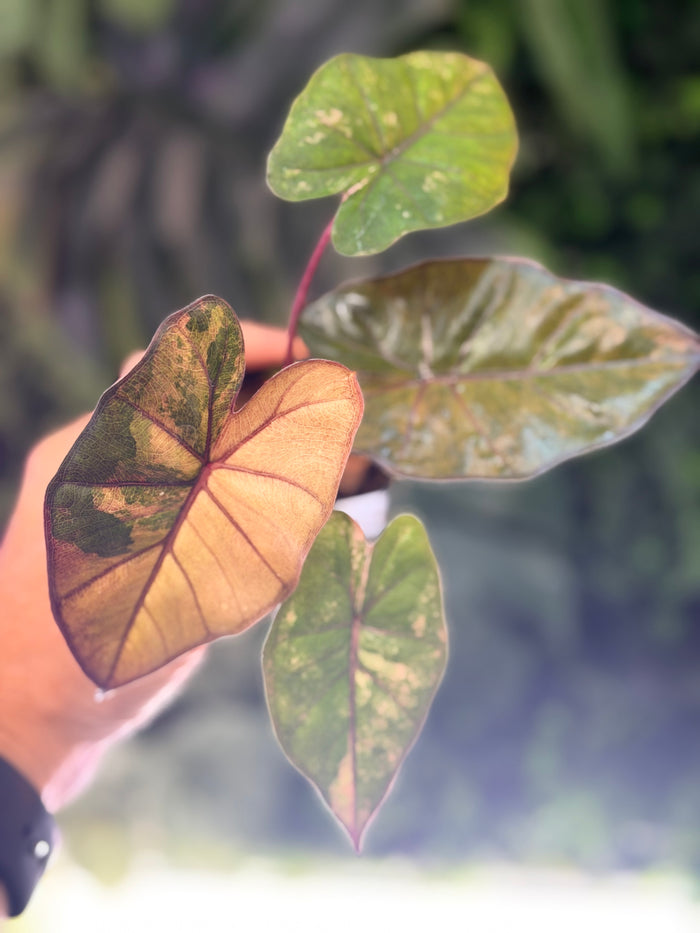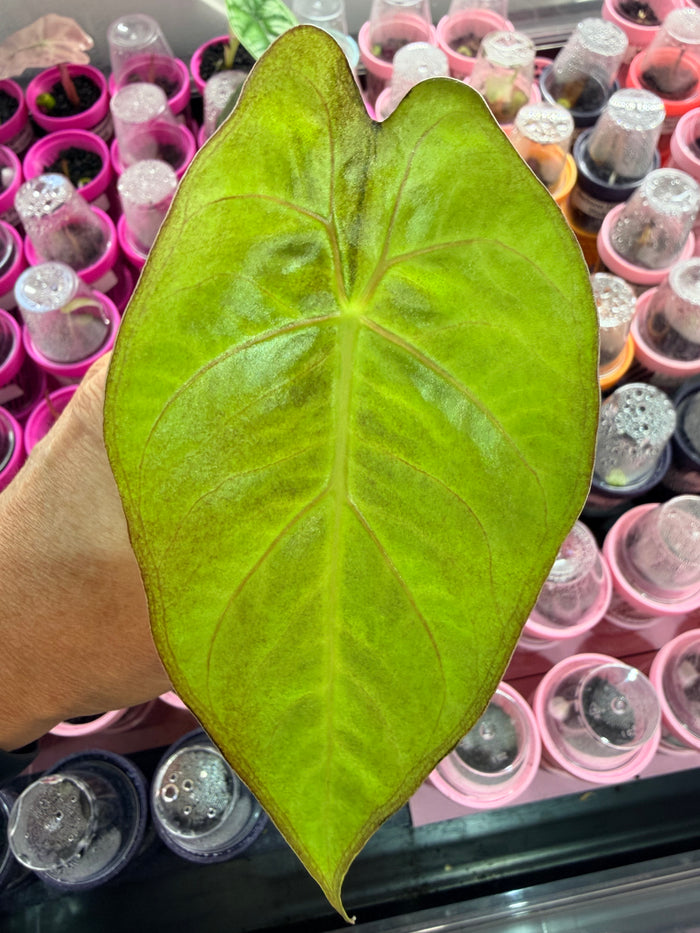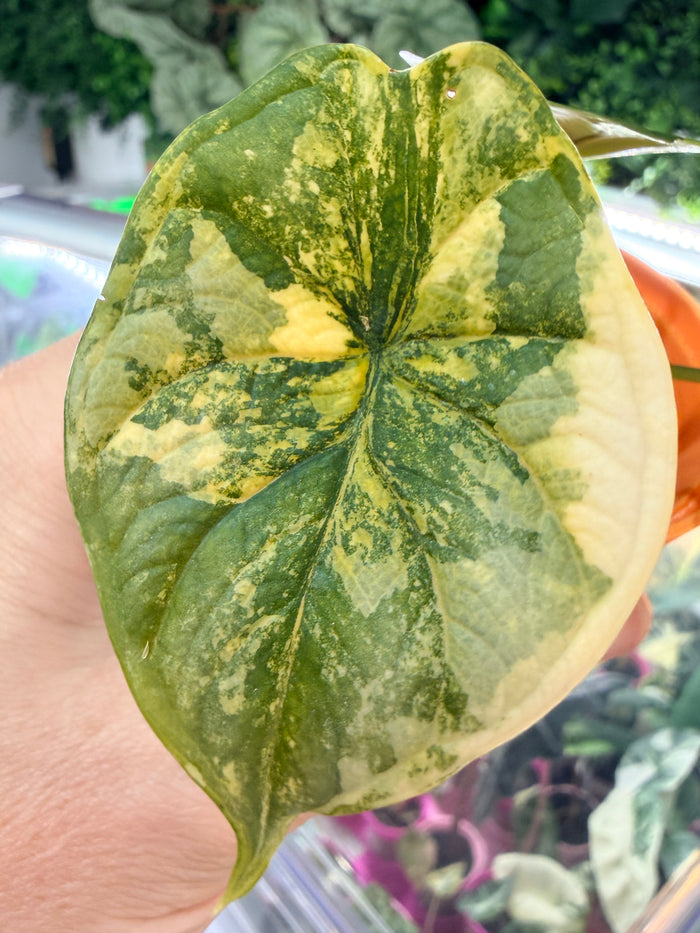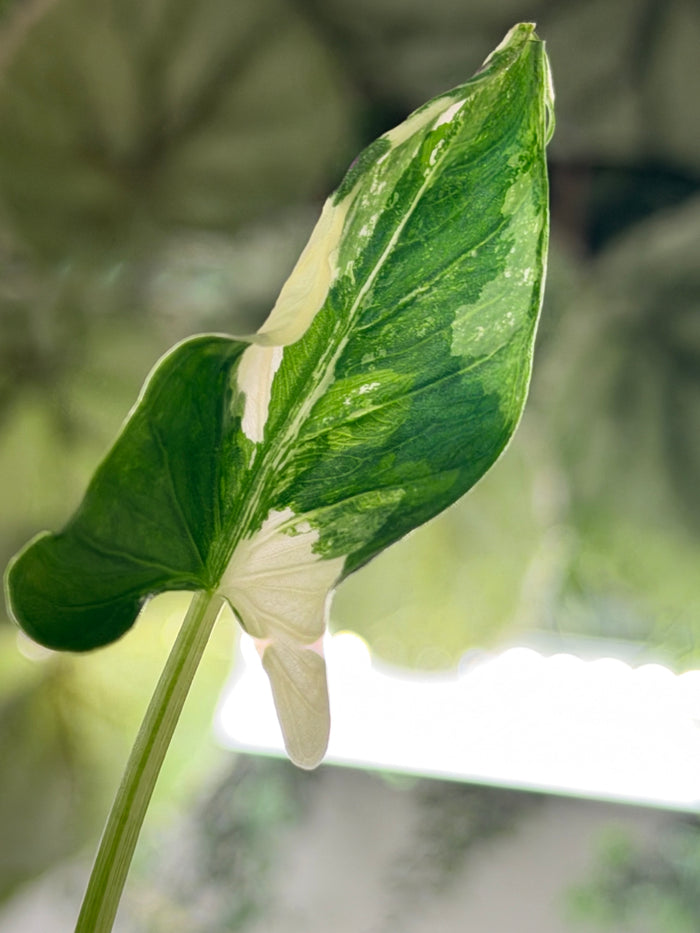

Alocasia fornicata occupies an unusual position in the modern collector Alocasia world. Unlike the jewel Alocasia from Borneo or the limestone forest endemics of the Philippines, species with narrow, restricted distributions and specialist ecological requirements, Alocasia fornicata is a wide-ranging species with a deep cultural history in its native range. It is, by any measure, a plant of genuine botanical significance: collected and cooked as a seasonal vegetable in North-East India for generations, distributed across a substantial arc of subtropical Asia from the Himalayan foothills to Vietnam, and now increasingly valued by European collectors for the elegance of its standard form and the exceptional visual complexity of its variegated cultivars.
This guide covers the standard Alocasia fornicata, the species in its natural green form, as a foundation for understanding the variegated cultivars covered in companion guides. Whether you are approaching this species for the first time or looking to understand it more fully before exploring the albo, aurea, mint, or lime aurea forms, this is the appropriate starting point.
Species Background and Botanical History
Most collector Alocasia arrive from somewhere small: one island, one limestone ridge, one narrow endemic range. Alocasia fornicata did not. It is native across North-East India (including Assam, Mizoram, Manipur, and Tripura), Bangladesh, the East Himalayan foothills, Laos, Myanmar, Sri Lanka, Thailand, and Vietnam, a substantial sweep of subtropical and tropical Asia rather than a restricted pocket of it, and it thrives in humid subtropical conditions with a pronounced wet season. That breadth is the first thing to understand about the green form, because most of what follows in this guide rests on it. The species was first formally described from the Indian subcontinent: William Roxburgh documented it in Flora Indica in 1832 as Arum fornicatum, it was transferred to Alocasia by Schott, and it was formally named in 1841 by Kunth. The epithet comes from the Latin fornix, meaning arched or vaulted, a reference to the characteristic form of its leaves and stems.
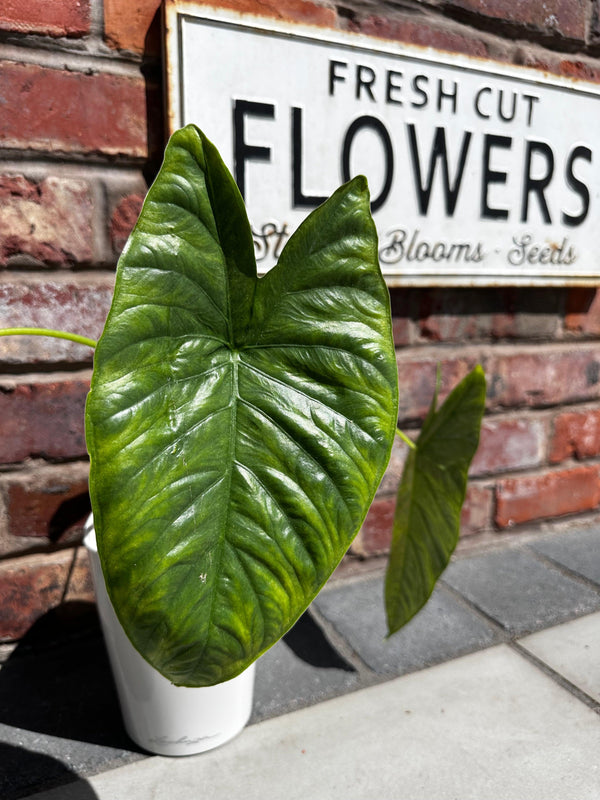
The name is well chosen. In cultivation Alocasia fornicata is recognised for a distinctively elegant growth habit: ovate-lanceolate, sagittate leaves carried on slightly pinkish petioles, with the stem typically growing in an inclined or prostrate position rather than upright, and horizontally spreading stolons running out from it. In its native range the plant can reach 60-90cm in height under optimal conditions. It has also been cultivated as a food plant in North-East India for generations: in Mizoram it is known as "Baibing", and the spadix is collected and cooked as a seasonal vegetable. That dual status, an edible species of cultural significance and, in its variegated forms, a collector's plant, is unusual in the Alocasia genus.
The distribution of Alocasia fornicata across such a wide geographic range is notable because it reflects a species with broader environmental tolerance than many Alocasia. Most of its range falls within subtropical humid climate zones, temperatures ranging from around 9°C at the cooler end to 31°C at peak summer, with humidity consistently at 60-70% and a pronounced rainy season from October to May in much of its range. This subtropical adaptation makes the species somewhat more tolerant of temperature variation than strictly tropical Alocasia, though it still requires consistent warmth and humidity in UK cultivation.
The slightly pinkish petioles of Alocasia fornicata are one of its defining visual characteristics, not the vivid, saturated pink of the Pink Dragon, but a soft blush tone that gives the stems a warmth absent from the purely green-stemmed Alocasia species. The leaf blade is ovate-lanceolate and sagittate, with the basal lobes notably shorter than the anterior lobe and connate for approximately a quarter to a third of their length. The leaves are slightly waved at the margin, not deeply bullate like Alocasia sinuata or Alocasia melo, but with a gentle undulation that becomes more pronounced in mature specimens. The plant's natural growth habit, with the stem inclined or prostrate and spreading via stolons, gives it a relaxed, spreading character that distinguishes it from the more upright jewel Alocasia species.
Why Collectors Value Alocasia fornicata
The standard green Alocasia fornicata appeals to collectors who appreciate botanical depth and historical context alongside visual interest. This is not a species chosen purely for dramatic visual impact, it lacks the extreme textural complexity of Alocasia melo, the metallic lustre of Alocasia cuprea, or the sharp architectural precision of Alocasia sinuata. Its appeal is of a different character: an elegant, graceful species with a long history of human interaction across some of the world's most botanically rich regions, and a leaf form that rewards careful observation without demanding instant attention.
For collectors building the foundation of an understanding of the genus, Alocasia fornicata is also contextually valuable because of its variegated forms. The albo, aurea, mint, and lime aurea cultivars of fornicata are among the more sought-after variegated Alocasia in the current collector market, and understanding the standard green form is the correct foundation for appreciating how dramatically variegation transforms the species' visual character. Our albo variegated collection, aurea variegated collection, and broader rare Alocasia collection all include fornicata variants when they are available through our drop model.
Light Requirements
Alocasia fornicata's subtropical origins, distributed across environments from the Himalayan foothills to the humid coastal regions of Sri Lanka and Vietnam, suggest a species adapted to a range of light conditions. In cultivation, bright indirect light is the appropriate target: a position within one to two metres of an east- or west-facing window, receiving consistent ambient light without direct sun exposure.
The species is somewhat more tolerant of moderate light levels than the strictly forest-floor jewel Alocasia, reflecting its broader ecological range. However, consistently inadequate light will slow growth significantly and reduce the leaf size and vigour that make a well-grown specimen compelling. In UK conditions, supplementary LED grow lighting maintains growth momentum and prevents the stall that insufficient light causes in tropical species.
Temperature and Humidity
The subtropical climate range of Alocasia fornicata, with seasonal temperature variation from around 9°C at the cold end to 31°C at peak summer, makes it one of the more temperature-tolerant Alocasia species in cultivation. In UK indoor conditions, maintaining 18-27°C is the target, with a minimum of 13-15°C tolerated for brief periods (though sustained cold will cause visible stress). This wider temperature tolerance is a genuine advantage for UK collectors compared to strictly tropical species that begin to suffer below 18°C.
Humidity should be maintained at 60-70%, consistent with the natural range of the species across its subtropical Asian distribution. UK homes drop significantly below this, and a dedicated humidifier or grouping of plants is recommended to maintain adequate moisture levels. A heat mat beneath the pot supports root zone health during cold periods.
Substrate, Watering and Feeding
Fluval Stratum provides the well-drained, aerated substrate that Alocasia fornicata requires. Water thoroughly when the top 2-3cm is dry, ensuring free drainage, and never allow standing water around the roots. The species' wider temperature tolerance extends to some degree to moisture consistency, it handles brief dry spells somewhat better than the strictly tropical jewel Alocasia, but consistently waterlogged substrate will cause root rot regardless of species resilience.
Feed with balanced liquid fertiliser at half strength every 2-3 weeks. The species' naturally broader ecological range means it is somewhat more tolerant of feeding inconsistency than narrowly adapted endemics, but a measured, consistent approach gives the best results. Our plant feed collection includes appropriate formulations for all Alocasia including fornicata.
Propagation and Corms
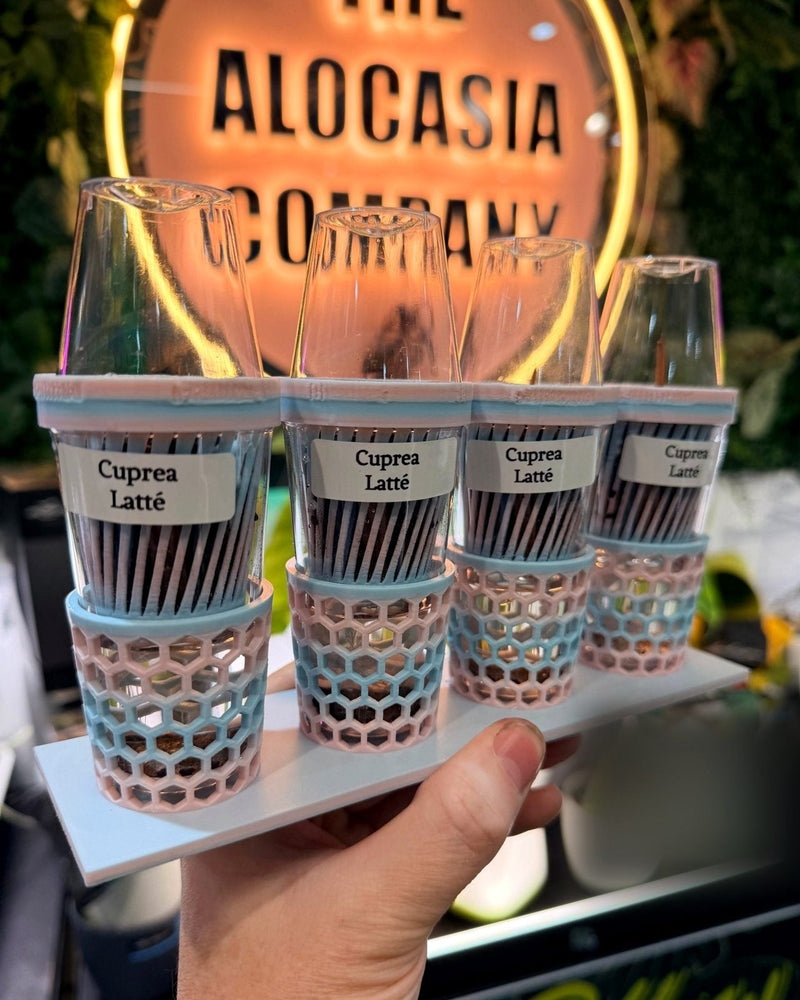
Alocasia fornicata produces offsets and corms in cultivation, making it more straightforward to propagate than the slower-growing jewel Alocasia. Corms can be harvested and propagated using Fluval Stratum as substrate, with consistent warmth and humidity supporting germination. Our corm collection and Corm Keeper and Corm Crown system provide all the infrastructure needed for successful corm propagation at home.
For the variegated forms, albo, aurea, mint, and lime aurea, vegetative propagation is essential to maintain colour expression, as seed propagation does not reliably transmit chimeric or carotenoid-based variegation. Our collector drop list provides early access notifications for variegated fornicata releases when material is available.
Questions about Alocasia fornicata, its variegated forms, or growing subtropical Alocasia in the UK? Contact our team for expert guidance from our UK-based specialist nursery.