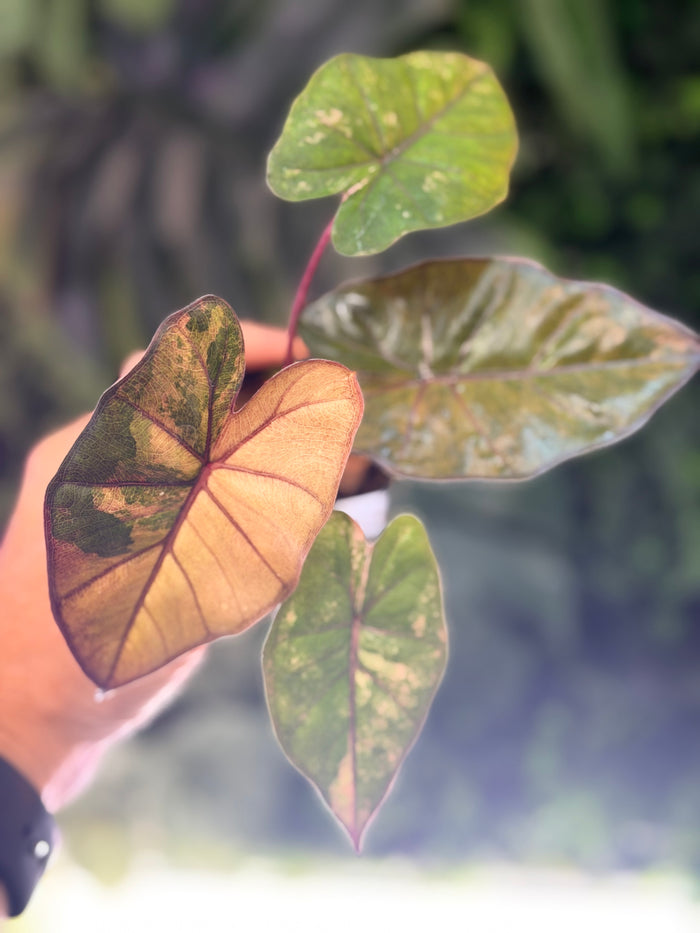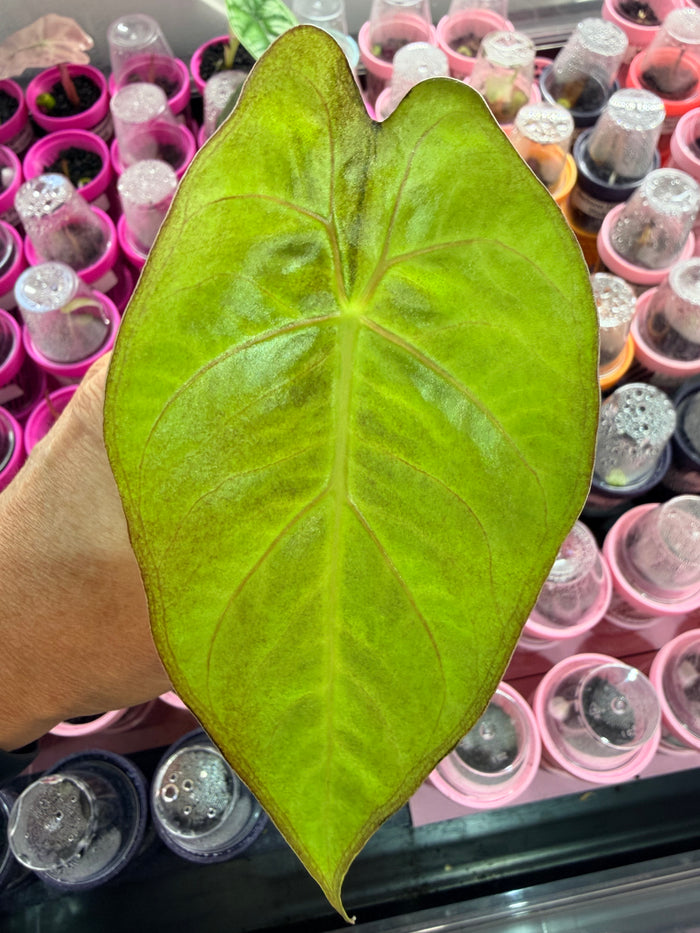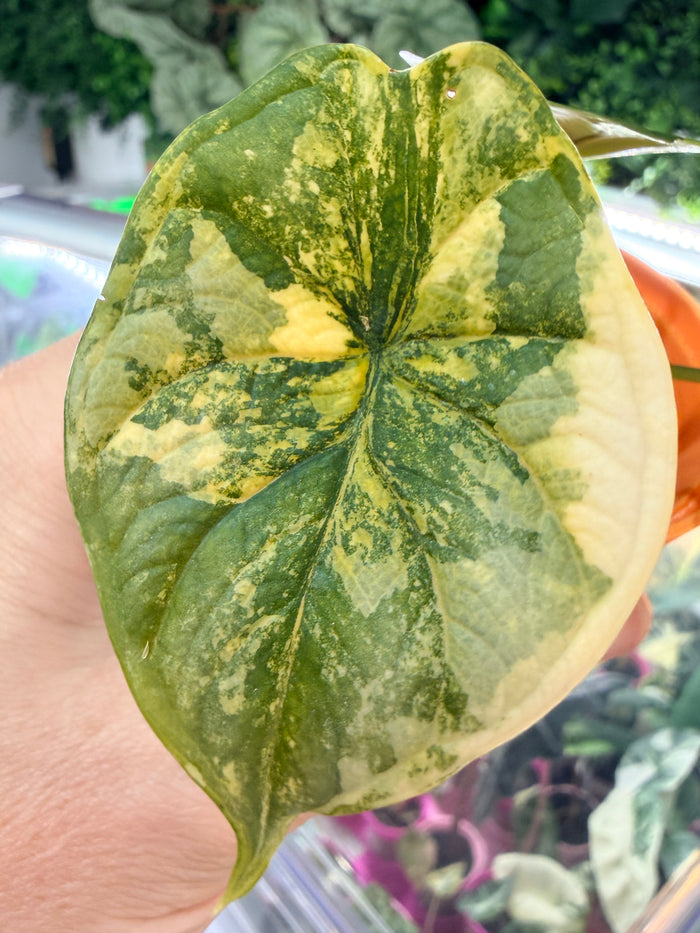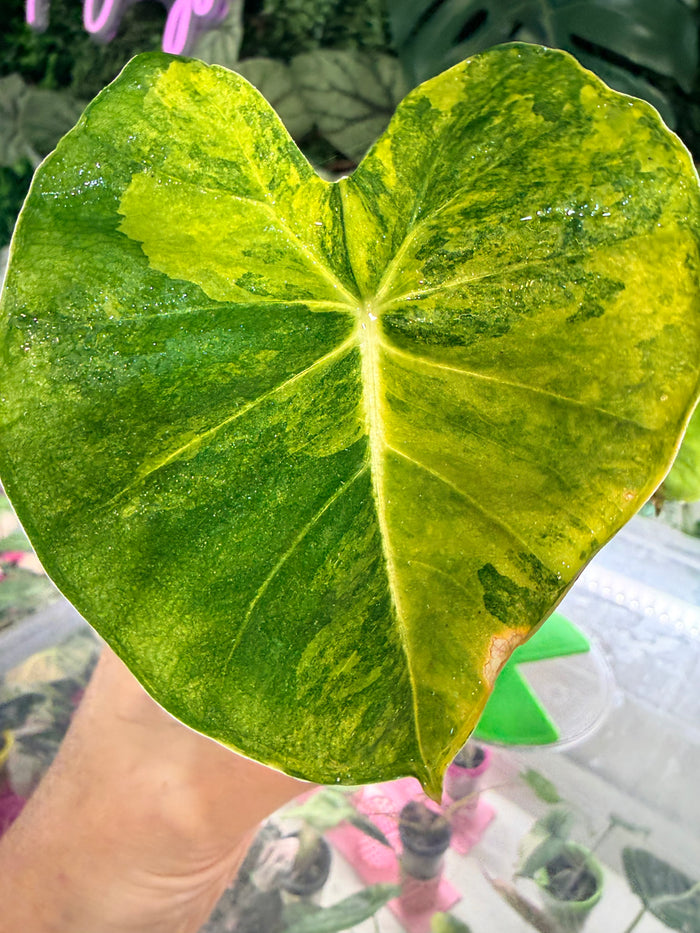

Alocasia fornicata aurea is a golden-yellow variegated form of Alocasia fornicata, a widely distributed Asian species that is far less often seen in collections than the jewel Alocasia of the Philippines and Borneo. This guide explains what the plant is, where the species comes from, what Aroidpedia does and does not record about it, how aurea variegation behaves, and how to look after it in a UK home.
What is Alocasia fornicata aurea?
The name describes an Alocasia fornicata carrying aurea variegation: sectors of yellow to golden tissue where chlorophyll is reduced but carotenoid pigments remain. It is a variegated form of a species, not a separate species in its own right, and it belongs with the other fornicata forms we have written up, including the standard green Alocasia fornicata, the albo form, the mint form and the lime aurea form. Our Alocasia fornicata species guide covers the plant without variegation.
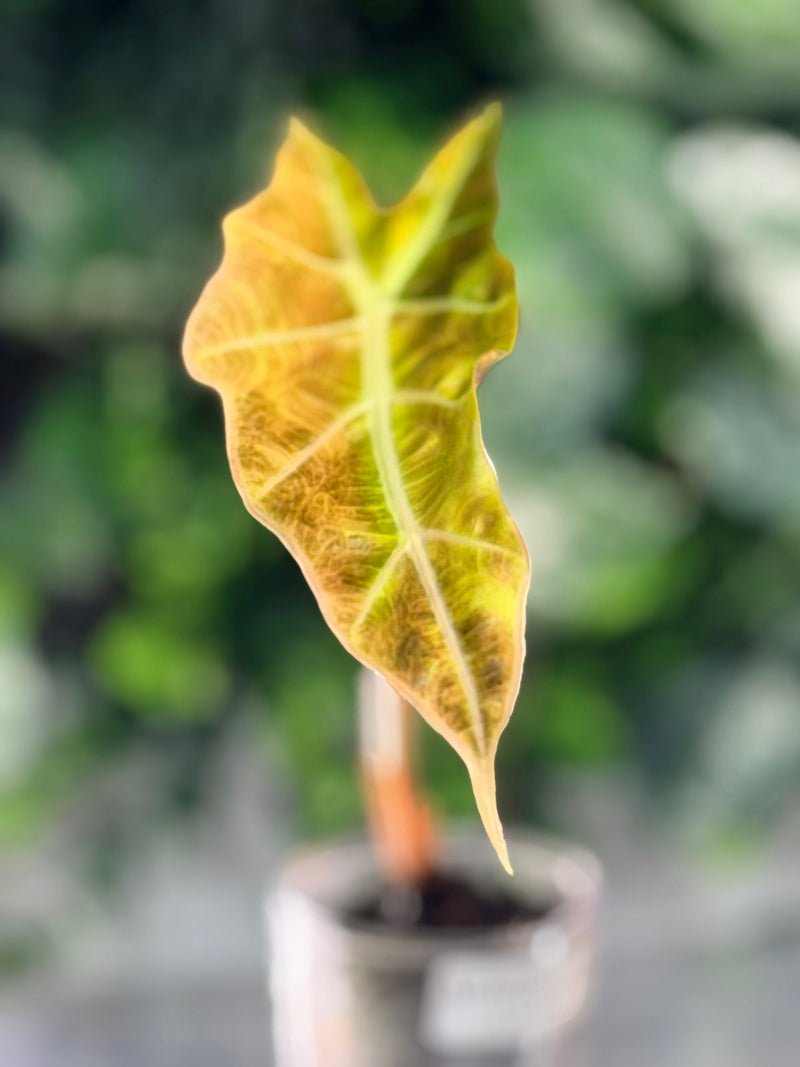
Alocasia fornicata is one of the more graceful Alocasia species in cultivation. Where the albo form creates a soft, harmonious effect through the combination of white sectors and pinkish petioles, the aurea form offers warmth on warmth: the golden-yellow carotenoid sectors read against the medium green blade and pink-toned stems as a fully warm composition, luminous and cohesive in a way that suits the species' naturally refined character. This is not the high-drama golden contrast of an aurea form on a very dark or metallic-leaved species; it is a subtler, more integrated expression of golden colour within a plant that already carries warmth in its petiole colouration.
One point of honesty before going further. Aroidpedia has a full entry for Alocasia fornicata, but it lists no variegated forms, no cultivars and no hybrids for the species, and there is no separate Aroidpedia entry for an aurea form. Cultivar-specific detail such as who first selected it, when, and from where is therefore not documented there, and we have not tried to fill the gap with guesswork. Everything below about the species comes from the Aroidpedia species entry, apart from the authorship note in the next section, which comes from our own notes; everything about the variegation is general to aurea variegation.
Origin, naming and history of the species
Aroidpedia records the native distribution of Alocasia fornicata as Assam, Bangladesh, the eastern Himalaya, India (including Manipur, Mizoram and Tripura), Laos, Myanmar, Sri Lanka, Thailand and Vietnam. That is a broad sweep of subtropical and tropical Asia, and the entry describes a humid subtropical climate with a distinct wet and dry pattern across the year, around 1,200 mm of annual rainfall and relative humidity of roughly 60 to 70 per cent.
On naming, Aroidpedia lists Arum fornicatum, attributed to William Roxburgh in Flora Indica (1832), as a homotypic synonym, and cites the 1841 Enumeratio plantarum as the protologue. It does not name the author of the current combination; our own notes credit Schott with transferring the species to Alocasia and Kunth with its formal naming in 1841, though Aroidpedia does not confirm this. It also warns that an Arum fornicatum published by Robert Wight in 1846 is a different taxon, now a synonym of Alocasia decipiens. The epithet comes from the Latin fornix, meaning arched or vaulted. Aroidpedia gives two local names: "Shola kachu" in Bengali and "Baibing" in Mizo. In parts of north-east India and Bangladesh the spadix is collected and cooked as a vegetable, which makes this an edible aroid with real cultural use as well as a collector's plant.
How to identify Alocasia fornicata aurea
Aroidpedia's description of the species gives a stem of roughly 1 to 3 ft (about 30 to 90 cm) that is inclined or prostrate rather than upright, around an inch across. The leaves are ovate-lanceolate and sagittate, about 8 to 12 in by 4 to 5 in (roughly 20 to 30 cm by 10 to 13 cm), with 6 to 8 pairs of lateral veins and basal lobes much shorter than the front lobes. Petioles run about 8 to 12 in (20 to 30 cm) and are slightly pinkish. The spathe is greenish yellow, 3 to 4 in long, with a tube about half the length of the limb.
Those are the features that identify the plant underneath the colour: a leggy, leaning stem, a fairly slender arrow-shaped blade and a long petiole. They are what separate it from the broader, more heavily textured leaves of species such as Alocasia longiloba or Alocasia sanderiana. Plants in cultivation are usually much smaller than the figures above, which describe mature specimens. The pinkish petioles are the reason the aurea form reads as warm throughout rather than as gold set against green.
Aurea variegation on this species
Aurea variegation is a yellow to golden expression in which chlorophyll is reduced but carotenoids are retained. Because those sectors still hold some chlorophyll, they are not the same as albo, where the white tissue has no chlorophyll at all. In practice that usually means an aurea plant tolerates strong light well and carries its coloured sectors with less strain than an albo, though it is still a variegated plant and still needs good light to function. On Alocasia fornicata the golden sectors create a warm, integrated visual effect that connects naturally with the pinkish blush of the petioles, and the slightly waved leaf margins add movement, the golden sectors rippling at the edges in a way that reinforces the species' naturally fluid character.
Light governs how the colour looks. In bright indirect light the gold stays clean and clearly separated from the green; as light drops, the green tissue takes over and the yellow sectors turn greener and less distinct. If your plant is losing its colour, light is the first thing to check. Variegation of this kind can also be chimeric, meaning the pattern depends on the arrangement of cell layers in the growing point, and a chimeric pattern may not carry over to plants grown from corms. For the wider picture, see our guides to aurea variegation in Alocasia and the complete guide to Alocasia variegation types, and browse our aurea variegated Alocasia collection.
Alocasia fornicata aurea care
This is general Alocasia care that applies to this plant; Aroidpedia gives no care instructions specific to an aurea form, so the points below are the routine we use for Alocasia as a group.
- Light: bright indirect light, supplemented with LED grow lights so that colour stays saturated.
- Temperature: 20 to 27°C. For this species 18 to 27°C is workable, with a minimum of 13 to 15°C tolerated. If the room runs cool, a heat mat under the pot helps keep the root zone warm.
- Humidity: 60 to 80 per cent, in line with the humidity Aroidpedia records for the native habitat. A dedicated humidifier keeps it steady.
- Watering: water thoroughly when the top 2 to 3 cm of the substrate has dried.
- Substrate: Fluval Stratum is our preferred substrate, and our substrates and growing media range has alternatives.
- Feeding: our Alocasia feed or another product from the plant feed range, at half strength; half to two-thirds strength every 2 to 3 weeks suits this species. The aurea form's greater vigour compared with the albo means it can sustain slightly more generous feeding, but a measured approach remains best practice for any variegated specimen.
Our ultimate Alocasia care guide goes through each of these in more depth, and the root rot guide is worth reading if a plant sulks. Like other aroids, the plant contains calcium oxalate crystals, so keep it away from pets and small children and do not eat it.
Propagating from corms
Alocasia fornicata spreads by stolons in the wild, and in cultivation it also forms corms. Our Alocasia corm propagation guide sets out the full method. In short, we use a self-wicking setup: the corm sits in Fluval Stratum inside a Corm Keeper, so the substrate draws moisture up evenly without the corm sitting in water. See also growing Alocasia corms in Fluval Stratum and how long a corm takes to sprout. Browse our current corms.
How it compares with similar plants
Within the fornicata group, the lime aurea is the closest relative in colour, with a more yellow-green cast, while the albo has white sectors with no chlorophyll. Outside the species, the Gageana x Fornicata aurea is a different plant with a different background, and the Melo aurea offers a very different, textured leaf under similar golden colouring.
We release our plants through our drop model; you can find out how access works on our rare plant drops page.
Frequently asked questions
Is Alocasia fornicata aurea a documented cultivar?
Aroidpedia lists no variegated forms or cultivars for Alocasia fornicata, so the origin of the aurea form is not documented there.
Where is Alocasia fornicata native?
Aroidpedia records it from Assam, Bangladesh, the eastern Himalaya, India, Laos, Myanmar, Sri Lanka, Thailand and Vietnam.
How large does it grow?
Aroidpedia describes a stem of about 1 to 3 ft with leaves 8 to 12 in long. Cultivated plants are often smaller.
Why are the golden areas turning green?
Low light is the usual cause. Brighter indirect light, with LED supplementation, helps the yellow sectors stay distinct.
Does a corm keep the variegation?
Not necessarily. Chimeric variegation may not carry over to a plant grown from a corm.
Is it safe for pets?
No. Like other aroids it contains calcium oxalate crystals and should be kept out of reach of pets and children.
Questions about Alocasia fornicata aurea? Contact our team for guidance from specialists who grow rare Alocasia in our UK-based private nursery. We are happy to talk through light, substrate and corm propagation for this plant.