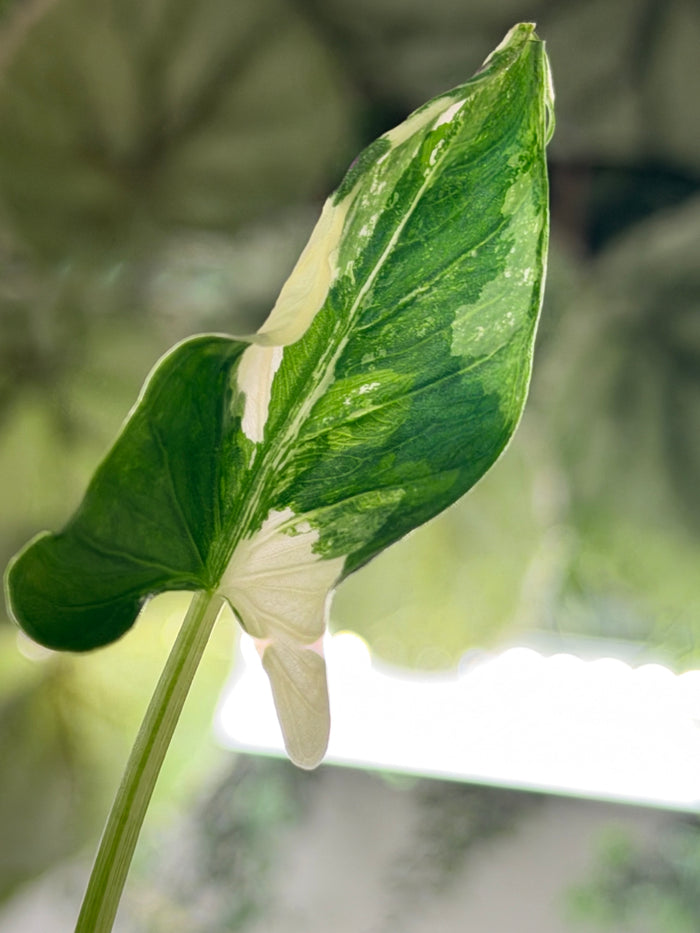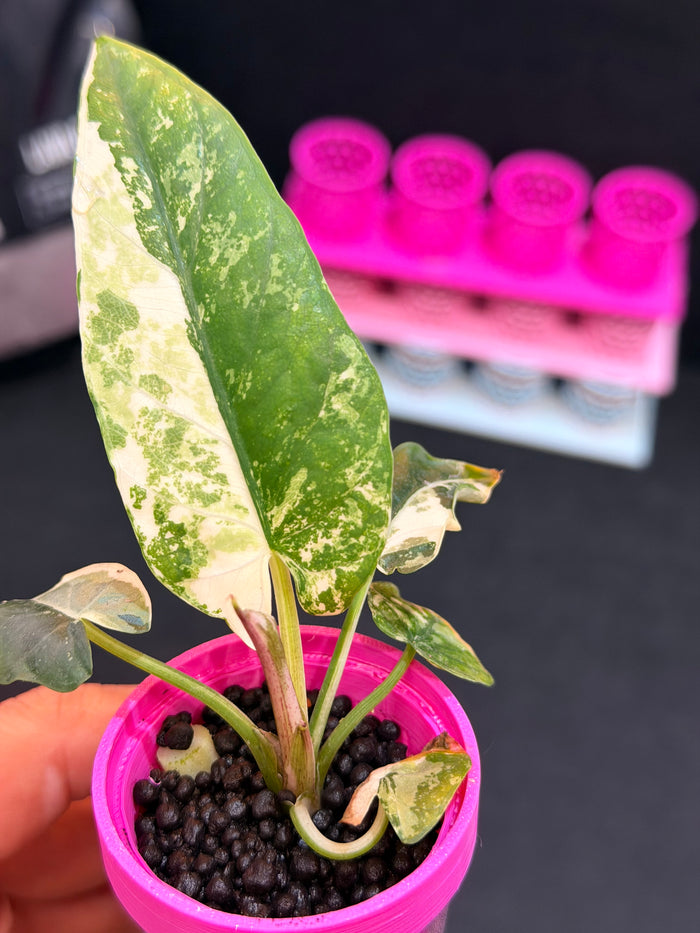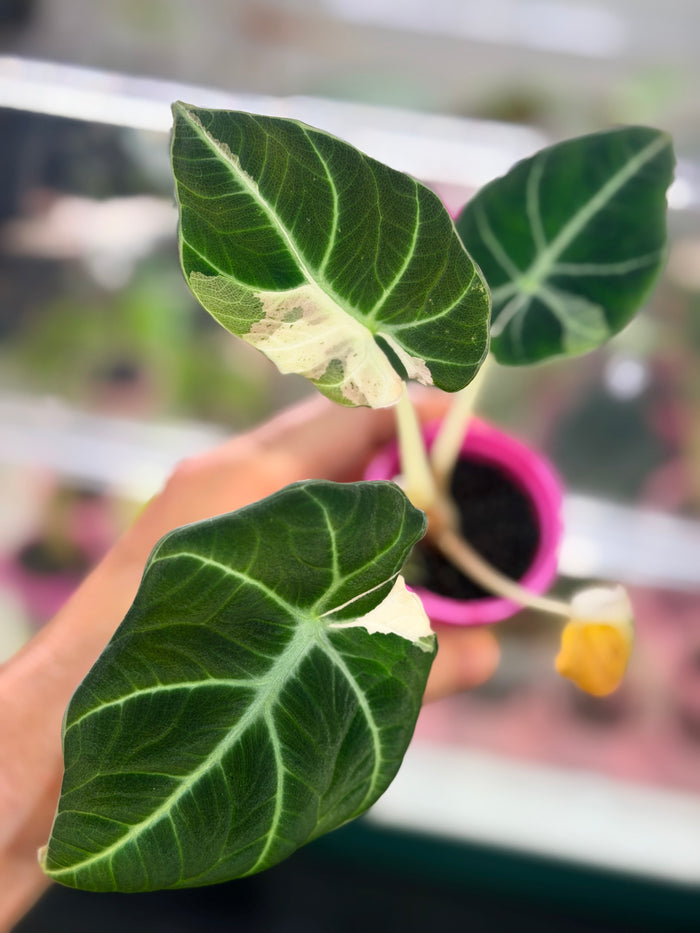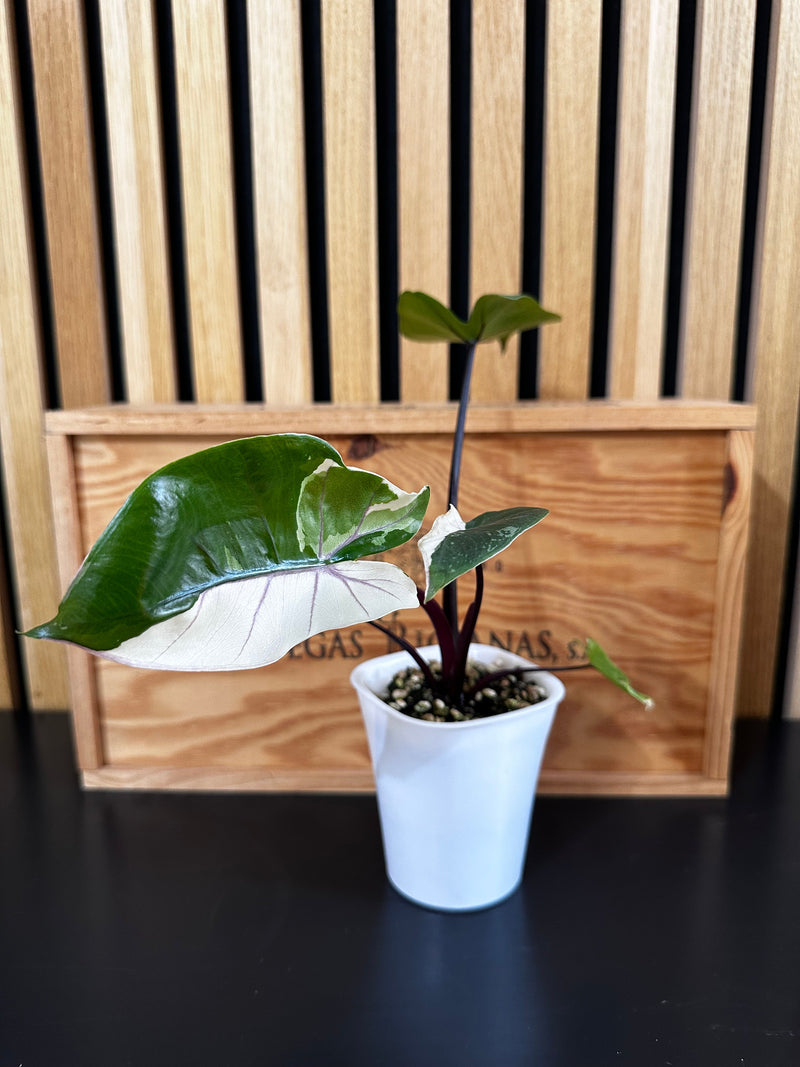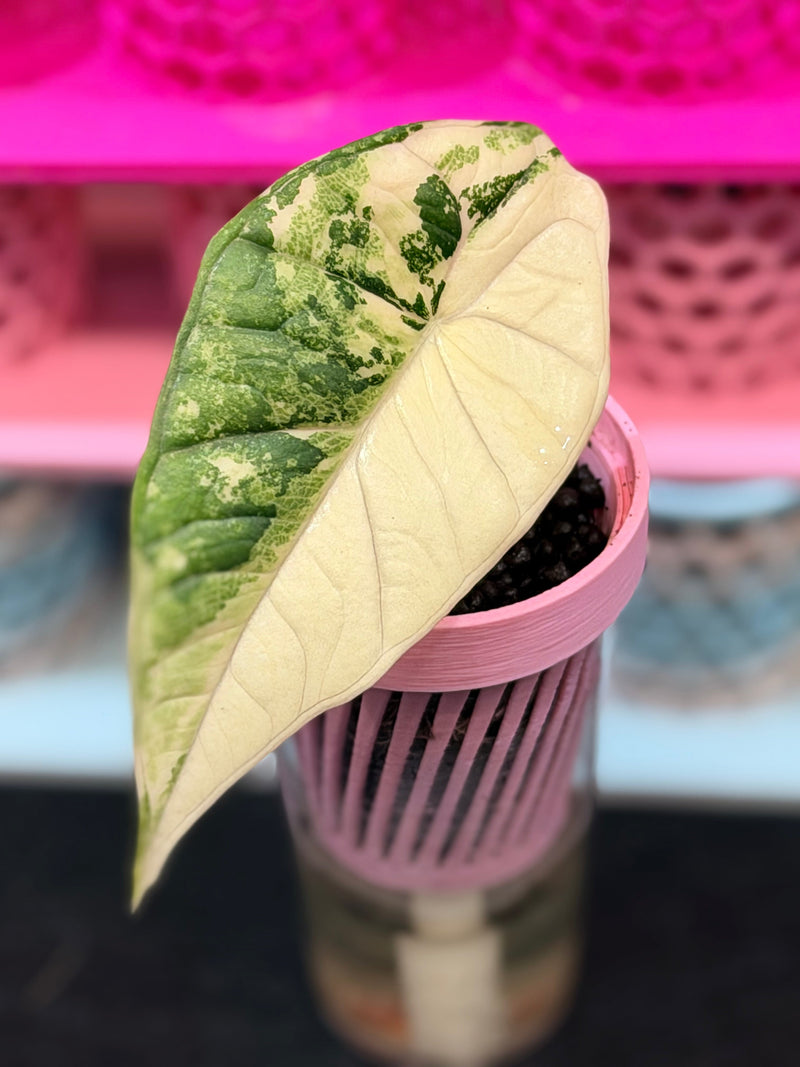

The Alocasia Lauterbachiana Albo brings chimeric white variegation to one of the most architecturally distinctive Alocasia species in collector cultivation. The Purple Sword's long, narrow, upward-pointing leaves with serrated, crispate margins are already visually unlike any other Alocasia in common collection. Albo variegation on this base creates striking white sectors that interact with the sword-like leaf architecture in a way that no round-leaved or arrow-shaped Alocasia can achieve, the white tissue following the narrow blade, the serrated margins, and the characteristic undulation that gives Alocasia lauterbachiana its baroque quality, to create a specimen of refined complexity.
Species Background: Alocasia lauterbachiana
Chimeric white variegation is only ever as compelling as the plant carrying it, and Alocasia lauterbachiana is an unusual plant by any measure. Its native range covers northern New Guinea and the Bismarck Archipelago, placing it at the far eastern limit of the Alocasia genus, a long way from the South-East Asian heartland that supplies most Alocasia in collector cultivation. Its taxonomic history reflects that outlying position: Heinrich Gustav Adolf Engler gave it its first formal description in 1898 under the name Schizocasia lauterbachiana, assigning it to a separate genus on features that then appeared distinct, and it was not returned to Alocasia until the Australian botanist Alistair Hay's landmark 1990 work 'Aroids of Papua New Guinea'. The name itself honours Dr. Karl Lauterbach, a German botanist and plant explorer whose field investigations in New Guinea during the late 19th century brought this and other remarkable plants to the notice of European science.
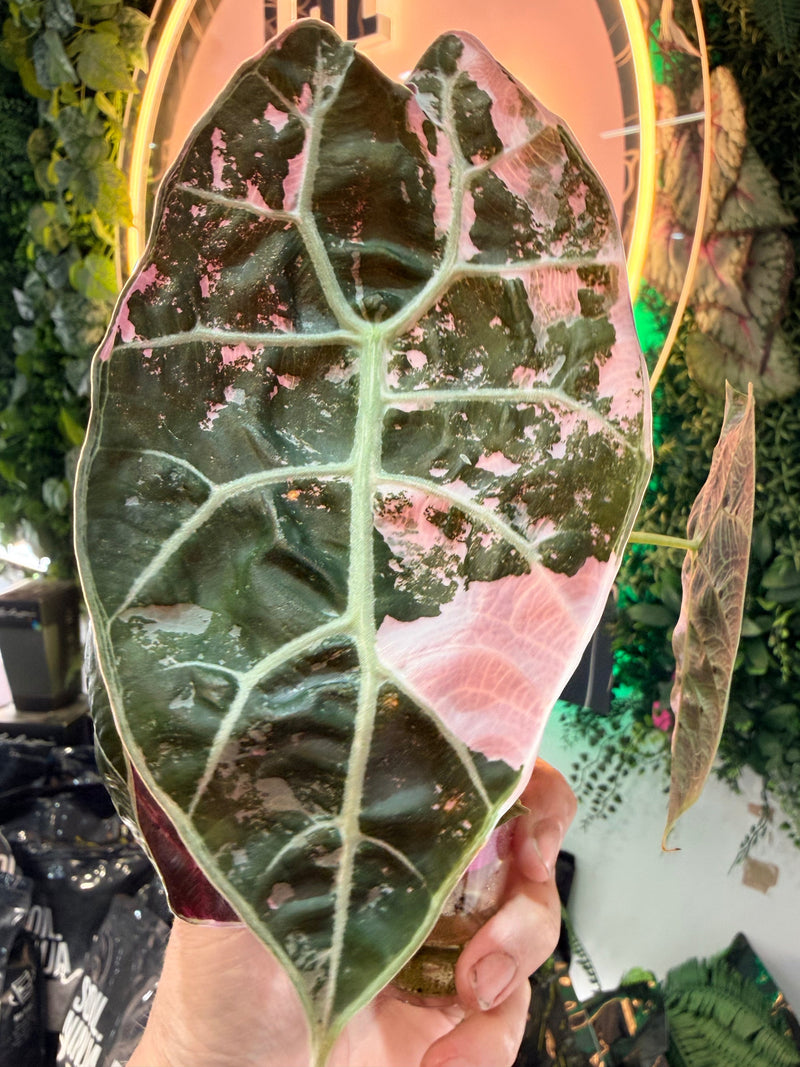
For the albo, the species' architecture is the whole point. In cultivation Alocasia lauterbachiana has earned the trade names "Purple Sword", "Baroque Sword" and "Silver Sword", each of them describing foliage that no other commonly cultivated Alocasia matches: long, narrow, sword-like blades pointing strongly upward on mottled chocolate-brown petioles, with gently serrated and crispate margins that lend the leaf edge an ornate, baroque quality. The upper surface is a deep, glossy green and the underside a rich violet-purple that adds a dramatic warmth when leaves catch the light at an angle. A mature specimen can reach 1-1.5m in indoor cultivation, making it one of the more substantial Alocasia for indoor collection, so white sectors here are carried on a genuinely tall, vertical plant. One further detail matters for a variegated form: the species is a pentaploid, possessing 70 chromosomes rather than the usual diploid 28 of most Alocasia, which contributes to its vegetative vigour and explains why it propagates freely from vegetative divisions.
Albo Variegation on Alocasia lauterbachiana
Chimeric albo variegation on Alocasia lauterbachiana produces white sectors through the standard chlorophyll-absence mechanism, but the narrow, elongated, sword-like leaf blade creates a different visual experience of albo variegation from broad-leaved forms. White sectors on a narrow blade tend to extend longitudinally, running along the length of the leaf rather than across it, which interacts with the upward-pointing habit of the lauterbachiana's leaves to create a vertical visual emphasis that is particularly effective in a tall, multi-leaved specimen. The serrated margins mean that white sectors at the leaf edge create a particularly intricate boundary, the white tissue following each serration tip, giving the Albo form an ornate, detailed quality at the edges of every variegated leaf.
The characteristic purple undersides of Alocasia lauterbachiana are unaffected by the adaxial albo variegation, white sectors on the upper surface do not correspond to pale undersides, and the purple colouration continues to provide warm contrast when leaves are viewed at an angle or in movement. This independence of the two colour characteristics means the Lauterbachiana Albo maintains its full visual range regardless of how extensively any given leaf is variegated above.
The non-photosynthetic albo sectors require the green tissue to sustain the plant's metabolic output. The species' pentaploid constitution and natural vigour mean it responds relatively well to adequate care, but consistent bright indirect light is essential. LED grow lighting from October to March is strongly recommended.
Care Requirements
Temperature 20-27°C, humidity 60-80%. Fluval Stratum substrate in a pot that accommodates the root system of a taller-growing specimen. Water thoroughly when top 2-3cm is dry. Feed conservatively at quarter to half strength from our plant feed range every 2-3 weeks during the growing season. A heat mat beneath the pot maintains root health through UK winters. Position where the full height of the sword-like leaves can be appreciated, this is a vertical statement specimen that benefits from space above as much as around it.
We release Lauterbachiana Albo through our drop model. Join the collector list for early access and view our Alocasia Lauterbachiana Albo listing for availability.
Questions about Alocasia Lauterbachiana Albo or Papua New Guinea Alocasia? Contact our team for specialist guidance from our UK nursery.