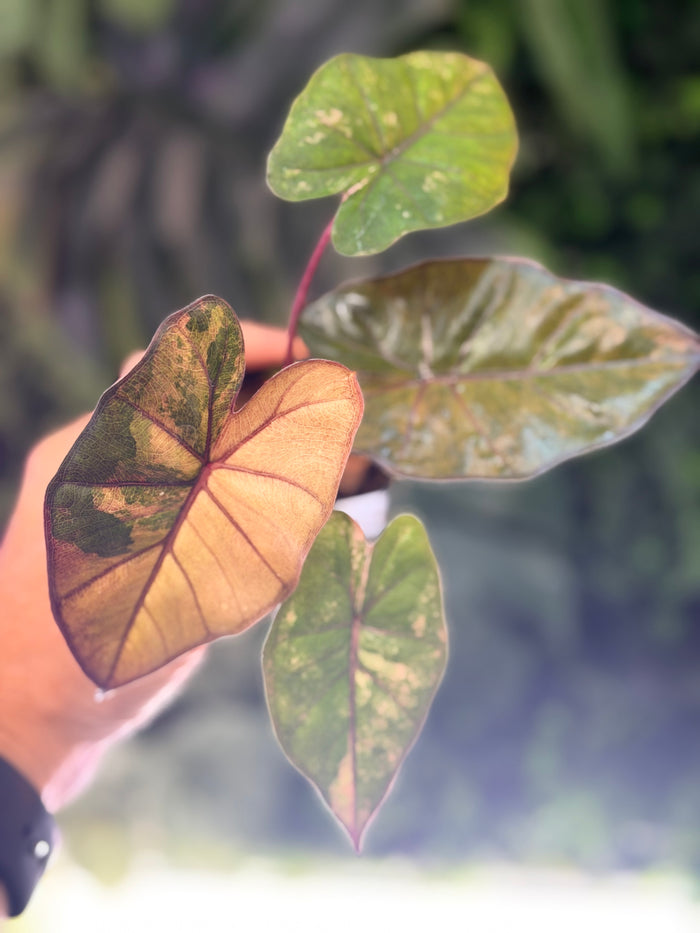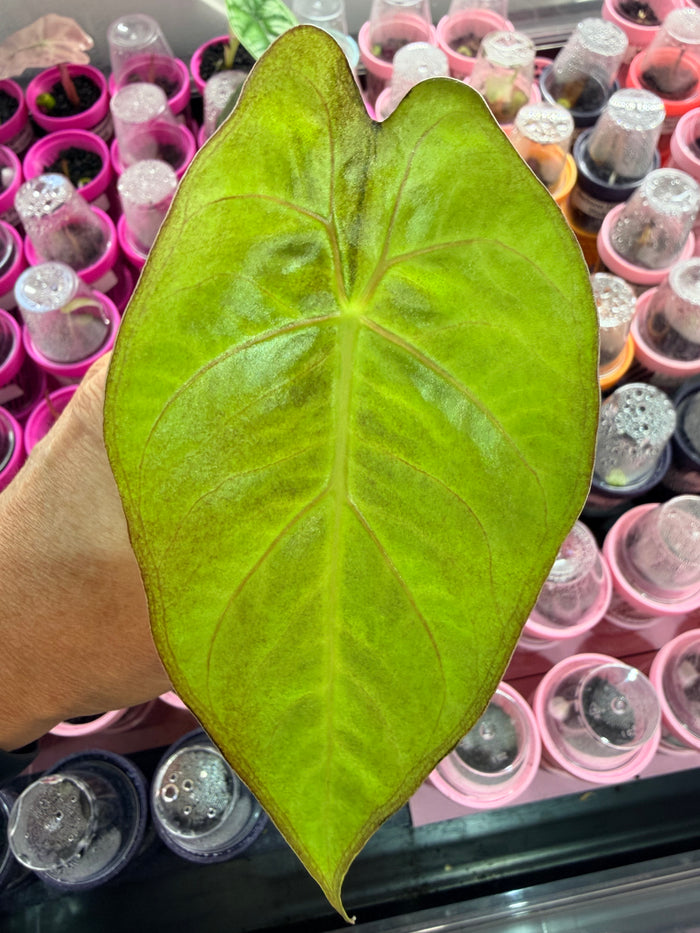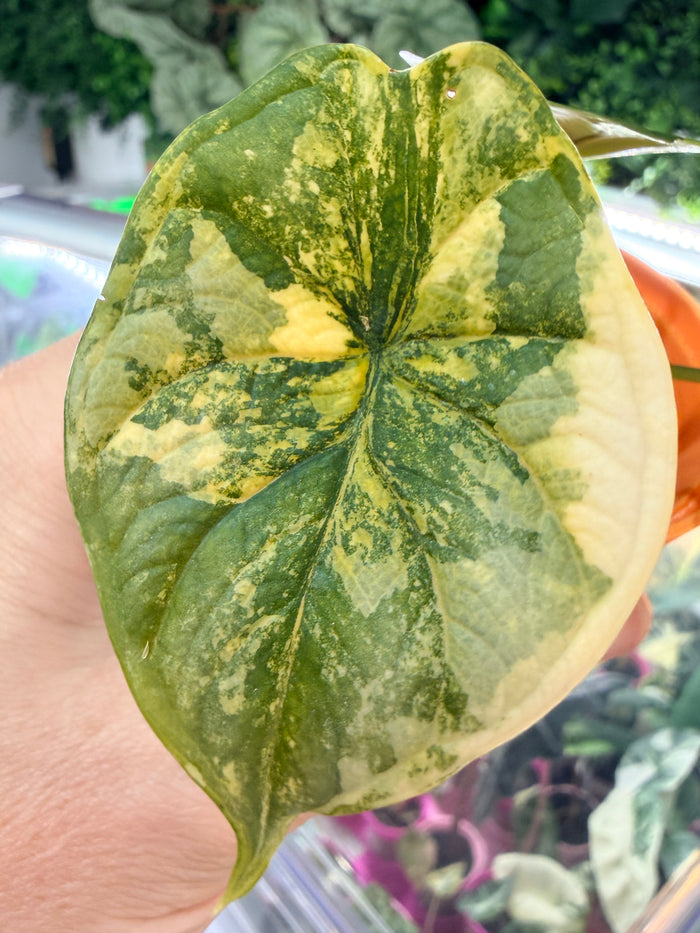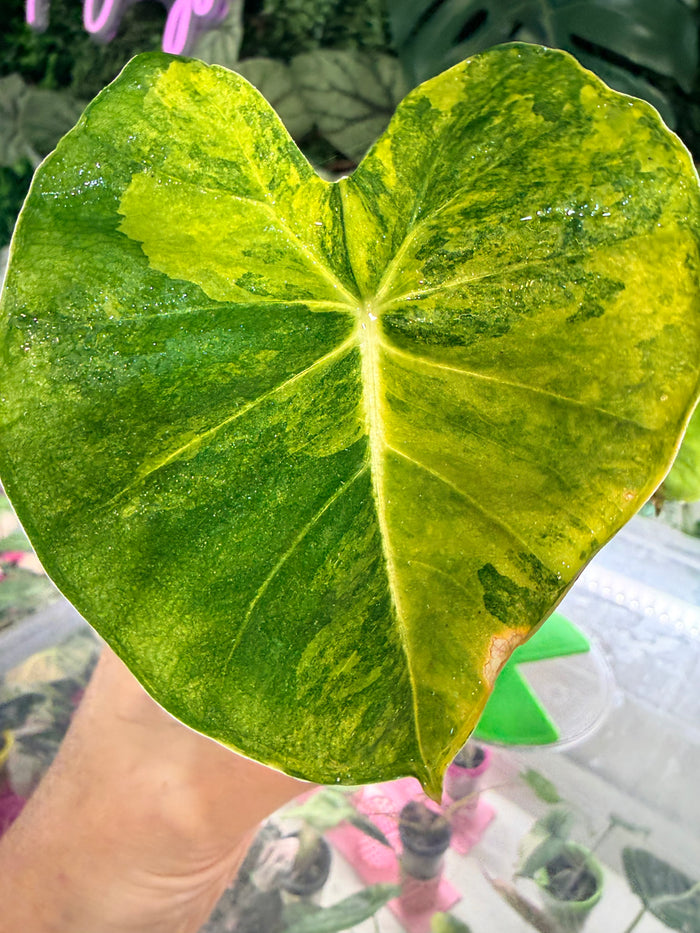

Alocasia Sarian Aurea is the golden-yellow variegated form of Alocasia 'Sarian', a Philippine Alocasia with an unusually well documented arrival in cultivation and a botanical status that is still unsettled. This guide covers where the plant comes from, what is and is not known about its parentage, what aurea variegation means, and how to look after it.
What is Alocasia 'Sarian'?
Aroidpedia, our main reference for aroid naming and history, describes Alocasia 'Sarian' as an undescribed species from Ilocos Norte, a province on the island of Luzon in the northern Philippines. It has no formal species name, which is why the name appears in quotation marks. Aroidpedia lists no cultivars under it, but it does list yellow as a variegated form, which is the category an aurea plant falls into. It does not document where any specific aurea plant arose, and we do not make claims about that either.
Aroidpedia also notes that the plant has been photographed growing in situ in Quezon, on Luzon, alongside Alocasia micholitziana at around 850 metres, which it gives as the upper limit of its altitude range. The climate recorded there is moderate: humidity of 60 to 70 per cent, temperatures from roughly 9 to 31°C, and minimums staying above about 7°C. That is a helpful guide to what the plant is comfortable with in a UK home.
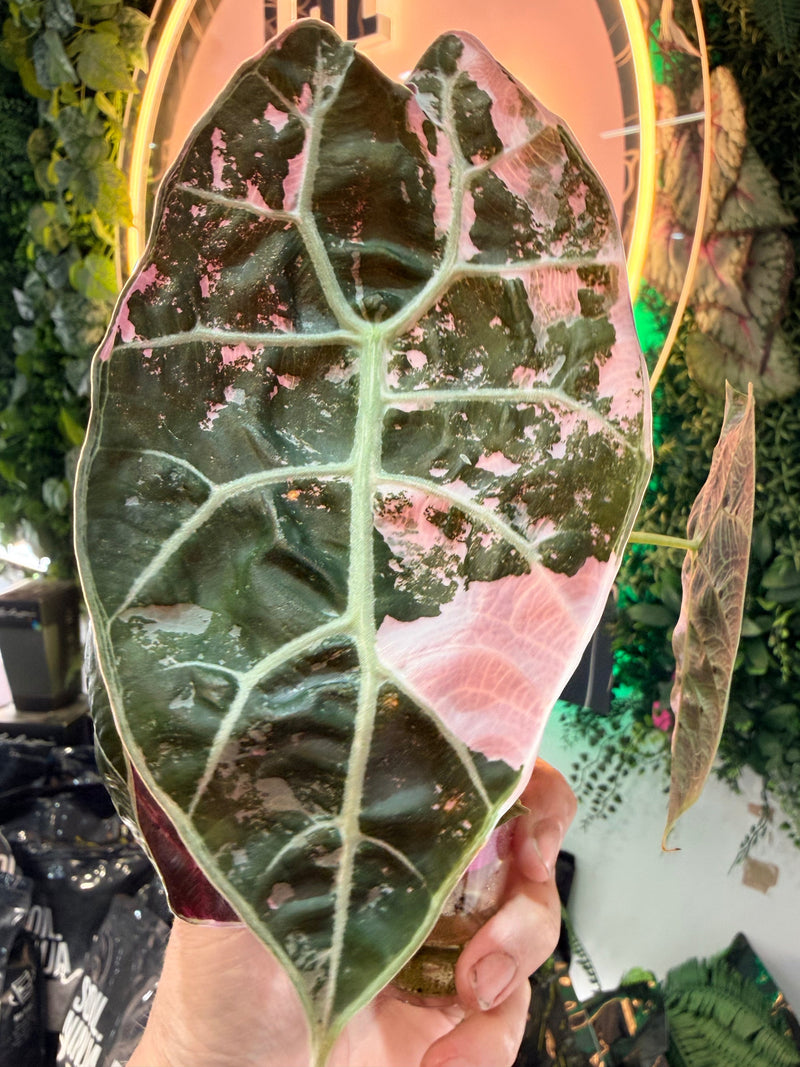
The Sarian Aurea presents golden-yellow, carotenoid-based variegation on the large, wavy foliage of one of the Philippines' most distinctive large Alocasia. Where the Sarian Albo creates high contrast, with white sectors against deep green on broadly waved leaves, the Aurea works in a warmer register: golden-yellow sectors that interact with the plant's existing white primary venation and zebra-striped petioles, so that three distinct colour elements, gold, white and green, coexist on a single leaf of impressive scale. At full size a well-variegated leaf commands attention at room scale in a way that compact aurea jewel specimens cannot achieve.
Origin and naming: who was Sarian?
The name honours Zacarias 'Zac' Bolong Sarian, a Filipino agricultural journalist who wrote for the Manila Chronicle in the 1960s and later edited Philippine Farms and Gardens. According to Aroidpedia, in the early 1980s a Singaporean buyer asked him to survey Aglaonema in the Philippines, and during that work a plant trader delivered offshoots of what became this plant. Visitors from the Australian chapter of the International Aroid Society then bought propagations from him and later wrote about the find in Aroideana, which is how it reached collectors more widely.
Is it a hybrid? Parentage explained
'Sarian' is frequently described as a hybrid of Alocasia zebrina and Alocasia micholitziana. Aroidpedia records that no parentage is documented and that this is only an assumption, one that Zac Sarian himself disputed on the grounds that the plant appears to be indigenous and widespread, with a range that does not overlap with the suspected parents. Whether it is a naturally occurring species, a natural hybrid or something else again, it is botanically distinct from the plants it is most commonly alleged to descend from.
The taxonomy is still open. Aroidpedia reports that in 2020 the Philippine botanist Fernando Biglang-awa Aurigue said it was still treated as a variety of Alocasia macrorrhizos, because of floral similarities and its presence in Ilocos Norte, and that a group was carrying out genetic studies to settle its status. Our Alocasia macrorrhizos species guide covers the plant it may eventually be placed under.
How to identify Alocasia 'Sarian'
Aroidpedia offers little general description and gives no leaf or plant dimensions; the sizes below come from our own growing. What it does provide is a comparison with A. micholitziana, the plant most often confused with it. The leaf of 'Sarian' is described as thinly rubbery rather than velvety, the margins are shallowly undulate rather than deeply sinuate, and the petiole joins the blade at the junction of the posterior lobes rather than sub-peltately. Those points are a more dependable way to tell the two apart than overall appearance, which varies with light and age.
In cultivation the blade is broadly arrow-shaped and intensely dark green with prominent white to cream venation, while the long, slender petioles carry a distinctive zebra-like striping that connects visually to the zebrina lineage often cited as a parent. Scale is the other half of the appeal: in optimal conditions leaves can exceed 60cm and the whole plant can reach 120-180cm or more, though in UK indoor cultivation a well-managed Sarian will typically settle at 60-90cm, with leaves of 30-45cm.
Aurea variegation explained
Aurea variegation produces yellow to golden sectors where chlorophyll is reduced but carotenoid pigments remain. Unlike albo, which is white and carries no chlorophyll at all, aurea tissue keeps some capacity to photosynthesise, which generally makes it the more forgiving of the two to grow. The golden sectors retain photosynthetic capacity, which makes the Sarian Aurea more vigorous than the albo form and more forgiving of brief care inconsistencies. The pattern is chimeric, so it differs from leaf to leaf and might not carry over to a plant grown from a corm. Our guide to aurea variegation in Alocasia explains the mechanism, and the complete guide to variegation types compares it with albo, pink and mint.
The white veins, a standard characteristic of 'Sarian', continue to run through the golden sectors as well as the green tissue, so the blade carries three distinct tones: deep green, golden yellow, and white venation threaded through both. The zebra-striped petioles add a fourth visual element, completing a composition that rewards close observation in the way large-leaved plants rarely achieve.
Light has the biggest influence on how vivid the gold looks. Under consistently bright indirect light, golden sectors stay saturated and clearly defined, while under weak light they tend to green up as chlorophyll becomes more dominant. LED grow lights help keep the colour strong; see our article on whether LED grow lights are worth it.
If you are comparing forms, our Alocasia Sarian Albo guide covers the white-sectored form, and our aurea variegated collection shows related plants.
Alocasia Sarian Aurea care
This is general Alocasia care, and it applies to this plant as it does to the rest of our collection. Our ultimate Alocasia care guide goes deeper on each point.
- Light: bright indirect light, with LED supplementation where the room is dim.
- Temperature and humidity: 20 to 27°C and 60 to 80 per cent humidity, maintained with a dedicated humidifier. A heat mat helps if the room runs cool.
- Substrate: Fluval Stratum in a free-draining pot. Our substrate article explains the thinking.
- Watering: water thoroughly when the top 2 to 3cm has dried. Our root rot guide covers prevention and recovery.
- Feeding: our Alocasia feed at half strength, from the plant feed range. Half to two-thirds strength every 2 to 3 weeks suits this form, as the aurea's greater vigour tolerates slightly more generous feeding than the albo.
- Pests: check the undersides of leaves regularly for spider mites and treat promptly. Our pest patrol guide and pest control range are a good start.
If leaves brown, curl or drop, our Alocasia troubleshooting guide is the place to begin.
Propagating Alocasia Sarian Aurea from corms
Corms are one of the most economical ways to grow more Alocasia, and the method is the same whatever the cultivar. Our Alocasia corm propagation guide sets out the self-wicking approach step by step: the corm sits in damp Fluval Stratum held in a Corm Keeper, which draws water up without waterlogging the corm. Our articles on growing corms in Fluval Stratum and how long a corm takes to sprout cover what to expect. Because the variegation is chimeric, golden sectors are not guaranteed on a corm-grown plant.
How Alocasia 'Sarian' compares with similar plants
The plant most often compared with 'Sarian' is Alocasia micholitziana, better known in collections as Frydek, which grows beside it in the wild. Our Frydek variegated guide is a good companion read. The other suspected parent, A. zebrina, is covered in our zebrina aurea guide, and you can browse more on rare Alocasia A to Z.
Where to find Alocasia Sarian Aurea
We release Sarian Aurea through our drop model. Join the collector list for early access to new releases.
Alocasia Sarian Aurea FAQ
Is Alocasia 'Sarian' a hybrid?
It is often described as a cross between A. zebrina and A. micholitziana, but Aroidpedia records this as assumed rather than documented, and Zac Sarian himself disputed it.
Where does Alocasia 'Sarian' come from?
Aroidpedia gives Ilocos Norte on Luzon, in the northern Philippines, and also records it in situ in Quezon.
Is aurea more stable than albo?
Aurea tissue keeps some chlorophyll, so it is generally easier to grow than albo. The variegation is still chimeric and can change over time.
Why is my golden variegation turning green?
Low light is the usual cause. Moving the plant to brighter indirect light, or adding LED lighting, helps new growth keep its colour.
How big does it grow?
Aroidpedia gives no size for this plant; from our own growing, leaves can exceed 60cm and the whole plant can reach 120-180cm or more, though in UK indoor cultivation it will typically settle at 60-90cm. Growth depends on light, feeding and pot size.
Is Alocasia Sarian Aurea toxic?
Like other Alocasia, all parts contain calcium oxalate crystals and are harmful if eaten, and the sap can irritate skin. Keep it away from pets and children.
Questions about Alocasia Sarian Aurea? Contact our team for guidance from specialists who grow rare Alocasia in our UK-based private nursery. We are happy to help with care, identification or propagation questions.