ALOCASIA FRYDEK VARIEGATED: THE COMPLETE COLLECTOR'S GUIDE

Few naming controversies in the ornamental Alocasia world are as well-documented or as instructive as the one surrounding Alocasia micholitziana. The plant that most of the world knows as 'Frydek' is, botanically, something more complex, and getting that complexity right matters both for collectors who want accurate information and for anyone building a serious understanding of the genus.
Here is what Aroidpedia establishes with precision: the green unvariegated cultivar correctly called Alocasia micholitziana 'Green Velvet' was named by photographer Don Worth in 1983 and documented by David Burnett in his 1984 work The Cultivated Alocasia. The name 'Maxkowskii' subsequently became the most widely used name in circulation for this form, as documented by Armitage's 2001 horticultural manual. Around 2002, Agristarts began selling Alocasia micholitziana under the name 'Frydek', Aroidpedia notes this was "most likely a typo" of the earlier name 'Freydyk' used by Glasshouse Works for the variegated form. The name 'Frydek' then spread through the trade and became a household name in the Alocasia world.
The current Aroidpedia consensus is: the correct name for the green cultivar in circulation is Alocasia micholitziana 'Green Velvet'. The name 'Frydek' should properly refer to the variegated forms, the chimeric-variegated cultivars that Glasshouse Works had marketed under the similar trade name 'Freydyk'. 'Maxkowskii' is no longer a valid cultivar name. Our product is correctly listed as the Frydek Variegated, the chimeric-variegated form, sold under the 'Frydek' trade name as that name has become commercially established for both forms.
This guide covers the full botanical history of Alocasia micholitziana, the variegation science, and complete UK care for this mid-altitude Philippine forest species.
The Species: Alocasia micholitziana
Formal Description
Alocasia micholitziana was formally described by Henry Frederick Conrad Sander in 1912, published in The Gardeners' Chronicle (series 3, volume 51, Supplement XVI). A more complete illustration appeared in Curtis' Botanical Magazine in 1913. Aroidpedia notes that the caption on the first photo of the species incorrectly states it is from Malaysia, it is in fact from the Philippines.
The species is named after the German plant collector Wilhelm Micholitz, whose collecting expeditions in the late nineteenth and early twentieth centuries contributed significantly to the introduction of Philippine and Malaysian plant species to European horticulture.
The synonyms documented by Aroidpedia include Alocasia 'African Mask', Alocasia 'Green Velvet', Alocasia 'Green Goddess', Alocasia 'Silver Vein', and Alocasia 'Frydek', a collection of trade names that reflects the species' long commercial history across different markets.
Distribution and Ecology
Alocasia micholitziana is endemic to Luzon in the Philippines, distributed across Apayao, Benguet, and Ifugao in northern Luzon. The ecology documented by Aroidpedia is particularly notable: primary and secondary forest and roadside clearings at approximately 1,200 to 1,500 metres altitude. This montane habitat is significantly different from the strictly lowland tropical ecology of many Alocasia species, and it explains several of the cultivar's care characteristics in cultivation.
The climate is tropical humid, with humidity moderate at 60 to 70 percent year-round, temperatures from approximately 9°C to 31°C during the day with minimums above 7°C, and a rainy season from October through May. Annual rainfall approximately 1,200 mm. The 1,200 to 1,500 metre altitude means this species experiences more pronounced seasonal temperature variation and somewhat cooler conditions than lowland forest species, which translates to greater tolerance of UK temperature variation in cultivation.
Species Description
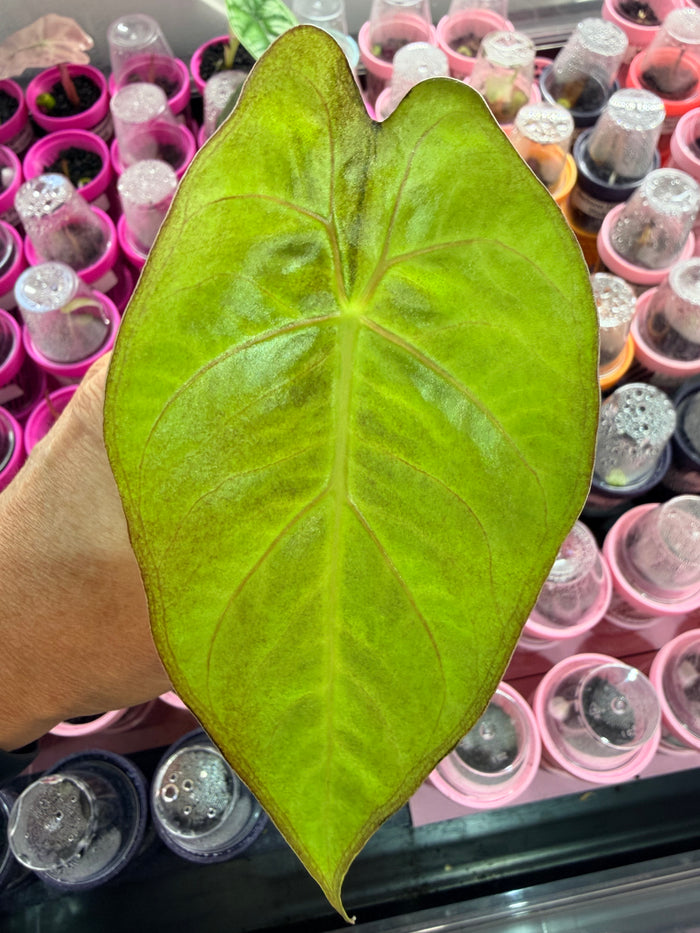
The formal description documents a moderately robust herb with stem erect to decumbent, to approximately 50 cm long and 4 cm diameter. Leaves 4 to 7 together, not interspersed with cataphylls. Petioles to 45 cm long, mottled brownish, reddish, and/or purplish. The blade is described as "rich velvety matt deep green adaxially", the velvet quality that gives 'Green Velvet' its cultivar name is formally documented in the species description. The blade is sagittate, approximately 40 cm long by 13 cm wide, very shallowly to shallowly peltate. Costae and primary veins are white adaxially, the distinctive white venation against the dark velvety green is the species' defining aesthetic characteristic. The anterior lobe is rather broadly triangular with strongly to shallowly but distinctly undulate margins.
Cultivar and Hybrid Legacy
Aroidpedia documents that Alocasia micholitziana 'Green Velvet' has contributed to notable hybrids including Alocasia 'Golden Bone' (Alocasia micholitziana 'Green Velvet' × Alocasia cuprea) and Alocasia 'Moresby' (Alocasia micholitziana × Alocasia longiloba). The species was extensively used in hybridisation as documented by Burnett (1984).
The Variegated Form: Chimeric Expression
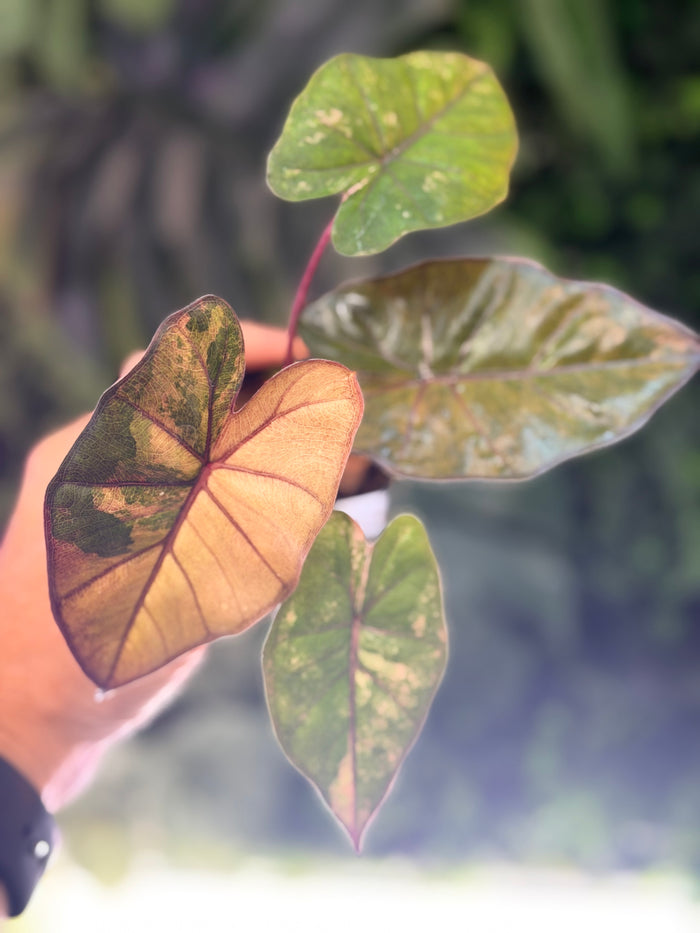
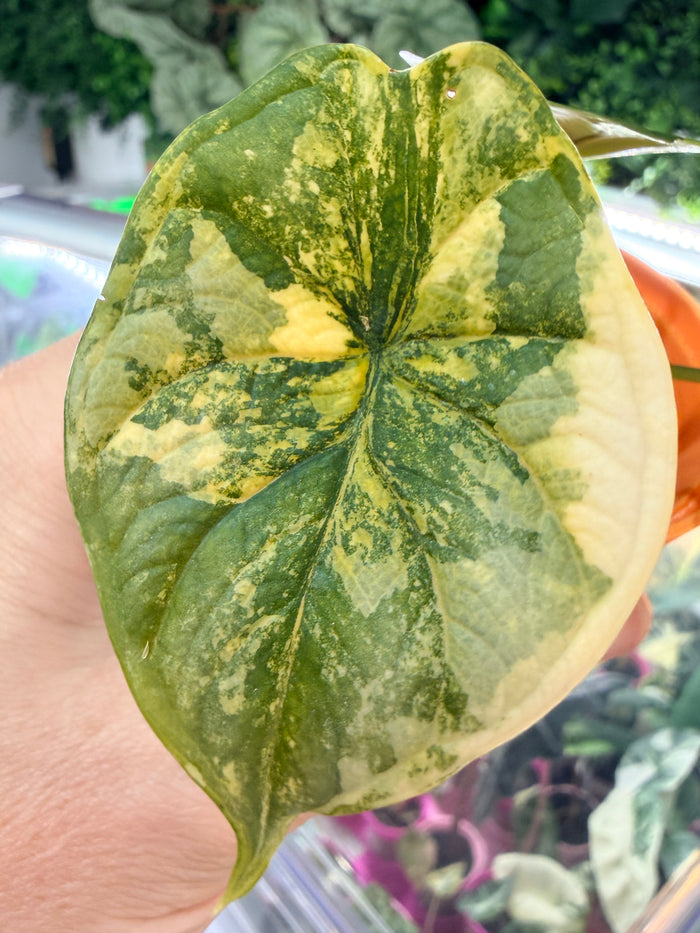
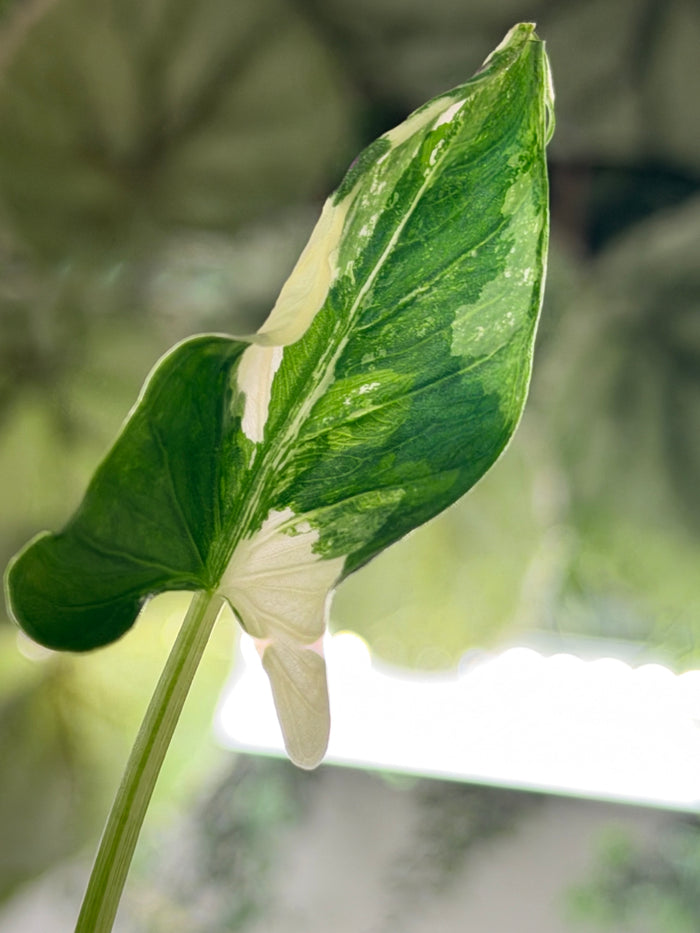
The variegated 'Frydek' form carries chimeric variegation, white to cream sectors distributed across the velvety deep green blade, contrasting with the white primary veins that the species already carries in its unvariegated form. The visual complexity is considerable: you have the deep velvety matte green base, the white primary venation as species character, and then the additional chimeric white and cream sectors layered over both. Against this background, the texture of the leaf, described formally as velvety and matt, adds a physical quality that photographs consistently struggle to capture.
Chimeric variegation in micholitziana follows the same cellular mechanism as in other Alocasia variegated forms, distinct meristematic cell populations producing inadequate chlorophyll, resulting in pale sectors in tissue derived from those cell lines. The velvety surface of micholitziana, produced by fine cellular structure on the adaxial epidermis, is maintained in the variegated form. For the detailed science of albo variegation, our albo variegation guide covers the mechanism in full.
The variegation adds care demands, reduced photosynthetic capacity in the pale sectors means more light is needed than for the green form, and the cream sectors are more sensitive to stress than fully photosynthetic green tissue.
Growing Alocasia Frydek Variegated in the UK
Light
The montane habitat at 1,200 to 1,500 metres altitude means micholitziana naturally receives light filtered through cloud-forest conditions, diffused, consistent, and at somewhat reduced intensity compared to lowland tropical light environments. This translates to excellent adaptation to the bright indirect light conditions of UK home cultivation. Bright indirect light from a south or east-facing window, or supplemented with LED grow lights, is ideal for the variegated form. The velvety matte surface does not reflect light as efficiently as glossy-leaved species, making consistent light provision more important.
Avoid direct sunlight, the velvety surface is particularly susceptible to burn, as the fine cellular structure responsible for the texture provides less physical protection against heat accumulation than smoother epidermis types.
Substrate and Watering
Fluval Stratum provides the airy, well-draining substrate appropriate for this species. The montane habitat indicates some tolerance of moisture variation, neither the strictly wet-adapted lowland tropics nor the sharply drained limestone specialists, and a substrate that maintains consistent moderate moisture with good drainage matches this ecology. Allow the top 2 to 3 cm to dry between waterings. The moderately robust growth habit means pot size should accommodate a developing rhizome without excessive excess substrate that retains unnecessary moisture.
Temperature and Humidity
The 1,200 to 1,500 metre altitude ecology gives micholitziana somewhat better tolerance of temperature variation than strictly lowland species. A target range of 16 to 27°C is appropriate, with the species generally managing UK home temperatures more comfortably than equatorial lowland forms. Humidity of 60 to 70 percent, the documented natural range, is achievable in UK homes with modest intervention. With central heating, desktop humidifiers or grouped plants maintain appropriate conditions.
Pests
Spider mites are the primary concern. The velvety leaf surface creates micro-environments that can shelter mite populations, regular inspection of undersides remains essential. The species may slow growth; reduce watering and stop feeding during this period. The montane adaptation means it is somewhat more tolerant of cooler UK conditions than lowland species, but prolonged cold below 13°C at root level should still be avoided.
Collector Notes: Nomenclature Matters
The naming history of Alocasia micholitziana is worth understanding for any serious collector. The correct cultivar name 'Green Velvet' predates 'Frydek' by nearly two decades; 'Frydek' originated as what Aroidpedia suggests was a likely typo of 'Freydyk', the name applied by Glasshouse Works to the variegated form. The trade adoption of 'Frydek' for both forms created the confusion that persists today. As a collector, knowing that your variegated 'Frydek' is correctly Alocasia micholitziana, a Philippine montane forest species first described in 1912, gives the plant a significantly richer context than the trade name alone conveys.
The complete variegation guide provides context for how the chimeric variegation in this species compares with other forms across the collection. For the care fundamentals shared across all Alocasia, our Alocasia care guide is the reference point.
Questions about Alocasia Frydek Variegated, the micholitziana species, or care for velvet-leaved Alocasia in UK conditions? Contact our team for guidance from specialists at our UK-based private nursery.
If you would like to grow more plants of your own, our Alocasia corm propagation guide explains how to propagate Alocasia corms using the self-wicking method, including how to choose a healthy corm and what to expect while it sprouts.