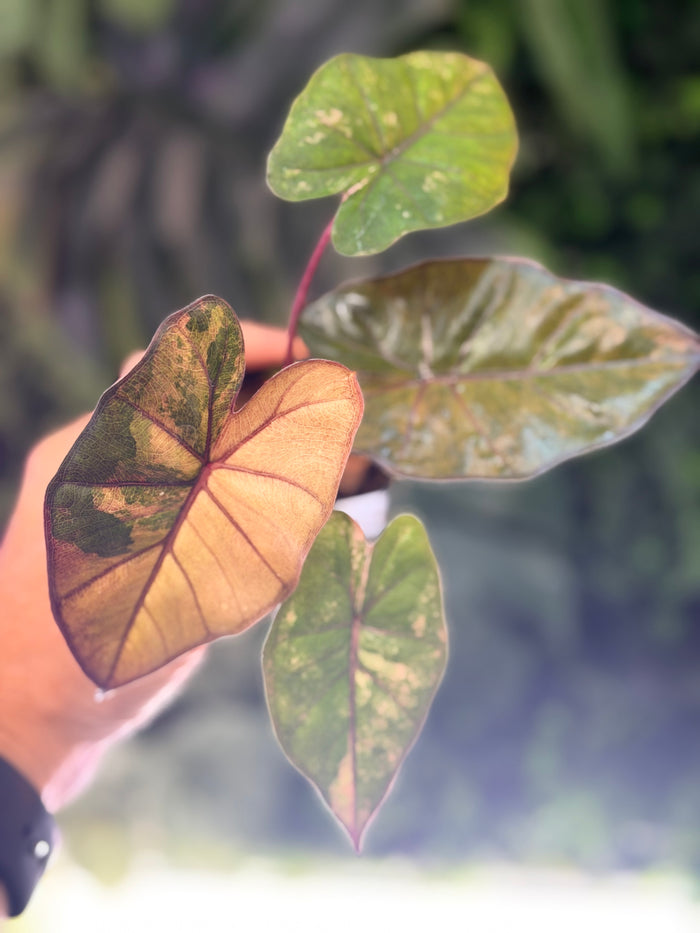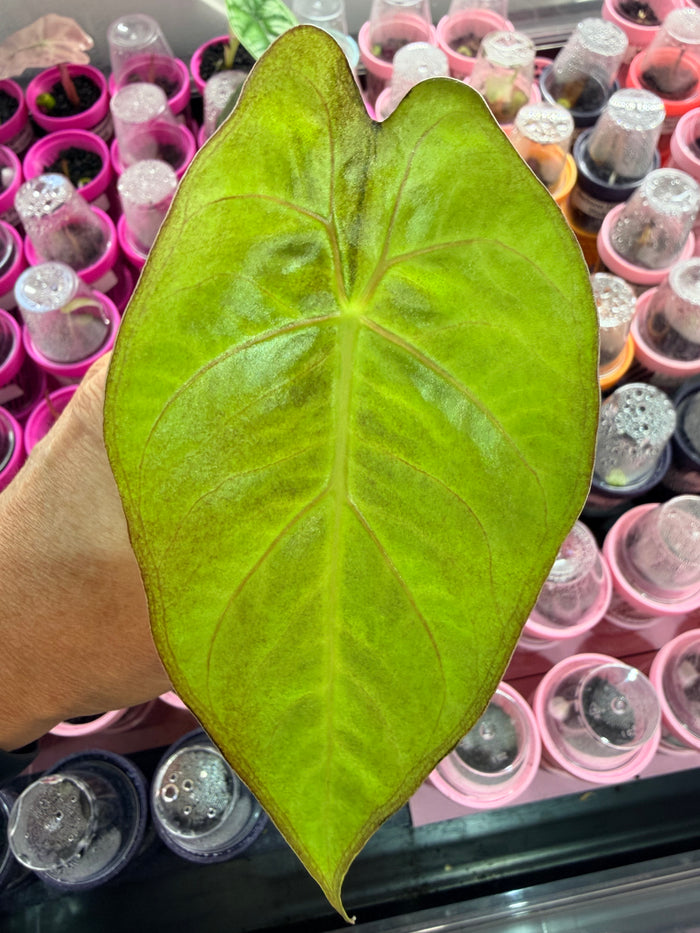

On 11 June 1862, at the Second Great Exhibition of the Royal Horticultural Society in London, Veitch and Sons, the nursery dynasty whose influence on Victorian horticulture was unequalled, exhibited a new plant and received a Silver Knightian Medal for it. The plant was Alocasia zebrina, introduced earlier that year at Veitch's Royal Exotic Nursery in Chelsea. When first placed on retail, it priced at 31 shillings and 6 pence, approximately £200 in modern purchasing power. The premium form, Alocasia zebrina 'Tigrina Superba', retailed for double that.
More than 160 years later, Alocasia zebrina is among the most widely available Alocasia in the UK market. The journey from Silver Knightian Medal to garden centre shelf is a testament to its genuinely exceptional ornamental qualities, qualities that have sustained collector and commercial interest across sixteen decades of horticultural change. The distinguishing feature has never changed: those petioles, obliquely streaked in brownish and darker green against pale green, giving the upright stems the banded pattern that earned the species its epithet. Zebrina, from the zebra-like pattern on each petiole.
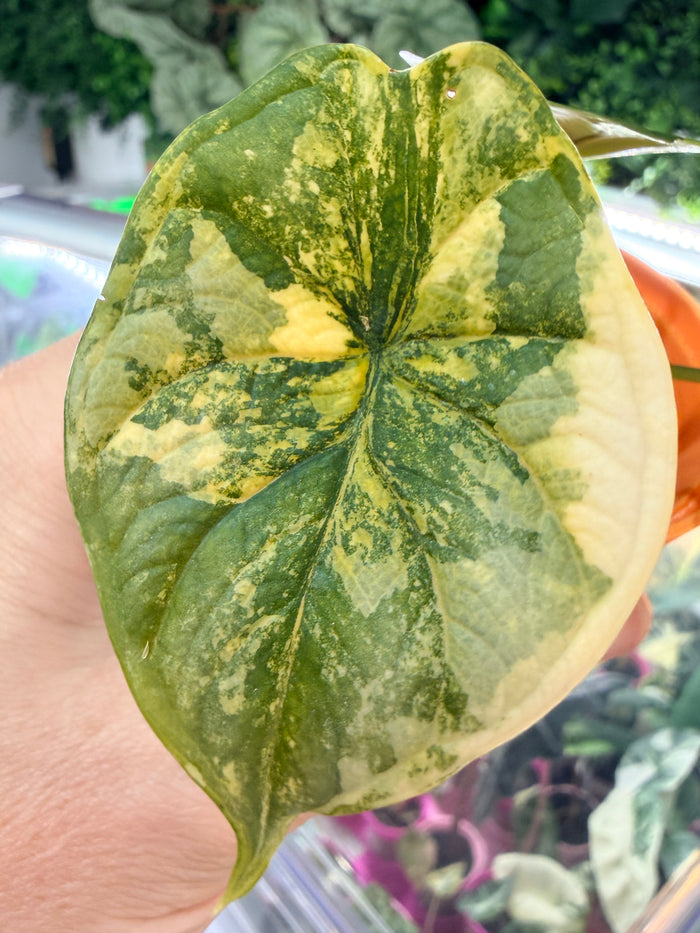
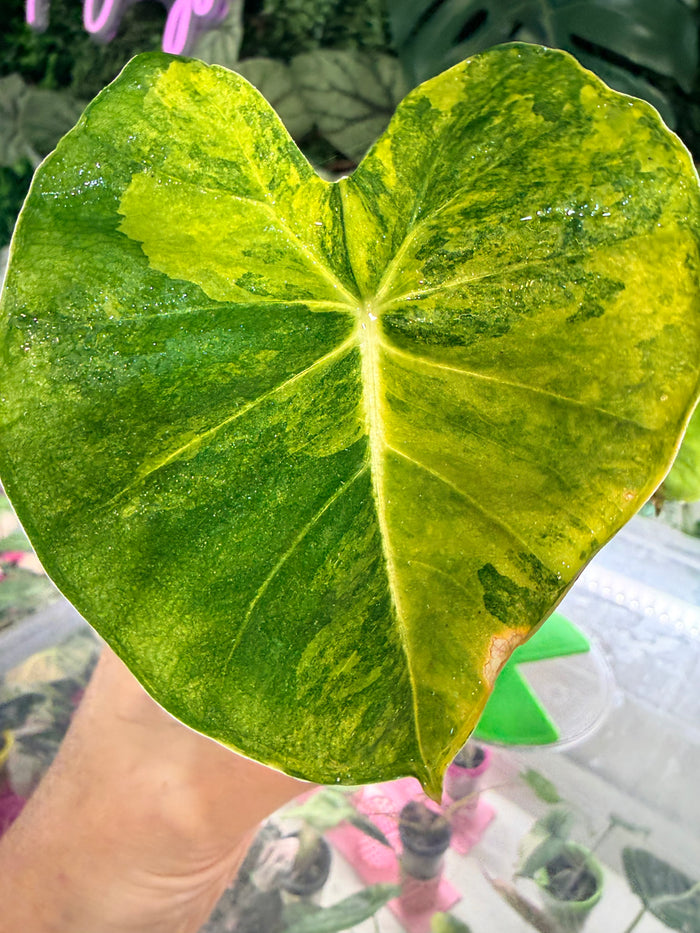
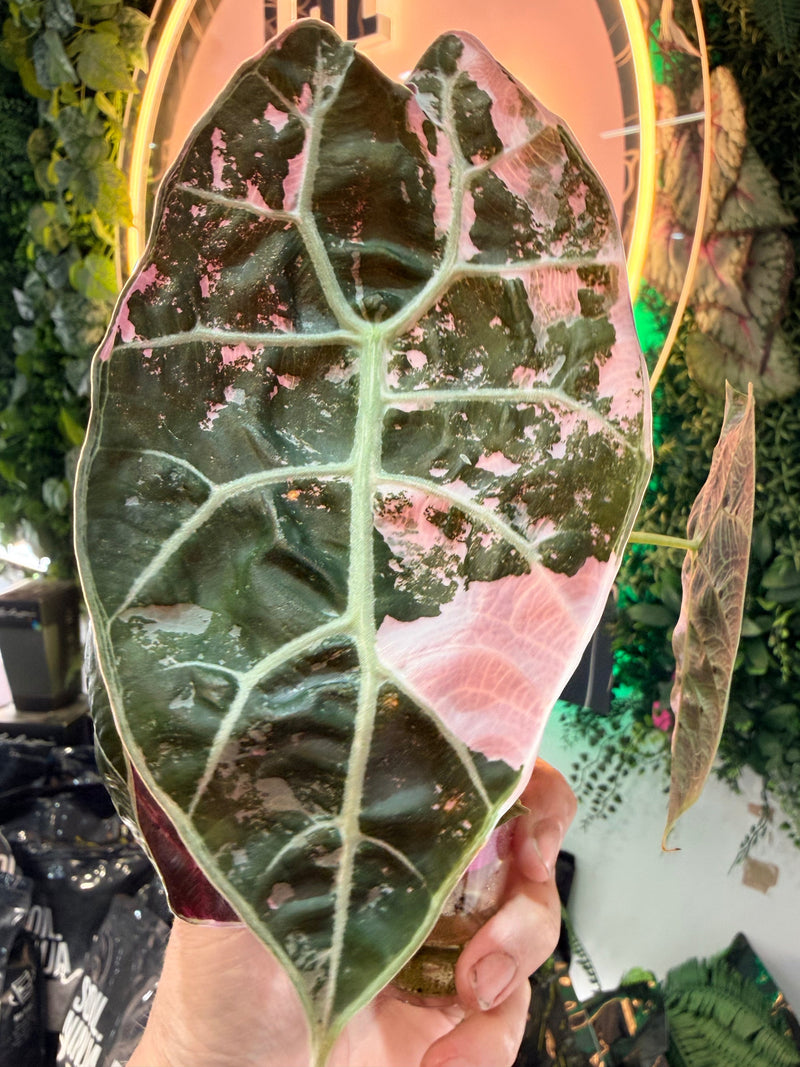
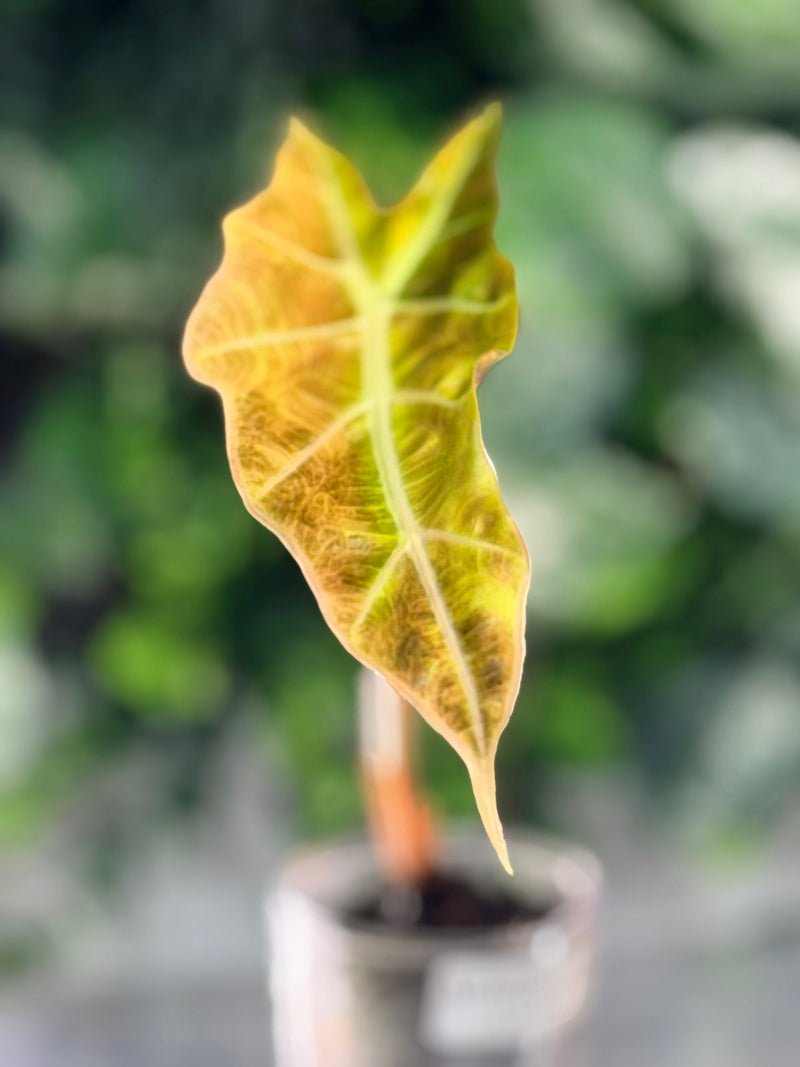
The aurea variegated form adds a layer of rarity to this classic species. Chimeric golden-yellow variegation across the large, glossy sagittate blades, set against the famous striped petioles, creates a specimen that honours the species' ornamental heritage while adding something genuinely uncommon to it.
The Species: Alocasia zebrina
Introduction and Victorian History
Alocasia zebrina was first described in the Journal of Horticulture, Cottage Gardener and Country Gentleman in 1862, in a visit to Veitch and Sons' Royal Exotic Nursery. The formal Latin description followed in the same year in the Proceedings of the Royal Horticultural Society (Volume 2, 1862) and the Flore des Serres (Volume 15, 1862). Aroidpedia's documentation of the original pricing, 31 shillings and 6 pence for the type, 63 shillings for 'Tigrina Superba', places this introduction in a very specific commercial context: this was a luxury plant for wealthy Victorian collectors, priced at what would today be serious collector-plant money.
The species is distributed across multiple Philippine islands, Luzon, Mindanao, Leyte, Samar, Biliran, Alabat, placing it firmly in the Philippine Alocasia lineage alongside scalprum, sinuata, and sanderiana. It was also known historically as "Snake Plant" in an 1892 plant catalogue, on account of the likeness of the stems to snake skin, a common name that predates the modern usage of that name for Sansevieria by several decades.
Aroidpedia also documents two incorrect renamings by Proven Winners: Alocasia 'Mythic Jungle Music' and Alocasia 'Mythic Blackout', both incorrect trade names applied to what is botanically Alocasia zebrina.
Species Description
The formal species description documents a moderately robust to robust herb reaching 1.8 m tall, with leaves several together not interspersed with cataphylls. Petioles reach 1.1 m long, sheathing in the lower third, pale green, obliquely streaked brownish and/or darker green, the definitive diagnostic feature. The blade is rather narrowly sagittate, 45 to 100 cm long, rather coriaceous, rich glossy green, with 4 to 10 primary lateral veins diverging from each side of the anterior costa at approximately 80 to 90°. Posterior lobes are elongate, three-fifths to two-thirds the length of the anterior lobe.
The inflorescence is paired, with peduncles to approximately 25 cm long and spathe 13 to 16 cm long. The fruiting spadix is globose, approximately 4.5 cm diameter. Cultivars include 'Tigrina Superba' and 'Reticulata'.
Climate and Distribution
The Philippine subtropical humid climate documented by Aroidpedia is consistent across the zebrina range: humidity moderate at 60 to 70 percent year-round, temperatures from approximately 9°C to 31°C with minimums above 7°C, rainy season October through May, dry season June through October. Annual rainfall approximately 1,200 mm. The ecology is described as rainforest at low to medium elevation, consistent with the species' adaptation to filtered forest light and consistently warm temperatures.
Hybrid Legacy
Alocasia zebrina has contributed to several hybrids documented by Aroidpedia: Alocasia 'Brisbane Tigress' (Alocasia brisbanensis × zebrina 'Tigrina'), Alocasia 'Giant Zebra' (Alocasia macrorrhizos 'Borneo Giant' × zebrina), and Alocasia 'Reticulate Giant' (Alocasia macrorrhizos 'Borneo Giant' × zebrina 'Reticulata'). The Alocasia tandurusa × Alocasia zebrina cross is also documented by Aroidpedia as an unreleased unnamed cultivar, two distinctive Philippine species in combination.
Aurea Variegation on Alocasia zebrina
Aroidpedia confirms white, yellow, and yellow mottled as the documented variegated forms for Alocasia zebrina. The aurea form, yellow chimeric variegation, applies golden sectors and splashes across the large, glossy blade while the iconic striped petioles remain in their standard green-and-brown banded form below. This combination is visually distinctive: the architectural structure of the famous petioles, unchanged by the variegation, supports blades that carry their own independent colour expression in the chimeric sectors above.
The scale of zebrina blades, 45 to 100 cm in mature specimens, means that even modest percentage aurea variegation produces large areas of golden colouration that are visible from significant distances. A mature zebrina Aurea with 30 percent variegation across a 70 cm blade is a very different visual proposition from the same percentage on a 15 cm jewel Alocasia leaf.
The carotenoid mechanism responsible for the gold colouration is the same as across other aurea-variegated Alocasia, chimeric cells unable to produce full chlorophyll allow the retained carotenoid pigments to express in the yellow-gold wavelengths. Our aurea variegation guide covers this mechanism in detail. Aurea sectors in zebrina carry some residual photosynthetic capacity through carotenoids, making the variegated form somewhat more robust than equivalent albo-variegated Alocasia of similar scale.
Growing Alocasia Zebrina Aurea in the UK
Light
Alocasia zebrina in its unvariegated form is among the more light-tolerant Alocasia in the mid-size to large category, its forest ecology at low to medium elevation means it receives more ambient light than strictly canopy-floor species. The aurea variegated form requires more light than the green type, as the reduced chlorophyll content in variegated sectors diminishes overall photosynthetic efficiency.
Bright indirect light from a large south or east-facing window, or supplemented with LED grow lights, is the target. Direct midday sun should be avoided, the large, glossy blade surface can heat up quickly and the marginal areas of the blade are susceptible to tip scorch in prolonged direct exposure. Supplemental lighting maintains growth momentum and prevents the reversion toward greener leaf production that occurs when light is insufficient to support variegated tissue.
Substrate and Watering
The Philippine rainforest ecology indicates consistent moisture rather than the sharp drainage of limestone specialists. Fluval Stratum provides the appropriate moisture balance. Given the large leaf area and correspondingly active transpiration rate, this plant will consume water at a higher rate than compact jewel forms. Water when the top 2 to 3 cm dry, and ensure thorough drainage each time. The 1.1 m petioles and large blade indicate a plant that benefits from a proportionate pot with adequate depth for rhizome development.
Temperature and Humidity
The standard Philippine subtropical climate parameters apply, 18 to 27°C, 60 to 75 percent humidity. Alocasia zebrina is among the more tolerant Alocasia in terms of temperature variation, which explains its consistent commercial availability, it adapts to UK home conditions more readily than strictly equatorial species. However, sustained cold below 13°C and cold draughts from poorly sealed windows still represent meaningful stress.
Historical Note for Collectors
There is something specifically enjoyable about growing a plant that received a Silver Knightian Medal from the Royal Horticultural Society in 1862. The species has been in continuous Western cultivation since its introduction by Veitch and Sons, one of the longest unbroken cultivation histories of any ornamental Alocasia. The aurea variegated form adds modern collector interest to a plant with genuine Victorian horticultural heritage.
For the broader context of zebrina care and the Philippine Alocasia group, our Alocasia care guide covers the cross-species fundamentals. The pink variegated Alocasia and aurea variegated collections provide the broader variegation context.
Corms are one of the most economical ways to grow more Alocasia, and the method is the same whatever the cultivar. Our Alocasia corm propagation guide sets out the self-wicking approach we use ourselves, step by step.
Questions about Alocasia Zebrina Aurea, the species' Victorian history, or building a large-format variegated Alocasia collection? Contact our team for guidance from specialists at our UK-based private nursery.