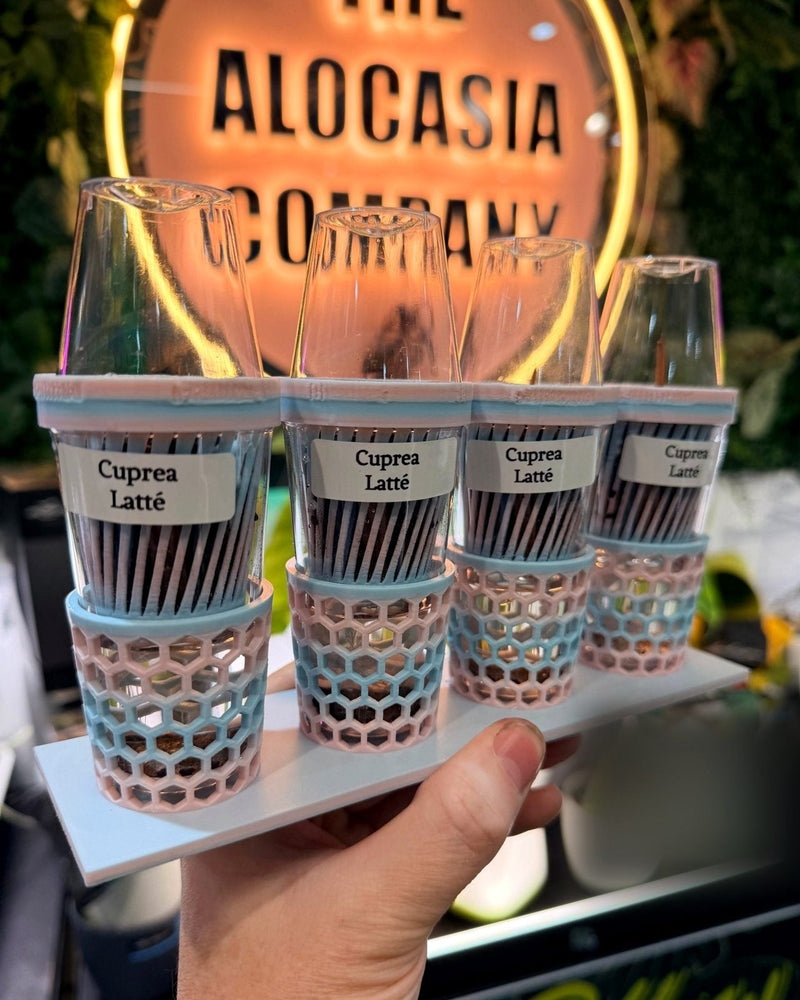

The Alocasia azlanii mutation is a collector's name for an unusual, non-standard form of one of Borneo's most recently described jewel Alocasia. This guide covers what is actually documented about the species, what the word "mutation" does and does not tell you, and how to look after the plant in the UK.
One point needs stating plainly at the outset: Aroidpedia, our main reference for aroid naming and history, has an entry for Alocasia azlanii but lists no named mutation or cultivar for it (the cultivar field reads "N/A"). Everything below about the mutation itself is therefore a general explanation, not a documented description of a specific, defined form.
What is Alocasia azlanii?
Alocasia azlanii is a small, peltate-leaved aroid from Borneo. Aroidpedia records that it was described as a new species by K. M. Wong and P. C. Boyce in 2016, in Acta Phytotaxonomica et Geobotanica, as part of the "Novitates Bruneienses" series. It sits within the Cuprea group of jewel Alocasia, alongside plants such as Alocasia cuprea, and it carries that group's hallmarks: a compact jewel habit, leathery foliage and an iridescent, metallic leaf surface that none of the larger-leaved Alocasia produce. It is barely a decade into its documented life, and a species named this recently is also one whose range of variation is still being learned, which is the context any unusual form on it belongs in. A species so recently named has a very short paper trail, and specimens sought by collectors worldwide today were, not long ago, unknown to science beyond their native forest.
Origin and naming
Aroidpedia gives the type locality as the Ladan Hills Forest Reserve in Brunei's Tutong District, with the type collected in 2015. The plant grows in shaded, moist ground above flood level beside a shallow tributary of the Benutan River, in mixed dipterocarp forest on sandy clays. The climate there is equatorial: humidity of 80 to 90 per cent, daytime highs near 32°C and nights at or above 20°C, with very high rainfall. Aroidpedia lists the distribution as Brunei and Borneo more broadly, though it gives no Indonesian localities.
The epithet honours Azlan Pandai of the Brunei National Herbarium. The authors separate the species from Alocasia beccarii and Alocasia peltata partly by habitat, since those two grow in kerangas forest rather than mixed dipterocarp forest.
How to identify the standard plant
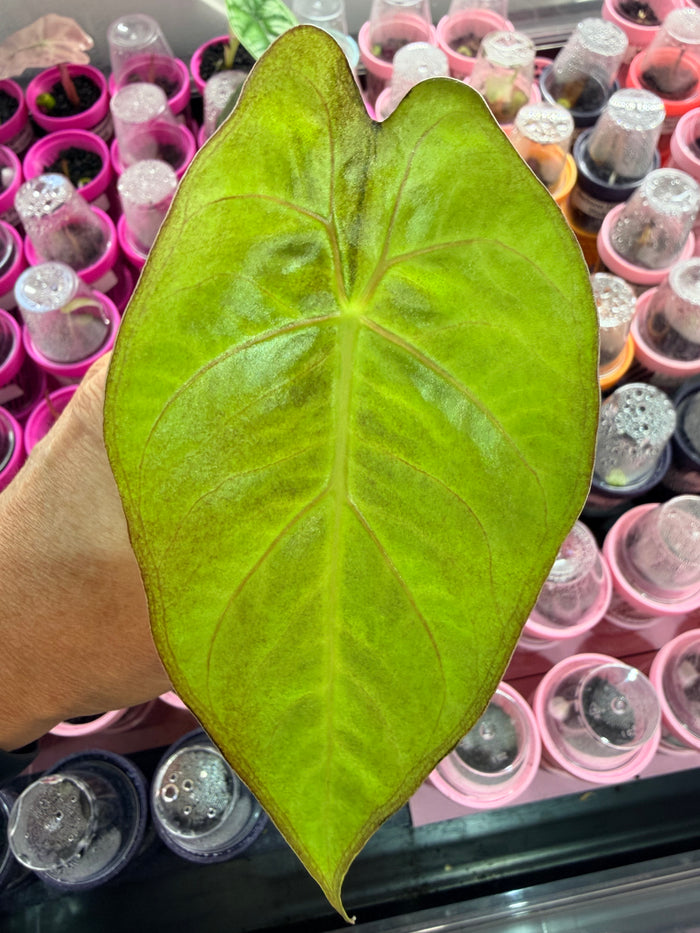
Per Aroidpedia, Alocasia azlanii is a compact herb 10 to 28cm tall with a slender, condensed stem. Leaves are broadly ovate-elliptic, roughly 16 to 20cm long and 8.5 to 11cm wide, thinly leathery, with a dark coppery purplish-green upper surface and a pale green underside. The surface carries a dramatic iridescent sheen that moves through green, copper and violet as viewing angle and light direction change. The primary veins are prominent. The inflorescence is solitary, with a pale green to nearly white spathe, and the fruit is a glossy white berry. Knowing this baseline matters, because any unusual form has to be judged against it. In cultivation the plant is genuinely compact, which suits shelving, terrariums and close-viewing displays where its extraordinary surface character can be appreciated at the scale it demands.
What does "mutation" mean here?
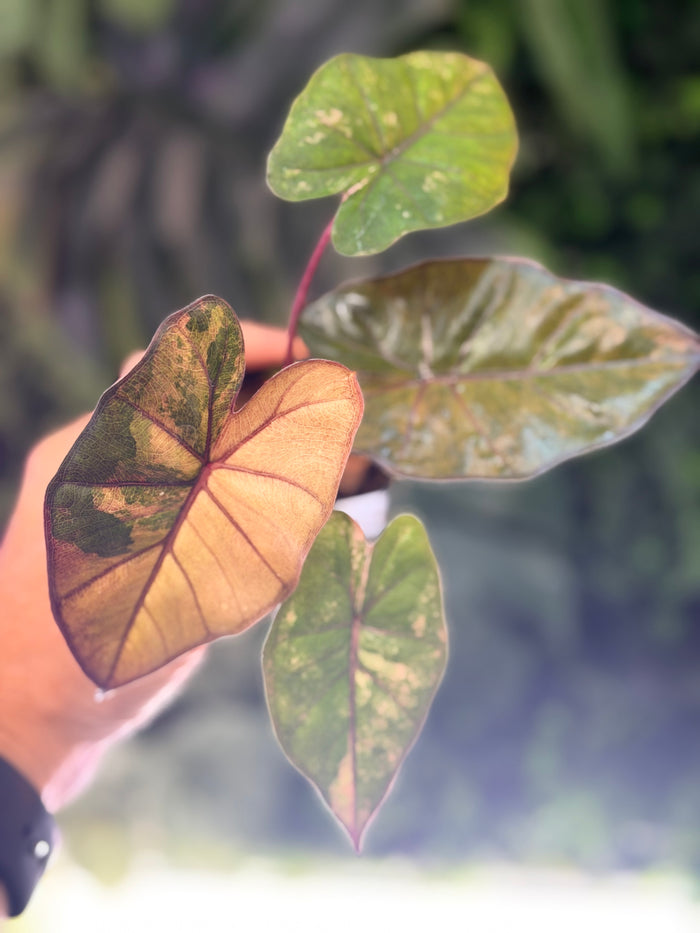
In collector usage, "mutation" is a loose label for a plant that departs visibly from the standard species and does not fit neatly into albo, aurea, pink or mint categories. It is not a formal botanical term, and without a documented cultivar entry there is no fixed standard for what an azlanii mutation should look like. Individual plants sold under the name can differ from one another.
Mutation forms in Alocasia represent the frontier of variegation collecting: specimens where the change from the standard is genuine and visually significant but where the precise biochemical mechanism, or the specific combination of mechanisms, has not been definitively categorised. For collectors who find the known and categorised forms of variegation familiar, mutation forms offer something genuinely unpredictable.
In the collector Alocasia world, "mutation" typically refers to a visible change from the standard species character that is consistently expressed across multiple leaves, suggesting it is not a random developmental anomaly but a genuine, heritable (within vegetative propagation) variation. This distinguishes mutation forms from individual leaves that show unusual patterning due to growing conditions or developmental accident. A mutation form can involve unusual sector distribution, unexpected colour expression, structural changes to leaf form, or combinations of multiple expression types that do not resolve cleanly into a single variegation category.
On Alocasia azlanii specifically, a species already at the extreme end of visual complexity with its iridescent metallic surface and deep magenta venation, an unusual mutation adds a layer of interest that compounds the species' inherent character. The mutation expression may involve irregular sector distribution of the metallic colour elements, areas where the copper, green and violet tones that normally shift uniformly across the surface are distributed in distinct patches or sectors rather than as a uniform iridescent sheen. The precise character varies between individual plants, which is consistent with the nature of chimeric variation in a recently described species where the full range of possible mutations has not yet been systematically documented.
What distinguishes mutation form collecting from standard variegated form collecting is the absence of category: each specimen is evaluated on its individual character rather than against an established type. Collectors who value unpredictability and genuine botanical novelty find mutation forms compelling precisely because there is no reference point against which to measure them.
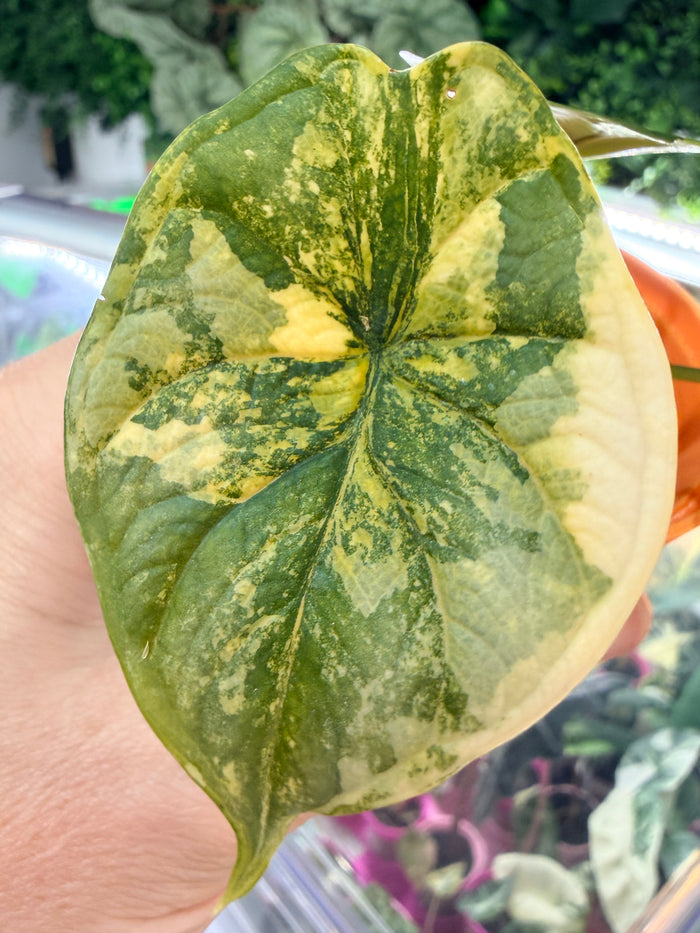
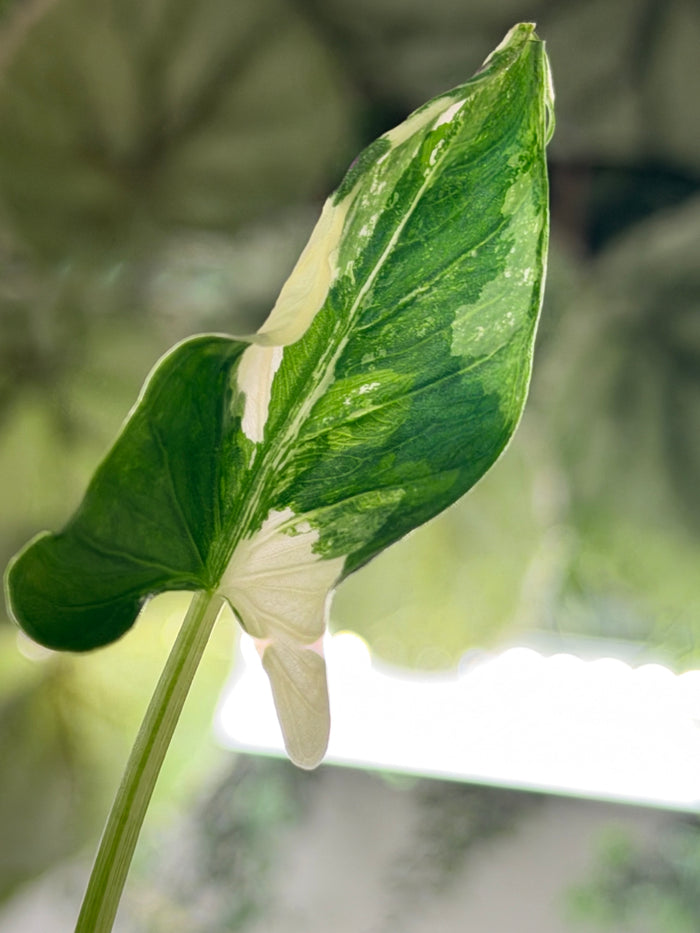
Aroidpedia does list variegated forms of the species as white and mottled. If you want the established categories first, our complete variegation guide explains how they differ, and our guides to albo pink azlanii and mint azlanii cover the named forms we do describe. Chimeric variegation, whatever the label, is unstable and may not carry over reliably to plants grown from corms.
Azlanii mutation care
This is general Alocasia care, and it applies to this plant. Aim for bright indirect light, supplemented with LED grow lights where daylight is limited, and a temperature of 20 to 27°C. Keep humidity at 60 to 80 per cent. Water when the top 2 to 3cm of the substrate has dried, and never leave the pot standing in water. Fluval Stratum is our preferred substrate. If the room runs cool, a heat mat beneath the pot helps the roots. Feed with our Alocasia feed from the plant feed range at half strength, with measured feeding at a strength appropriate to the degree of any pale or non-photosynthetic tissue present.
The plant's natural setting is humid, shaded and stable, so a terrarium or a sheltered, humid corner suits it well. Our ultimate Alocasia care guide goes into more depth, and our root rot guide is worth reading if the leaves start to decline. If you are bringing in tissue culture plants, see our acclimation guide.
Propagation from corms
Our Alocasia corm propagation guide explains the self-wicking method. In short, a healthy corm is set in Fluval Stratum inside a Corm Keeper, which draws moisture up evenly without waterlogging. See also growing corms in Fluval Stratum. Because chimeric patterns can be lost, a corm-grown plant may not look like its parent.
How does it compare with related plants?
Alocasia azlanii is also a parent of several hybrids according to Aroidpedia, including Alocasia 'Green Unicorn' (crossed with Alocasia baginda 'Dragon Scale'), which we cover in our Green Unicorn guide. For another small Bornean jewel Alocasia, see our Cuprea species guide.
We release azlanii forms through our drop model when material is ready. You can join the collector list for advance notice, or browse our Alocasia house plants and albo variegated Alocasia collections.
Frequently asked questions
Is the azlanii mutation a defined cultivar?
Not according to Aroidpedia, which lists no named mutation or cultivar for Alocasia azlanii. The term is used informally by collectors.
Where does Alocasia azlanii come from?
Borneo. The type was collected in the Ladan Hills Forest Reserve in Brunei's Tutong District.
How big does it get?
Aroidpedia records plants 10 to 28cm tall, with leaves up to about 20cm long.
Will a corm-grown plant look like its parent?
Not necessarily. Chimeric variegation is unstable and may not carry over to corm-grown plants.
Does it need special care?
No. General Alocasia care applies: bright indirect light, 20 to 27°C, 60 to 80 per cent humidity and watering once the top 2 to 3cm has dried.
Is it related to Alocasia cuprea?
Yes, Aroidpedia files it under the Cuprea group of jewel Alocasia.
Questions about the azlanii mutation or the Cuprea group? Contact our team for guidance from specialists who grow rare Alocasia in our UK-based private nursery. We are happy to explain what is and is not documented about a plant before you decide.