ALOCASIA 'GREEN UNICORN': THE COMPLETE COLLECTOR'S GUIDE

Currently sold out
GREEN UNICORN (AZLANII x DRAGON SCALE)
New plants go to the drop list first.
Join the drop listIn the world of ornamental aroid hybrids, most cultivars arrive without documentation. A plant appears in the market, acquires a trade name, and its origins remain conveniently vague, parentage assumed rather than confirmed, hybridiser unknown or uncredited, and any botanical claims made informally at best. Alocasia 'Green Unicorn' is the opposite of this. It is one of the most comprehensively documented modern Alocasia hybrids in existence: precise parentage confirmed by independent verification, hybridiser publicly credited, pollination date recorded, berry harvest dates logged, corm harvest timed, and the resulting cultivar protected under US Plant Patent PP35554.
The parents are Alocasia azlanii as the ovule parent and Alocasia baginda 'Dragon Scale' as the pollen donor. The hybridiser is Lindsay Sisti, known online as @alltheplantbabies. Pollination took place on 29 July 2021. The first berry was harvested on 23 December 2021, with all berries ripened by 7 January 2022. First propagation was done from corms harvested on 1 June 2022, which came to maturity on 22 September 2022. This is the level of documentation that exists for this hybrid, a standard that most collector plants, including many with considerably longer histories, cannot approach.
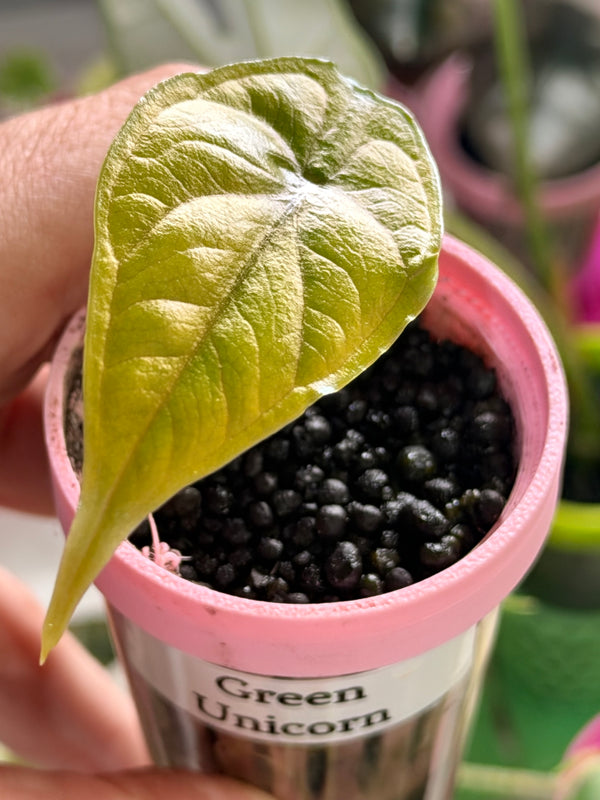
The result of that cross is a plant that synthesises characteristics from both parents in ways that are genuinely unexpected. Alocasia azlanii contributes iridescence and dramatic colouration. Alocasia baginda 'Dragon Scale' contributes scale-like texture and a distinctly bullate surface. What emerges from their combination is a compact, vigorous jewel-scale hybrid with dark greyish-green adaxial surfaces, an intensely iridescent sheen, dramatic dark red leaf undersides, and a bullate texture between the impressed veins, a plant that carries botanical complexity that neither parent alone would produce.
The Parents
Alocasia azlanii
Alocasia azlanii is a Malaysian species known for its exceptional iridescence, the quality of the adaxial leaf surface that produces a metallic, shifting shimmer as the viewing angle changes. This iridescence results from the organisation of photosynthetic cells within the palisade layer of the leaf: structural colour, produced by the physical arrangement of cells rather than by pigment chemistry. The adaxial surface of azlanii is described as dark coppery purplish green, with distinct maroon secondary veins on the adaxial surface, a colouration profile that is immediately distinctive and unlike most Alocasia.
The abaxial surface of azlanii is pale green, making the contrast between upper and lower leaf surfaces much less dramatic than in baginda and its hybrids. Leaf veins in azlanii protrude on both surfaces rather than being impressed, giving the blade a different textural character from the Dragon Scale parent.
As the ovule parent in the Green Unicorn cross, azlanii contributed its iridescence genetics, the capacity for structural colour in the leaf surface, as well as elements of its characteristic colouration. In Aroidpedia's comparison of the hybrid with its parents, 'Green Unicorn' is described as iridescent and dark greyish green on the adaxial surface, with secondary veins that are moderate yellow green, retaining the iridescent quality from azlanii while the specific colour and vein tones shift toward a different character through the influence of the baginda parent.
Alocasia baginda 'Dragon Scale'
Alocasia baginda was formally described in 2011 by Peter Boyce and Deden Mudiana, collected from primary forest in the Sangkulirang peninsula of East Kalimantan, Indonesian Borneo, at elevations between 100 and 400 metres. The 'Dragon Scale' cultivar is the most widely known of the baginda cultivars, characterised by its distinctive bullate (pebbled or blistered) leaf surface, in which the tissue between the veins creates raised, scale-like protrusions that give the leaf a three-dimensional texture reminiscent of reptile scales. The adaxial surface is matte dark green with pale grey bullae; the abaxial surface is pale green with a red colouration at the distal portion of the primary vein and deep red secondary and marginal veins.
As the pollen donor in the Green Unicorn cross, 'Dragon Scale' contributed the bullate texture genetics, the structural arrangement of the leaf mesophyll that creates the scale-like surface, as well as elements of its vein colouration. Aroidpedia's formal comparison shows that 'Green Unicorn' differs from 'Dragon Scale' in having glabrous (smooth, hairless) and shiny leaves rather than the matte texture of the pollen parent, a slightly bullate surface between the veins (less pronounced than Dragon Scale), and dark red rather than pale green on the abaxial surface. The hybrid inherits the bullate principle from 'Dragon Scale' while moderating it through the azlanii influence.
The Hybrid: Alocasia 'Green Unicorn'
Formal Description from Aroidpedia
Aroidpedia's entry on 'Green Unicorn' provides the full cultivar description as documented in the patent filing. The leaves are described as light yellow green, glabrous and glossy, characterised by dark red interveinal areas, light yellow green primary and secondary veins (with a slight dark red tinge on the secondary veins), and greenish white veinlets with light yellow green margins. Petioles are flexible, semi-erect, and overly arching toward the lamina, measuring 17.5 to 19.7 cm in length with a 1.4 cm base diameter narrowing to 0.5 cm at the leaf insertion point. The yellow sheath measures 6.4 cm long and 1 cm wide.
This botanical precision matters because it establishes what 'Green Unicorn' actually is as a cultivar, rather than what the trade name or casual descriptions suggest. The name "Green Unicorn", chosen, as Lindsay Sisti has noted, because "unicorn" is used in the houseplant hobby to describe a beautiful, highly sought-after, uncommon plant, could suggest a uniformly green plant. The formal description reveals something more complex: dark red interveinal areas, iridescent sheen, glossy surface, and the bullate texture between impressed veins all contribute to a leaf character that earns the unicorn designation through quality rather than simply colour.
The Inflorescence
The patent documentation records an unusually detailed inflorescence description. The peduncle is strong yellow green, fading to pale yellow green at the base of the spadix, 8 cm long and 6 mm in diameter. The spathe is hooded, with a rotund shape above the female zone and elliptical form surrounding it, 5.4 cm above the female zone and 2.3 cm surrounding it. Margins are tinted purplish red above the female zone. The spadix is 6 cm long, with a pale green and lanceolate appendix approximately 3.5 cm long, a white cylindrical male zone of 1.5 cm, and a greenish yellow conical female zone of 1 cm.
This level of inflorescence documentation is rare in ornamental Alocasia culture, where flowering is often incidental and frequently goes unrecorded. Its presence in the patent filing establishes the cultivar's botanical identity with the same rigour as the vegetative description.
Plant Patent PP35554
The patent documentation covers not just the physical description of the hybrid but the full breeding record: pollination on 29 July 2021, berry harvest commencing 23 December 2021 with final ripening by 7 January 2022, seed germination leading to corm harvest on 1 June 2022, and first mature specimens available by 22 September 2022. This timeline, from pollination to mature plant in just under 14 months, reflects the relatively rapid reproductive cycle that baginda-cross hybrids can achieve under optimal controlled conditions. The plant breeders' rights have been applied for in the EU, reflecting the international commercial significance of the cultivar.
Growing Alocasia 'Green Unicorn' in the UK
Growth Habit and Scale
'Green Unicorn' is a compact hybrid, Aroidpedia and multiple grower accounts confirm a mature size of approximately 30 cm in height and 50 to 55 cm in spread. This places it firmly in the jewel-scale category rather than the mid-size or architectural range, making it suitable for shelf, windowsill, or cabinet growing. The growth habit is tuberous and bushy, with new leaves pushing from the central corm in a symmetrical clump pattern rather than on an extending stem.
The compact size is partly a consequence of the azlanii parent contribution. Alocasia azlanii is itself a smaller-scale species, and the cross with 'Dragon Scale' has produced a hybrid that sits between the two parents in scale while inheriting some of the vigour, described consistently by growers as more vigorous than azlanii in cultivation, that hybrid crosses between compatible Alocasia species often produce through heterosis.
Light Requirements
Both parent species are adapted to shaded forest floor conditions in tropical Asia, which might suggest tolerance of low light. In practice, 'Green Unicorn' performs best in bright indirect light, ideally from an east or south-facing position with diffused natural light, or supplemented with LED grow lights. The iridescent leaf surface is most dramatic when the plant receives consistent light from a relatively stable direction, as the structural colour shifts with viewing angle and benefits from adequate illumination to display properly.
One noted characteristic of 'Green Unicorn' relative to its azlanii parent is improved tolerance of lower humidity, multiple grower accounts confirm that the hybrid is more adaptable than azlanii in variable humidity conditions, while still performing best in the 60 to 75 percent range. This makes it a somewhat more forgiving jewel-scale choice than pure azlanii would be, particularly in UK home environments where humidity management requires active effort through autumn and winter.
Substrate and Watering
Given the baginda parent's primary forest origin in East Kalimantan, where the species grows on steep terrain in humus-rich, well-drained soil at 100 to 400 metres elevation, and the smaller-scale ecology of azlanii, this hybrid benefits from an airy, well-draining substrate. Fluval Stratum is our standard recommendation for jewel-scale Alocasia, providing the structural drainage and appropriate moisture retention for compact forms. Allow the top 2–3 cm to dry between waterings, and never allow standing water to persist in the base of a decorative pot.
'Green Unicorn' is described by some growers as slightly more drought-tolerant than the more demanding jewel forms like azlanii itself, but this tolerance should not be tested by sustained dry periods. Consistent moderate moisture is the target, neither saturated nor desiccated.
Temperature
A stable temperature range between 18°C and 26°C is the documented optimal for this cultivar, consistent with the tropical forest conditions of both parent species. Cold draughts and cold windowsills represent the primary risk in UK conditions. Minimum temperatures at root level should remain above 15°C at all times.
Humidity
Although 'Green Unicorn' tolerates lower humidity than azlanii, sustained periods below 50 percent will compromise leaf quality and increase susceptibility to spider mites. The 60 to 75 percent range produces the best leaf development and the most vivid iridescence. During UK winter heating season, active humidity management, through a desktop humidifier, grouped plants, or a humidity-controlled growing cabinet, is advisable.
Feeding
A balanced liquid feed at half-strength every two to three weeks through the growing season is appropriate for this compact hybrid. Reduce or stop feeding through UK winter when growth slows. Our plant feed collection has appropriate options for jewel-scale forms.
Pests
Spider mites are the primary concern, as with all compact tropical Alocasia in UK conditions. The iridescent upper surface of 'Green Unicorn' leaves can mask early stippling damage from mites, the changing light-play across the surface makes subtle colour changes less immediately apparent than on a uniformly matte leaf. Regular inspection of leaf undersides is essential, particularly through autumn and winter when low indoor humidity creates optimal mite conditions.
Dormancy and Propagation
Seasonal Behaviour in UK Conditions
'Green Unicorn' is described by growers as more robust than Alocasia azlanii in cultivation, but it shares the genus-level characteristic of slowed growth or dormancy in reduced light and cool temperatures. In UK conditions, growth will typically slow through late autumn and winter, the plant may shed lower leaves and reduce new leaf production to a near-standstill. This is normal and expected.
During this period, reduce watering frequency, stop feeding, and ensure root zone temperatures remain above 15°C. The corm remains viable through dormancy and will push new growth reliably when warmth and light return. Plants grown under consistent supplemental LED lighting often avoid full dormancy or experience only a modest slow period rather than a complete pause.
The improved humidity tolerance of 'Green Unicorn' compared to azlanii means that the winter slow period is less stressful for this hybrid than it might be for the parent species, but it still benefits from attention to humidity and temperature management through the colder months.
Propagation via Corms
Alocasia 'Green Unicorn' propagates from corms produced at the base of the central corm or as basal offsets from the rhizome. Because this is a hybrid cultivar, not a variegated chimeric form, propagation via corms reliably produces offspring that carry the same genetic character as the parent. This distinguishes it from chimeric variegated forms such as the Dragon Scale Albo, where corm-grown offspring carry variable variegation expression. Every corm from a 'Green Unicorn' will produce a 'Green Unicorn', the hybrid genetics are stable and consistent.
This stability also means that 'Green Unicorn' can be propagated and grown on with confidence, making it a rewarding choice for collectors who want to build population from a single acquired plant. Our Corm Keeper propagation system provides the optimal warm, humid environment for jewel Alocasia corm germination.
Comparing Green Unicorn with Its Parents
The formal Aroidpedia comparison of 'Green Unicorn' against both parents reveals what hybrid development actually achieves when done carefully. The iridescence from azlanii is retained but the surface becomes glabrous and glossy rather than the coppery purple-green of the ovule parent. The bullate texture from 'Dragon Scale' appears in moderated form, slightly bullate between the veins rather than the dramatic scale-like protrusions of the pollen parent. The dark red abaxial surface is a characteristic shared with aspects of both parents but expressed more prominently in the hybrid than in either. The growth habit is more compact than 'Dragon Scale' and the leaves more flexible and thinner, again a characteristic between the two.
This is hybrid vigour expressed with precision: not a simple averaging of parental traits, but a recombination that produces a plant more collectively capable in cultivation than either parent, with a leaf character that is genuinely distinct from both. The Alocasia Dragon Scale Albo Variegated is the closest parent available in our collection and makes a compelling comparison piece, the scale texture of baginda without the azlanii hybridisation, versus the Green Unicorn synthesis. The Alocasia Maharani Aurea offers a parallel reference point: another carefully documented hybrid from reginula × melo lineage, also with a detailed breeding record, showing what modern Alocasia hybridisation looks like when done with scientific rigour.
For the broader context of jewel Alocasia care across the compact species and hybrids, our complete Alocasia care guide covers the fundamentals that apply across the jewel scale.
Final Thoughts
Alocasia 'Green Unicorn' represents something worth paying attention to in a market where novelty is abundant and documentation is rare. A hybrid with a confirmed pollination date, a documented patent, a named and credited hybridiser, and botanical comparisons with both parents drawn from that patent filing is an unusually transparent plant for the ornamental Alocasia world.
What it produces in growing terms reflects that care in development. The iridescent, dark leaf surface, the dark red undersides, the moderated Dragon Scale texture, the compact vigorous growth, and the improved humidity tolerance compared to azlanii alone, all of these are coherent outcomes of a deliberate cross between two well-understood parents, developed with the kind of intention that distinguishes serious hybridisation from opportunistic crossing.
If you are building a jewel-scale collection and want a hybrid that carries documented provenance alongside genuine aesthetic distinction, 'Green Unicorn' belongs in it.
Questions about Alocasia 'Green Unicorn', jewel Alocasia care in UK conditions, or the broader baginda and azlanii species context? Contact our team for guidance from specialists who grow this hybrid at our UK-based private nursery. We can advise on everything from initial setup through to long-term management of compact collector plants.