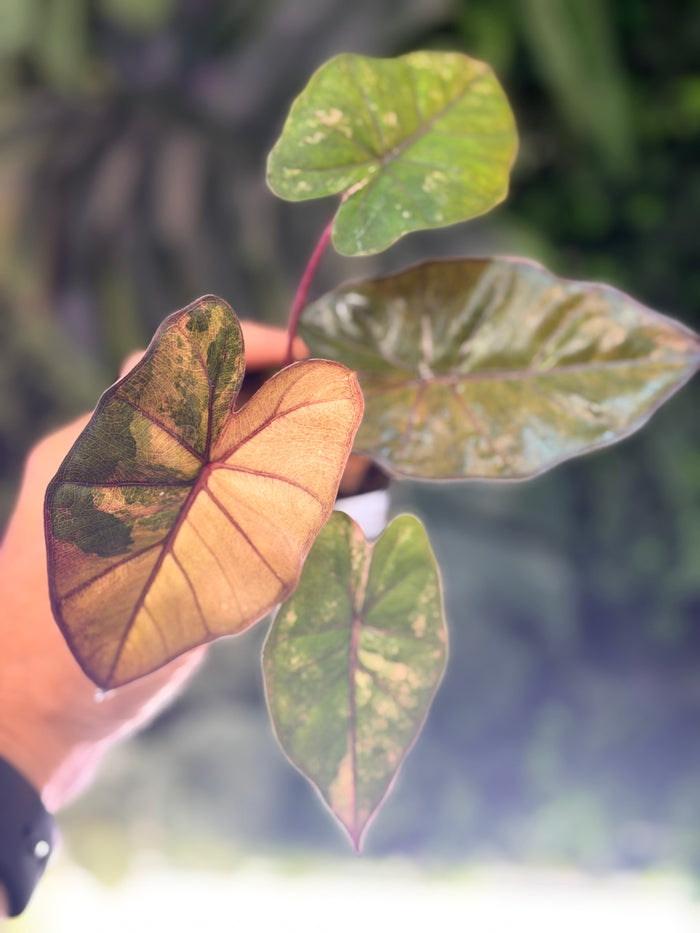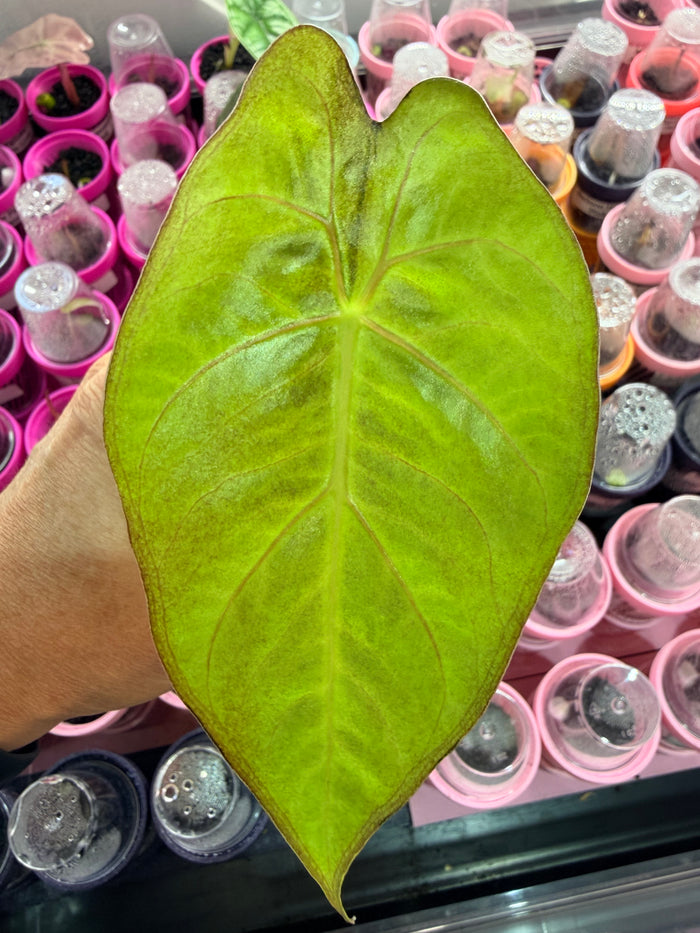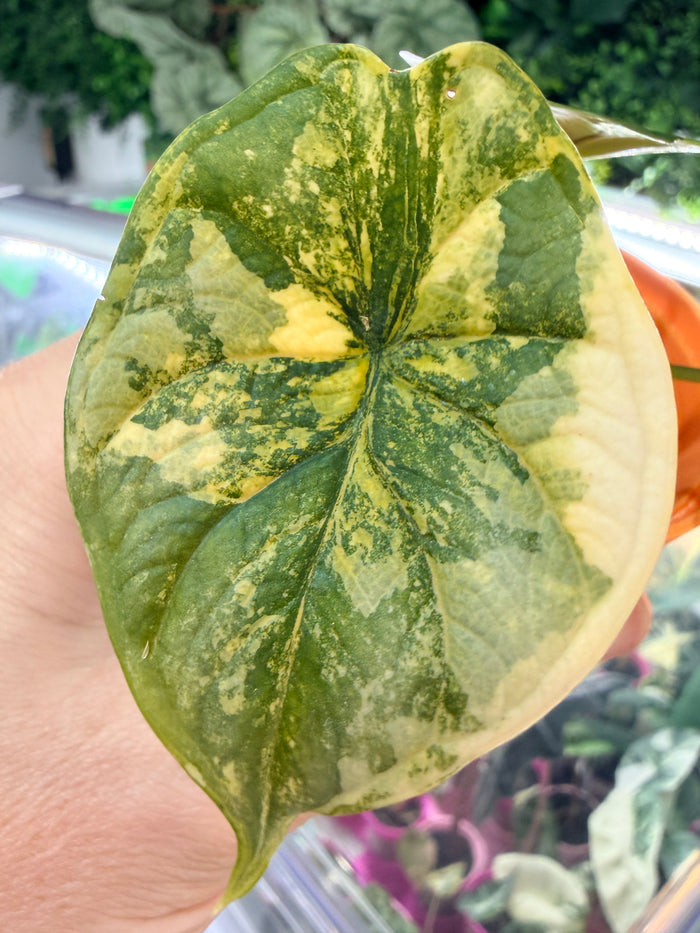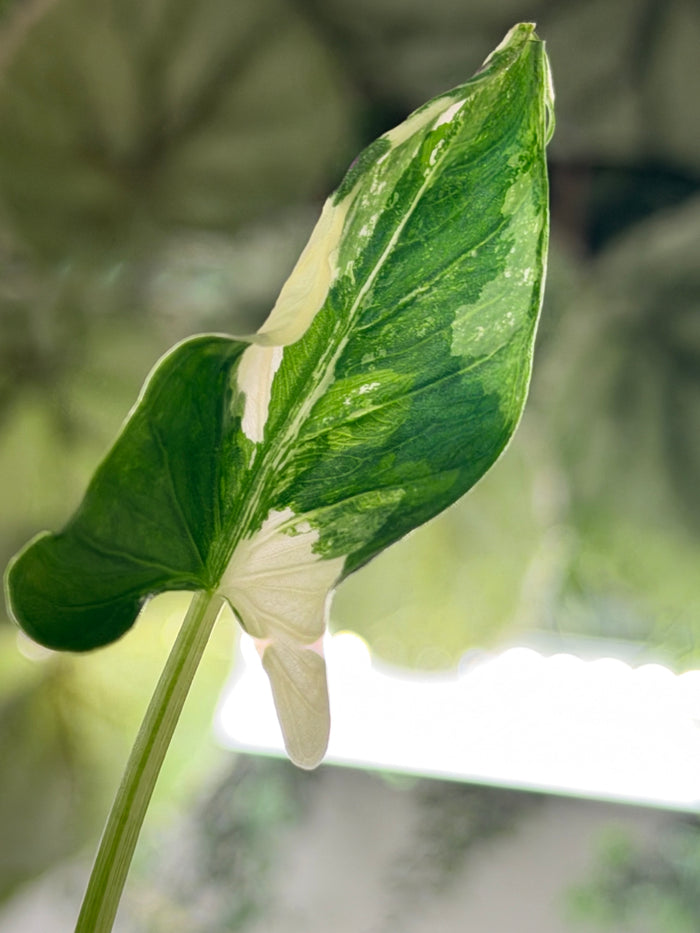

The Alocasia azlanii Mint Variegated is a form of Alocasia azlanii, a small Bornean aroid, in which part of the leaf is pale green rather than the usual dark colouring. It brings a cool, luminous colour expression to one of the most visually extraordinary species in the jewel Alocasia world. This guide covers the species, what is documented about the mint form, how mint variegation behaves, and general care. Where the sources are silent we say so rather than guess.
Alocasia azlanii: origin, naming and history
Alocasia azlanii was formally described by K. M. Wong and P. C. Boyce in 2016, in the journal Acta Phytotaxonomica et Geobotanica, as part of a series titled Novitates Bruneienses. Aroidpedia records that the type material was collected in 2015 in Brunei, in the Tutong District, within the catchment of the Benutan Dam in the Ladan Hills Forest Reserve. The holotype is held at the Brunei herbarium (BRUN) with an isotype at Singapore (SING).
The name honours Azlan Pandai of the Brunei National Herbarium, whose field searches for aroids produced many of the finds described in that series. Aroidpedia gives the plant's habitat as well-shaded, moist ground just above flood level beside a shallow tributary of the Benutan River, in mixed dipterocarp forest on sandy clays. That is a warm, humid, lowland setting, with humidity of 80 to 90 per cent and temperatures that rarely fall below 20°C. Aroidpedia lists Borneo as the range, with Brunei the only locality it documents; it also carries an Indonesia entry with no supporting locality, so we treat Brunei's Tutong District as the established record.
The Aroidpedia entry covers the 2015 collection and the 2016 publication only. It gives no cultivation history and no account of how the plant entered collections, so we do not offer one here.
How to identify Alocasia azlanii
Aroidpedia, which reproduces the botanical description, records a small herb of 10 to 28cm with a short stem 8 to 10mm across and tightly packed internodes. The leaf blade is broadly ovate-elliptic, 16 to 20cm long by 8.5 to 11cm wide, thinly leathery, with a dark coppery purplish-green upper surface and a pale green underside. The two posterior lobes together measure 5 to 7cm, and the petiole is pale green and smooth.
The describers separated the species from two similar small, shield-leaved aroids, A. beccarii and A. peltata, mainly by its conspicuous marginal and intramarginal veins. It also grows in mixed dipterocarp forest, whereas those two are recorded from kerangas forest. Collectors commonly describe the foliage as metallic or iridescent with strongly coloured veins, with a sheen whose green, copper and violet tones move as light and angle of view change; that is a horticultural impression rather than something the botanical description states, and it is best judged on the plant itself.
The flower is a small, solitary inflorescence with a pale green to almost white spathe of about 6cm and a white appendix, followed by glossy white fruits up to 8mm across.
What is documented about the Mint Variegated form
Aroidpedia has an entry for the species, Alocasia azlanii, but lists no cultivars under it, and records the species' variegation only as white and mottled. Mint is not mentioned. There is therefore no cultivar-specific entry for a Mint form, and no documented origin, breeder, date or parentage. Anything specific to this form comes from observing plants rather than from the published record.
The mint variegation explained
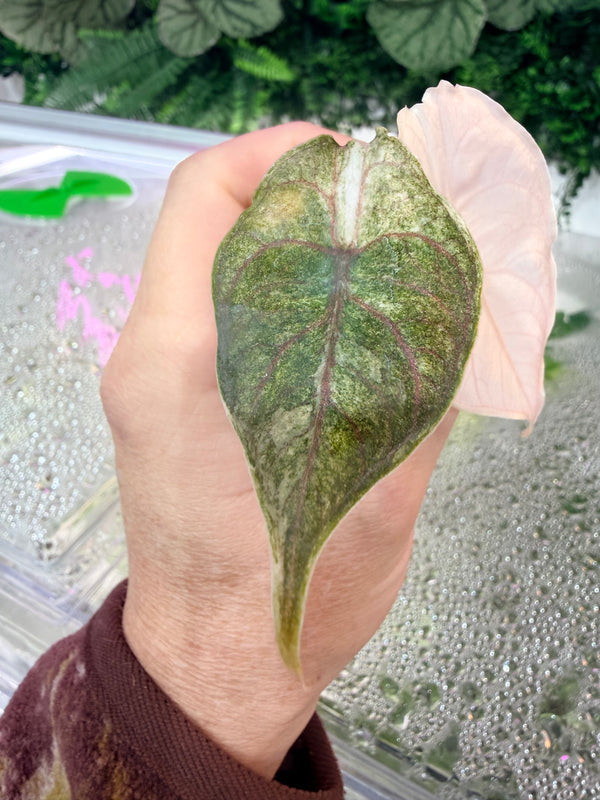
Mint variegation is a pale green expression. Unlike albo, where the white tissue has no chlorophyll, mint tissue keeps some chlorophyll in reduced amounts, so it still contributes to the plant's energy. That generally makes mint-variegated plants somewhat easier to keep than heavily white ones, though the paler sectors are still less efficient than fully dark leaf tissue. In our experience this gives the Azlanii Mint greater vigour and somewhat more forgiving care requirements, and makes it a more accessible entry point into azlanii variegated collecting than the dual-expression Albo Pink form.
Mint patterns are typically chimeric, so they can shift from leaf to leaf, increase, fade, or vanish in a new leaf, and they are not guaranteed to carry over to plants grown from corms. On this species the dark coppery-green base, as Aroidpedia describes the upper surface, gives the pale sectors plenty of contrast. Bright indirect light helps the pattern show clearly; too little light tends to make new leaves darker and greener.
The interaction with this species' metallic, iridescent base foliage creates a visual effect unlike mint variegation on any other cultivar. The cool chartreuse-green of the mint sectors sits within a leaf surface that is already chromatically complex: the metallic sheen shifts the perceived colour of all tissue on the blade depending on light angle, so mint sectors read differently under different light than they would on a matte-surfaced species, and in oblique light they may appear almost silver-green, picking up the metallic quality of the surrounding tissue. In our plants the deep magenta venation continues through the mint-variegated leaves, and the relationship between the cool mint sectors and the warm magenta veins, with the warm metallic tones, is one of the cultivar's most distinctive visual characteristics. This warm-cool interplay is more nuanced on azlanii than on most other mint variegated Alocasia because of the additional element of the metallic base colouration.
Our complete guide to Alocasia variegation types compares mint with albo, aurea and pink in more detail, and our other azlanii pages, such as the Albo Pink guide, show how the white and pink forms differ. You can also browse the wider Alocasia house plants collection.
Alocasia azlanii care
This is general Alocasia care, and it applies to this plant. The conditions Aroidpedia records for the wild habitat, warm, humid and well shaded, point to the same approach we use for the whole genus.
Give bright indirect light, supplemented with LED grow lights where a room is dim; 10,000 to 15,000 lux for 12 to 14 hours a day suits it well. Aim for 20 to 27°C and humidity of 60 to 80 per cent, and keep the plant out of cold draughts. Water thoroughly once the top 2 to 3cm of substrate has dried, and let excess drain away. Fluval Stratum is our preferred substrate, as it holds moisture while staying open and free-draining. If the room runs cool, a heat mat under the pot keeps the roots comfortable. Feed from our Alocasia feed at half strength every 2 to 3 weeks; the plant feed range has what you need.
The plant is small, so it suits a shelf or an enclosed cabinet where temperature and humidity are easy to hold steady and the foliage can be seen at close range. Our complete Alocasia care guide goes through the fundamentals in more detail, and our root rot guide is worth reading if leaves yellow or growth stalls.
Propagating Alocasia azlanii from corms
Alocasia produce small corms that can be grown on. Our Alocasia corm propagation guide sets out the self-wicking method step by step: the corm sits in Fluval Stratum inside our Corm Keeper, which draws moisture up evenly without leaving the corm waterlogged. Our posts on growing corms in Fluval Stratum and how long a corm takes to sprout cover what to expect.
How Alocasia azlanii compares to similar plants
Aroidpedia lists three named hybrids with A. azlanii as a parent: 'Andromeda' and 'Green Unicorn', both recorded as A. azlanii × A. baginda 'Dragon Scale', and 'Java Miracle', recorded as A. azlanii × A. melo. Our own Alocasia Green Unicorn guide covers one of them. Our other azlanii guides, the Albo Pink, Mint and Mutation forms, show how the same species varies.
Where to find it
We release Mint azlanii through our drop model. Join the collector list for early access, and see the Alocasia Azlanii Mint Variegated listing for the plant itself. A CalMag supplement is useful if you water with soft water.
Frequently asked questions
What is Alocasia azlanii Mint Variegated?
It is a form of the species Alocasia azlanii with pale green (mint) variegated sectors. Aroidpedia does not list it as a cultivar, so its specific history is not documented.
What is the difference between mint and albo variegation?
Albo sectors are white and contain no chlorophyll. Mint sectors are pale green and keep reduced chlorophyll, so they still photosynthesise to a degree.
Where does Alocasia azlanii come from?
Aroidpedia records the type collection from Brunei, in the Tutong District of Borneo, described in 2016 by K. M. Wong and P. C. Boyce.
How big does it get?
The species is recorded at 10 to 28cm tall, with leaf blades 16 to 20cm long and 8.5 to 11cm wide.
Will mint variegation be passed on through corms?
Not reliably. Chimeric variegation can fail to carry over to corm-grown plants, so results vary.
Questions about the Mint azlanii? Contact our team for guidance from specialists who grow rare Alocasia in our UK-based private nursery. We are happy to help with identification, variegation or care.