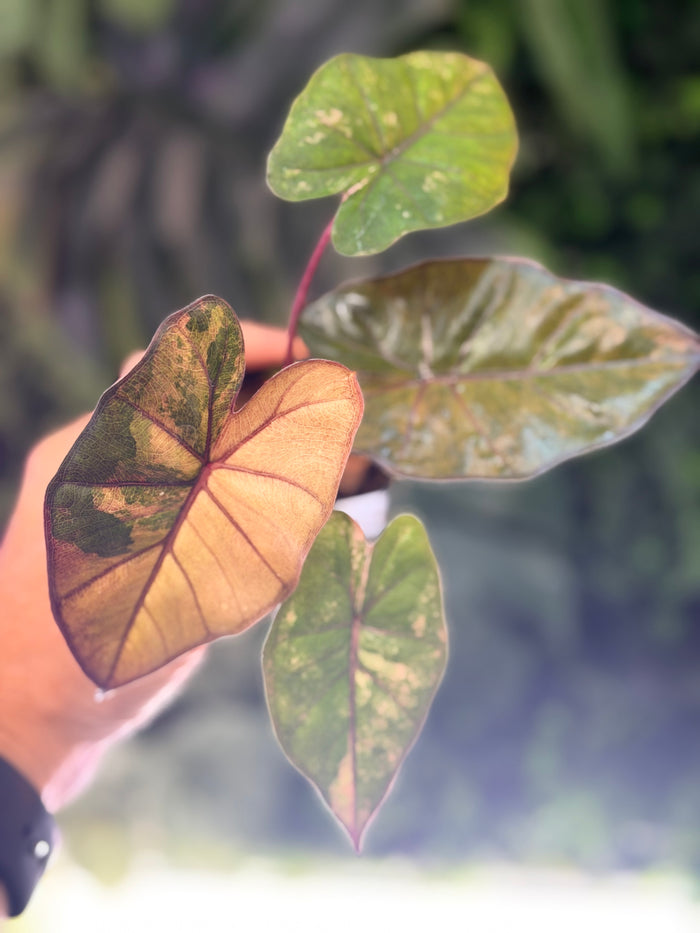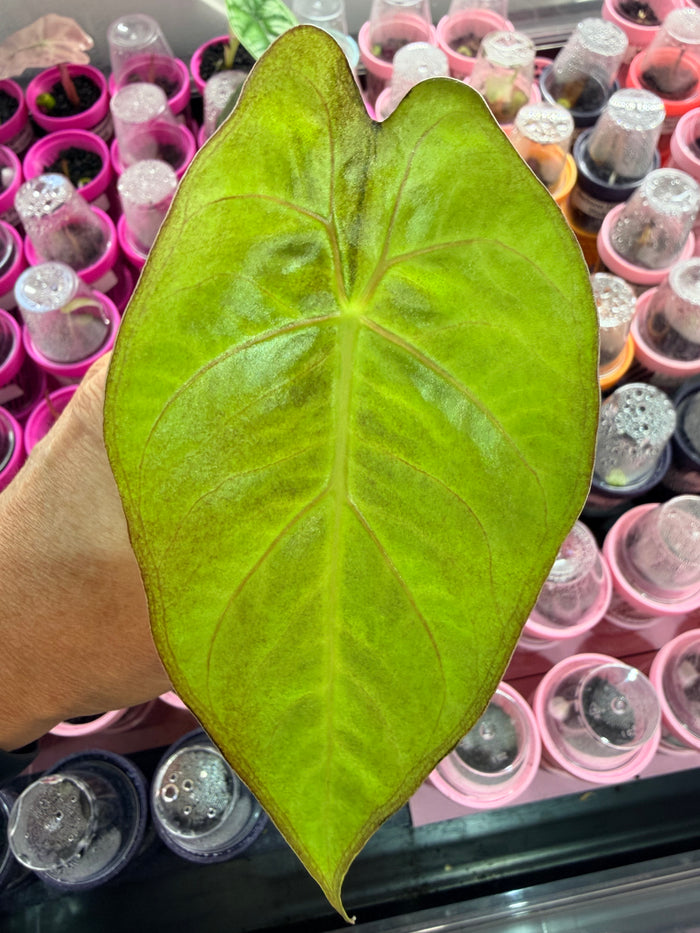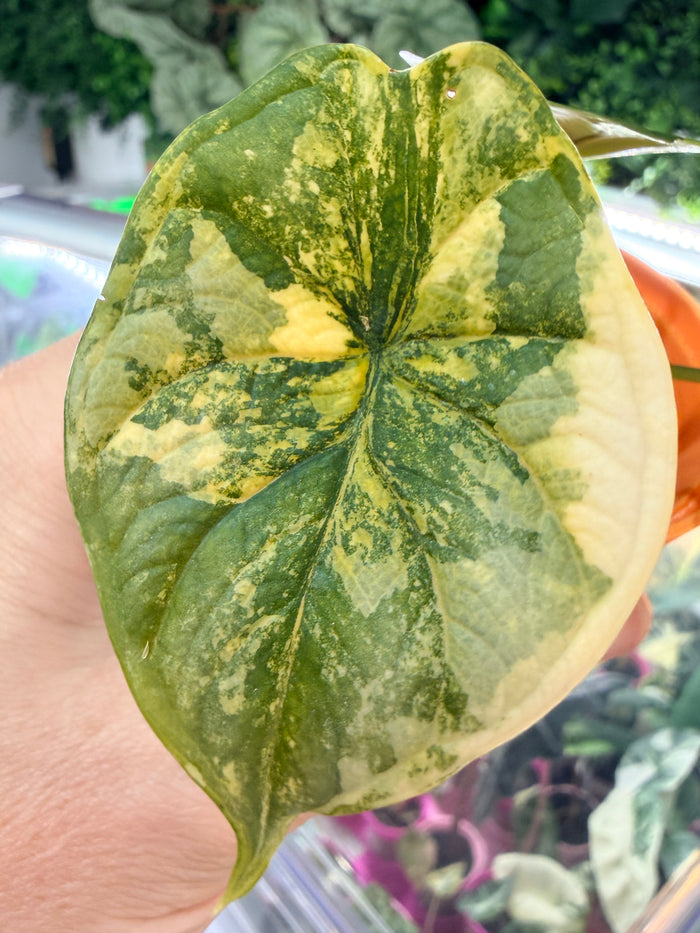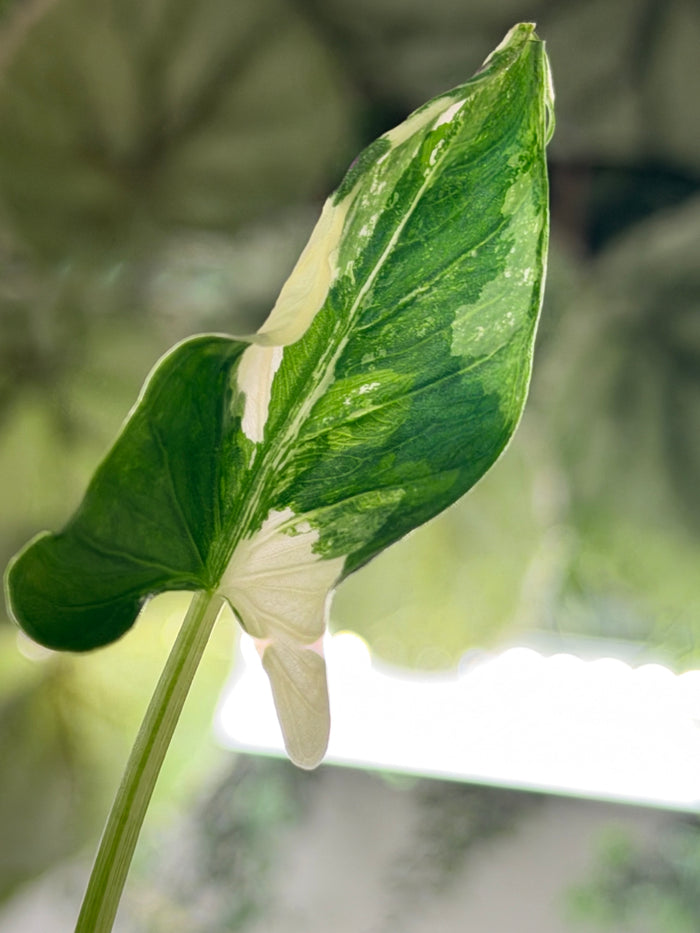

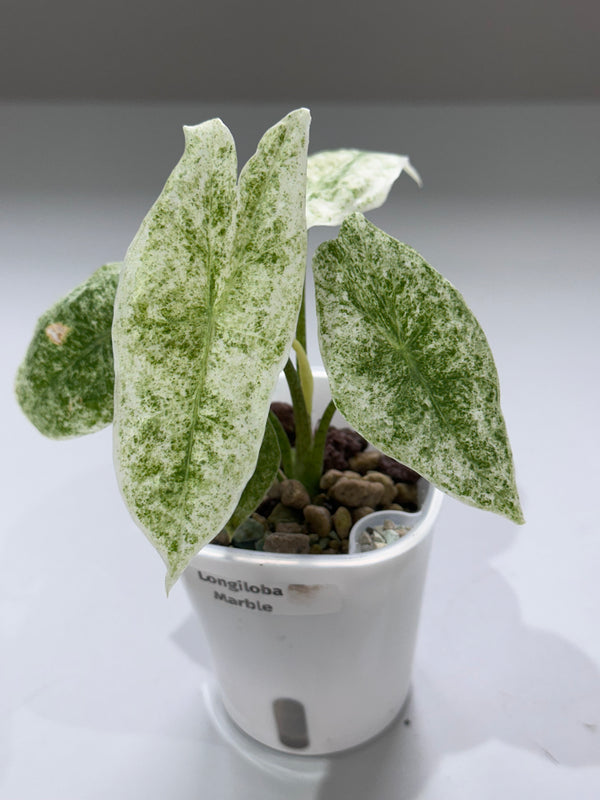
Alocasia longiloba Marble Variegated is a variegated form of the Alocasia longiloba complex, grown for irregular, flowing pale marbling over a dark green, arrow-shaped blade with silver veins. The name comes from the visual quality of its colour expression rather than from a specific variegation mechanism: the irregular, flowing distribution of lighter sectors against the deep green blade creates an effect genuinely reminiscent of marble, with veins of cream, pale green and white running through the darker base and interwoven with the silver primary venation that all longiloba forms share. On the large, arrow-shaped leaves of the longiloba complex this patterning rewards extended observation, as there is no single, clean sector boundary as in classic chimeric albo expression, but a diffuse, flowing distribution of colour that gives each leaf a uniquely dynamic quality. This guide covers what the plant is, where the species comes from, how marble variegation differs from other types and how to care for it. It also states clearly what is documented and what is not.
For the species as a whole, see our Alocasia longiloba species guide.
What is Alocasia longiloba Marble Variegated?
Marble Variegated is a trade description rather than a formally defined cultivar. It describes a longiloba whose lighter tissue, from pale green through cream to white, is spread through the blade in diffuse, veined patches instead of clean-edged sectors. The name describes how the leaf looks, not a specific mechanism.
Aroidpedia, our main reference for aroid naming and history, has a page for Alocasia longiloba and for several named cultivars, but it has no entry for a marble form. Who selected it, when and from what material is therefore not documented there, and we could not verify it elsewhere. What follows is based on the species entry and on what the plant itself shows.
Origin and naming of Alocasia longiloba
Clean boundaries are not something this species has ever offered, on the leaf or in the botanical record. Alocasia longiloba is the namesake of one of the most botanically complex, horticulturally significant and widely hybridised species groups in the genus. Aroidpedia gives the native range as Indochina to West and Central Malesia, excluding the Philippines, with records from Borneo, Sumatra, Java, Sulawesi, the Lesser Sunda Islands, Malaysia, Thailand, Cambodia, Laos, Vietnam, Myanmar and southern China including Hainan and Yunnan. Few Alocasia species cover so much ground, and the forms within it vary in leaf shape, venation character, underside colouration and growth habit; botanists have at various times treated several of them as separate species before consolidating them within the longiloba complex. It grows on forest floors, in swamp forest and regrowth, among boulders and on cliffs and ravines at low to medium elevations.
The epithet means long lobes, after the elongated posterior lobes of the blade. Aroidpedia cites the original description in Flora van Nederlandsch Indie (1856) and treats the group as an ochlospecies, a complex of forms that blend into one another. That variability is why names such as A. lowii, A. veitchii, A. watsoniana and A. thibautiana now sit under longiloba as synonyms, some of them continuing as cultivar names. The page also records that Lindley described Caladium veitchii from a cultivated plant said to come from Borneo, and that Schott, the world authority on Araceae at the time, moved it into Alocasia in 1863.
How to identify it
Aroidpedia describes a terrestrial to lithophytic herb of about 40 to 150cm from an elongate rhizome that can extend along the ground, with petioles of 30 to 120cm that are often mottled, and blades typically 27 to 65cm long, occasionally up to 85cm. Blades are often pendent and range from hastate-sagittate to ovate-sagittate, glossy dark green above with a rich purple to deep burgundy underside on many forms, and the major veins can be white to pale grey-green on top.
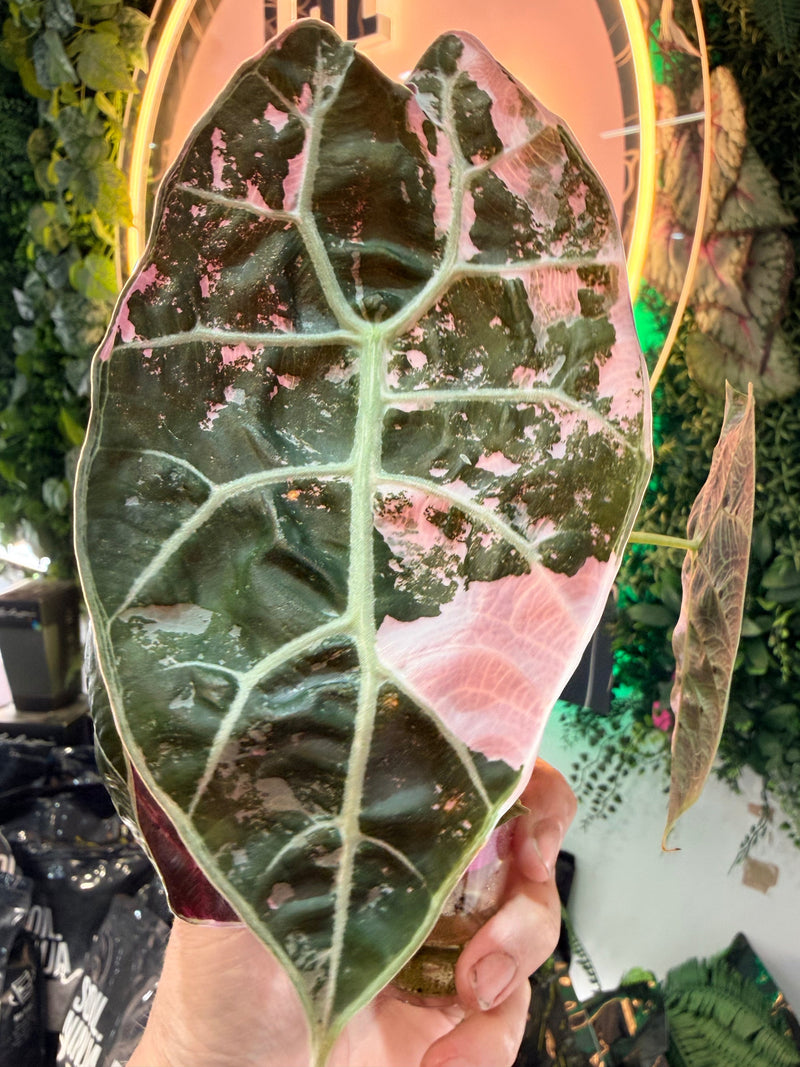
On the Marble form, look for pale patches that blur into the green rather than stopping at a clean line, often following the veins. The pattern differs from leaf to leaf, so no two leaves match.
Understanding marble variegation
Marbling is a description of distribution, not a pigment type. The marble effect arises when chimeric or carotenoid-based variegation is distributed across the leaf blade in an irregular, flowing pattern rather than as cleanly bounded sectors. Where the lighter tissue is white or cream it is largely without chlorophyll, as in albo variegation; where it is pale green or mint it simply has less chlorophyll; where it is yellow, as in aurea variegation, carotenoids are retained. Aroidpedia notes that variegated longiloba forms occur in white, mint and yellow. Our complete guide to Alocasia variegation types sets these side by side.
Diffuse edges are consistent with a chimeric plant in which the boundary between variegated and normal cell layers is uneven, though we cannot say that is proven for every marbled plant. Practical consequences follow. A leaf with a lot of white has less photosynthetic tissue, so growth can vary between individual plants and between leaves. Cream or white marbling contains less chlorophyll than pale green marbling, so a leaf with extensive white marbling will have reduced photosynthetic output compared with one where the lighter areas are predominantly pale green. And as with other chimeras, the marbling may not carry over to corm-grown plants.
The marble quality is most compelling on the longiloba because of the scale and architecture of the leaves. The large, lobed blade with its prominent silver primary and secondary venation provides a structural grid through which the marble patterning flows, and the veins create visual order within the flowing distribution of lighter and darker tissue, so the effect reads as richly complex rather than disordered. Each new leaf is entirely distinct and the pattern never repeats, which gives the Marble Variegated longiloba a perpetual freshness that more regular variegation patterns do not provide.
Alocasia longiloba Marble Variegated care
This is general Alocasia care, and it applies to this plant as it does to the rest of the genus.
Provide bright indirect light, with LED grow lights added where natural light is limited. Good light keeps the contrast between pale and dark tissue clear; in weak light the pale areas tend to green up. Keep the temperature at 20 to 27°C and humidity at 60 to 80%. Water thoroughly once the top 2 to 3cm of the mix has dried. Fluval Stratum is our preferred substrate, and a heat mat helps if the room runs cool. Feed at half strength using our Alocasia feed from the plant feed range.
The large leaves of the longiloba are more susceptible to spider mites than compact species, so check the undersides regularly and treat early with the pest control range. The ultimate Alocasia care guide and our root rot guide cover the wider picture.
Propagating from corms
Our Alocasia corm propagation guide explains the method in full. We use a self-wicking approach: the corm sits in Fluval Stratum in a Corm Keeper, which supplies moisture evenly from below. See also growing Alocasia corms in Fluval Stratum and how long a corm takes to sprout, or browse corms.
How it compares to similar plants
The Lime Lava carries bright yellow-green patches, the mint variegated longiloba is paler green, and the Lava King Cobra works in subtle green tones. The pink back albo longiloba combines white sectors with a pink underside. For white variegation on other species, browse the albo variegated Alocasia collection.
Aroidpedia calls longiloba the most prolific parent in Alocasia hybridising since the mid-1800s, including Alocasia × amazonica, from 'Watsoniana' crossed with A. sanderiana. That cross is sold as "African Mask" or "Alocasia Polly" and is one of the most widely sold houseplants in the world, which established the complex as foundational to modern decorative Alocasia cultivation. Numerous other hybrids in current collector cultivation trace their lineage to longiloba forms, so a marbled specimen sits at one end of a lineage that runs from a variable wild complex to the most familiar Alocasia on the market. Our Amazonica group guide follows that line.
Frequently asked questions
What does marble variegation mean?
It describes lighter tissue spread through the leaf in flowing, soft-edged patches rather than clean sectors. It is a visual term, not a single pigment type.
Is Marble Variegated documented on Aroidpedia?
No. Aroidpedia has an entry for Alocasia longiloba and several named cultivars, but none for a marble form, so its history is not documented there.
Is marble variegation stable?
Not reliably. The pattern changes from leaf to leaf, and chimeric variegation may not carry over to corm-grown plants.
Why is the marbling fading?
Low light is the common cause, because chlorophyll builds up in the pale tissue. Brighter, steadier light with LED supplementation helps.
Do white areas affect growth?
They can. Tissue with little or no chlorophyll contributes less energy, so heavily marbled plants may grow more slowly than greener ones.
How big does it get?
Aroidpedia gives the species as about 40 to 150cm tall with blades typically 27 to 65cm. Size on an individual variegated plant can be smaller.
We release plants like this through our drop model. Join the collector list for early access, and see our Alocasia Longiloba Marble Variegated listing.
Questions about Alocasia longiloba Marble Variegated? Contact our team for guidance from specialists who grow rare Alocasia in our UK-based private nursery. We are happy to help with light, watering and identification questions.