
Alocasia longiloba Lava King Cobra is a collector name attached to a form of the Alocasia longiloba complex, one of the most widely hybridised species groups in the genus. This guide explains what the species is, how it was named, what is and is not documented about the Lava King Cobra name, how to compare it with related plants, and how to care for it.
What is Alocasia longiloba Lava King Cobra?
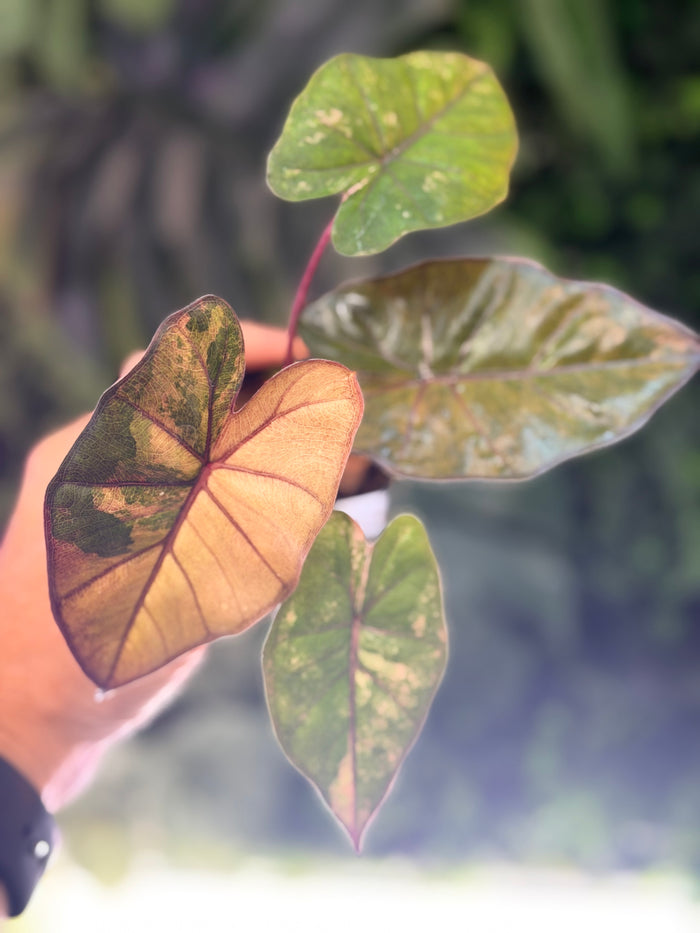
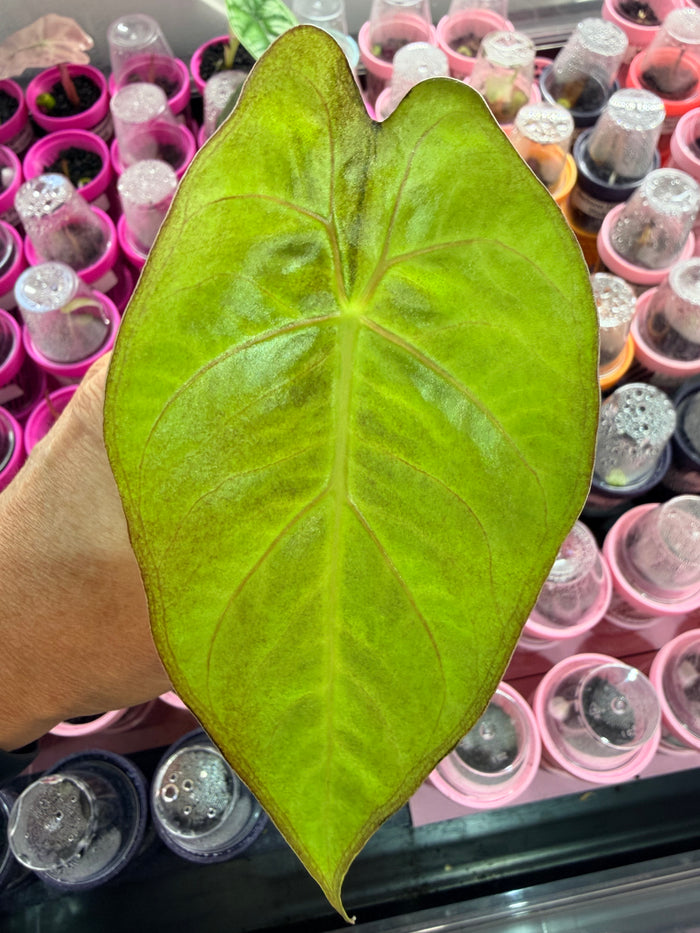
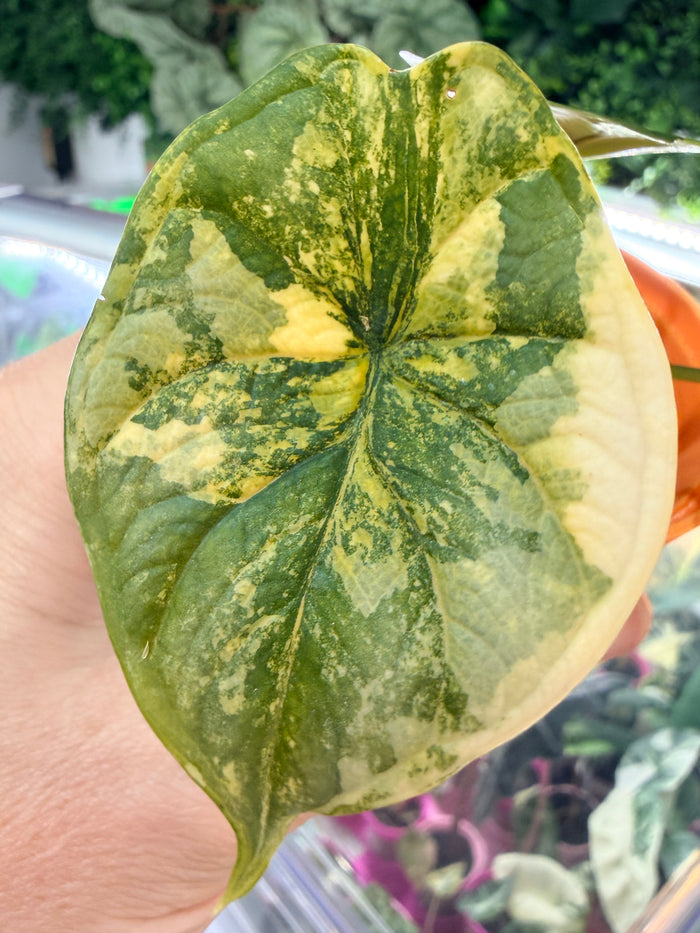
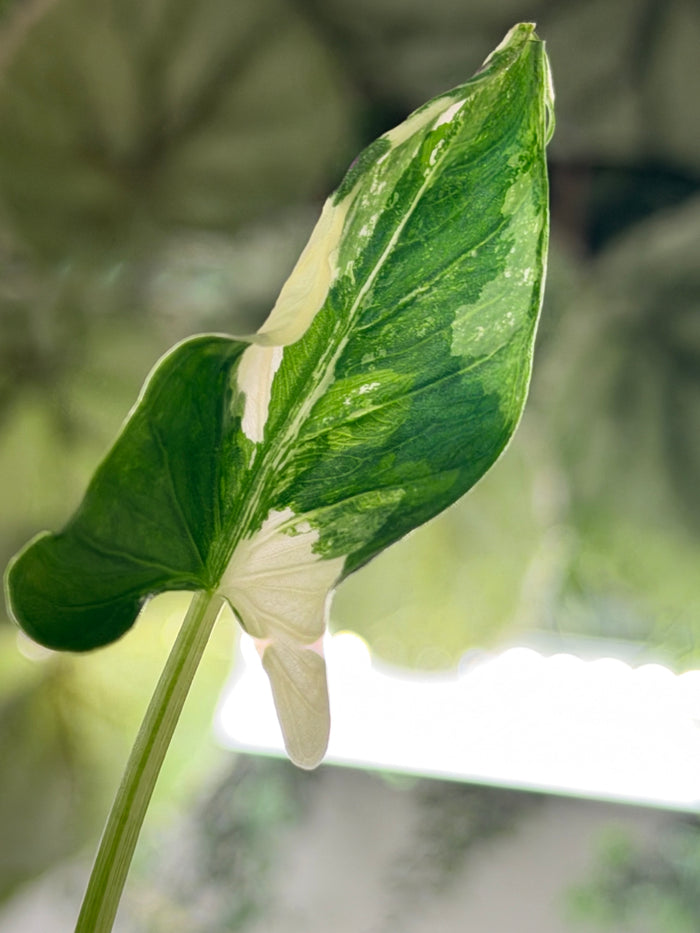
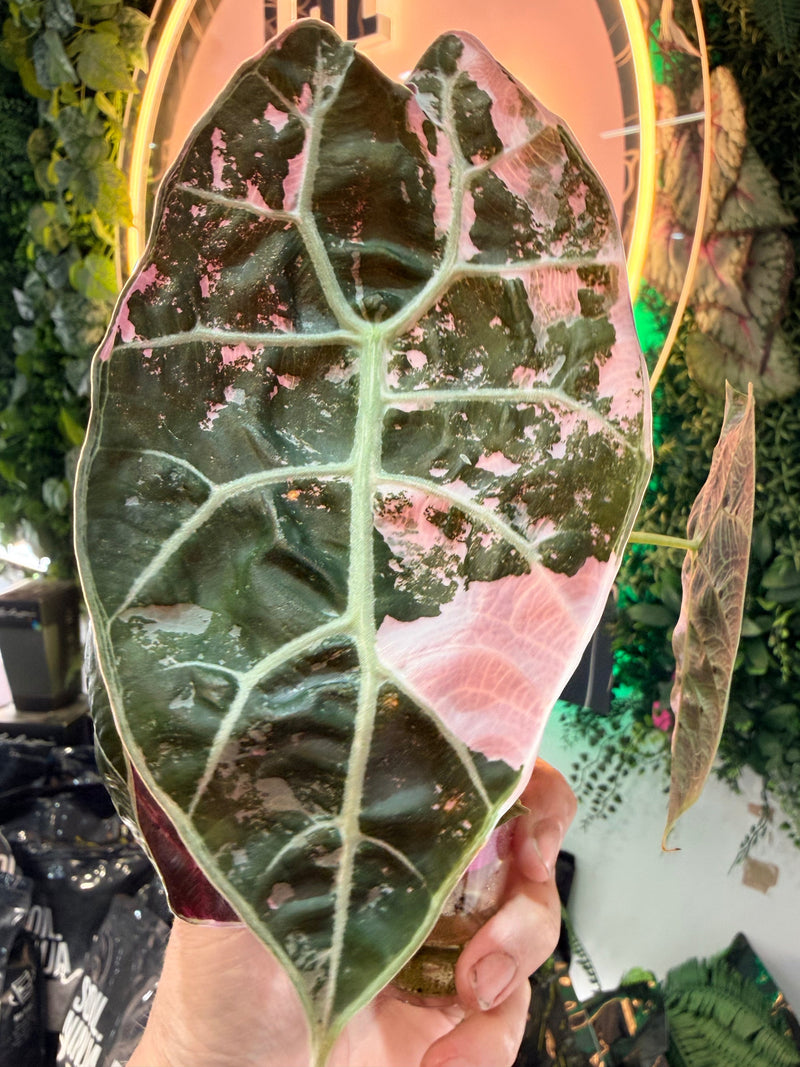
Aroidpedia, our primary reference, has an entry for Alocasia longiloba but no entry for a cultivar called Lava King Cobra, and none of the named cultivars it lists on that page uses either word. We therefore treat Lava King Cobra as a trade name rather than a documented cultivar. We describe our plant as a green-on-green form with strongly defined veins, but there is no published breeder, origin, parentage or date that we can point to, and we will not invent one. Aroidpedia records white, mint and yellow variegation for the species as a whole; green-on-green is not among the forms it lists for A. longiloba.
The plant stands apart from the broader variegated Alocasia world in a specific way: it expresses what is known as green-on-green or lava variegation, a subtle tonal variation within the green spectrum rather than the high-contrast expression of albo, aurea or mint variegation. The 'King Cobra' designation refers to the distinctive venation pattern that gives the leaves their snake-like quality: bold, raised and geometrically precise primary veins creating a pattern that collectors describe as resembling the markings of a king cobra. The lava variegation adds a flowing, irregular distribution of slightly different green tones to this already distinctive venation architecture, creating a plant that is less immediately dramatic than the high-contrast variegated forms but arguably more botanically interesting on close inspection.
Origin and naming of Alocasia longiloba
The epithet refers to the long lobes of the blade. Aroidpedia gives the original publication as Flora van Nederlandsch Indie, volume 3, in 1856. It also records that John Lindley described a cultivated plant said to have come from Borneo as Caladium veitchii, and that Heinrich Schott, the world authority on Araceae at the time, made the combination in Alocasia in 1863, citing a Java collection. Many former species names, including A. watsoniana, A. lowii, A. denudata, A. thibautiana and A. veitchii, now sit as synonyms, which is why the group is so tangled.
The native range runs from Indochina to West and Central Malesia, excluding the Philippines: Cambodia, parts of China including Hainan and Yunnan, Java, Sumatra, Sulawesi, the Lesser Sunda Islands, Laos, Malaysia, Myanmar, Thailand, Vietnam and Borneo. Aroidpedia describes it as growing on rainforest and swamp-forest floors, on boulders and on cliffs and ravines at low to medium elevation. Few Alocasia species have that geographic breadth, and the diversity within the complex follows it: leaf shape, venation character, underside colouration and growth habit all vary between forms that botanists have at various times treated as separate species before consolidating them within the longiloba complex.
How to identify the longiloba complex
Aroidpedia describes a small to robust herb, 40 to 150cm tall, terrestrial or lithophytic, with an elongate rhizome that is often exposed. Petioles are 30 to 120cm long and frequently mottled chocolate brown. Blades are extremely variable in shape, usually 27 to 65cm long, mid to dark green above with white to pale grey-green major veins, and rich purple beneath. In cultivation the upper surface is typically glossy dark green with prominent silver-white midribs and primary veins, over undersides that run from rich purple to deep burgundy, on a robust rhizomatous base that can extend along the ground. Because the species is so variable, the pale venation is the most dependable cue; it is also the feature that a name like King Cobra seems to be pointing at.
Aroidpedia lists these named cultivars: 'Grandis', 'Korthalsii', 'Lowii', 'Purple', 'Putzeysii', 'Thibautiana', 'Veitchii' and 'Watsoniana', and notes a 'Silver' form that circulates in trade with no documented origin. Lava King Cobra falls into the same category as 'Silver': a name in circulation without a documented history.
About green-on-green variegation
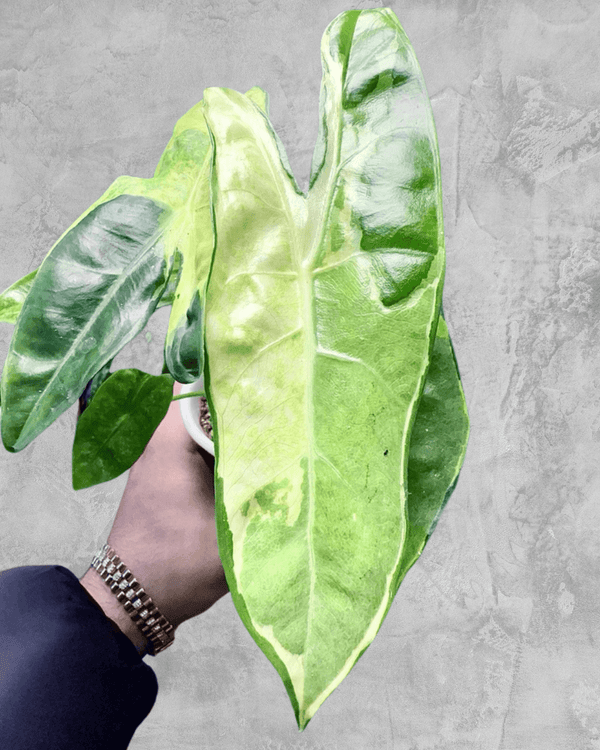
Green-on-green variegation describes tonal differences within green tissue, such as darker and lighter patches, rather than the loss of chlorophyll seen in albo or aurea sectors. Because every sector keeps its chlorophyll, such patterning is generally less demanding than white-sectored forms. We cannot confirm from published sources what produces the pattern on this particular plant, and it is also worth remembering that vein contrast and tonal patterning on an Alocasia can change with light level and leaf age, so judge a plant over several leaves rather than one. Our complete guide to Alocasia variegation types places the different forms side by side.
Sometimes described as lava variegation when it has a flowing, irregular distribution, green-on-green is a different kind of colour complexity from the standard white, yellow or mint forms. Rather than the complete suppression or dramatic alteration of chlorophyll production in affected sectors, it involves subtle differences in chloroplast density or distribution between adjacent tissue areas, producing tonal variations within the green spectrum. The effect can read as darker islands within a lighter green background, lighter flows through a deeper green matrix, or patterned areas where the surface sheen or texture differs from adjacent tissue.
In the Longiloba Lava King Cobra this expression is overlaid on a leaf architecture where the venation itself is a primary visual feature. The bold, raised primary veins, with their geometric, almost reptilian quality, create a structural grid through which the lava variegation flows. Unlike the silver venation of the standard longiloba forms, the King Cobra venation has a heavier, more sculptural quality that creates physical as well as visual interest on the leaf surface.
Collectors who appreciate green-on-green variegation value it precisely because it is underrepresented in the collector market relative to albo and aurea forms. It is, in some senses, a connoisseur's variegation, one that requires close attention rather than immediate impact and that reveals its complexity progressively rather than instantly. In a collection, the Lava King Cobra provides tonal and textural contrast against higher-contrast variegated specimens in ways that simple colour variation cannot achieve.
Unlike albo or mint variegated forms, the green-on-green expression means the plant has full or near-full photosynthetic capacity in all sectors. That gives it excellent vigour compared with white or pale variegated forms, and it is somewhat more resilient under brief periods of suboptimal care. The expression is also more stable than chimeric albo variegation, and it does not carry the same risk of greening out or reverting that white albo forms present.
How it compares with similar plants
Aroidpedia calls A. longiloba the most prolific parent in Alocasia hybrids, used since the middle of the 1800s. It records 'Amazonica' as A. sanderiana crossed with A. longiloba 'Watsoniana', and lists 'Polly', 'Loco', 'Venom', 'Mandalay' and 'Purpley' under the same parentage. Alocasia × amazonica is better known as "African Mask" or "Alocasia Polly" and is one of the most widely sold houseplants in the world. That hybrid established the complex as foundational to modern decorative Alocasia cultivation, and numerous other hybrids in current collector cultivation trace their lineage to longiloba forms. If you are weighing the Lava King Cobra against its relatives, these guides are the closest comparisons:
- Alocasia longiloba species guide
- Longiloba pink back
- Longiloba lime lava
- Longiloba marble variegated
- Longiloba mint variegated
- Alocasia amazonica group guide
Our Alocasia house plants collection shows how these forms sit alongside the rest of the range.
Care for Alocasia longiloba Lava King Cobra
This is general Alocasia care that applies to this plant; Aroidpedia gives no cultivation instructions for it.
- Light: bright, indirect light, supplemented with LED grow lights where natural light is limited.
- Temperature and humidity: 20 to 27°C with humidity of 60 to 80 percent. A heat mat helps if the room runs cool.
- Water: water thoroughly when the top 2 to 3cm has dried. If roots decline, our root rot guide explains how to diagnose and recover them.
- Substrate: Fluval Stratum is our preferred substrate; more options are in our substrates and growing media collection.
- Feeding: our Alocasia feed from the plant feed range, at half strength every 2 to 3 weeks.
The ultimate Alocasia care guide goes into more depth. Place the plant where the light rakes across the leaf, so that the vein structure is visible at close range.
Propagating from corms
Aroidpedia describes the species rhizome as sometimes swollen and sub-cormous, and many collectors begin with corms. Our Alocasia corm propagation guide sets out the self-wicking method we use, with a firm corm set in Fluval Stratum inside the Corm Keeper. See also growing Alocasia corms in Fluval Stratum. Variegation or tonal patterning from a parent plant might not carry over to a corm-grown plant.
We release Longiloba Lava King Cobra through our drop model. Join the collector list for advance notification and view our Alocasia Longiloba Lava King Cobra listing.
Frequently asked questions
Is Lava King Cobra a recognised cultivar?
Not in Aroidpedia, which does not list it. We treat it as a trade name with no documented origin.
Where does Alocasia longiloba come from?
From Indochina through West and Central Malesia, excluding the Philippines, according to Aroidpedia.
How large does the species grow?
Aroidpedia gives 40 to 150cm tall, with blades usually 27 to 65cm long.
Is it related to Alocasia amazonica?
Longiloba is a parent group of the amazonica cross: 'Amazonica' is recorded as A. sanderiana crossed with A. longiloba 'Watsoniana'.
Does it need different care from other Alocasia?
No cultivar-specific requirements are documented, so general Alocasia care applies.
Questions about the Lava King Cobra or the longiloba complex? Contact our team for guidance from specialists who grow rare Alocasia in our UK-based private nursery. We are glad to help you tell the related forms apart.