
The Alocasia longiloba Pink Back is a collector's name for a longiloba-type plant with pink-toned leaf undersides. Most attention in the genus goes to what happens on the upper surface of the blade, such as variegation, velvet or venation. A Pink Back asks you to look underneath, where the colour is meant to sit. This guide explains where the plant fits within the Alocasia longiloba complex, what is and is not documented about the form, and how to grow it well in a UK home.
What is Alocasia longiloba Pink Back?
Pink Back is a descriptive trade name rather than a formally documented cultivar. Aroidpedia has an entry for the species Alocasia longiloba but no separate entry for a Pink Back form, and its species page describes the typical leaf underside as a rich purple. We therefore cannot point to a published origin, breeder, date or formal description for the Pink Back, and we would rather say so than invent one. What we can say is that it is grown and sold as a longiloba with a pinker, less purple-leaning underside than the typical plant.
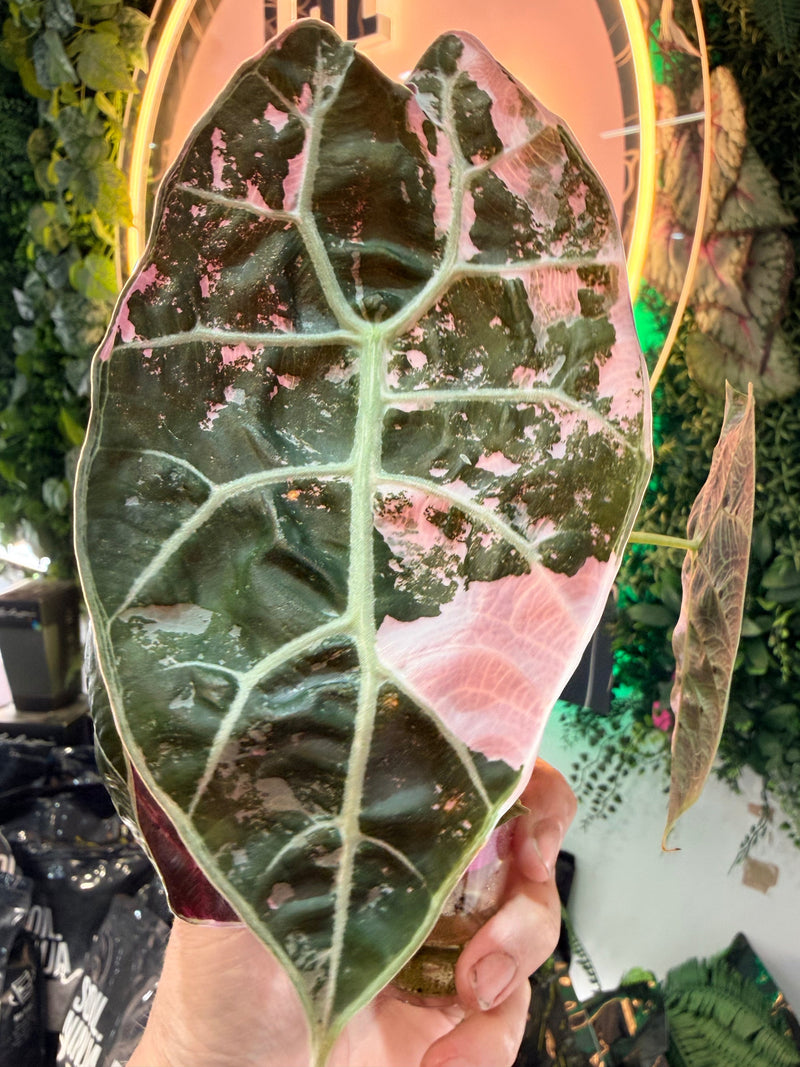
Where most collector attention focuses on blade colouration, variegation pattern and venation, all characteristics of the upper (adaxial) surface, the Pink Back delivers its primary visual drama on the lower (abaxial) surface: a vivid, saturated pink that replaces the standard purple or deep burgundy underside of most longiloba forms. When the large, arrow-shaped leaves move in air circulation, which they do readily given their size and the length of their petioles, the pink undersides flash dramatically, and when leaves are lit from behind or seen at an angle the pink reads through the translucent margins of the blade, adding a warm glow to the entire leaf.
Aroidpedia does list a separate cultivar, Alocasia longiloba 'Purple', described as having pinkish tones on the upper leaf and a purplish underside; that is a different entry and should not be assumed to be the same plant. Because naming in this complex is unsettled, a pink-backed plant could represent more than one form, so treat the label as a description of appearance.
The Alocasia longiloba complex: origin and naming
Aroidpedia gives the native range of Alocasia longiloba as Indochina to West and Central Malesia, excluding the Philippines, with records including Borneo, Java, Sumatra, Sulawesi, Thailand, Vietnam, peninsular Malaysia, Myanmar and southern China. The wider distribution also takes in Cambodia, Laos, Hainan, Guangdong and southern Yunnan. It grows on rainforest and swamp-forest floors, in regrowth and on boulders and ravine sides at low to medium elevation. The epithet refers to the long lobes of the blade, and Aroidpedia cites the original description as published in 1856. European botanists documented the group in the mid-19th century, with John Lindley describing a cultivated plant from Borneo and Heinrich Wilhelm Schott, the leading authority on Araceae at the time, placing it formally within Alocasia.
The name has absorbed many older names. Aroidpedia lists a long run of synonyms, including A. veitchii, A. lowii and A. watsoniana, which is why longiloba is best thought of as a complex of related forms rather than a single uniform plant. Few Alocasia species have that geographic breadth, and the forms within the complex differ in leaf shape, venation character, underside colouration and growth habit, several having been treated as separate species by botanists at various times before being consolidated within the longiloba complex. Aroidpedia also records it as the most prolific parent of Alocasia hybrids, used since the mid-1800s. One well-known example is the widely sold Alocasia 'Amazonica', which Aroidpedia lists as A. sanderiana × A. longiloba 'Watsoniana'. You can read more in our Amazonica group guide and our Polly hybrid story.
How to identify a longiloba and its pink underside
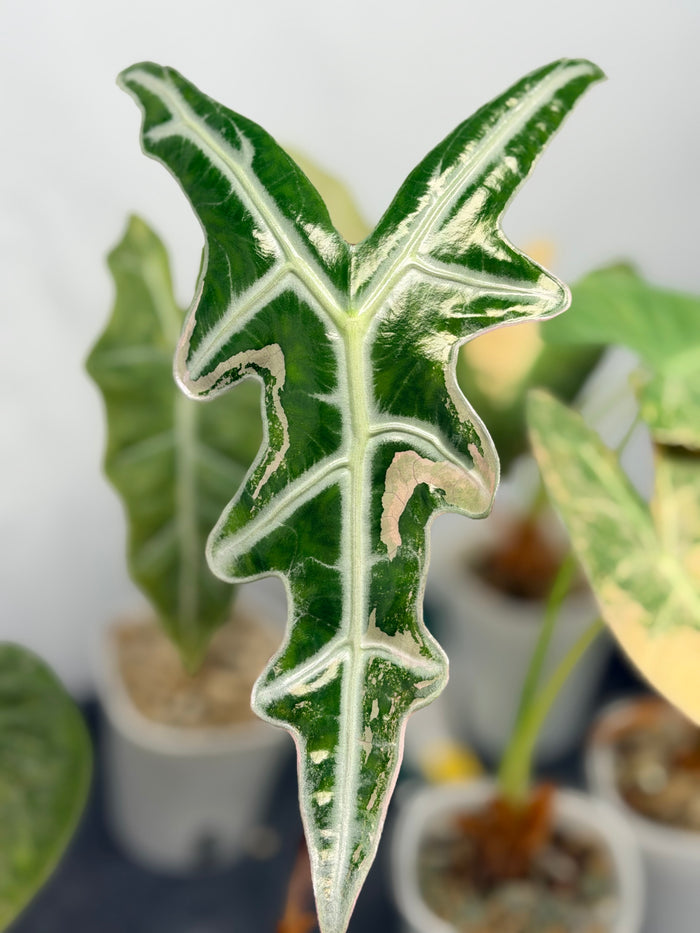
Aroidpedia describes the species as 40 to 150cm tall, with petioles of 30 to 120cm and blades typically 27 to 65cm long, hastate-sagittate to ovate-sagittate in shape and mostly peltate. The upper surface is mid to dark green with paler major veins. Petioles vary from green to pink or purple-brown and are often mottled with chocolate brown. In cultivation the typical form has a robust rhizomatous base that can extend along the ground, glossy dark green upper surfaces and prominent silver-white midribs and primary veins, with rich purple to deep burgundy beneath.
A Pink Back is recognised by turning the leaf over, where the underside should read pink rather than the deep purple typical of the species. Judge colour on a mature, well-lit leaf rather than on a single new one. Aroidpedia does not document whether the effect is a stable, genetically fixed trait; from our own growing it is a constitutive, stable characteristic, as set out below. Collectors who position their Pink Back where light catches the leaf undersides, or where air movement causes the leaves to shift and reveal them periodically, will get the most from its character.
Is a pink underside the same as pink variegation?
No. Pink variegation in Alocasia is anthocyanin-based and chimeric, meaning it appears as patches or sectors that can be unstable and might not carry over to plants grown from corms. A pink underside is a colour of the whole leaf back rather than a mosaic of tissues. If you want to understand the chimeric kind, read the mystery of pink variegation in Alocasia and the complete guide to variegation types, or browse the pink variegated Alocasia collection.
The pink of the Pink Back arises from anthocyanin pigments, the same pigment class responsible for pink variegation in chimeric pink Alocasia, but expressed constitutively, as a stable characteristic of the plant, on the lower surface rather than as a chimeric mutation on the blade. All longiloba forms carry some anthocyanin in the leaf underside, which is why the standard form is purple to deep burgundy beneath, but in the Pink Back the expression is more intense and in a distinctly pink rather than purple register, suggesting either a different anthocyanin composition or a higher concentration that gives a warmer, more saturated tone.
This is not variegation in the traditional sense: it does not involve sectors of different tissue on a single surface, and it does not carry the instability or propagation constraints of chimeric variegation. The characteristic is constitutive and relatively stable, so every leaf a Pink Back produces expresses the pink underside to a consistent degree. That stability is a genuine advantage over chimeric variegated forms for collectors who want reliable, consistent colour without the management complexity of albo or aurea forms.
Alocasia longiloba Pink Back care
This is general Alocasia care that applies to this plant, and nothing here is specific to the Pink Back form.
- Light: bright indirect light, supported by LED grow lights where daylight is thin.
- Temperature and humidity: 20 to 27°C and humidity of 60 to 80%. If the room runs cool, a heat mat under the pot helps root activity.
- Watering: water thoroughly once the top 2 to 3cm of substrate has dried, and let excess drain away. Persistently wet roots lead to rot, which is covered in our root rot guide.
- Substrate: our preferred choice is Fluval Stratum.
- Feeding: use our Alocasia feed or another product from the plant feed range at half strength.
Because the plant can reach a large size, give it room and a pot that matches its root mass. Our ultimate Alocasia care guide goes deeper on all of the above.
Propagating Alocasia longiloba Pink Back from corms
Corms, where a plant produces them, can be grown on using the self-wicking method with Fluval Stratum in our Corm Keeper. The full method is in our Alocasia corm propagation guide. Aroidpedia does not document how a Pink Back behaves from corms; because the pink is constitutive rather than chimeric, it does not carry the propagation constraints of chimeric variegation.
How Pink Back compares with other longiloba forms
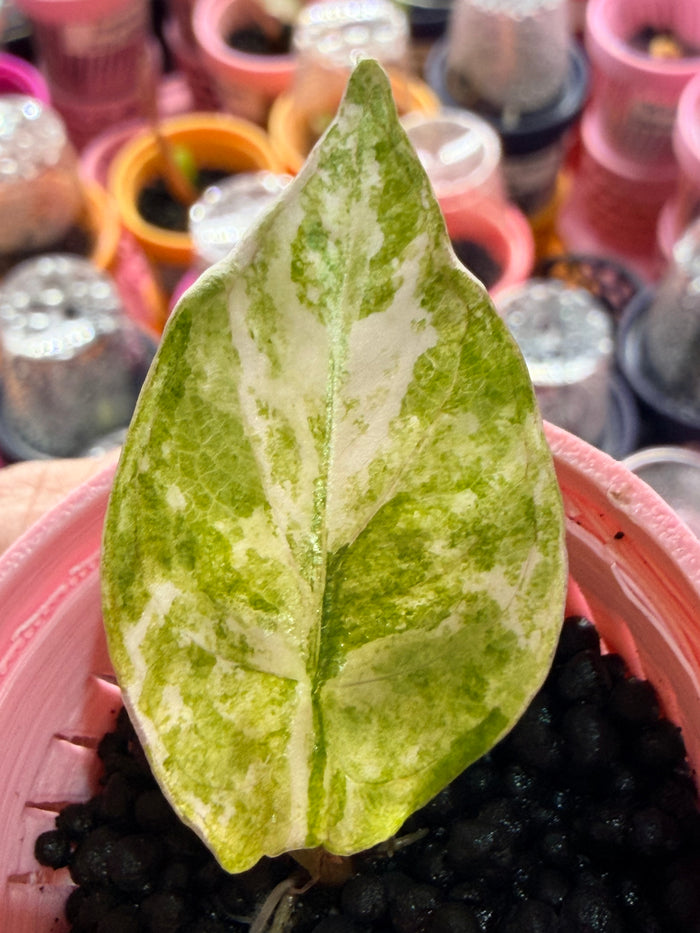
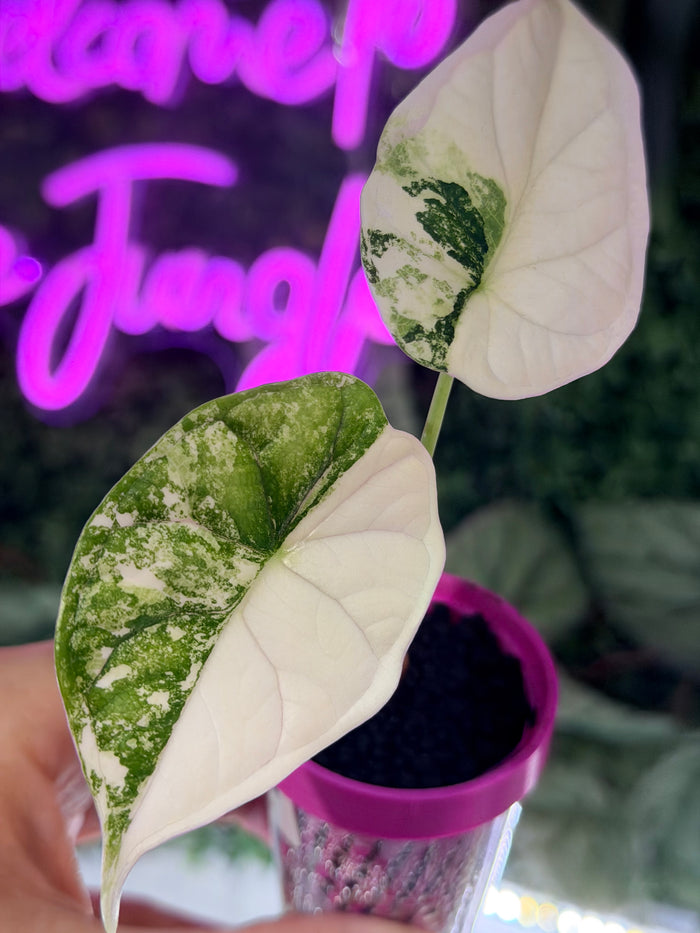
Within the complex there are several forms worth knowing. Our longiloba species guide is the best starting point. Variegated or patterned relatives include the Pink Back Albo, the Marble variegated, the Mint variegated, Lava King Cobra and Satun Stardust.
We release plants through our drop model; see how to join the collector list for early access, and browse the wider Alocasia house plants collection.
Frequently asked questions
Is Alocasia longiloba Pink Back a true cultivar?
It is a trade and collector name. Aroidpedia has no separate entry for it, so no formal origin or breeder is documented.
Why is the underside pink and not purple?
The typical longiloba underside is described by Aroidpedia as rich purple. Aroidpedia does not document the reason some plants read pinker for this form; from our own growing, it is constitutive anthocyanin pigmentation, expressed more intensely and in a pinker register than the typical purple.
Is a Pink Back the same as a pink variegated Alocasia?
No. Pink variegation is chimeric and sits on the blade in sectors, while a pink underside is a colour of the whole leaf back.
How big does it get?
Aroidpedia gives 40 to 150cm for the species as a whole. A given plant will vary with conditions.
What care does it need?
The same general care as other Alocasia: bright indirect light, warmth, humidity and a free-draining substrate watered when the top 2 to 3cm has dried.
Questions about Alocasia longiloba Pink Back? Contact our team for guidance from specialists who grow rare Alocasia in our UK-based private nursery. We are happy to help you work out which longiloba form suits your space.
From the nursery