Alocasia Longiloba Pink Back Albo: The Complete Collector's Guide

Currently sold out
LONGILOBA PINK BACK ALBO VARIEGATED
New plants go to the drop list first.
Join the drop listAlocasia longiloba pink back albo is a collector form that pairs white-sectored (albo) leaves with a pink-toned back to the leaf, set on one of the most widely hybridised Alocasia complexes. This guide sets out what Alocasia longiloba is, where it comes from, how to identify it, what albo variegation means for the plant, and how to care for it in a UK home. Aroidpedia, our primary reference, has an entry for the species but not for this form, and we flag clearly where the cultivar-specific detail is not documented.
What is Alocasia longiloba pink back albo?
It is an albo variegated plant of Alocasia longiloba that is sold with a pink-coloured underside to the leaf. Aroidpedia lists white, mint and yellow among the variegated forms of the species, so white (albo) variegation on this plant is recognised. It does not list a 'Pink Back' or 'Pink Back Albo' cultivar, and it records no breeder, date of origin or parentage for such a plant. Aroidpedia does not confirm anything more specific than that, including whether the pink back is a stable, inherited trait; from our own growing, the pink back is a constitutive, stable characteristic, as set out below.
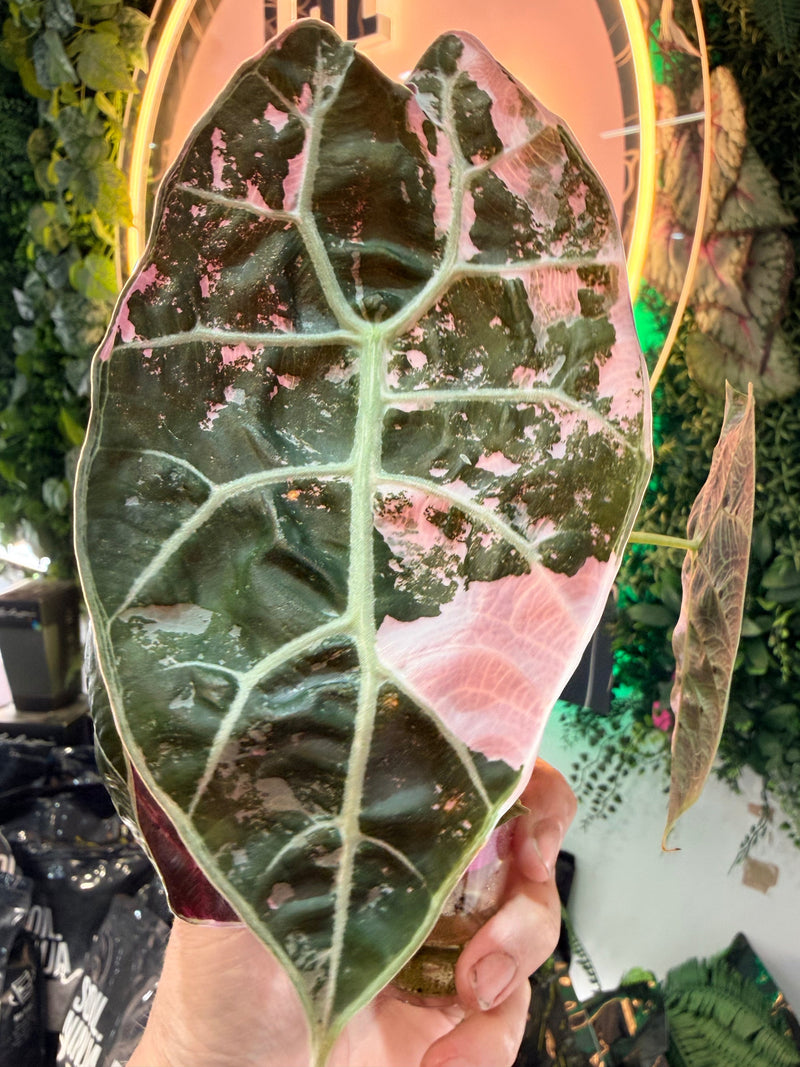
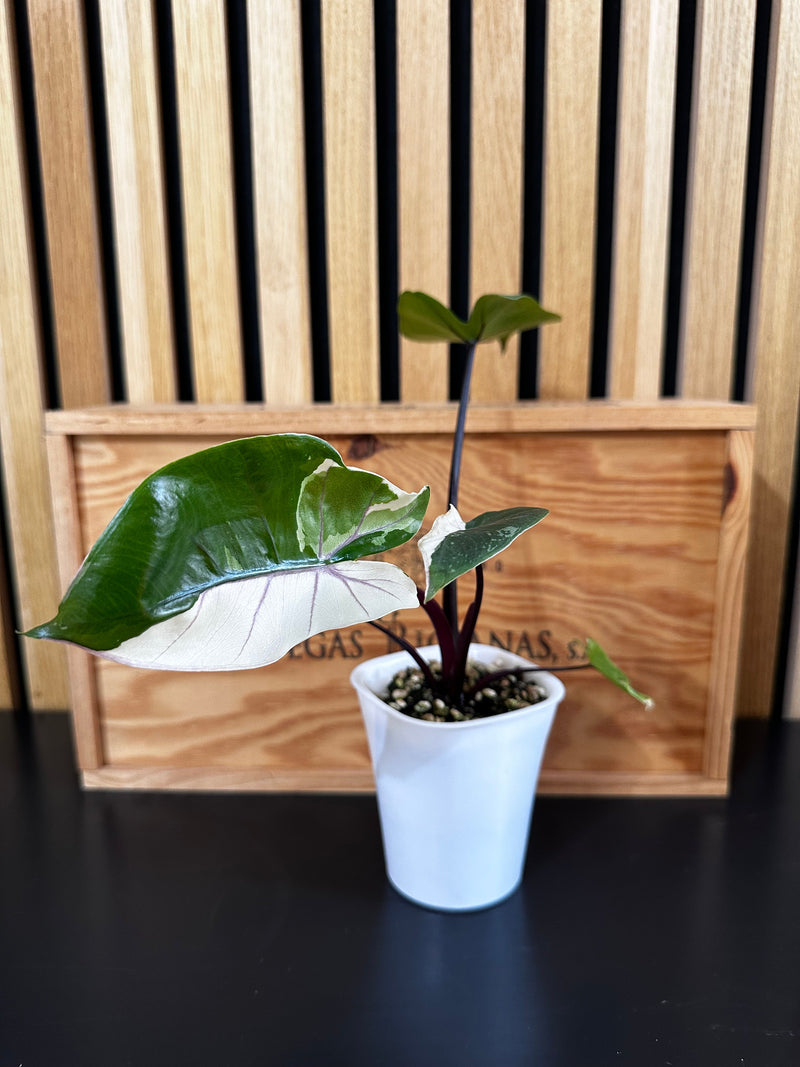
This is the most visually complex form in the longiloba Pink Back family, a specimen where chimeric albo variegation on the upper surface combines with the vivid pink anthocyanin expression of the Pink Back underside. The result is a leaf with four distinct colour elements: white albo sectors, deep green tissue, silver-white venation, and a saturated pink underside that flashes when the leaf moves or is viewed at an angle. No other longiloba form carries this combination, and few Alocasia cultivars anywhere in current collector cultivation present this specific layering of variegation type and constitutive colour expression in a single specimen.
What the reference does tell us is that the species commonly has coloured undersides. Aroidpedia describes blades that are dark green above with a rich purple underside, and petioles that can be purple-brown, pink or green. It also documents a cultivar called 'Purple', a selection of the form long grown as 'Denudata' that reached Europe from Singapore with Jean Linden in the mid-1860s and is valued for its deep purple back. That is a separate named plant and we do not suggest the pink back form is the same thing. Our Alocasia longiloba species guide covers the base plant in more depth.
Origin, range and naming of Alocasia longiloba
Aroidpedia gives the range as Indochina through to West and Central Malesia, excluding the Philippines, covering Borneo, Cambodia, southern China (Guangdong, Hainan and southern Yunnan), Java, Sumatra, Sulawesi, Laos, Malaysia, Myanmar, Thailand and Vietnam. It grows on rainforest and swamp-forest floors, among boulders, and on cliffs and ravines at low to medium elevation. Alocasia longiloba is the namesake of one of the most botanically complex, horticulturally significant and widely hybridised species groups in the genus, and few Alocasia species have that geographic breadth. The forms within the complex vary in leaf shape, venation character, underside colouration and growth habit, several of them treated as separate species by botanists at various times before being consolidated within the longiloba complex.
The species was published in 1856, and the epithet refers to the long lobes of the leaf. Lindley described Caladium veitchii from a cultivated Bornean plant and Schott transferred it to Alocasia in 1863. Aroidpedia now lists names such as A. lowii, A. veitchii, A. watsoniana and A. thibautiana as synonyms, and treats the whole group as an ochlospecies, a continuum of variation in which distinct forms can occur side by side. Its named cultivars are 'Grandis', 'Korthalsii', 'Lowii', 'Purple', 'Putzeysii', 'Thibautiana', 'Veitchii' and 'Watsoniana'.
How to identify Alocasia longiloba
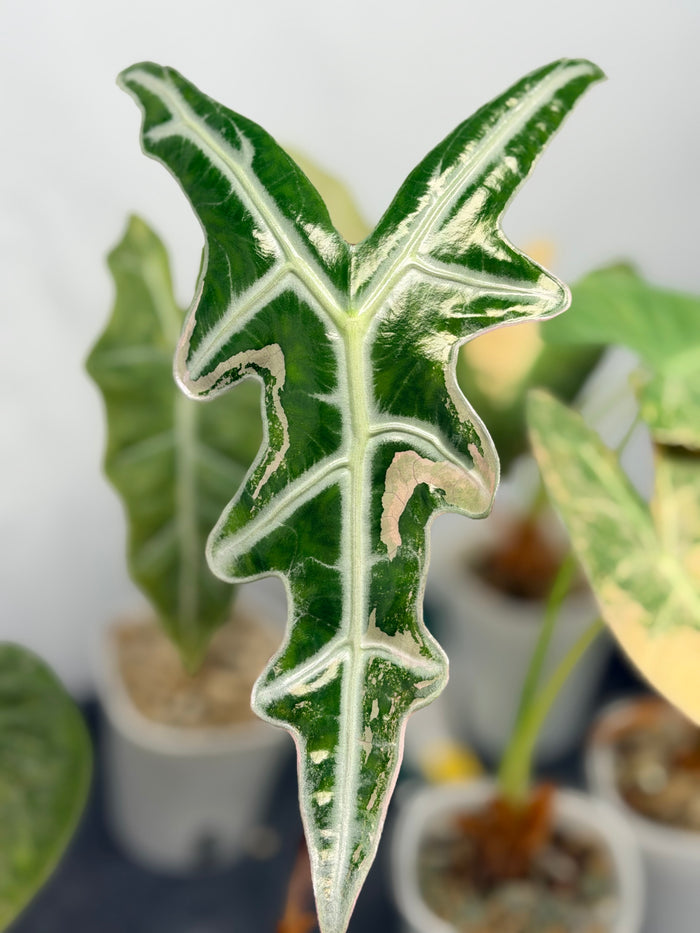
Aroidpedia describes a small to robust herb, about 40 to 150cm tall, with an elongated rhizome that is often exposed and petioles of 30 to 120cm, frequently mottled brown. The blade is arrow- or shield-shaped, often pendent, typically 27 to 65cm long and occasionally up to 85cm, and is peltate in most forms. Veins on the upper surface are commonly white to pale grey-green, and the posterior lobes are joined for part of their length. In cultivation the typical form sits on a robust rhizomatous base that can extend along the ground, with glossy dark green upper surfaces, prominent silver-white midribs and primary veins, and the rich purple to deep burgundy undersides that the Pink Back forms take further still.
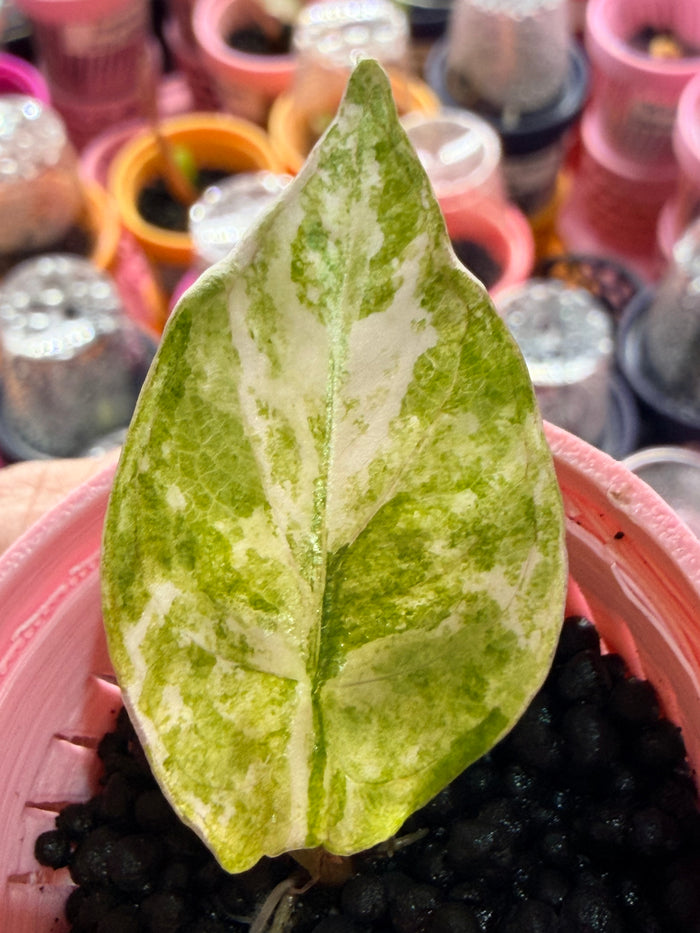
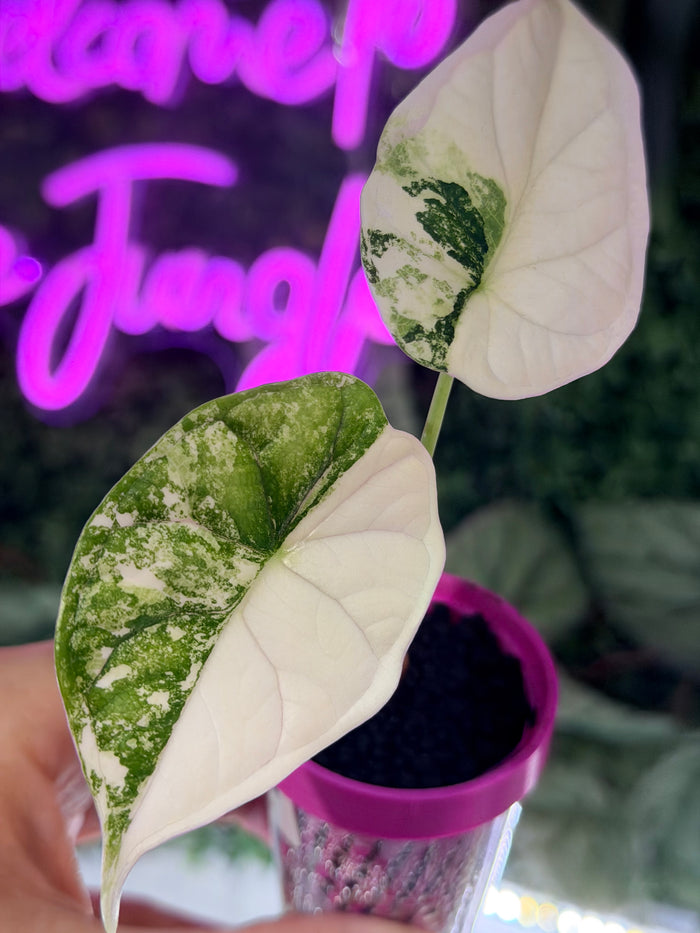
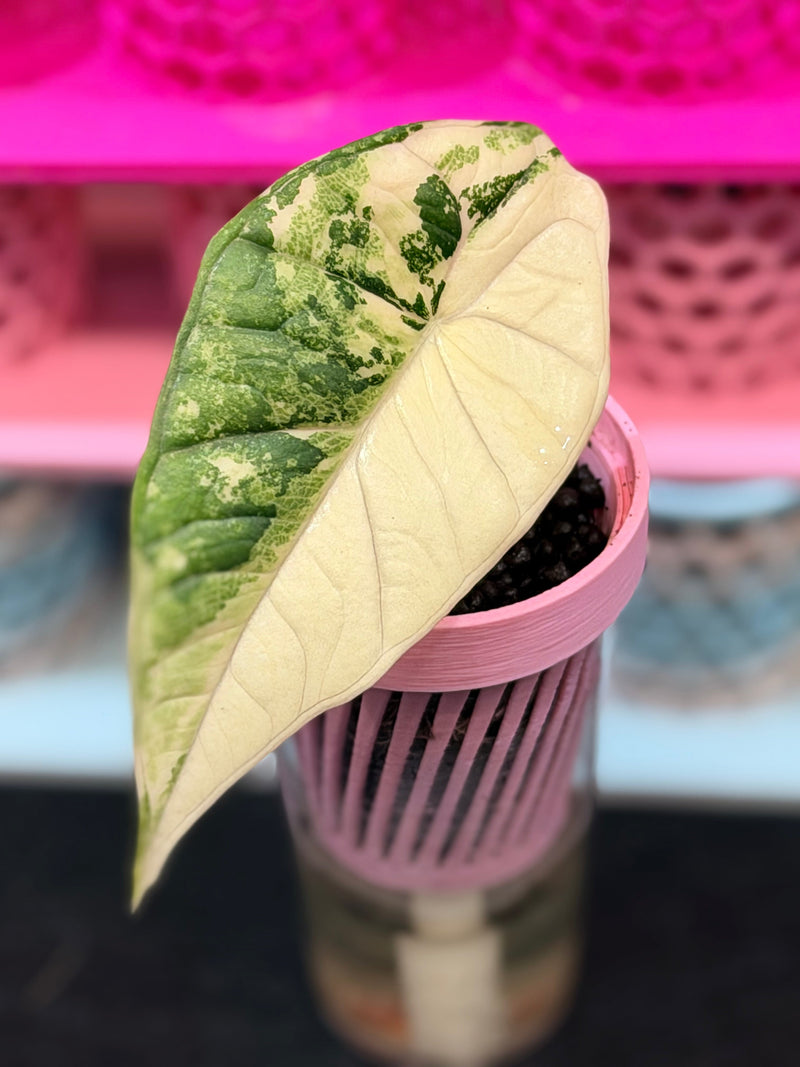
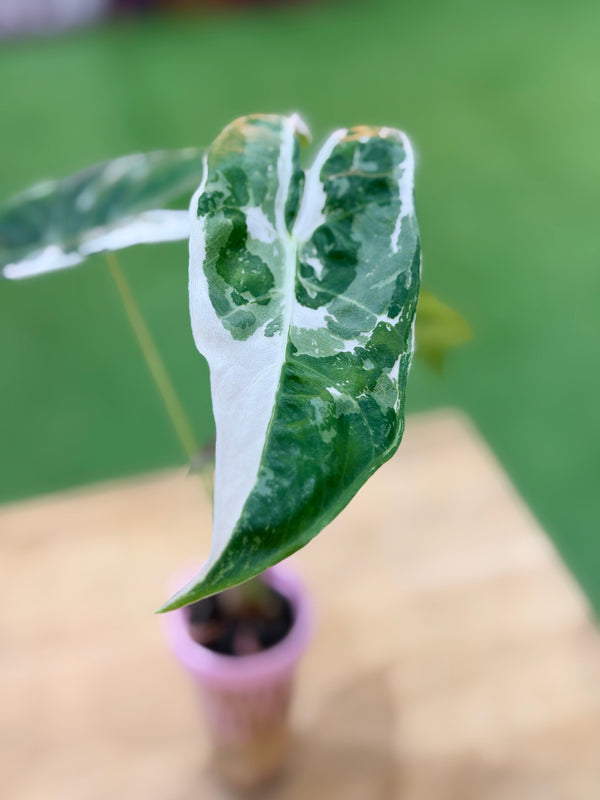
On a pink back albo, look for two things. On top, irregular white sectors against green, which differ from leaf to leaf. Underneath, a pink wash to the back of the blade instead of the more usual deep purple. Check the back of the leaf as well as the front when comparing plants, since the underside colour and the white pattern are separate features.
What albo variegation means for the plant
Albo variegation produces sectors that are white because they carry no chlorophyll. This sets it apart from aurea, where yellow or golden sectors keep some pigment, from mint, which is pale green, and from pink variegation, which is anthocyanin-based and unstable. Our complete guide to Alocasia variegation types and our guide to understanding albo variegation explain the differences, and the mystery of pink variegation covers the pink type.
Two consequences matter in practice. White tissue cannot photosynthesise, so the green parts of the leaf do all the work and heavily white leaves are slower and more fragile. And chimeric variegation is unpredictable: the proportion of white changes from leaf to leaf, and the pattern does not always carry through to plants grown from corms.
On this plant the albo and the pink back arise through entirely different mechanisms. The albo variegation on the upper surface is chimeric, a plastid genome mutation causing chlorophyll absence in specific cell lineages, producing white sectors whose distribution and extent varies between leaves and is inherently unpredictable. The pink underside expression is constitutive, a stable anthocyanin pigmentation characteristic of this Pink Back form, expressed consistently across all leaves regardless of their upper-surface variegation pattern. A leaf with extensive albo sectors will still express the full pink underside, and a leaf with minimal albo expression will still have the same vivid pink beneath; the white sectors on the upper surface do not correspond to lighter or differently coloured areas on the underside. Even on a predominantly green leaf, the pink underside ensures the specimen retains visual interest from all viewing angles. One of the challenges of collecting chimeric albo Alocasia is the variability of expression, with some leaves dramatically variegated and others minimally so, and the consistent pink underside ensures that every leaf is visually interesting regardless of how much white it carries.
Alocasia longiloba pink back albo care
This is general Alocasia care, and it applies to this plant as to any other in our collection.
Light. Provide bright, indirect light, with an LED grow light to supplement daylight; 10,000-15,000 lux for 12-14 hours per day is strongly recommended. Albo leaves need steady light because so little of the blade is green, and white sectors can scorch in direct sun. The pink underside is enhanced by bright light and cooler growing temperatures within the acceptable range, so positioning near a well-lit window rather than in a warm, less illuminated spot will support both albo stability and pink underside vividness.
Temperature and humidity. Keep the plant at 20 to 27°C with humidity of 60 to 80%, maintained with a dedicated humidifier. A heat mat helps if the room runs cool.
Watering and substrate. Water when the top 2 to 3cm has dried and let the pot drain fully. Our preferred substrate is Fluval Stratum. Check before watering larger pots, as they stay damp for longer. If you are worried about the roots, read our root rot guide.
Feeding. Feed at half strength using our Alocasia feed from the plant feed range, or down to quarter strength, every 2 to 3 weeks during the growing season. More detail is in our Alocasia care guide. Like other aroids, the plant contains calcium oxalate crystals, so keep it away from pets and children.
Propagating from corms
Our Alocasia corm propagation guide explains the process. We use a self-wicking method: a firm corm sits in Fluval Stratum inside the Corm Keeper, which holds even moisture until it sprouts. A corm from an albo plant is not guaranteed to produce an albo plant.
How it compares with similar plants
Within the same species, our Alocasia longiloba Pink Back guide covers the pink-backed form, and the Mint Variegated guide covers the pale green type. For related hybrids, Aroidpedia records A. longiloba as the most prolific parent in the genus, behind A. × amazonica (A. sanderiana × 'Watsoniana'), 'Loco' and 'Venom'. A. × amazonica is known to most buyers as "African Mask" or "Alocasia Polly" and is one of the most widely sold houseplants in the world, and it established the complex as foundational to modern decorative Alocasia cultivation. See our Amazonica group guide and Loco guide. Other white-sectored plants are gathered in our albo variegated collection.
We release plants through our drop model. Join the collector list to hear about drops, and see the Alocasia Longiloba Pink Back Albo listing.
Frequently asked questions
Is Pink Back Albo a documented cultivar?
Not in Aroidpedia, which lists no Pink Back or Pink Back Albo entry. It does record white variegation and a purple-backed 'Purple' cultivar for the species.
Where does Alocasia longiloba come from?
Indochina to West and Central Malesia, excluding the Philippines, according to Aroidpedia.
How large does it grow?
The species is recorded at about 40 to 150cm, with blades typically 27 to 65cm long. Variegated plants are not separately documented.
Why is albo variegation harder to grow?
White sectors contain no chlorophyll, so the plant has less green tissue to make energy and needs good, steady light.
Will the pink back and the albo always show together?
Not always. The pink back is a constitutive, stable trait that shows on every leaf, but the two are separate features and chimeric albo in particular varies from leaf to leaf.
Questions about Alocasia longiloba pink back albo? Contact our team for guidance from specialists who grow rare Alocasia in our UK-based private nursery. We are glad to talk through care, identification and variegation.
From the nursery