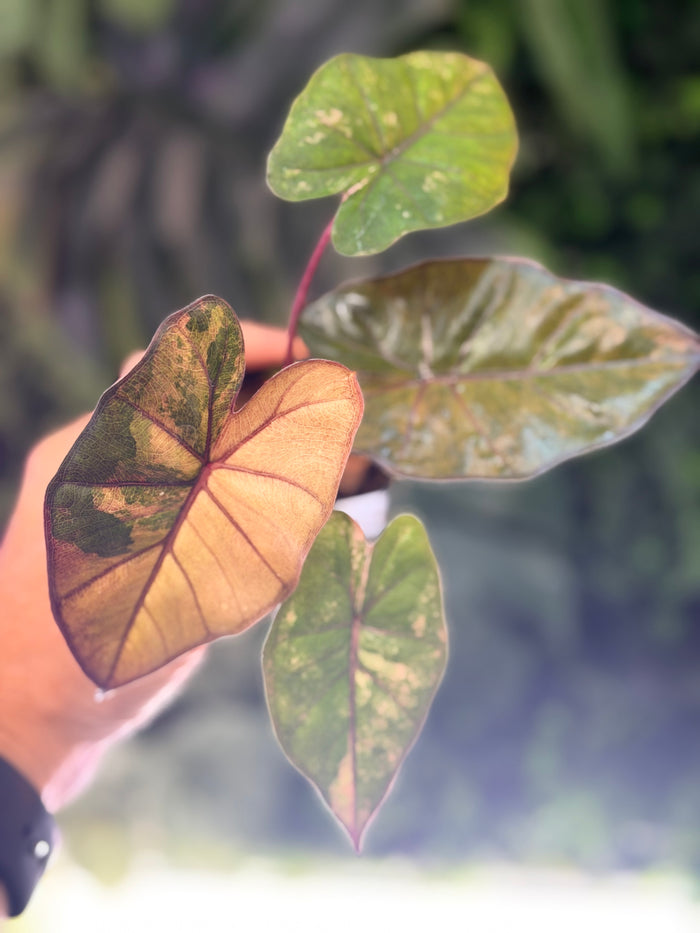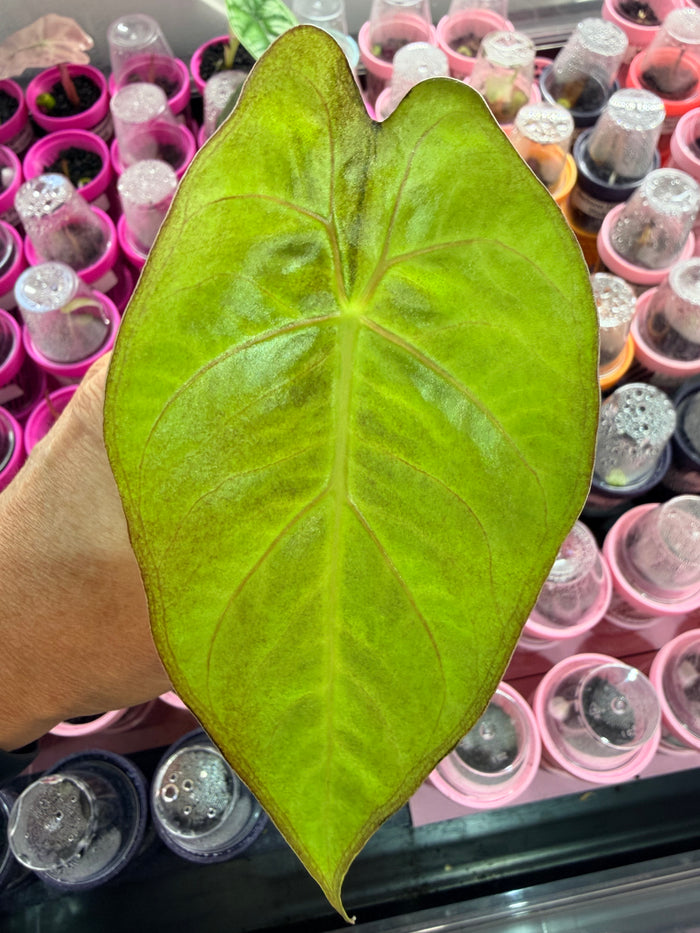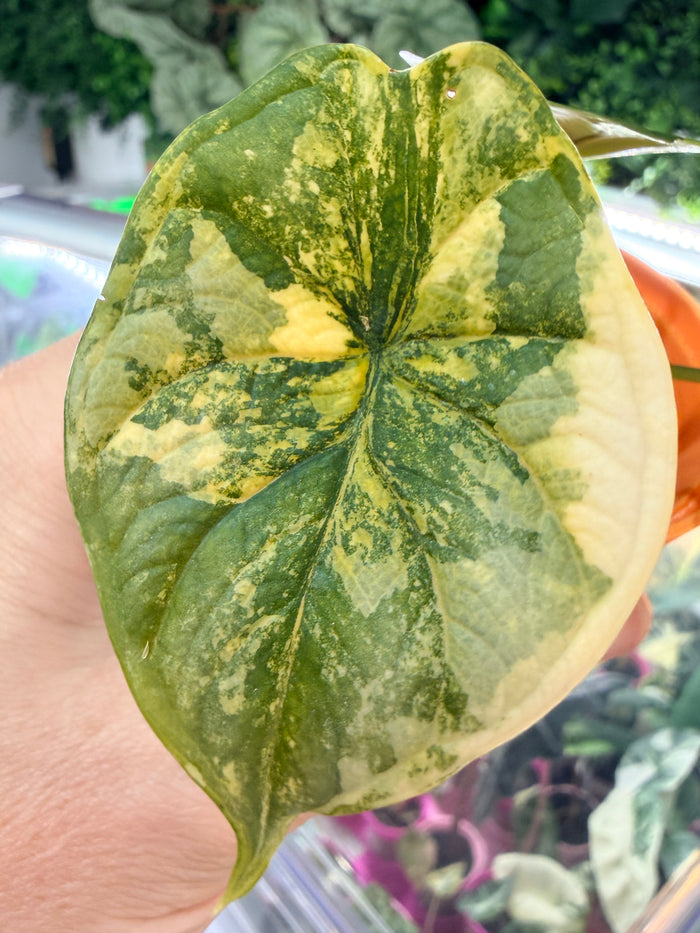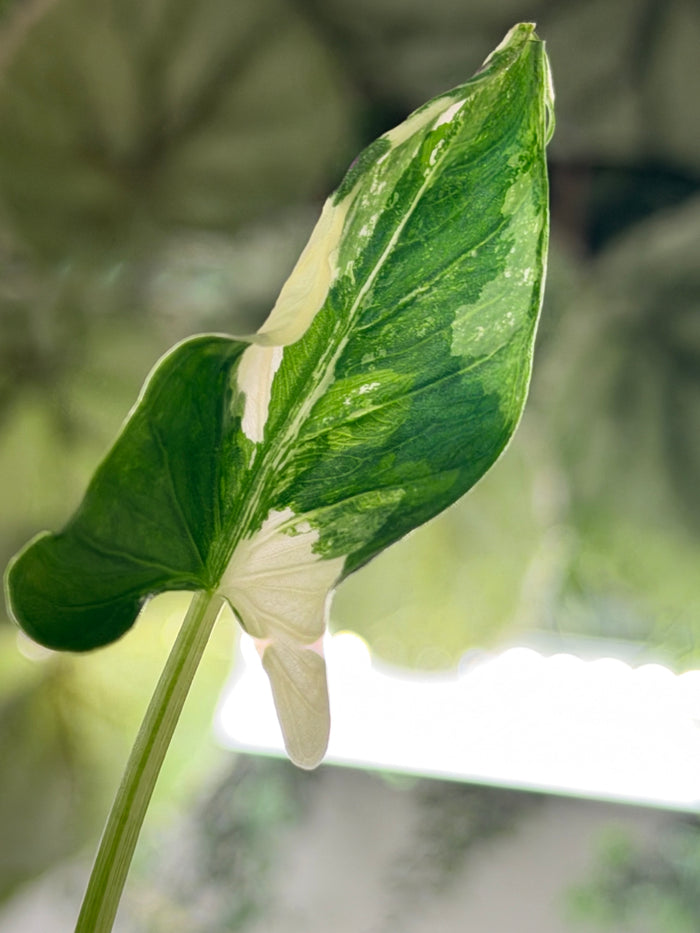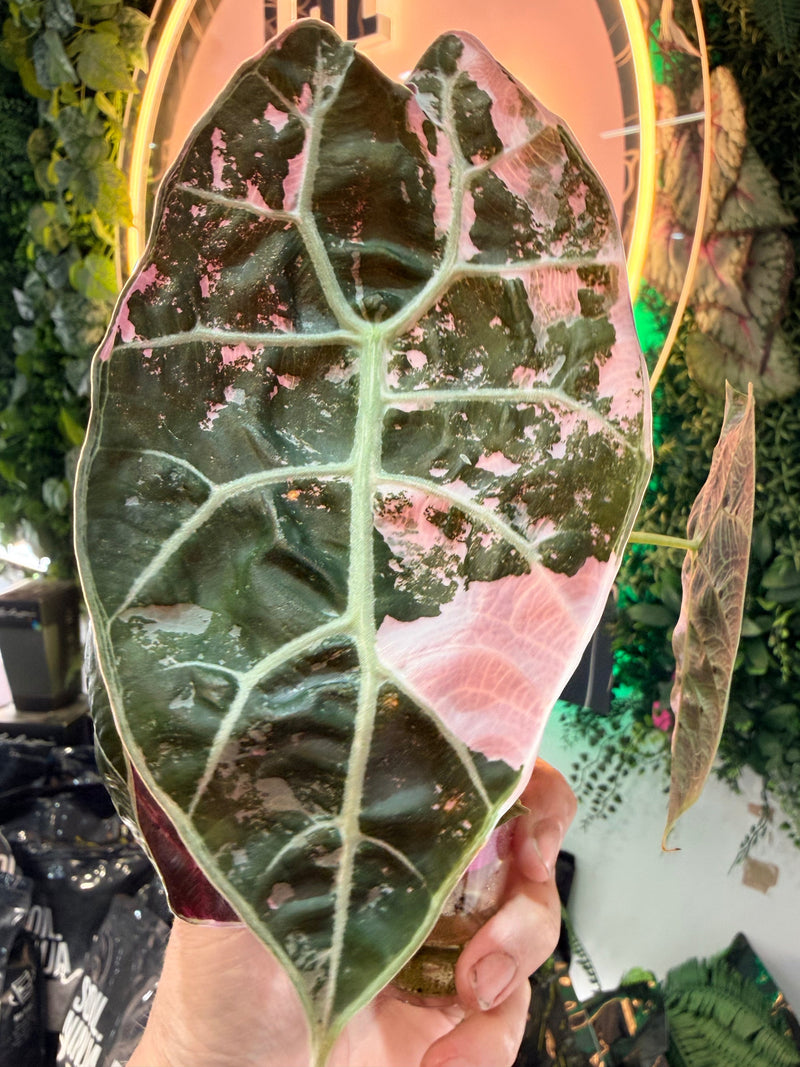

Alocasia longiloba Lime Lava is a variegated form of the Alocasia longiloba complex, grown for flowing sectors of acid lime-yellow across a large, dark green, arrow-shaped blade. It is the most vivid colour expression in the longiloba lava family. This guide explains what the plant is, where the species comes from, what the lime colouring is and how to keep it looking its best. It also says plainly which parts of the story are documented and which are not.
Where the Lava King Cobra works with subtle green-on-green tonality, Lime Lava brings high contrast: the bright lime-yellow sectors read against the deep green base with the same electric quality found in lime aurea expression on other species, but with the flowing, diffuse distribution of lava patterning rather than the cleanly bounded sectors of standard aurea variegation.
For the wider species background, read our Alocasia longiloba species guide. For a green-on-green take on the same patterning, see the Lava King Cobra guide.
What is Alocasia longiloba Lime Lava?
Lime Lava is a trade name for a variegated Alocasia longiloba. The plant carries bright lime to chartreuse-yellow tissue in irregular, flowing patches rather than in neat, sharply bounded halves. The yellow reads strongly against the deep green of the rest of the blade, and the silver-white primary veins that longiloba forms are known for run through both colours.
Aroidpedia, the main reference we use for aroid naming and history, has an entry for the species and for several named longiloba cultivars, but it does not have a page for Lime Lava. The cultivar-specific details, including who first selected it, when and from what material, are therefore not documented there, and we have not been able to verify them elsewhere. What can be described reliably is the species it belongs to and the kind of variegation it shows.
Origin and naming of Alocasia longiloba
Alocasia longiloba is the namesake of one of the most botanically complex, horticulturally significant and widely hybridised species groups in the genus. Aroidpedia records it as native from Indochina through to West and Central Malesia, excluding the Philippines. Its geographic tags include Borneo, Sumatra, Java, Sulawesi, the Lesser Sunda Islands, Malaysia, Thailand, Cambodia, Laos, Vietnam, Myanmar and parts of southern China including Hainan and Yunnan. Few Alocasia species range as widely. In the wild it grows on rainforest and swamp-forest floors, in regrowth, among boulders and on exposed cliffs and ravines at low to medium elevations.
The epithet refers to the long lobes of the blade. European botanists first documented the species in the mid-19th century, when John Lindley described a cultivated plant from Borneo and Heinrich Wilhelm Schott, the world authority on Araceae at the time, placed it formally within Alocasia. Aroidpedia cites the original description as published in Flora van Nederlandsch Indie in 1856. Its notes also describe the group as an ochlospecies, meaning a complex of forms that grade into one another rather than separating cleanly. The forms within the complex differ in leaf shape, venation character, underside colouration and growth habit. Many names that were once treated as separate species, among them A. lowii, A. veitchii, A. watsoniana and A. thibautiana, now sit within it as synonyms, and several survive in the trade as cultivar names such as 'Lowii', 'Veitchii' and 'Watsoniana'.
How to identify the plant
Aroidpedia describes the species as a terrestrial to lithophytic herb of roughly 40 to 150cm, growing from an elongate rhizome that is often partly exposed. Petioles are long, from 30 to 120cm, and may be purple-brown, pinkish or green and are often mottled. Blades are frequently pendent and typically 27 to 65cm long, occasionally up to 85cm, shaped from hastate-sagittate to ovate-sagittate. Dark green upper surfaces with a rich purple underside are common, and the major veins can be white to pale grey-green on top.
On Lime Lava the identifying features are the lime-yellow patches combined with that longiloba structure. If the yellow is confined to clean, bounded sectors, the plant is behaving more like a classic aurea chimera than a lava pattern; if the whole leaf is evenly pale, it is more likely a nutrition or light issue than variegation.
The lime variegation explained
Yellow or golden variegation, the aurea type, comes from tissue with reduced chlorophyll that still retains carotenoid pigments. That is different from albo variegation, where affected sectors lack chlorophyll and read as white, and from pink variegation, which is anthocyanin-based. Aroidpedia notes that variegated longiloba forms occur in white, mint and yellow. Our aurea variegation guide and the complete guide to Alocasia variegation types cover the pigment differences in more detail.
This combination of colour mechanism and flowing distribution produces an effect that is genuinely distinctive: not the sharp boundaries of classic aurea sectors, and not the subtle tonal variation of green-on-green lava, but a flowing, organic distribution of vivid lime-yellow that gives each leaf an almost geological, topographic quality. On the large leaves of the longiloba, potentially 60-80cm in mature specimens, the expression operates at a scale that amplifies its visual impact. Wide flows of lime-yellow through the deep green blade, bounded by the silver primary venation, create a leaf surface that reads as a landscape rather than a pattern. The purple undersides add a fourth colour element when leaves are seen at an angle, so the plant changes character as the viewing position changes.
Because the yellow tissue keeps some photosynthetic ability, aurea-type sectors generally support steadier growth than pure white ones. This gives Lime Lava good vigour relative to albo forms, and it grows with meaningful momentum under appropriate care. The same property makes the colour light-sensitive: under weak light the plant tends to produce more chlorophyll and the lime shifts towards green. Like other chimeric variegation, the pattern is not guaranteed to carry over to plants grown from corms, so a corm-grown plant may differ from its parent.
Alocasia longiloba Lime Lava care
This is general Alocasia care, and it applies to this plant as it does to the rest of the genus.
Give bright indirect light, supported by LED grow lights where the room is dim, because strong, consistent light is what holds the lime colour. Aim for 20 to 27°C and 60 to 80% humidity, maintained with a dedicated humidifier. Water thoroughly when the top 2 to 3cm of the mix has dried. We prefer Fluval Stratum as a substrate, and a heat mat helps if the room runs cool. Feed at half to two-thirds strength, every 2 to 3 weeks, with our Alocasia feed and the wider plant feed range.
Large leaves give pests plenty of surface. Check the undersides regularly, as the undersides of longiloba foliage are prime spider mite habitat, and use the pest control range promptly if you find mites, since early treatment prevents established infestations. Our pest patrol guide and the ultimate Alocasia care guide go into more depth. If leaves yellow overall and the base turns soft, read our root rot guide.
Propagating from corms
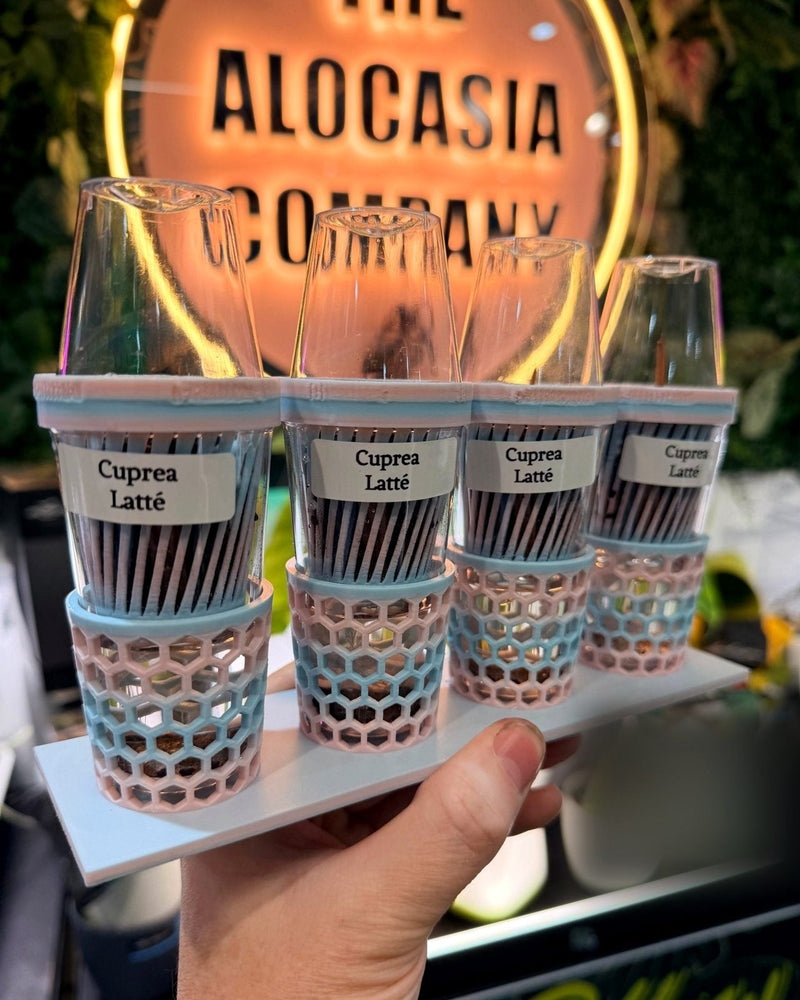
Our Alocasia corm propagation guide sets out the method step by step. In short, we use a self-wicking approach: the corm sits in Fluval Stratum inside a Corm Keeper, which draws moisture up evenly without leaving the corm sitting in water. Our guides to growing Alocasia corms in Fluval Stratum and how long a corm takes to sprout explain what to expect. You can browse available corms in the shop.
How it compares to similar plants
The Lava King Cobra shows the same flowing pattern in subtler tones. The mint variegated longiloba carries pale green rather than yellow, and the marble variegated longiloba shows lighter, more cream and white marbling. The pink back longiloba is a different expression again. More yellow-toned plants sit in our aurea variegated Alocasia collection.
Aroidpedia lists longiloba as the most prolific parent in Alocasia hybridising since the mid-1800s, including the cross of 'Watsoniana' with A. sanderiana that produced Alocasia × amazonica, known to most buyers as "African Mask" or "Alocasia Polly" and one of the most widely sold houseplants in the world. That cross established the complex as foundational to modern decorative Alocasia cultivation, and numerous other hybrids in current collector cultivation trace their lineage to longiloba forms. You can see where that lineage leads in our Amazonica group guide.
Frequently asked questions
What is Alocasia longiloba Lime Lava?
It is a variegated form of Alocasia longiloba with lime to chartreuse-yellow patches over dark green, arrow-shaped leaves.
Is Lime Lava documented on Aroidpedia?
No. Aroidpedia has a species entry for Alocasia longiloba and entries for several named cultivars, but not for Lime Lava, so its origin and breeding are not documented there.
Is the yellow the same as albo variegation?
No. Albo sectors have no chlorophyll and look white. Yellow or lime sectors have reduced chlorophyll but retain carotenoid pigments.
Why is my plant turning greener?
Low light is the usual cause. More chlorophyll forms in the pale tissue, so brighter, steadier light and LED supplementation help keep the lime colouring.
Will a corm grow into a variegated plant?
Not necessarily. Chimeric variegation may not carry over to corm-grown plants, so the resulting plant can come out plain green or differ from its parent.
How should I water it?
Water thoroughly when the top 2 to 3cm of the mix has dried, and avoid leaving the plant sitting in standing water.
We release plants like this through our drop model. Join the collector list for early access, and see our Alocasia house plants collection.
Questions about Alocasia longiloba Lime Lava? Contact our team for guidance from specialists who grow rare Alocasia in our UK-based private nursery. We are happy to help with identification, light and watering questions.