Alocasia Golden Bone: The Complete Collector's Guide

Alocasia 'Golden Bone' is a collector hybrid with an unusual back story, and this guide sets out what Aroidpedia and other sources actually record about it. Several details that circulate about the plant, including its parentage, are less certain than they are often presented, so we separate what is documented from what is assumed. It is one of the most visually striking hybrid Alocasia introduced to the collector market in the 2000s, a cross of Indonesian origin whose combination of parent species is said to create a leaf character that is genuinely unlike either parent alone.
What is Alocasia Golden Bone?
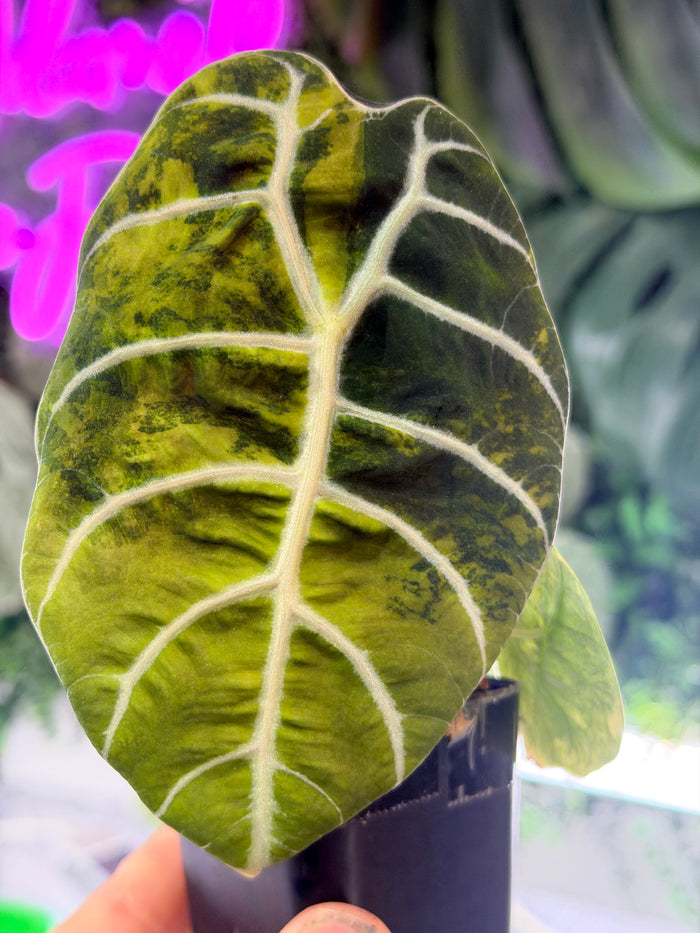
Aroidpedia lists Alocasia 'Golden Bone' as a hybrid cultivar in the genus Alocasia. The name is a cultivar name, and Aroidpedia does not explain where it comes from. Its entry records yellow mottled variegation, a dark reddish inflorescence with similar colouring on the outer side of the spathe, and orange berries. It gives no leaf size, height or growth habit, so we make no claims about those. In the collector world the name is understood to come from the lime-green venation against a deep green blade, the plant's most immediately recognisable characteristic: bold, bright vein structure that reads like a skeleton of golden-lime colour threaded through the darker foliage.
Origin and history
Aroidpedia records that Indonesian grower Astri Yanto introduced the plant to the market in 2006. According to the entry, Yanto obtained it from a friend who had supposedly collected it from the jungle in Indonesia. That account is secondhand and the page gives no precise date or locality for the collection. Aroidpedia's hybridiser field reads "natural hybrid", which means no human breeder is credited.
It is worth being plain about this: the plant's history rests on a single chain of word-of-mouth, and it should be read as a reported origin rather than an established one.
Parentage: assumed, not confirmed
Golden Bone is usually given as Alocasia micholitziana 'Green Velvet' × Alocasia cuprea. Aroidpedia lists exactly that, but labels the parentage "undocumented" and "unconfirmed". It also points out a difficulty with the story: A. micholitziana is native to the Philippines and A. cuprea to Borneo, so a natural cross between the two in Indonesia is hard to explain. We therefore describe the parentage as an assumption.
It is the suggested parents, rather than anything about the plant itself, that make the idea attractive. Our guides to the species behind the assumed cross are useful background: see our Alocasia cuprea species guide and our micholitziana Frydek guide.
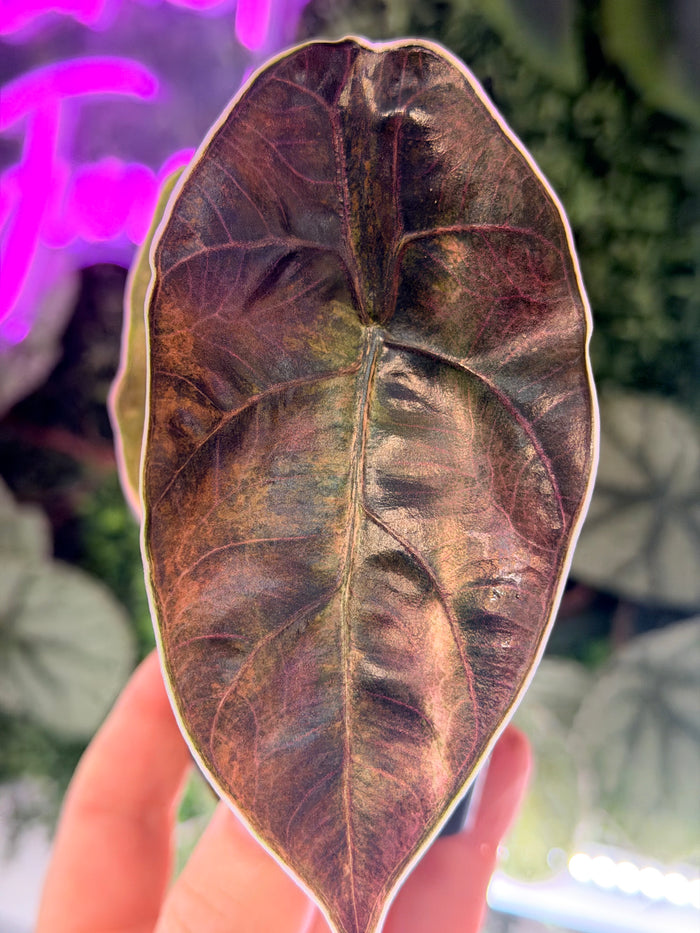
The two assumed parents are very different plants. Alocasia micholitziana, the Green Velvet Alocasia, is endemic to the Philippines and known for its velvety dark green foliage with white midrib and primary venation, and it is the assumed source of the leaf form and the venation architecture. Alocasia cuprea is endemic to Borneo and celebrated for its metallic, coppery-bronze leaf surface and deep purple undersides, one of the most collectible species in the Cuprea Group, and it is the assumed source of the metallic surface quality and the Bornean jewel character that shows subtly in the Golden Bone's leaf surface under certain light. On that reading the cross produced a plant that inherits the dark, slightly glossy leaf surface and the venation architecture of the micholitziana parent, but with the venation colour shifted from the standard white to vivid lime-green, an effect not present in either parent, and with the subtle metallic quality of the cuprea lineage detectable in the sheen of the leaf. How exactly the lime-green venation arises from these two parents is not definitively documented; it may represent a novel expression of pigmentation that emerges from the hybrid combination rather than being inherited directly from either parent.
How to identify Golden Bone
Aroidpedia's entry does not describe the leaf shape or the venation of Golden Bone in words, so we avoid giving a definitive description. What it does record is the yellow mottled variegation noted above, and the dark reddish inflorescence and orange berries, which are useful if you ever see the plant flower. As with any plant whose parentage is unconfirmed, the most reliable approach is to compare leaves side by side with a plant of known provenance, and to treat dramatic claims from sellers with caution.
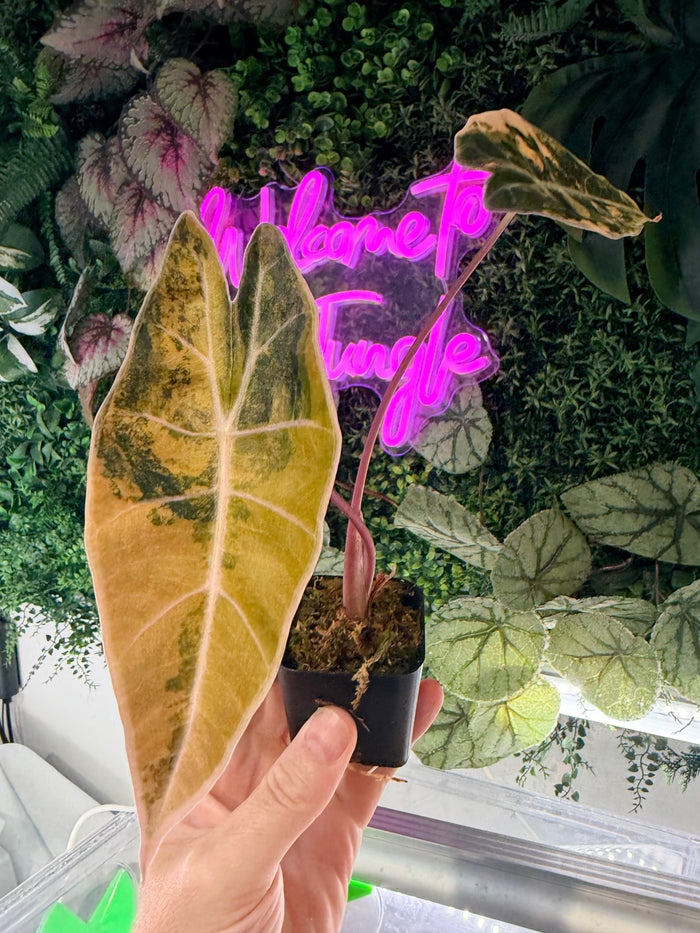
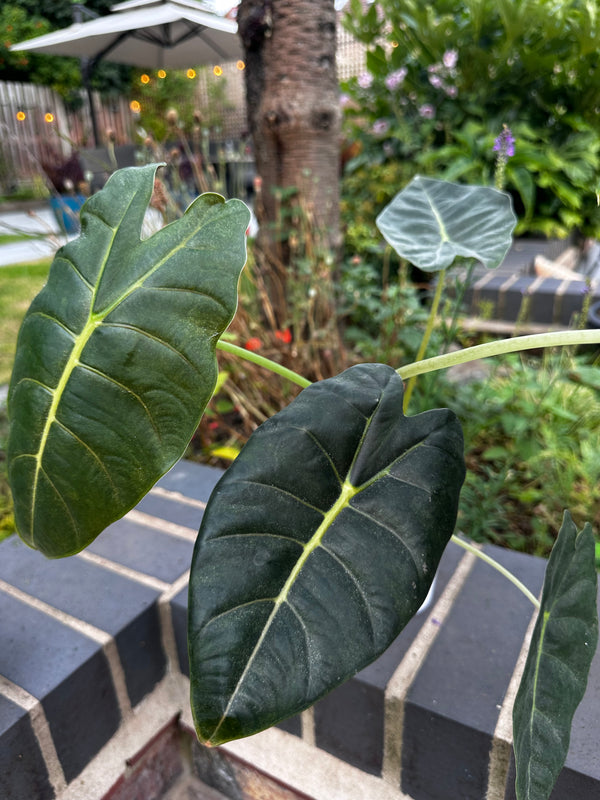
From our own plants, the blade is broad and shield-like with gently wavy margins, combining elements of both assumed parent species, and in good growing conditions the plant reaches 40-70cm, a size at which the venation displays clearly and dramatically. The lime-green venation operates at high contrast against the deep green blade, more vivid than the white venation of standard micholitziana and more unusual in the context of Alocasia hybridisation generally. The broad, shield-like leaf provides a good canvas for this venation display, and the slight waviness of the margins adds movement to what would otherwise be a very geometrically ordered composition. In good light the purple undersides from the cuprea lineage add a warm colour dimension that is visible when leaves move or are viewed at an angle.
The variegation
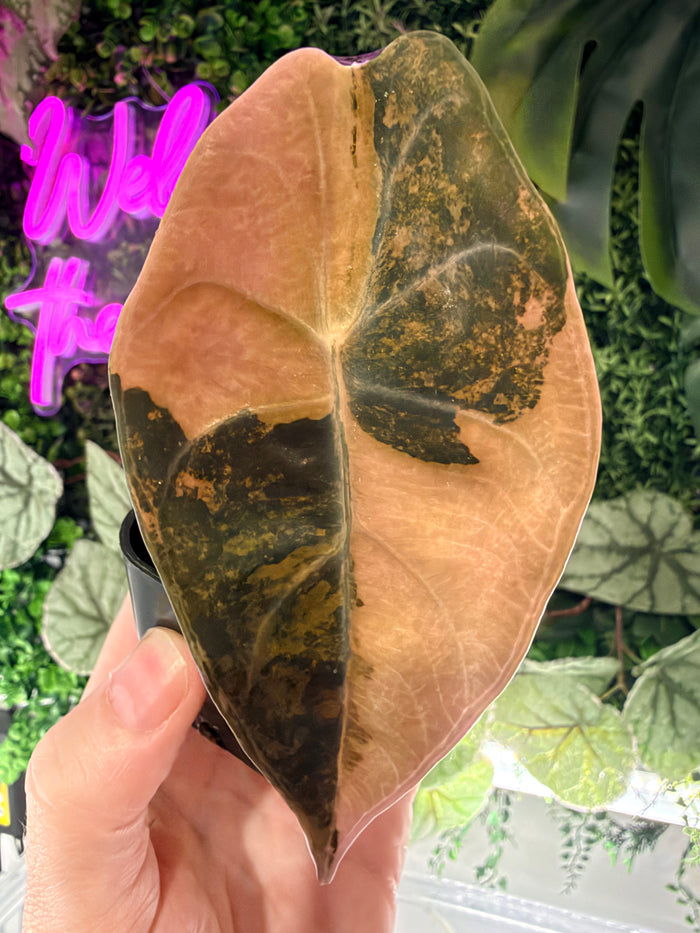
Yellow mottling in Alocasia is aurea-type variegation: yellow or golden tissue with reduced chlorophyll and retained carotenoid pigments. Variegation of this kind can be chimeric, so the pattern may be unstable and may not carry over to plants grown from a corm. Our aurea variegation guide and the guide to Alocasia variegation types cover the mechanism, and our Golden Bone variegated guide looks at the variegated form in more detail. You can also browse the aurea variegated Alocasia collection.
How to care for Alocasia Golden Bone
This is general Alocasia care, and it applies to this plant. We apply the same approach across our collection.
- Light: bright indirect light, with LED grow light supplementation where daylight is limited.
- Temperature and humidity: 20 to 27°C and humidity of 60 to 80%. If the room runs cool, a heat mat helps keep the roots warm.
- Watering: water thoroughly when the top 2 to 3cm of substrate has dried. For problems, see our root rot guide.
- Substrate: Fluval Stratum is our preferred substrate, and the substrates collection has related options.
- Feeding: our Alocasia feed at half strength, from the plant feed range.
Our ultimate Alocasia care guide covers the rest in depth.
Propagating from corms
Corms are an economical way to grow more Alocasia. Our Alocasia corm propagation guide describes the self-wicking method, in which the corm sits in Fluval Stratum inside a Corm Keeper. See also growing corms in Fluval Stratum. A corm from a variegated plant may produce a plain green plant.
How it compares with similar plants
Golden Bone is often discussed alongside other Cuprea-lineage plants such as the Cuprea Pink and the Cuprea Super Pink, though their parentage is different and each has its own page in the guides. Because Golden Bone's own parentage is unconfirmed, comparisons should be made cautiously.
Frequently asked questions
What is Alocasia Golden Bone's parentage?
It is usually given as A. micholitziana 'Green Velvet' × A. cuprea, but Aroidpedia labels this undocumented and unconfirmed.
Who introduced Golden Bone?
Aroidpedia records Indonesian grower Astri Yanto as introducing it to the market in 2006.
Is it a natural hybrid?
Aroidpedia lists it as a natural hybrid with no human breeder credited, although the page also questions how a natural cross of those two species could have happened.
How large does it grow?
Aroidpedia gives no size for Golden Bone, so we do not state one.
Can it be propagated from a corm?
Yes, using the self-wicking method described above, though variegation may not carry over.
Is it toxic?
Alocasia contain calcium oxalate crystals and are toxic if chewed or eaten, so keep the plant away from children and pets.
We release Golden Bone through our drop model. Join the collector list for early access and view our Alocasia Golden Bone listing.
Questions about Alocasia Golden Bone? Contact our team for guidance from specialists who grow rare Alocasia in our UK-based private nursery. We are glad to help with care, variegation and corm propagation.