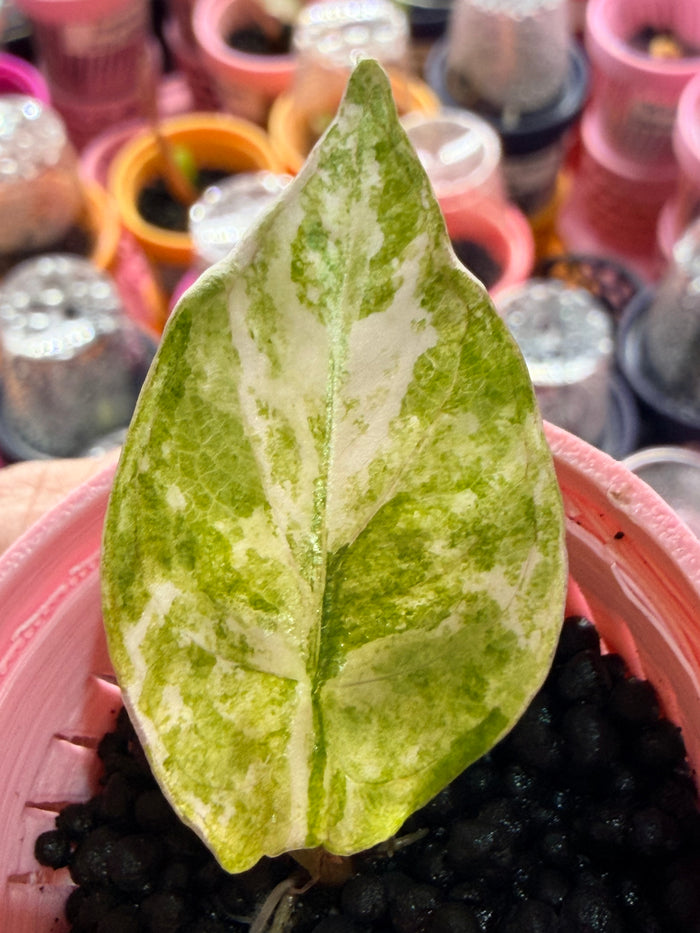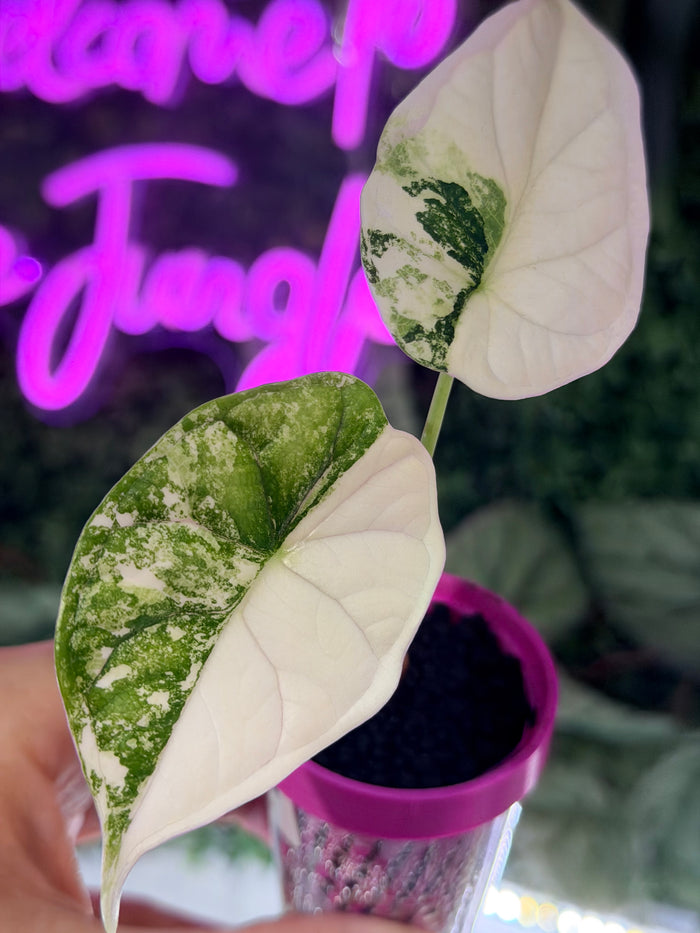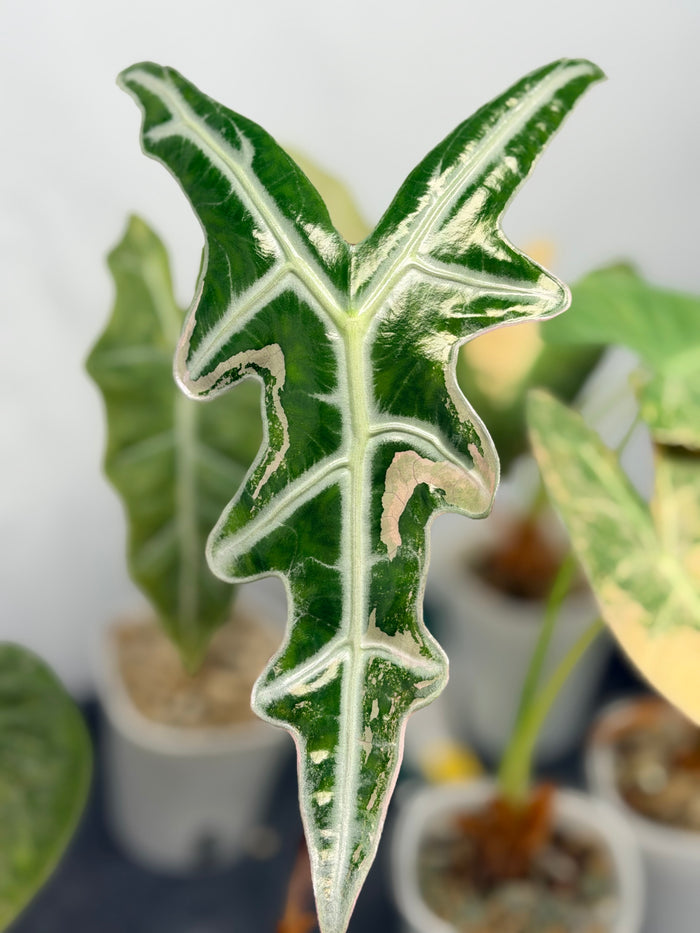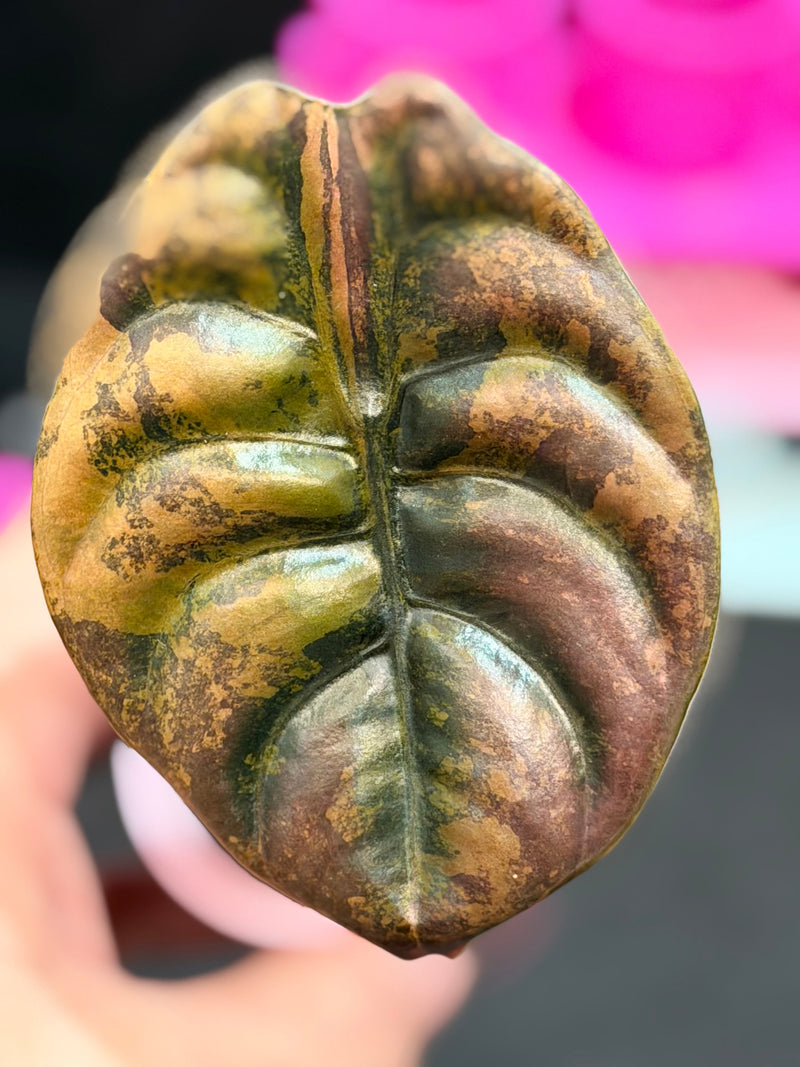

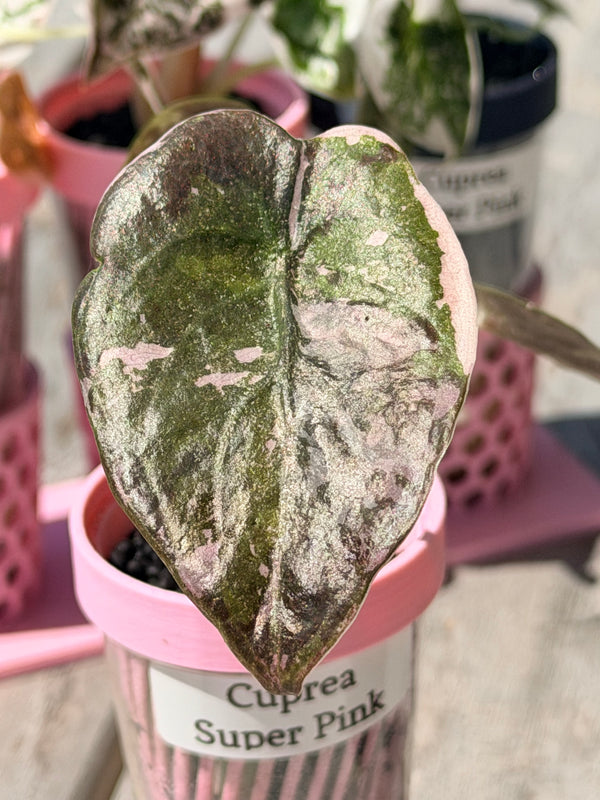
The Alocasia Cuprea Pink brings chimeric pink variegation to one of the most celebrated metallic jewel Alocasia species, Alocasia cuprea, the Bornean endemic whose iridescent copper-bronze leaf surface has captivated collectors since Thomas Lobb brought the first specimens to Britain in the 1850s. Pink chimeric sectors on the cuprea's characteristic metallic surface create a visual composition unlike any other variegated Alocasia: warm pink emerging against a warm metallic copper-bronze base, both elements warm-toned but tonally distinct, on a surface that already has a depth and iridescence no simple green-leaved species can approach.
Species Background: Alocasia cuprea
Behind every pink variegated Alocasia cuprea sits a species whose surface is remarkable before any variegation is added to it. Alocasia cuprea is a Bornean endemic, and its epithet is simply the Latin for copper, taken from the coppery-bronze cast of its juvenile leaves. Thomas Lobb sent the first specimens to Veitch Nurseries in the 1850s, and the German botanist Karl Koch formally described the species in 1861, folding in the tangle of earlier names, Alocasia metallica among them, that had accumulated since the plant reached European horticulture.
Its wild range covers Sabah, Sarawak and Kalimantan, where it grows on steep slopes above streams in shaded humid forest at elevations up to roughly 700m. It is rare there. After its Victorian prominence the species fell out of European horticulture almost entirely, then returned to collector attention around 2004 and 2005 as Asian nurseries began producing it in quantity, and it now counts among the most recognised of the jewel Alocasia.
A mature leaf is thick, strongly ovate and moderately bullate, and almost peltate: the petiole meets the blade just inside the margin rather than on it. The upper surface carries the iridescence the species is known for, coppery-bronze on juvenile leaves and deepening to bronze-green with age. That iridescence is thought to be an adaptation to the understorey, reflecting and scattering what little diffuse light arrives across the whole blade. Undersides on good specimens are a rich reddish-purple, and the primary veins are pressed deeply into the surface, framing the metallic panels between them.
The species stands behind a good deal of hybrid Alocasia as well. Alocasia 'Chantrierii' pairs it with Alocasia sanderiana, Alocasia 'Uhinkii' with Alocasia odora (the plant usually sold as "Alocasia wentii"), Alocasia 'Sedenii' with Alocasia longiloba 'Lowii Veitchii', and Alocasia 'Golden Bone' with Alocasia micholitziana. For a species that spent a century out of fashion, it has been quietly foundational.
Pink Variegation on Alocasia cuprea
Chimeric pink variegation on Alocasia cuprea produces anthocyanin-tinted sectors through elevated anthocyanin expression in specific cell lineages. On the cuprea's metallic copper-bronze surface, the pink sectors appear as areas where the warm metallic quality is suffused with an additional rose-pink tone, the pink anthocyanin overlay sitting on top of the same iridescent surface quality rather than replacing it. This creates pink sectors that are themselves metallic and iridescent, rather than the flat, matte pink of anthocyanin sectors on non-metallic foliage. The rich reddish-purple undersides of the cuprea, already warm-toned and present on all leaves, provide a warm backdrop that connects visually to both the copper-bronze surface and the pink sectors, giving the plant a fully warm-toned composition of exceptional coherence.
Pink chimeric sectors retain chlorophyll, giving this form meaningful photosynthetic capacity. The metallically adapted surface of Alocasia cuprea means the plant naturally handles lower light levels than many collector Alocasia, it is adapted to the deep shade of Bornean forest slopes, but consistent bright indirect light is still the target for maintaining vividly metallic cuprea colouration and vivid pink sector expression. LED supplementation from October to March is recommended. Temperature 20-27°C, humidity 60-80%. Fluval Stratum substrate, excellent drainage, never waterlogged. Feed conservatively at quarter to half strength from our plant feed range during the growing season. Heat mat support through UK winters.
We release Cuprea Pink through our drop model. Join the collector list and view our Alocasia Cuprea Pink listing. Our pink variegated collection includes related specimens.
Questions about Alocasia Cuprea Pink or the cuprea metallic jewel family? Contact our team for specialist guidance.
From the nursery