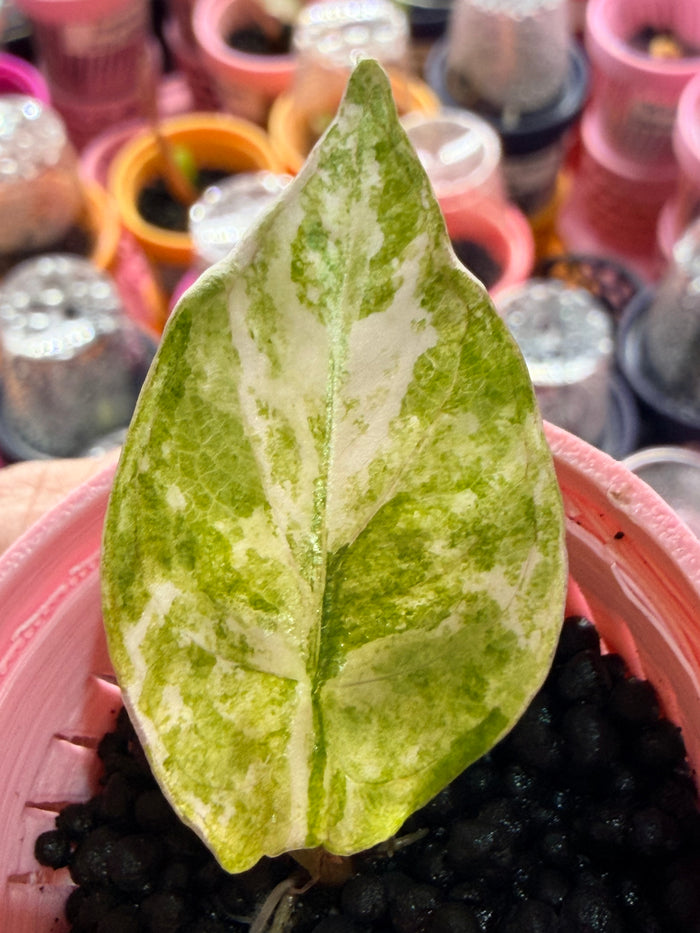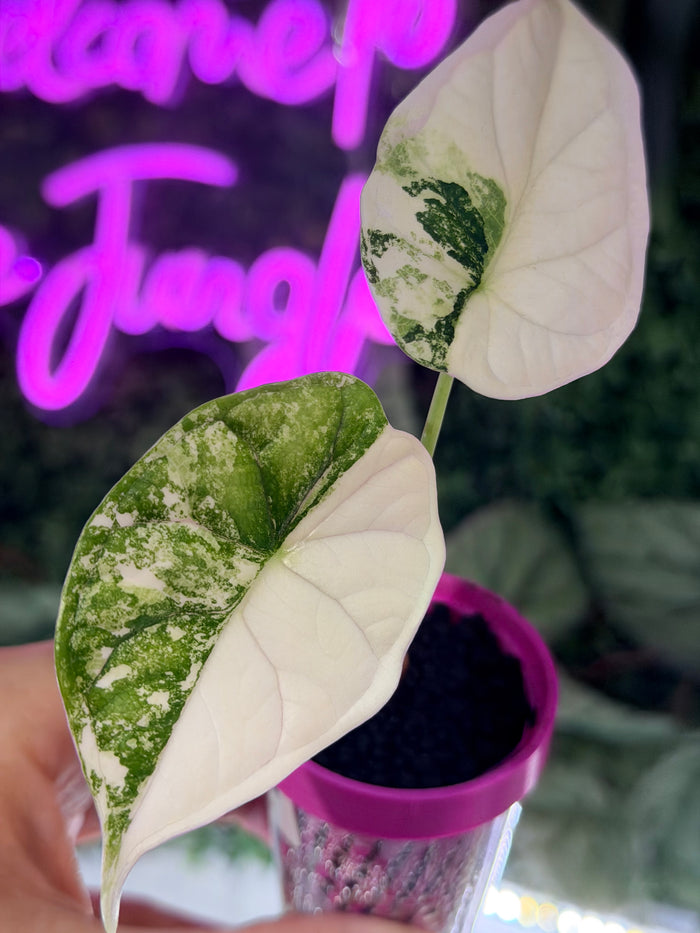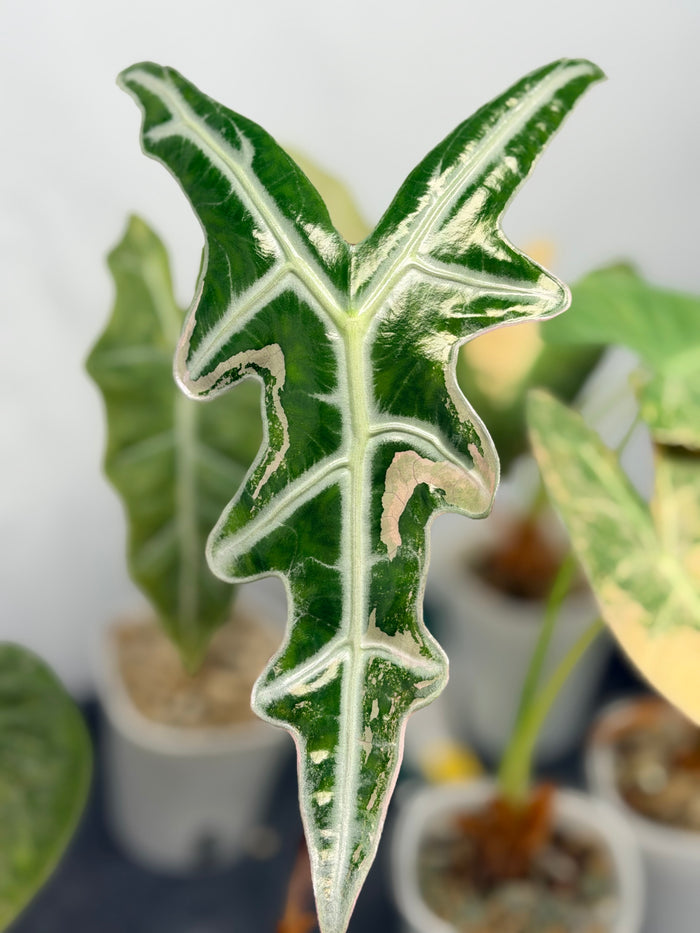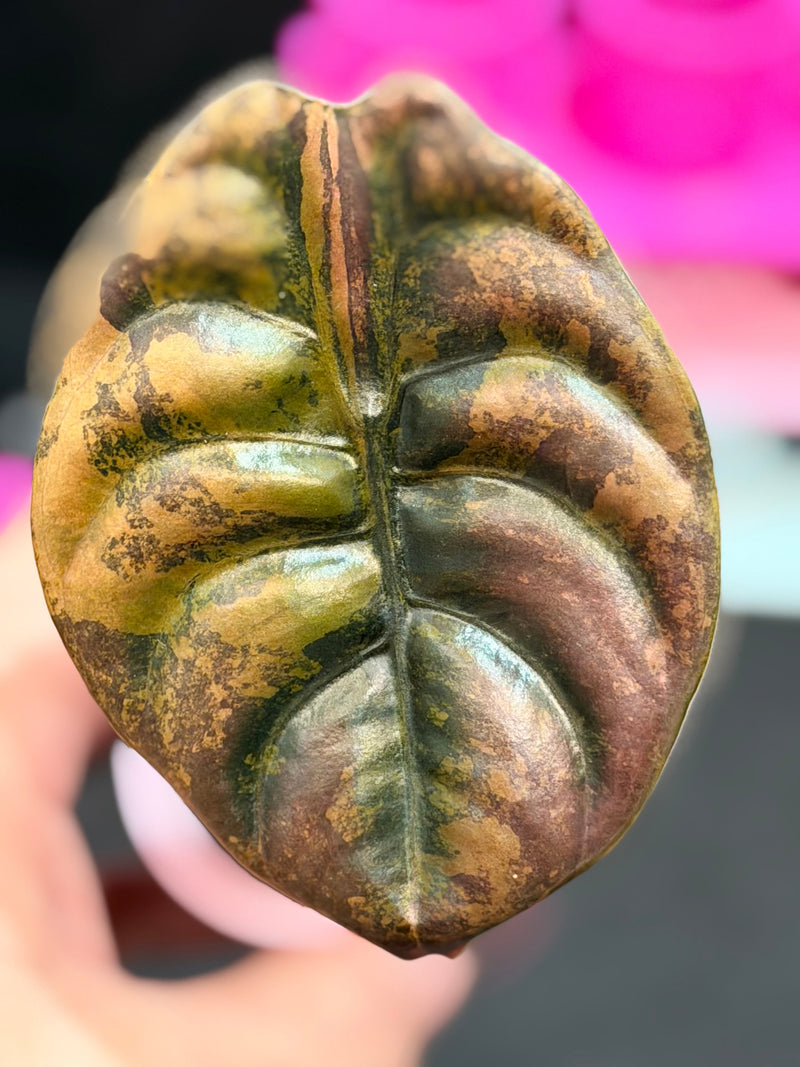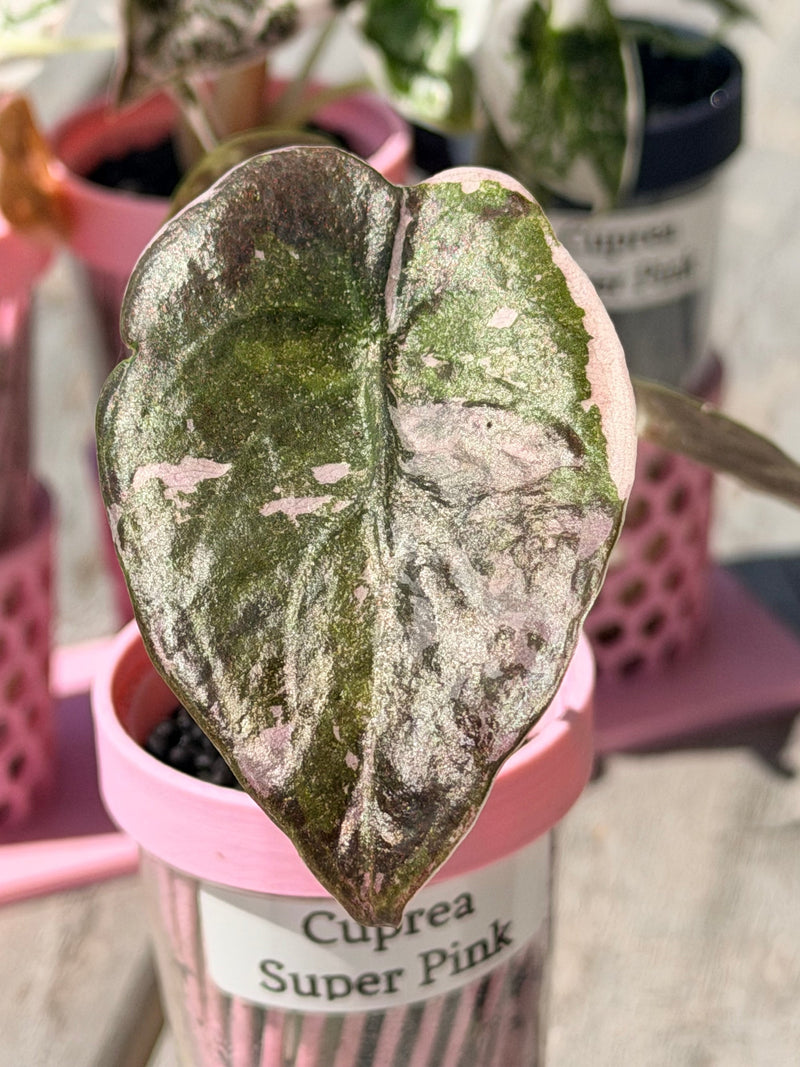

The Alocasia Cuprea Super Pink represents an intensified, more extensively expressed version of the pink chimeric variegation on Alocasia cuprea, a specimen selected for particularly vivid, broad, or densely distributed pink sector coverage across the metallic copper-bronze blade. Where standard Cuprea Pink forms may carry moderate pink sector distribution alongside significant areas of the standard metallic surface, the Super Pink form is selected for specimens where the pink expression is more pervasive, more saturated, or more dramatically present, creating a plant where the pink-metallic combination is immediately visible and compelling at room scale.
Species Background: Alocasia cuprea
The metallic surface that a heavy pink expression sits on belongs to Alocasia cuprea, a jewel species endemic to Borneo and one of the few whose leaf reads as metal rather than as leaf. Its name is the Latin for copper, after the coppery-bronze tone of juvenile foliage. Thomas Lobb's specimens reached Veitch Nurseries in the 1850s, and in 1861 the German botanist Karl Koch drew the species together under a single name, absorbing the earlier labels, Alocasia metallica included, that had built up around it in European horticulture.
Wild plants occur in Sabah, Sarawak and Kalimantan, on steep slopes above streams in shaded humid forest at up to about 700m, and they are rare. European growers largely lost interest after the Victorian era, and the species only came back into collector circulation around 2004 and 2005, once Asian nurseries were producing it in numbers. It is now among the best known jewel Alocasia in cultivation.
A mature blade is thick, strongly ovate and moderately bullate, and almost peltate, with the petiole joining just inside the leaf rather than at its edge. Colour runs from coppery-bronze when young to a deep bronze-green at maturity, and the iridescence is thought to be a light-gathering adaptation: in deep understorey shade a surface that reflects and scatters diffuse light works harder than a matte one. Undersides on good plants are richly reddish-purple, and the primary veins sink into the blade so the metallic panels between them sit raised and framed. That framing is what keeps a broadly pink specimen legible rather than muddy.
Hybridisers have leaned on the species repeatedly. Alocasia 'Chantrierii' (with Alocasia sanderiana), Alocasia 'Uhinkii' (with Alocasia odora, sold in the trade as "Alocasia wentii"), Alocasia 'Sedenii' (with Alocasia longiloba 'Lowii Veitchii') and Alocasia 'Golden Bone' (with Alocasia micholitziana) all carry cuprea in their parentage.
Intensified Pink Expression
The 'Super Pink' designation refers to a selection standard rather than a different variegation mechanism, the same anthocyanin-driven chimeric pink expression as in the standard Cuprea Pink, but present in greater quantity, with more saturated pink tones, or more broadly distributed across each blade. On the metallic surface of Alocasia cuprea, more extensive pink coverage creates a specimen where the characteristic iridescent bronze-copper quality is seen through a warmer, more rose-tinted lens across a larger proportion of the blade. The relationship between the pink sectors, the metallic base surface, and the deep reddish-purple undersides creates a colour composition that is fully warm and deeply rich in a way that more extensive coverage amplifies rather than simply increases.
The Super Pink selection is rarer and more variable than standard Cuprea Pink, individual leaves may carry different proportions of pink expression, and the chimeric nature of the variegation means some leaves will be more extensively pink than others. Consistent bright indirect light with LED supplementation from October to March is essential for maintaining both the metallic surface quality and vivid pink expression. Temperature 20-27°C, humidity 60-80%. Fluval Stratum substrate, excellent drainage. Feed conservatively at quarter to half strength from our plant feed range during the growing season. Heat mat through UK winters.
We release Cuprea Super Pink through our drop model. Join the collector list and view our Alocasia Cuprea Super Pink listing.
Questions about Alocasia Cuprea Super Pink? Contact our team for specialist guidance.
From the nursery