Alocasia Golden Bone Variegated: The Complete Collector's Guide

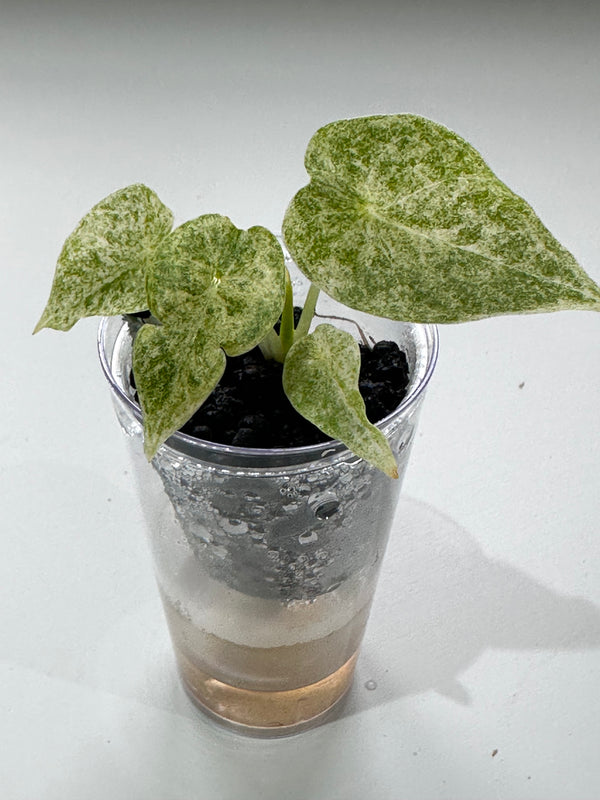
Alocasia Golden Bone Variegated is a variegated form of the Golden Bone hybrid, a compact, shield-leaved Alocasia known for pale veins that stand out against a dark blade. This guide covers what is actually documented about Golden Bone, what is only assumed, and what that means for the variegated plant and its care. Where a detail is not documented anywhere we can verify, we say so rather than fill the gap.
What is Alocasia Golden Bone Variegated?
The plant is a variegated Golden Bone: the same hybrid, with irregular patches of lighter tissue added to the leaf. The cultivar-specific record is thin. Aroidpedia has an entry for Alocasia 'Golden Bone' but no separate entry for a variegated Golden Bone, so the details below about origin and parentage come from the base plant. Anything specific to the variegated form, such as exact colour, pattern or stability, is not documented there and should be treated as variable from plant to plant.
Origin, parentage and naming
Aroidpedia records Golden Bone as a hybrid of uncertain parentage. The cross it gives as assumed is Alocasia micholitziana 'Green Velvet' with Alocasia cuprea, and it describes the parentage as unconfirmed and undocumented. It also points out why that assumption is awkward: A. micholitziana comes from the Philippines and A. cuprea from Borneo, while the original plant was reportedly collected in Indonesia, so a natural cross between those two species is unlikely. In other words, the micholitziana-by-cuprea story is a reasonable guess and not an established fact.
On the history, Aroidpedia says the Indonesian grower AstriYanto introduced the plant to the market in 2006, having received it from a friend who supposedly collected it in the jungle. No specific locality is given. The page lists the plant as a natural hybrid, though that sits uneasily with the doubts about the assumed parents, which is a fair reflection of how little is firmly known. Aroidpedia also notes a photographed example of successful self-pollination, and records dark reddish inflorescences and orange berries.
The name describes the look: the pale venation reads like fine bones laid across the leaf. You can read more about the plain form in our Golden Bone guide.
How to identify Golden Bone and its variegated form
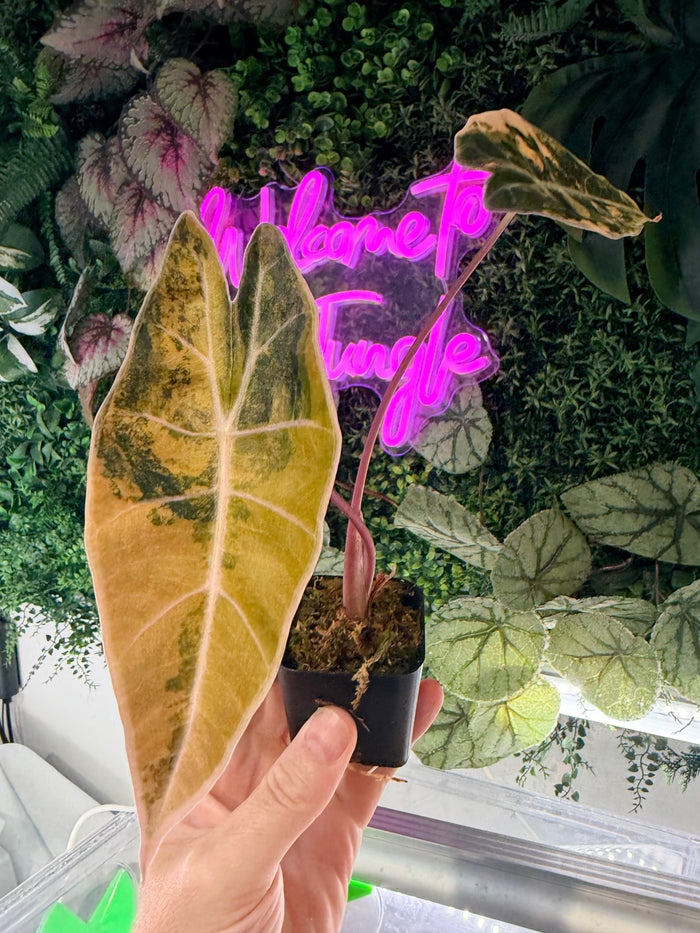
Aroidpedia does not give a leaf description or a size for Golden Bone, so we will not quote one. What can be said safely is based on the plant's name and its assumed parents: a dark leaf with strongly contrasting pale veins, with a shield-like shape that would be consistent with a micholitziana influence. In the variegated plant, the lighter patches interrupt that dark blade, so each leaf looks different from the last. As with any variegated Alocasia, judge the plant by the leaves in front of you, not by a generic description.
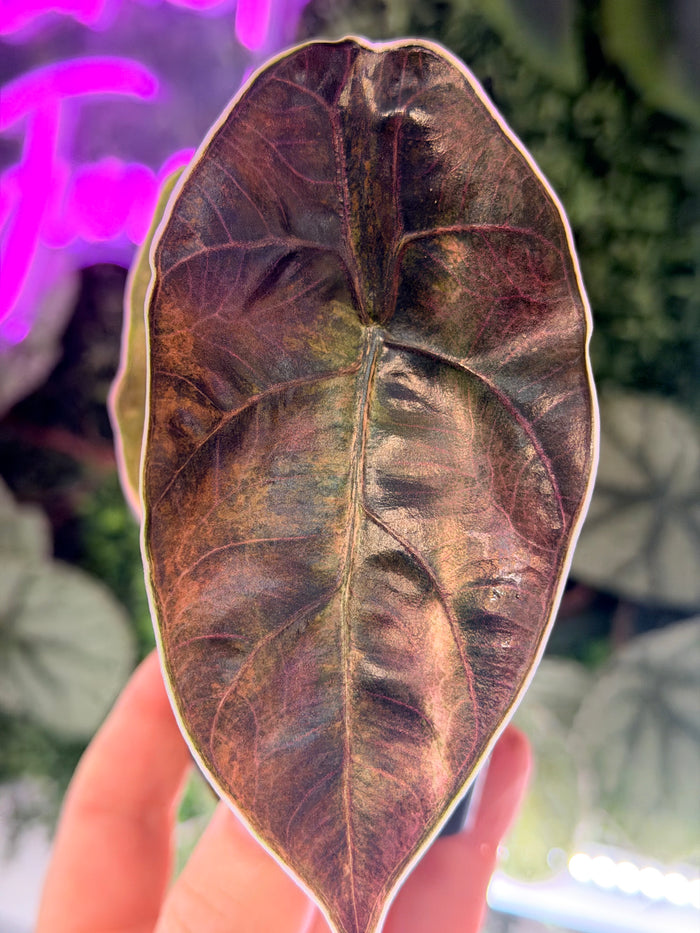
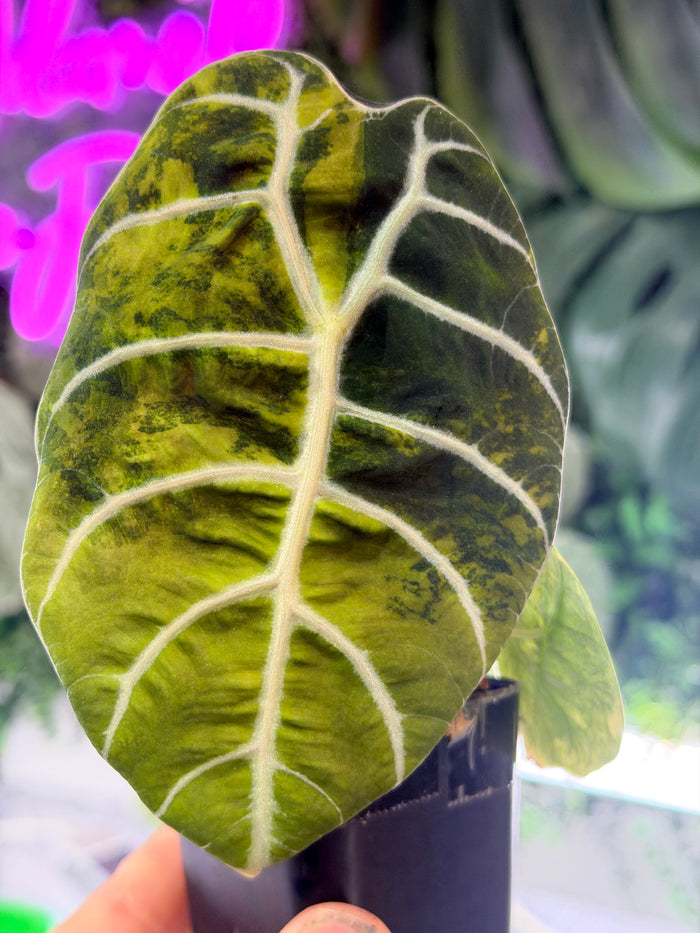
From our own plants, the venation is a lime green set against a deep green blade, and the leaf is broad and shield-like with gently wavy margins, drawing on both of the assumed parent species. In good growing conditions the plant reaches 40-70cm, with broad leaves that display the lime venation clearly and dramatically. The assumed parents are very different plants: Alocasia micholitziana, the Green Velvet Alocasia, is a Philippine species known for its velvety dark green foliage and white midrib and veins, and Alocasia cuprea is the Bornean metallic jewel species with its characteristic coppery-bronze surface and deep purple undersides. The cuprea parentage occasionally shows itself under certain light as a subtle bronze cast, giving depth to what would otherwise be a straightforward dark green background.
The variegation
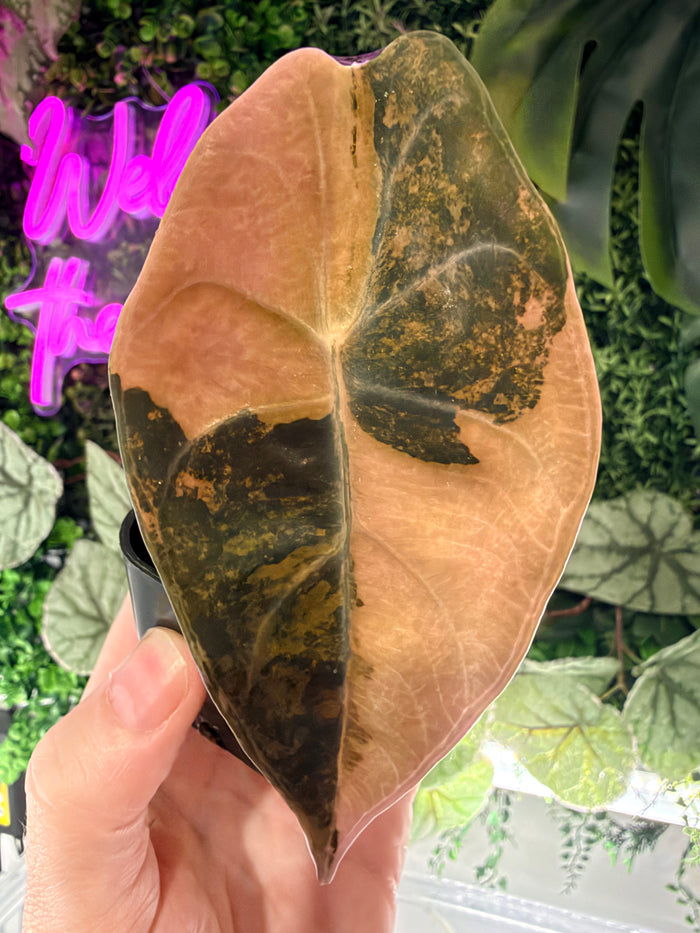
Aroidpedia lists the variegation recorded on its Golden Bone entry as yellow mottled. That is the closest documented description we have, and it does not tell us whether the plant sold as Golden Bone Variegated is yellow, cream, white or pale green in its lighter areas. If you are comparing it with other forms, our guides to aurea variegation (yellow or golden tissue with reduced chlorophyll), albo variegation (white sectors with no chlorophyll) and our complete variegation guide explain how to tell the types apart.
On our plants the variegation typically appears as lighter green, cream, or white sectors distributed across the blade alongside the existing lime-green venation. The lime-green veins, already the plant's most visually dominant characteristic, now run through a blade where the background tissue itself is no longer uniform deep green. The relationship between vein colour and blade colour shifts, creating a composition of graduated light tones from deep green through lighter variegated areas to vivid lime veins. Where the standard Golden Bone operates with two colour elements (lime-green veins and deep green blade), the variegated form introduces a third, a composition of three distinct colour notes on a single leaf that is unusually rich even within the variegated Alocasia world. The exact character of the variegation, whether cream-sectored albo-type, green-on-green, or other expression, varies between specimens and may be more or less stable depending on propagation history. The collector appeal lies in that three-colour composition of deep green, lighter variegated sectors and lime-green venation, with the subtle metallic quality from the cuprea parentage adding further depth in good light.
Two practical points apply to any chimeric variegation. The pattern is unstable by nature, so a plant can throw leaves with more, less or none of the lighter tissue. And because it depends on the arrangement of cell layers in the growing point, variegation may not carry over reliably to plants grown from corms. Paler tissue also photosynthesises less, so good light matters more for variegated plants than for the plain green form.
Golden Bone Variegated care
This is general Alocasia care that applies to this plant; nothing in the sources we trust suggests it needs anything unusual.
- Light: bright indirect light, supplemented with LED grow lights where daylight is limited. Bright indirect light year-round is essential for maintaining both the lime venation vividness and the colour quality of any variegated sectors. Our article on whether LED grow lights are worth it goes into detail.
- Temperature and humidity: 20-27°C and humidity of 60-80%. A heat mat helps if the room runs cool.
- Watering: water thoroughly once the top 2-3cm of substrate has dried, and never leave the pot standing in water. If roots are a concern, see our root rot guide.
- Substrate: Fluval Stratum is our preferred substrate; browse the wider substrates and growing media range for alternatives.
- Feeding: use our Alocasia feed or another product from the plant feed range at half strength, every 2-3 weeks. Our plant feed guide covers the reasoning.
For the full routine, see the ultimate Alocasia care guide, and the Alocasia plant care collection for supplies.
Propagating from corms
Our Alocasia corm propagation guide walks through the method step by step. In short, we use a self-wicking setup: corms sit in Fluval Stratum inside a Corm Keeper, which holds steady moisture around the corm without soaking it. Corms from a variegated plant do not always return the variegation, so a chimeric parent plant should not be assumed to produce chimeric offspring. See also growing Alocasia corms in Fluval Stratum.
How does it compare with similar plants?
The closest comparison is the plain green Golden Bone, which is the plant the variegated form is derived from; both share the pale-veined look. For other lineages that sometimes get mentioned alongside it, our guides to Alocasia cuprea and Frydek (Alocasia micholitziana) describe the two species most often given as assumed parents. Our rare Alocasia A to Z places it among the wider collection.
Frequently asked questions
What are the parents of Golden Bone?
They are not confirmed. Aroidpedia gives A. micholitziana 'Green Velvet' x A. cuprea as the assumed cross and notes that a natural cross between those species is unlikely.
Who introduced Golden Bone?
Aroidpedia records that the Indonesian grower AstriYanto introduced it to the market in 2006.
What colour is the variegation?
Aroidpedia lists yellow mottled for Golden Bone. The specific colour on the variegated plant is not documented and can vary between plants.
How big does it get?
No size is documented in the sources we trust, so we do not give one.
Will corms keep the variegation?
Not necessarily. Chimeric variegation may not carry over to corm-grown plants.
Is it toxic?
Yes, like other Alocasia it contains calcium oxalate crystals and is harmful if chewed or eaten, so keep it away from pets and children.
We release our rare plants through our drop model. Join the collector list for early access, or browse the Alocasia house plants collection.
Questions about Alocasia Golden Bone Variegated? Contact our team for guidance from specialists who grow rare Alocasia in our UK-based private nursery. We are happy to talk through care, variegation and corm propagation.