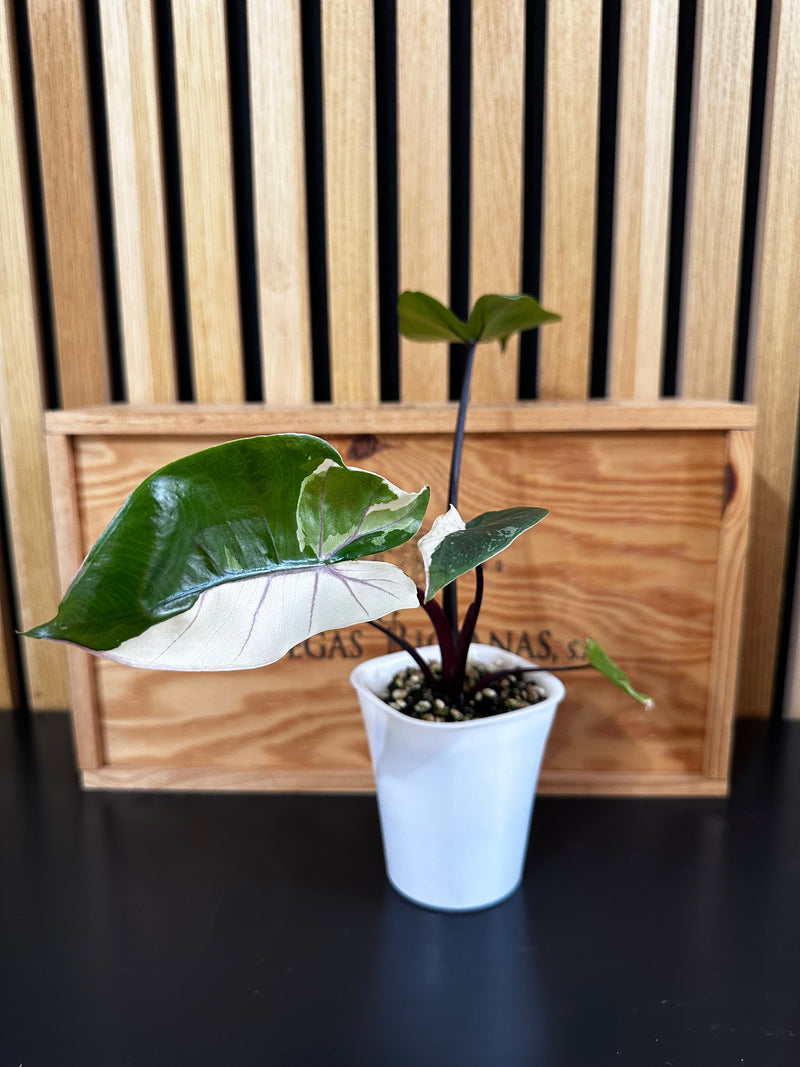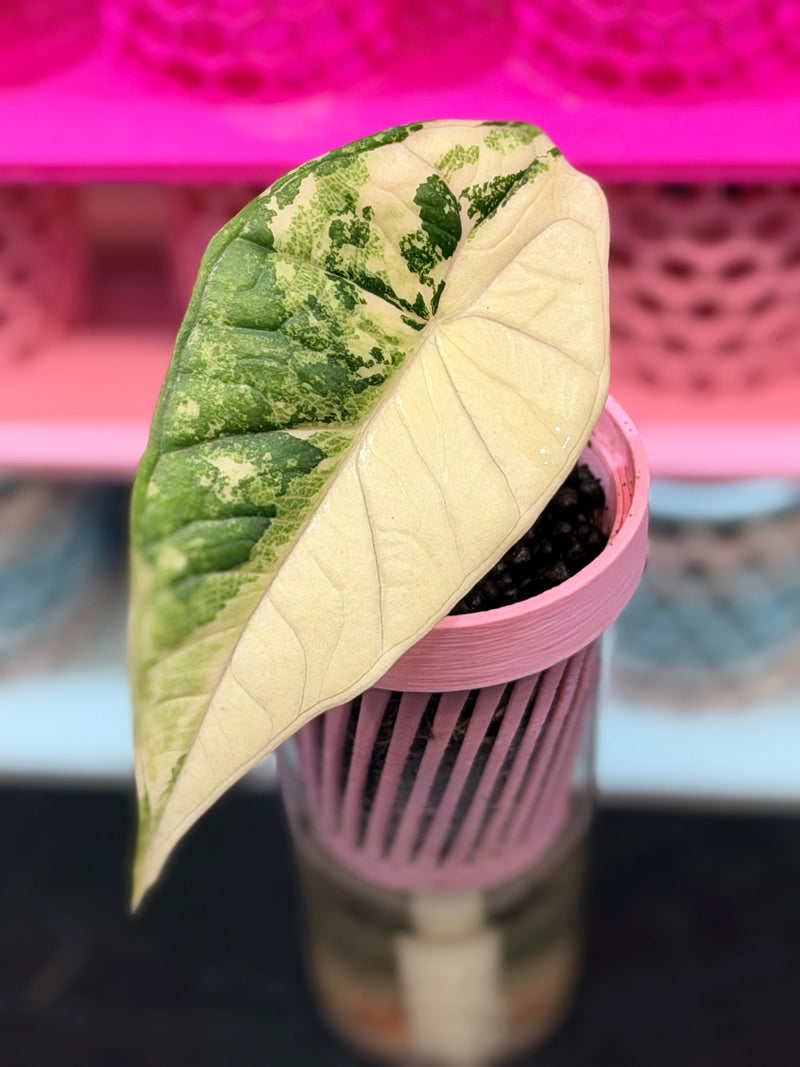

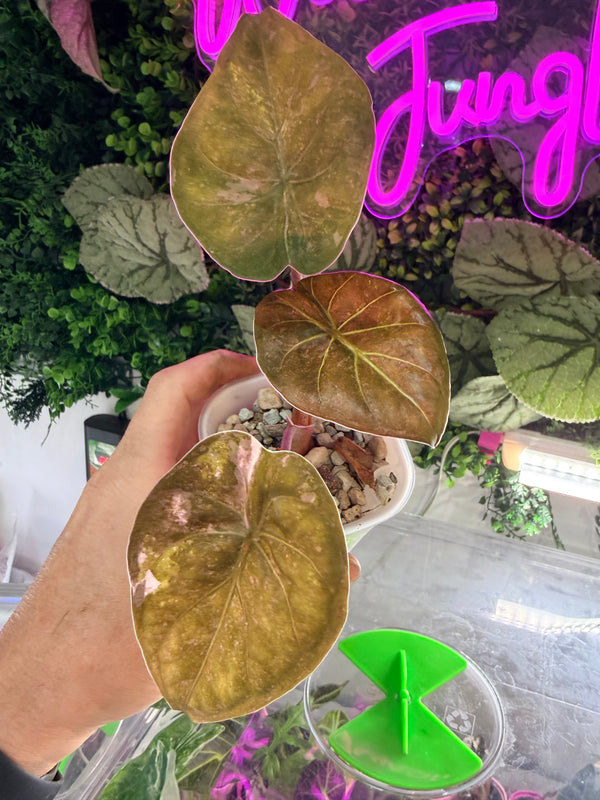
The Alocasia Wentii Pink Splash is a pink variegated plant sold under the name Alocasia wentii. That name carries a long-running identification problem, so this guide first explains what the plant usually is, then covers the pink variegation and how to care for it.
What is Alocasia wentii?
Aroidpedia lists Alocasia wentii as a species described in 1916-1917 and named after the Dutch botanist Frits Went. It is poorly known: only three collections are recorded, from mid to upper montane rainforest on Mount Hellwig in West Irian and in the Hindenburg and Star Mountains of Papua New Guinea, where it grows as an epiphyte at around 1,560m. It is a small herb with dark green arrow-shaped leaves up to about 15cm long, which is nothing like the large plant usually sold under the name. Aroidpedia records no variegated forms of the true species.
The plant sold as wentii: Alocasia 'Uhinkii'
Aroidpedia notes that the plant in the trade as A. wentii does not match the original description and is probably Alocasia 'Uhinkii'. Its entry for 'Uhinkii' gives the cross as Alocasia odora × Alocasia cuprea, raised by the Chantrier brothers at Mortefontaine, France, around 1897. Alocasia expert Alistair Hay and wider botanical research reach the same conclusion, treating the trade plant as this hybrid, later confused with the true wentii through a sequence of misidentifications. The parents are worth knowing: Alocasia cuprea from Borneo is the metallic jewel species, and Alocasia odora, widely distributed across East and South-East Asia, is the giant upright elephant ear. The hybrid inherits the cuprea's purple undersides and some of its metallic quality, combined with the odora's vigorous growth habit and larger scale. The parentage is the breeders' own 1897 statement and is not independently confirmed: LariAnn Garner's attempts to recreate the cross produced seedlings that resembled wentii but were larger and broader-leaved, and she suspected the cuprea parent used may not have been pure.
The link between 'Uhinkii' and the trade wentii is an argument rather than a proven fact. Aroidpedia points to the lack of any documented collection locality, an inflorescence resembling A. odora, no observed pollen, and a chromosome count of 2n = 42 (Ishida, 2001) that suggests a polyploid hybrid. It also notes that the name 'Whinkii' appeared in American catalogues by 1952, and that a misspelling could explain the drift to 'wentii'. The epithet 'Uhinkii' probably honours the German horticulturist Gottlieb Wilhelm Uhink of Bühl.
How to identify the plant
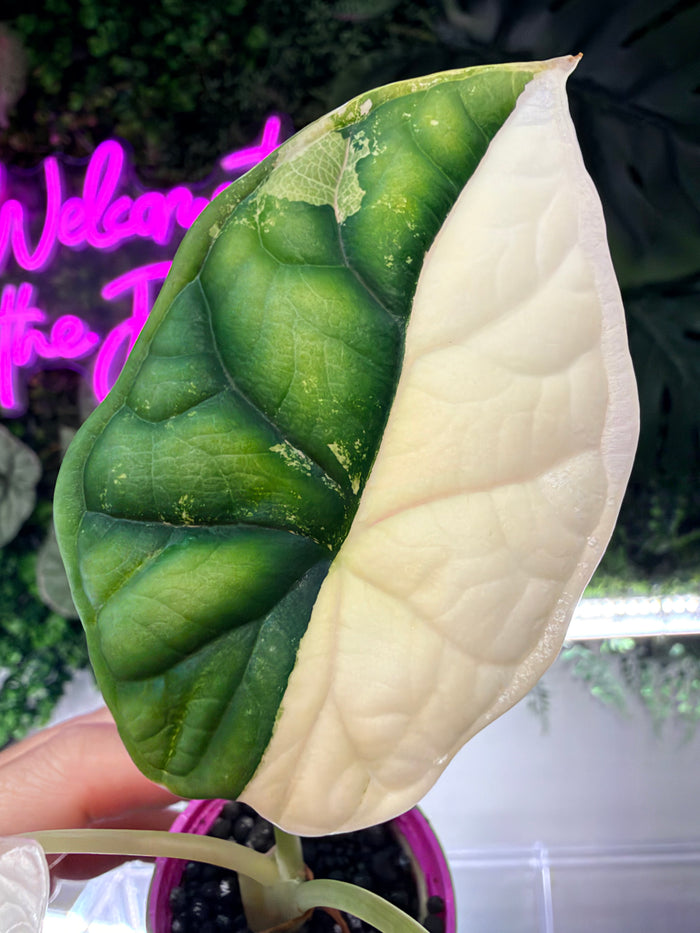
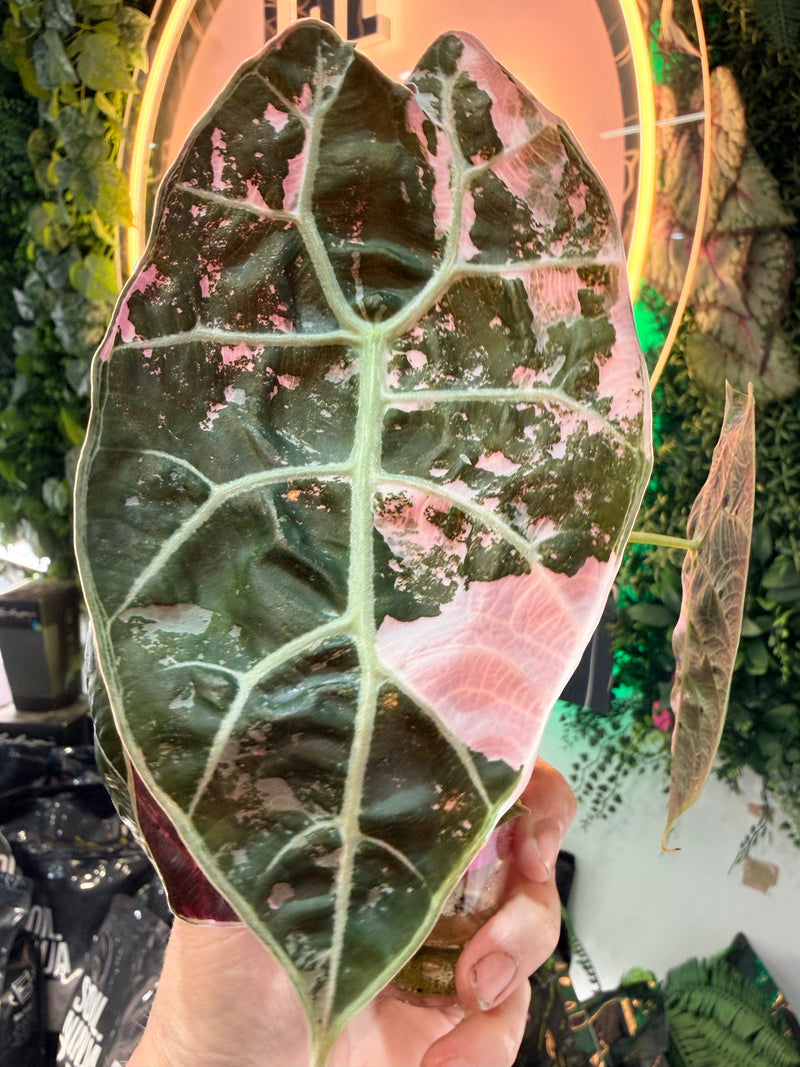
For 'Uhinkii', Aroidpedia gives leaves of about 60cm long and 40cm wide, dark green above and violet-brown below, on light green stems, and lists the variegation as mottled white. The deep purple-bronze reverse is a useful identifying feature that you can see when a leaf tips in the light. The large, broadly arrow-shaped leaves with a glossy green upper surface and deep purple-bronze undersides are a hybrid expression of exactly these two parents.
The pink splash variegation
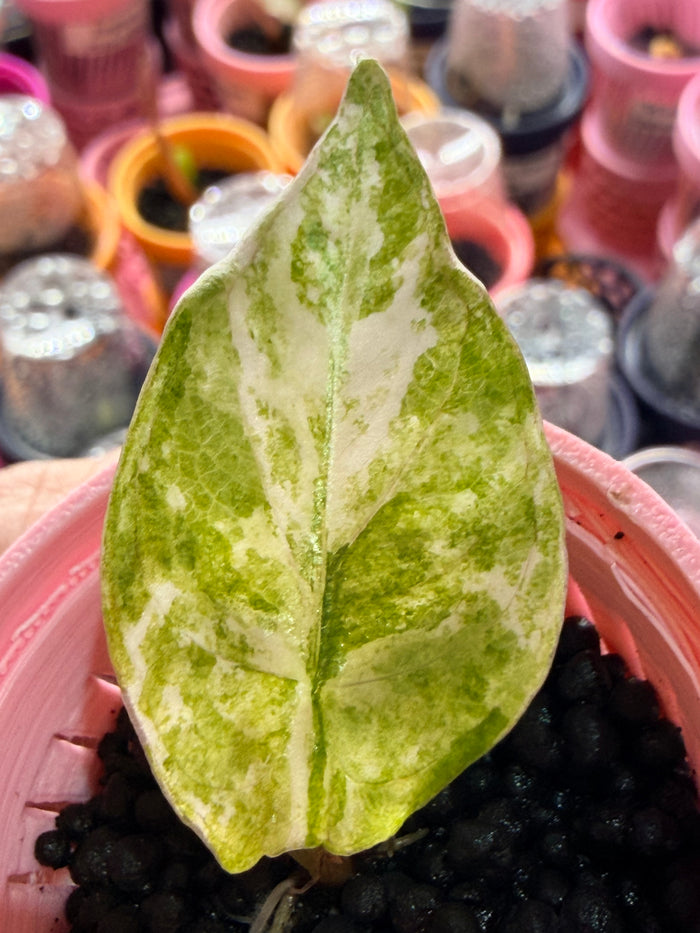
Pink variegation in Alocasia is anthocyanin-based and chimeric: pink sectors or splashes appear where certain cell lineages carry more pigment. On this plant it shows as irregular splash or speckle patterns distributed across the blade. It is unstable, varies between leaves, and may not carry over to corm-grown plants. Pink areas still hold chlorophyll, which separates them from albo white sectors, where chlorophyll is absent. Because those sectors contribute to photosynthesis, the Pink Splash form has good vigour.
Aroidpedia does not record a pink or splash cultivar of either wentii or 'Uhinkii', so we cannot point to a documented origin or date for this form. Where it is seen, pink against the purple underside gives a warm combination. On leaves where the blade edge turns to show the underside, the pink splash and purple reverse are visible together, which reinforces the warm character across the whole leaf. Our guides to pink variegation and variegation types explain how this pigment behaves.
Alocasia Wentii Pink Splash care
This is general Alocasia care that applies to this plant. Provide bright indirect light, supplemented with LED grow lights, which also help keep pink expression. Aim for 20-27°C and 60-80% humidity, maintained with a dedicated humidifier. Water when the top 2-3cm of substrate has dried and never leave the pot standing in water. We prefer Fluval Stratum, and a heat mat helps if the room runs cool. Feed at half strength from our plant feed range.
Our ultimate Alocasia care guide and root rot guide go further.
Propagating from corms
Our Alocasia corm propagation guide covers the self-wicking method: the corm sits in Fluval Stratum inside the Corm Keeper. See also how long a corm takes to sprout. Because pink variegation is chimeric, corm-grown plants may differ from the parent.
How it compares with similar plants
Its parent species have their own guides: see the Alocasia cuprea species guide, and cuprea pink for another pink form. You can browse related plants in our pink variegated collection.
We release Wentii Pink Splash through our drop model. Join the collector list for early access, or view our Alocasia Wentii Pink Splash listing.
Frequently asked questions
Is this the true Alocasia wentii?
Probably not. Aroidpedia treats the plant sold as wentii as most likely the hybrid 'Uhinkii', though that identification is argued rather than proven.
What is 'Uhinkii' a cross of?
Alocasia odora × Alocasia cuprea, according to the breeders' 1897 statement. It is not independently confirmed.
Is there a documented pink form?
Aroidpedia does not record one, so the origin of Pink Splash is not documented.
Will the pink stay?
Not reliably. Chimeric pink varies between leaves and can fade or revert.
How big does it grow?
Aroidpedia gives leaves of about 60cm by 40cm for 'Uhinkii'.
Questions about Alocasia Wentii Pink Splash or the Uhinkii lineage? Contact our team for guidance from specialists who grow rare Alocasia in our UK-based private nursery. We are happy to help with identification and care.
From the nursery